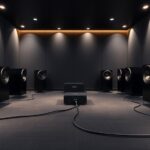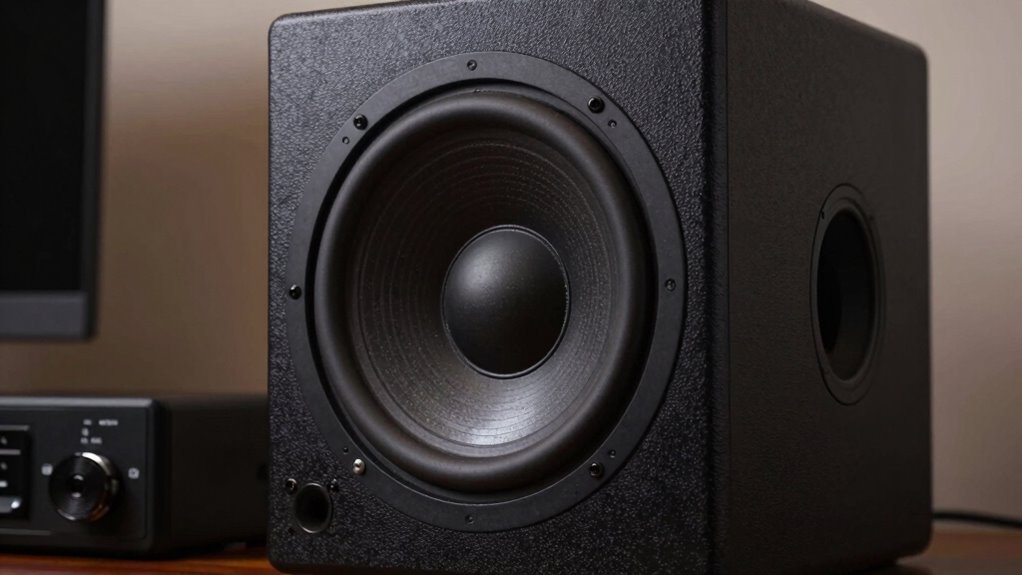

If your subwoofer sounds boomy, it’s likely due to poor calibration, placement issues, or room acoustics that amplify bass. Moving your sub away from walls and corners, adjusting crossover and volume settings, and adding acoustic treatments can help tighten the sound. Also, consider repositioning or upgrading your subwoofer if problems persist. Learning more about these solutions can help you tame excess bass and enjoy clearer, more balanced sound.
Key Takeaways
- Poor placement near walls or corners can cause bass resonance and boominess; reposition the subwoofer to reduce buildup.
- Incorrect crossover settings or volume levels may amplify bass unevenly; calibrate your system for balanced sound.
- Hard reflective surfaces increase sound reflections, boosting boominess; add acoustic treatments like panels or rugs.
- Small or irregularly shaped rooms create standing waves that amplify bass; consider room acoustics and adjust placement accordingly.
- Overly high volume or gain settings can cause distortion and boominess; fine-tune the volume and use equalizers for clarity.

NothingProjector Motorized ALR Screen for Ultra Short Throw Projector, 95% Ambient Light Rejecting, 100 inch, Floor Rising, 4K/8K UHD, Active 3D, Anti Daylight, Electric Retractable Automatic NothPJ
✔ Adjustable Height, Zero Installation – Effortlessly adjust the screen to any height with a single press of...
As an affiliate, we earn on qualifying purchases.
Why Does My Subwoofer Sound Boomy? Common Causes Explained
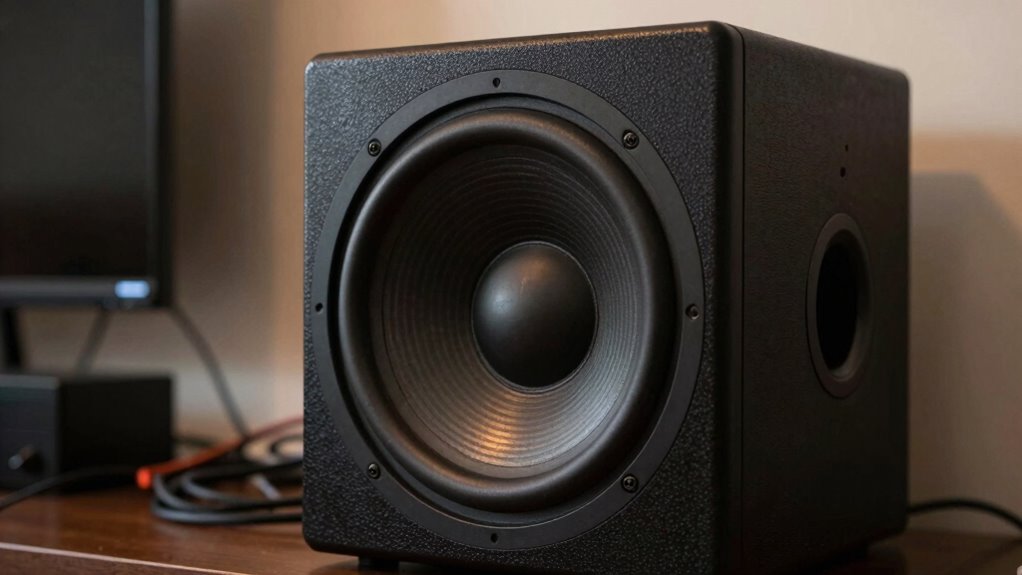
A boomy subwoofer often results from issues with placement, settings, or equipment. Poor subwoofer calibration can cause uneven bass response, making it sound harsh or overbearing. If your subwoofer isn’t properly calibrated, the bass can become overly prominent or muffled. Adjusting the bass response is essential; try fine-tuning the low-frequency settings to achieve a balanced, tight sound. Incorrect crossover settings or volume levels can also lead to boominess, so ensure these are set appropriately for your room and equipment. Sometimes, the subwoofer’s position amplifies certain frequencies, causing resonance that sounds boomy. By carefully calibrating your subwoofer and adjusting its bass response, you can eliminate excessive boominess and enjoy clearer, more accurate bass. Proper subwoofer placement can significantly reduce unwanted resonance and improve overall sound quality. Additionally, understanding and room acoustics can play a crucial role in minimizing boominess and achieving a more precise bass response. Paying attention to room treatments and acoustic panels can further help dampen unwanted vibrations and resonance. Using measurement tools like a sound level meter or room correction software can also assist in identifying and correcting boominess issues for a more balanced sound.

AWOL VISION 120" Motorized ALR Floor Rising Projector Screen for Ultra Short Throw Projector, Projector Screen for Home Theater, 4K/8K Ultra HD, 95% Ambient Light Rejecting,ALR-F220C
Premium HD Quality Screen Material: Immerse yourself in stunning visuals with our top-tier HBSI ALR screen material. With...
As an affiliate, we earn on qualifying purchases.
How Do Room Size and Acoustics Make Your Bass Boom?
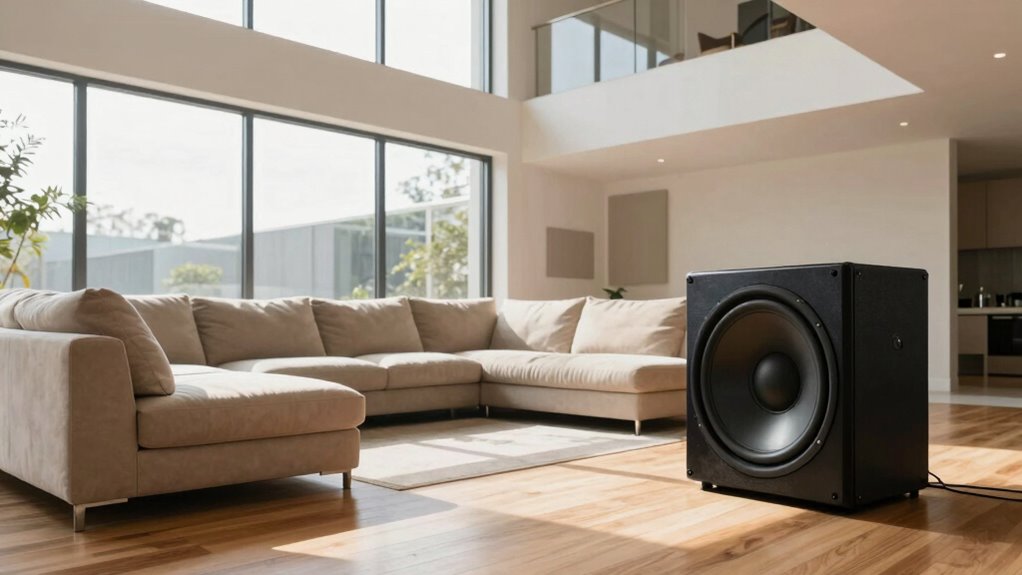
Your room’s size and shape can substantially influence how your bass sounds. Reflective surfaces and absorptive materials also play a key role in how sound waves interact. Understanding these factors helps you control and improve your subwoofer’s performance. For example, incorporating elements like acoustic treatments can significantly reduce boominess and enhance sound clarity. Additionally, considering room acoustics can help you optimize your listening environment for better sound quality. Being aware of how sound reflection impacts bass response allows you to make more informed adjustments to your setup.
Room Dimensions and Shape
Room dimensions and shape markedly influence how bass sounds in your space, often causing boomy or uneven low frequencies. Small or oddly shaped rooms can create shape distortion, amplifying certain bass notes and canceling others. This uneven response results in bass that feels overwhelming or muddy. Additionally, projection techniques can help manage sound distribution and improve overall audio clarity. Consider these factors:
- Low ceilings that trap sound waves
- Narrow, elongated rooms that cause standing waves
- Sharp corners intensifying bass buildup
- Irregular wall angles creating unpredictable reflections
- Large open spaces with minimal sound absorption
Furthermore, room acoustics play a critical role in how sound waves interact within the space, impacting bass response. Surface materials and furnishings influence sound absorption and reflection, further shaping the bass performance. These elements can lead to constructive or destructive interference, making your subwoofer’s sound appear boomy. Understanding how room size and shape affect bass can help you implement targeted solutions to tame that unwanted boominess.
Surface Reflection and Absorption
Surface reflections and absorption play a crucial role in how bass behaves in your space. When sound waves from your subwoofer hit surfaces, they reflect or get absorbed, shaping the bass’s clarity and boominess. Hard surfaces like concrete or glass cause strong surface reflections, amplifying boomy bass. Absorption techniques, such as adding soft furnishings, curtains, or acoustic panels, reduce these reflections, creating a more controlled sound. The table below shows how different surfaces impact bass response:
| Surface Type | Effect on Bass | Absorption Techniques |
|---|---|---|
| Hard surfaces | Increases reflections, boominess | Use rugs, curtains, acoustic panels |
| Soft surfaces | Damps reflections, smooths bass | Add upholstered furniture |
| Reflective surfaces | Cause uneven bass response | Cover with absorbent materials |
| Absorptive surfaces | Minimize reflections, clarity | Install acoustic treatments |
Additionally, understanding room acoustics can help you optimize your listening environment for better bass control. Properly managing surface reflection and absorption can make a significant difference in achieving balanced, tight bass without unwanted boominess. Being aware of room size and shape can further influence how sound behaves and should be considered when designing your audio setup.

LIHONG Screen 100 inch 16:9 Portable Manual Pull Up Floor Rising Projector Screen Indoor & Outdoor HD Matte White for Long Standard Projection Fast Setup for Home Theater Movies,Classroom,Office
【Projection Sceen Dimension】100 INCH Diagonal, 16:9 Aspect Ratio. View Size: 87" H x 48.82" W. Overall Size: 92"...
As an affiliate, we earn on qualifying purchases.
Where Should I Place My Subwoofer to Get Better Sound? Tips for Proper Placement

Finding the right spot for your subwoofer can substantially improve its sound quality, especially by reducing boomy or muddy bass. Proper subwoofer placement ensures even sound distribution and prevents bass from becoming overwhelming. To optimize placement, consider these tips:
Proper subwoofer placement enhances sound clarity and balances bass for an optimal listening experience.
- Place the subwoofer near a wall but avoid corners to reduce excessive bass.
- Experiment with different spots along the room’s length and width.
- Keep the subwoofer away from large furniture that can block or absorb sound.
- Use room symmetry to balance sound across listening areas.
- Avoid placing it in the center of the room if it causes boomy effects; instead, try an off-center position.
- Additionally, room acoustics play a crucial role in how your subwoofer sounds, so adjusting for reflective surfaces can make a big difference.
- Incorporating bass traps or acoustic panels can also help manage reflections and improve overall sound clarity.
- Remember that room size can influence how bass behaves, so adjusting placement based on your space can help achieve the best results.
- Using a subwoofer calibration tool or equalizer can further fine-tune the sound for optimal performance.
- Don’t forget that subwoofer positioning can be affected by your specific listening environment, so taking the time to test different locations will yield the best sound.

LIHONG Screen 80 inch 16:9 Manual Floor Rising Pull Up Projector Screen Portable Indoor & Outdoor 4K HD Matte White for Long Standard Projection Fast Setup for Home Theater Movies,Classroom,Office
【Projection Sceen Dimension】80 INCH Diagonal, 16:9 Aspect Ratio. View Size: 69.6" H x 39.3" W. Overall Size: 74.8"...
As an affiliate, we earn on qualifying purchases.
How to Adjust Your Subwoofer Settings for Balanced, Tight Bass

To achieve balanced, tight bass from your subwoofer, start by adjusting its volume and crossover settings to match your main speakers and room size. Proper subwoofer calibration ensures that the bass response is smooth and integrated, preventing muddiness or boomy sounds. Set the volume so that the bass complements your overall sound system without overpowering. The crossover frequency should be high enough to blend seamlessly with your speakers but low enough to deliver deep, punchy bass. Use test tones or bass-heavy music to fine-tune these settings, listening for clarity and tightness. Making these adjustments helps eliminate excess boominess, creating a more accurate and controlled bass response. Regular calibration ensures your subwoofer performs flawlessly and maintains balanced sound across your listening space. Additionally, understanding room acoustics can help you optimize your subwoofer placement for better sound quality, as room environment can significantly influence bass performance. Considering subwoofer placement is also crucial, since proper positioning can reduce boominess and improve overall sound clarity.
Troubleshooting Tips to Reduce Excessive Bass and Fix Boominess
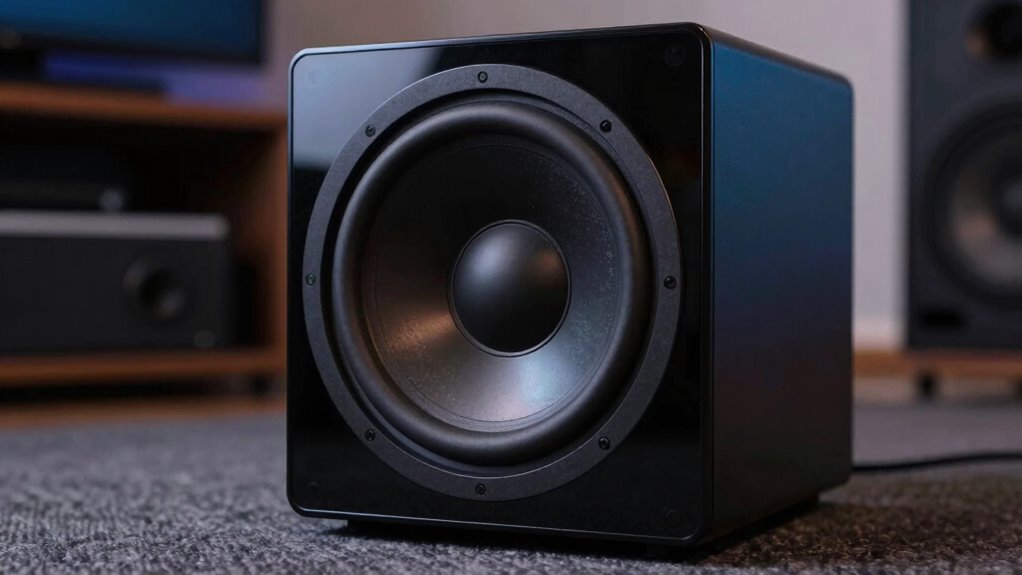
If your subwoofer produces excessive bass or boomy sounds, start by checking its placement. Proper subwoofer placement can markedly reduce boominess caused by standing waves and bass frequency buildup. Move the subwoofer away from walls and corners, which amplify bass. Elevate it off the floor slightly to prevent bass from bouncing off the surface. Experiment with different positions to find a spot where the bass feels tight and controlled. Visualize these adjustments:
- Moving it away from shared walls
- Placing it near the room’s center
- Elevating it on a stand
- Using furniture to diffuse sound
- Ensuring it’s not directly on the floor
Additionally, consider incorporating commercial kitchen equipment such as sound-absorbing panels or diffusers, which can help control bass reflections and improve overall sound quality. These tweaks help manage subwoofer placement, smoothing out bass frequency issues and reducing boominess.
How Room Treatments and Equalization Can Help Tame Boomy Bass
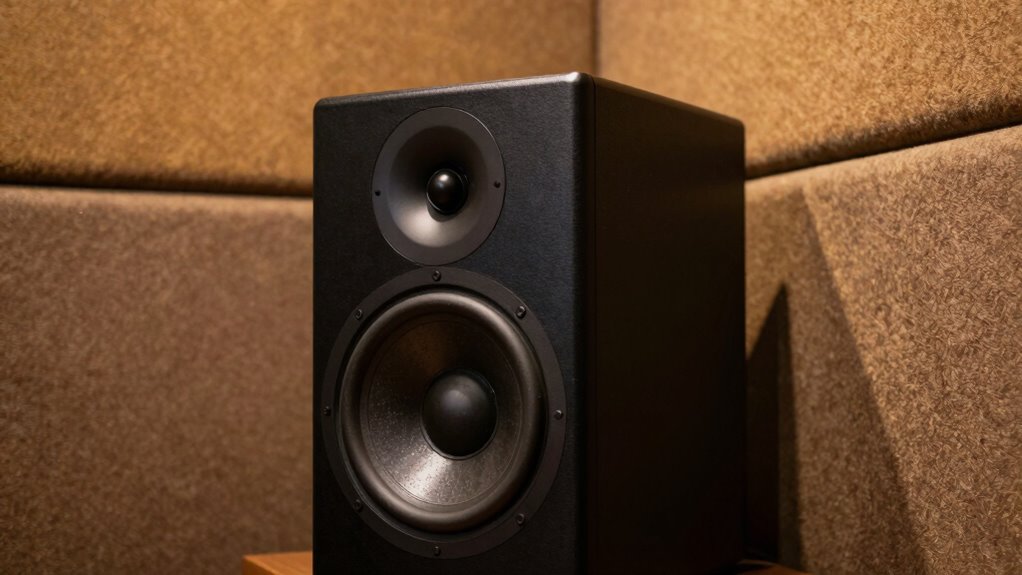
Room treatments like bass traps and acoustic panels can considerably reduce boomy sound by absorbing excess low frequencies. Using precise equalization settings helps fine-tune your subwoofer’s output, targeting problem areas. Together, these techniques give you better control over bass clarity and balance in your space.
Effective Room Treatments
Effective room treatments are essential for taming boomy bass, as they directly influence how low-frequency sound waves interact within your space. Properly placed acoustic panels, bass traps, and diffusers can absorb or scatter troublesome frequencies, reducing resonance. Incorporate soundproofing techniques to minimize external noise and prevent sound leakage, enhancing overall clarity. Adjusting speaker positioning also plays a critical role; moving your subwoofer closer to walls or corners can amplify boomy sounds, so experiment with placement to find a balanced setup. Visualize your room with:
- Thick bass traps in corners
- Acoustic panels on walls
- Rugs and carpets on floors
- Bookshelves filled with books
- Cushioned furniture absorbing vibrations
These treatments help create a more controlled environment, enabling your subwoofer to produce cleaner, tighter bass.
Precise Equalization Techniques
While physical room treatments markedly reduce boomy bass, precise equalization is essential for fine-tuning your sound and achieving a clean, balanced low end. Use equalization techniques to target problem frequencies, smoothing out peaks that cause boominess. Start by adjusting your subwoofer placement to minimize boundary reinforcement, then employ a parametric equalizer to cut resonant frequencies. Keep in mind, small tweaks can make a big difference. For example:
| Frequency | Adjustment Type | Effect |
|---|---|---|
| 50-80Hz | Cut | Reduces boominess |
| 100Hz | Boost | Adds warmth if needed |
| 40Hz | Cut | Tames extreme low-end |
| 60Hz | Slight Cut | Balances overall bass |
| 70Hz | Slight Boost | Enhances punch |
Combine proper subwoofer placement with targeted equalization for ideal sound.
Should I Upgrade My Subwoofer or System? Signs It’s Time for an Update
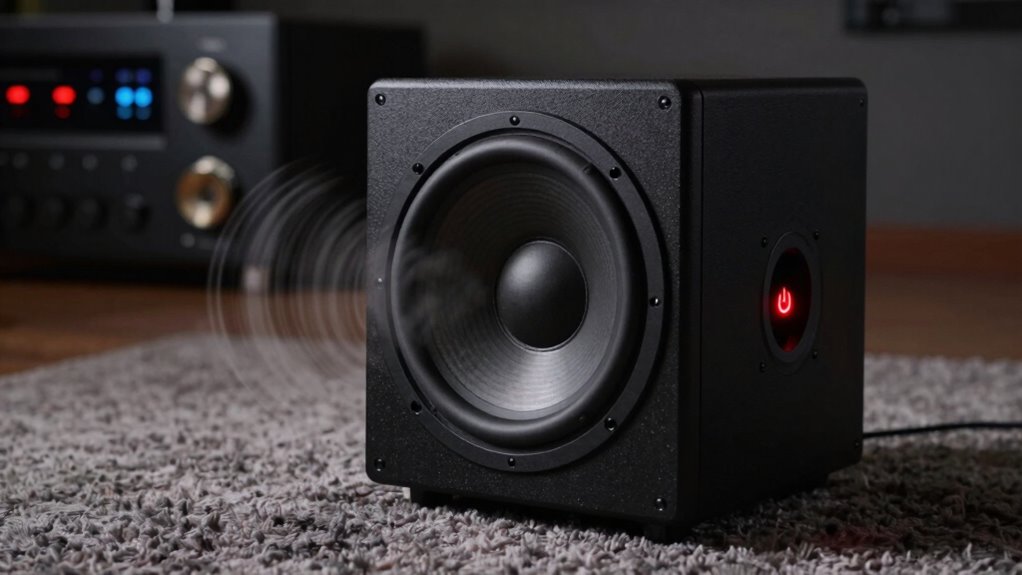
If your current subwoofer no longer delivers the punch and clarity you crave, it’s likely time to contemplate an upgrade. Signs include persistent boomy sounds, difficulty integrating with your system, or if your subwoofer struggles during intense bass moments. Regular subwoofer maintenance can prolong its life, but sometimes, the system just needs an overhaul. Consider whether your current subwoofer still matches your speaker compatibility needs—older models may no longer keep up. Upgrading might involve choosing a more powerful subwoofer or a system with better crossover options. Imagine tight, controlled bass replacing muddiness, and seamless integration with your existing speakers. If these signs resonate, it’s time to evaluate new options and ensure your new setup fits your space and listening habits.
Frequently Asked Questions
Can Subwoofer Placement Affect Bass Boominess Without Moving the Unit?
Yes, subwoofer placement can affect bass boominess even without moving the unit. Room acoustics play a big role, so try adjusting your sub’s position slightly to see if it reduces boominess. Additionally, proper equipment calibration can help balance bass levels. Experimenting with placement and fine-tuning your system allows you to control boominess without physically relocating your subwoofer, improving overall sound clarity.
How Do Different Music Genres Influence Perceived Subwoofer Boom?
Did you know that genres like hip-hop and electronic music often have 20-60% more bass content than classical? This markedly impacts your perceived bass, making it seem boomier with certain music genres. When you switch between genres, your subwoofer’s response varies because each type emphasizes different bass frequencies. So, adjusting your EQ or choosing genre-specific settings helps you control perceived bass, preventing that boomy sound regardless of your music choice.
Is a Louder Volume Level More Likely to Cause Boominess?
Yes, increasing the volume can make your subwoofer sound boomy, especially if room acoustics aren’t optimized. Higher volumes can amplify resonances and distortions, highlighting boominess. To prevent this, you should focus on proper speaker calibration, adjusting levels for a balanced sound. Also, consider treating your room with acoustic panels or bass traps to minimize unwanted reflections, ensuring a clearer, tighter bass response even at louder volumes.
What Role Does Subwoofer Crossover Frequency Play in Boominess?
Irony strikes when your subwoofer’s crossover frequency actually worsens boominess. If you set the crossover too low or high, it disrupts the frequency balance, causing boomy sounds. Adjusting crossover settings helps blend bass seamlessly with your main speakers. A well-chosen crossover guarantees your subwoofer and speakers work in harmony, resulting in a clear, balanced sound without that annoying boom. Remember, proper crossover tuning is key to avoiding bass chaos.
Can Using Multiple Subwoofers Reduce Boominess?
Using dual subwoofers can help reduce boominess by improving sound distribution in your space. When you add a second subwoofer, it balances out uneven bass response, minimizing room resonances that cause boomy sound. Proper placement and calibration of both subs ensure more even bass, making the overall sound clearer and tighter. This setup allows you to enjoy deeper, more controlled low frequencies without the boominess that single subs sometimes produce.
Conclusion
To tame that boomy subwoofer, start with proper placement, adjust your settings, and consider room treatments—think of it as your personal quest to tame the beast. Don’t be afraid to experiment, much like a knight refining their armor. If the bass still overpowers, upgrading your subwoofer might be your best move. With patience and the right tweaks, you’ll enjoy tight, balanced bass that makes your music and movies truly come alive—no more “boomy” battles to fight!