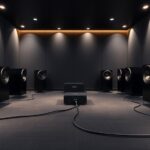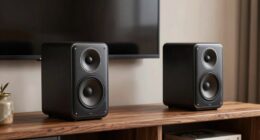
To measure your subwoofer’s phase alignment, start by setting your crossover to around 80Hz and playing a test tone or bass-heavy music at a moderate volume. Walk around your space and listen for bass consistency; areas where bass disappears or sounds weak may indicate phase issues. Use the phase switch or control to make small adjustments, listening for the most seamless, full bass response. Continue with these steps to fine-tune your setup effectively.
Key Takeaways
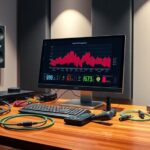
- Use a measurement microphone and room calibration software (e.g., REW, Dirac, Room EQ Wizard) to analyze phase response.
- Play a test tone or sweep signal and observe phase shifts at the crossover frequency.
- Compare the phase response of the subwoofer and main speakers to identify misalignment.
- Adjust the subwoofer’s phase control or switch (0°/180°) while monitoring measurements for best alignment.
- Confirm proper phase alignment by listening for seamless bass and checking for minimized phase cancellation.
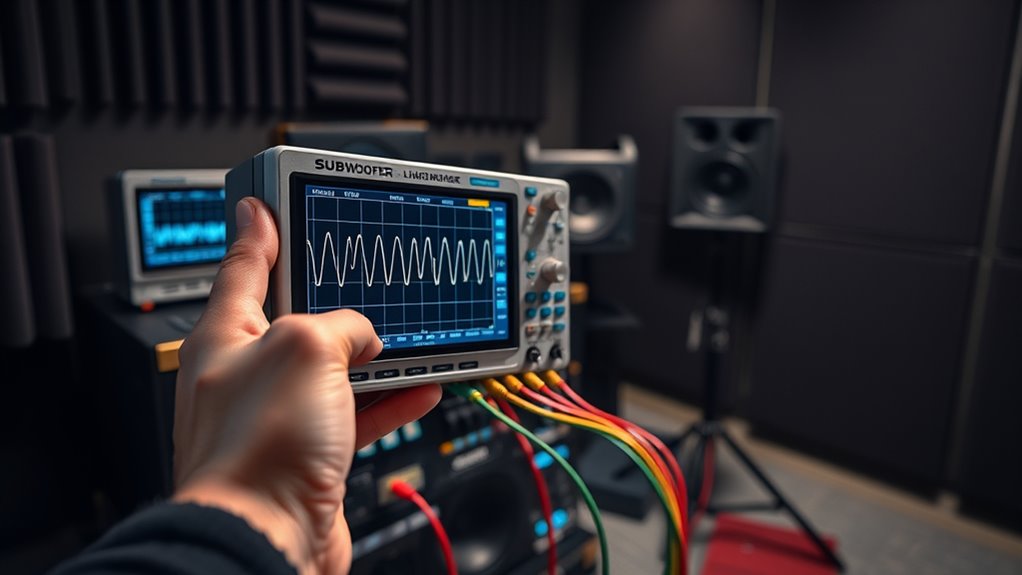
Have you ever noticed a boomy or hollow sound from your subwoofer? That sensation often indicates a phase misalignment between your sub and the main speakers. Correctly measuring and adjusting the subwoofer phase guarantees seamless integration, creating a balanced, punchy sound. The process starts with understanding how crossover settings and room acoustics influence your setup. Crossover settings determine at what frequency your subwoofer begins to take over from the main speakers. If these settings aren’t properly aligned, it can cause phase conflicts, resulting in sound cancellations or boosts at certain frequencies. Similarly, room acoustics play a significant role; reflections, furniture, and wall materials can all impact how sound waves interact, making it essential to fine-tune phase settings in your specific environment.
A boomy bass often signals a phase misalignment between subwoofer and main speakers.
To measure phase alignment, begin by setting your crossover to a moderate level—typically around 80 Hz—so that the sub isn’t overwhelmed or underutilized. Make sure your subwoofer is turned on and connected correctly. Play a test tone or a bass-heavy track at a comfortable volume. Next, listen carefully for how the bass sounds—if it feels exaggerated or muffled, it’s likely out of phase. One quick way to check is to walk around your listening space and listen for areas where the bass seems to vanish or intensify. This indicates that your room acoustics are affecting the sound, and phase adjustments are needed to compensate.
Most subwoofers have a phase switch, usually a 0°/180° toggle, or a continuous phase control knob. If your sub has a switch, start with it set to 0° and listen again. If the bass still sounds off, flip the switch to 180° and compare the sound. If your sub has a dial, slowly rotate it while listening for the point where bass response sounds most natural and full. The goal is to find the position where the subwoofer’s sound blends seamlessly with your main speakers, creating a unified bass response. Remember, room acoustics can cause certain frequencies to cancel or reinforce, so it’s best to perform these adjustments in your usual listening position and, if possible, use a measurement microphone and software for more precise results.
Additionally, understanding how hackathons like those hosted by institutions such as MIT can foster collaborative problem-solving can inspire innovative approaches to audio calibration and room acoustics adjustments, leveraging technology and community input for better results.
Fine-tuning your subwoofer’s phase takes patience, but it’s worth it. Proper phase alignment reduces phase cancellation, resulting in tighter, more accurate bass that complements your overall soundstage. Keep in mind that small adjustments can make a big difference, and you might need to revisit these settings periodically as your room’s acoustics change or furniture shifts. Ultimately, understanding how crossover settings and room acoustics influence phase alignment will help you achieve a richer, more balanced listening experience.

Klipsch R-12SW Powerful Deep Bass Front Firing 12" Copper-Spun Driver 400W Digital Power Subwoofer 14" X 18.5" X 16"
Powerful 12" copper-spun front-firing woofer
As an affiliate, we earn on qualifying purchases.
Frequently Asked Questions
Can Phase Alignment Improve Overall Sound Quality?
Yes, phase alignment can improve your overall sound quality. When you properly align your subwoofer’s phase using correct speaker placement and amplifier settings, you guarantee that sound waves from all speakers work together harmoniously. This reduces cancelation and boosts bass clarity, providing a more balanced, immersive listening experience. Adjusting phase helps your system deliver tight, punchy bass and clearer audio across your entire setup.
What Tools Are Necessary for Measuring Phase?
To measure phase, you’ll need measurement tools like a microphone, a sound level meter, and calibration devices such as a signal generator or an audio analyzer. These tools help you accurately capture the subwoofer’s response and compare it to other speakers. By using calibration devices, you can generate test signals and guarantee your measurements are precise, allowing you to align the phase properly for ideal sound quality.
How Often Should I Check Subwoofer Phase?
Imagine you notice a dull or muddy sound from your bass. You should check your subwoofer phase at least every few months or after changing subwoofer placement or amplifier settings. For example, if you move your sub, recheck the phase to guarantee proper alignment. Regular checks help maintain ideal performance, preventing phase issues that can cause sound cancellation or distortion, keeping your bass tight and clear.
Does Room Acoustics Affect Phase Alignment?
Yes, room acoustics considerably affect phase alignment. Room reflections can cause sound waves to bounce and interfere, altering the perceived phase relationship between your subwoofer and speakers. Proper speaker placement helps minimize these reflections and improves phase consistency. You should experiment with positioning and consider acoustic treatments to reduce reflections, ensuring your subwoofer maintains correct phase alignment for the best sound quality.
Can Software Automatically Sync Subwoofer Phases?
Yes, software automation can automatically sync your subwoofer phases. Modern calibration tools use advanced algorithms to analyze your system’s audio signals and perform phase synchronization quickly and precisely. You simply run the software, and it adjusts the phase settings for you, saving time and effort. This technology ensures ideal sound coherence across your speakers, providing a seamless listening experience without the need for manual adjustments.

Klipsch R-120SW Subwoofer, Black
12" high excursion spun-copper Imp woofer
As an affiliate, we earn on qualifying purchases.
Conclusion
By paying close attention to phase alignment, you’ll subtly fine-tune your subwoofer’s performance, creating a seamless blend with your main speakers. With patience and a gentle touch, you can enjoy richer, more harmonious sound that feels just right. Remember, small adjustments often lead to the most satisfying results. Trust your ears, take your time, and soon enough, you’ll find that perfect balance, transforming your listening experience into something truly special.

Rockville Rock Shaker 15" Powered Subwoofer, 1000W Peak / 500W RMS, Class-D, MDF Enclosure, RCA, Speaker Inputs, Phase & Crossover Control, Black, for Home Theater & Studio
POWERFUL 1000W SUBWOOFER - 1000 watts peak / 500 watts RMS delivers deep, thumping bass ideal for home...
As an affiliate, we earn on qualifying purchases.

PreSonus Eris Sub 8BT — 8" Inch Powered Subwoofer, Powered Sub, Active Subwoofer, Wireless, Bluetooth, Home Audio, Bass Speaker, Home Theater, Music Production, Gaming
HONEST. The Eris Sub 8BT compact 8-inch, front-firing studio subwoofer with Bluetooth wireless delivers studio-quality, accurate sound perfect...
As an affiliate, we earn on qualifying purchases.