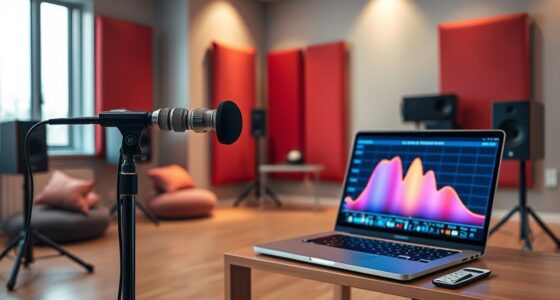
To calibrate your subwoofer’s phase, placement, and level, start by experimenting with different positions near walls or corners to find the best bass response. Adjust the volume so the bass blends smoothly with your main speakers without overpowering. Then, tweak the phase control to ensure sound waves align properly, preventing cancellation or reinforcement. Fine-tuning these settings enhances deep, balanced bass—continuing to optimize your setup brings even better results.

Get business pricing on your home office setup
- Business-only prices and quantity discounts
- Tax-exempt purchasing
- Multiple users, one account, clear invoices
Key Takeaways
- Adjust subwoofer phase to align with main speakers, preventing cancellation or reinforcement issues.
- Experiment with placement near walls or corners for deeper, more balanced bass response.
- Set the subwoofer level to match the main speakers for seamless blending and consistent sound.
- Use test tones or calibration tools to fine-tune phase, placement, and level settings accurately.
- Revisit and tweak calibration periodically to maintain optimal sound quality as room dynamics change.

Calibrating your subwoofer is essential to achieving balanced and powerful sound in your home theater or audio setup. Proper calibration ensures seamless woofer integration, making sure your subwoofer complements the main speakers rather than overpowering or underperforming. One of the key elements in this process is understanding how room acoustics influence sound. Your room’s size, shape, and furnishings can considerably affect how bass frequencies travel and how you perceive them. Before tweaking your subwoofer settings, take a moment to analyze your space. Soft furnishings like curtains and carpets absorb bass, while reflective surfaces like walls and windows can cause echoes or standing waves. Recognizing these room acoustics helps you make informed decisions about placement and adjustment.
When it comes to woofer integration, placement plays a critical role. Ideally, you want your subwoofer positioned where it can deliver even, punchy bass without creating hotspots or dead zones. A common recommendation is to place the sub near a wall or corner to enhance bass response, but this isn’t a universal rule. Experimenting with different spots in your room allows you to find the sweet spot where the bass sounds most natural and balanced. Once in position, use calibration tools or test tones to assess how well your subwoofer blends with your main speakers. Adjusting the phase and level settings during this process ensures the subwoofer’s sound aligns with the rest of your system, preventing phase cancellation or reinforcement issues. Additionally, understanding the contrast ratio of your projector can help optimize your overall viewing experience by ensuring that the visual environment complements your audio calibration.
Adjusting the phase control is crucial for woofer integration. If your subwoofer has a phase switch or dial, try flipping or rotating it while listening to bass-heavy content. The goal is to synchronize the sub’s sound wave with that of your main speakers, creating a unified bass response. Similarly, setting the correct level ensures the sub isn’t too loud or too quiet. Use a calibration microphone or built-in auto-calibration feature if available, or rely on your ears to judge the balance. You want the bass to feel full and impactful without overwhelming the overall soundstage. Remember, room acoustics can cause certain frequencies to become exaggerated or subdued, so make small adjustments and listen carefully.
In essence, careful attention to woofer integration, room acoustics, placement, and phase and level adjustments culminates in a cleaner, more immersive sound experience. Calibration isn’t a one-time task; revisit it periodically as your room setup changes or as you upgrade equipment. By fine-tuning these elements, you ensure your subwoofer delivers the deep, powerful bass you desire, seamlessly integrated into your audio environment.
Frequently Asked Questions
How Often Should I Recalibrate My Subwoofer Settings?
You should recalibrate your subwoofer settings every 6 to 12 months to guarantee peak performance. Regular subwoofer maintenance helps catch any drift in calibration caused by equipment changes or room adjustments. Keep an eye on sound quality and bass response, and if you notice inconsistencies, don’t hesitate to recalibrate sooner. Consistent calibration frequency ensures your subwoofer delivers clear, balanced bass for the best listening experience.
Can I Calibrate Multiple Subwoofers Simultaneously?
Yes, you can calibrate multiple subwoofers simultaneously, but you need to focus on subwoofer synchronization and phase alignment. Use a calibration tool or receiver settings to guarantee each subwoofer’s phase matches, minimizing cancellation or reinforcement issues. Proper placement and level adjustments help achieve a cohesive bass response. Take your time, listen carefully, and verify that the combined sound is smooth and balanced for peak performance.
What Tools Are Best for Measuring Subwoofer Phase?
Imagine tuning your subwoofer like aligning two dancers in perfect harmony. To measure subwoofer phase, use measurement tools like a real-time analyzer (RTA), a phase meter, or a smartphone app with a microphone. These tools help you visualize phase alignment, ensuring your subwoofer’s sound waves sync seamlessly with your main speakers. Accurate measurements allow you to fine-tune and achieve deep, powerful bass with precise timing.
How Does Room Acoustics Affect Subwoofer Calibration?
Room acoustics substantially impact your subwoofer calibration by creating room modes that cause uneven bass response. These modes can make certain frequencies sound boomy or weak. To counteract this, you should consider acoustic treatment like bass traps and diffusers, which help smooth out the sound. Proper calibration accounts for these effects, ensuring your subwoofer delivers balanced, accurate bass throughout your listening space.
Is Professional Calibration Necessary for Optimal Sound?
Think of professional calibration as tuning a fine instrument—you’ll notice clearer, richer sound. While you can tweak your subwoofer at home, a pro ensures minimal distortion and ideal crossover settings, eliminating subwoofer distortion that dulls your listening experience. For the best results, especially in complex rooms, professional calibration is worth it—it fine-tunes your system and keeps your sound pure and powerful.
Conclusion
Now that you know the secrets of subwoofer setup—phase, placement, and level—you’re ready to create a compelling, crisp cinematic sound. With careful calibration, you’ll conquer clunky bass and craft a seamless soundscape. Remember, patience and precision pave the path to perfection. So, take your time, tweak thoughtfully, and enjoy the richly resonant results. Your perfect, powerful bass awaits—practice, persist, and enjoy the pure pleasure of pristine sound!
Fall Picks
fall essentials
As an affiliate, we earn on qualifying purchases.