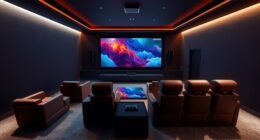
This checklist is for anyone putting together a projector viewing setup for a home theater, media room, or work space. It covers six parts of the setup, from the screen and mount to the audio gear and wall panels.

Get business pricing on your home office setup
- Business-only prices and quantity discounts
- Tax-exempt purchasing
- Multiple users, one account, clear invoices
The sections follow the main choices listed for this setup: display and mounting, source switching, audio, and room treatment. Each one explains why the slot matters and what to check when comparing options.
Use the checklist to confirm that each item suits your room and works with the rest of your equipment. Check dimensions, placement, and compatibility before choosing, and treat the listed product as a starting point for that slot.
Projector Screen
A screen is the viewing surface at the center of a projector setup, so its size and placement should fit the room and the way you plan to watch. The AWOL VISION 120 is described as a motorized floor-rising matte white projector screen. Before selecting it, measure the available wall and floor area, and consider whether a screen rising from the floor suits your furniture and viewing position.
A common mistake is choosing a screen based on its listed size without checking the usable space around it. Verify the screen’s dimensions and how much clearance it needs when raised and lowered. Also check the product details for the screen surface and the controls or power requirements, and confirm these suit your projector and room layout. Plan the viewing position as well: the screen should be visible from the seats without forcing an awkward placement relative to the projector.
What to look for:
- Screen dimensions that fit the room and viewing area
- Floor clearance for raising and lowering the screen
- Motor and control requirements
- A matte white surface that suits the intended setup
- Placement that aligns with the projector and seating
AWOL VISION 120" Motorized Floor Rising Matte White Projector Screen (MW-F220)

This 120-inch motorized floor-rising projector screen features a matte white PVC surface with 1.3dB peak gain, optimized for dark rooms and dimly lit environments. It offers universal compatibility with long, short, and ultra-short throw projectors, featuring USB synchronization for automatic deployment and a 170-degree viewing angle.
Pros:
- Hassle-free plug-and-play installation with no complex mounting required
- USB synchronization allows the screen to automatically rise and lower with the projector
- 1.3dB peak gain enhances picture brightness and vividness in dark rooms
- Space-saving design that retracts completely when not in use
Cons:
- Does not reject ambient light, making it unsuitable for rooms with ceiling lights or bright sunlight
- Requires a dedicated dark or dimly lit environment for optimal performance
Best for: Rooms where a floor-rising screen fits the layout
Not ideal for: Spaces without enough clearance for the screen to rise
Bottom line: Measure the screen area and its operating clearance before settling on this motorized floor-rising option.
Projector Mount
A mount helps keep the projector in a stable viewing position and makes placement part of the room plan. This pick is described as an electric ceiling mount with a remote and a retractable design. Check that a ceiling installation works for your room, and determine where the projector needs to sit to align with the screen and seating.
One frequent buying mistake is assuming that any ceiling mount fits any projector or ceiling. Confirm the mount’s supported projector dimensions, weight capacity, mounting pattern, and extension range in the product details. For an electric retractable model, check its power and remote-control requirements, plus the clearance needed to lower and retract it safely. Compare the mount’s travel with the projector’s required placement and the room’s ceiling height; a mismatch can make alignment difficult even when the mount physically attaches.
What to look for:
- Supported projector weight and dimensions
- Compatibility with the projector’s mounting pattern
- Extension and retraction range
- Power and remote-control requirements
- Ceiling clearance and alignment with the screen
Electric Projector Ceiling Mount with Remote Control, Retractable, Universal Fit

This electric ceiling mount conceals your projector when not in use and allows remote-controlled raising and lowering. It supports most projector brands with a maximum load of 22 lbs and offers a travel distance of 39 inches, making it suitable for home theaters, offices, and other settings.
Pros:
- Sleek hidden design with remote control for easy operation
- Supports most projector brands with high load capacity
- Simple installation process with included hardware
- Versatile for various environments like home theaters and conference rooms
Cons:
- Limited to projectors weighing up to 22 lbs
- Requires ceiling mounting space and proper installation
- Travel distance may not be sufficient for very large setups
Best for: Setups that call for retractable ceiling placement
Not ideal for: Rooms where ceiling mounting or clearance is limited
Bottom line: Confirm the projector fit, ceiling conditions, and movement range before choosing an electric mount.
HDMI Switch
An HDMI switch can bring several sources together for connection to a display path, making input selection a key part of the setup. This pick is described as a four-in, one-out HDMI 2.1 switch with a remote. Check that the number of inputs covers the devices you expect to connect, including any equipment you may add later.
A common mistake is matching only the HDMI version or headline format while overlooking the capabilities of every device in the chain. Review the switch’s supported resolutions and refresh rates, then compare them with the projector, receiver, and connected sources. Check how switching works, whether the remote suits your seating arrangement, and whether any required cables or power supply are included. Verify the full signal path rather than assuming that one high-capability component guarantees the same performance across all connected equipment.
What to look for:
- Enough HDMI inputs for current sources
- Supported resolution and refresh rate for each device
- HDMI 2.1 compatibility across the signal path
- Remote-control operation from the viewing position
- Power and cable requirements
HDMI 2.1 Switch, 4 in 1 Out, 8K@60Hz, 4K@240Hz HDMI Switcher with Remote Support

This HDMI 2.1 switch allows you to connect four HDMI sources to a single display, supporting up to 8K resolution and high refresh rates for smooth visuals. It features remote control operation, compatibility with various devices, and supports advanced HDR and audio formats.
Pros:
- Supports ultra-high resolutions up to 8K with high refresh rates
- Easy remote control and manual switching with LED indicators
- Compatible with a wide range of gaming and media devices
Cons:
- Requires external power supply via USB
- Does not support one source to multiple displays (not a splitter)
- HDMI cables for 8K should be 3 meters or shorter for optimal performance
Best for: Setups with several HDMI sources to connect
Not ideal for: Systems that need more than four source inputs
Bottom line: Check the switch’s supported formats against every device in the signal path.
AV Receiver
An AV receiver is a central connection point for a home theater, so its channel configuration and inputs need to suit the rest of the system. The Denon AVR-A10H is described as a 13.4-channel 8K home theater receiver. Consider how many speakers and other components you plan to connect, and confirm that the receiver’s layout matches that plan. Map your system first so the channel count is meaningful for your room.
A common mistake is choosing a receiver by channel count alone. Check the product specifications for supported connections and formats, then compare them with your projector, HDMI switch, and speakers. Confirm the physical space, ventilation, and cable access available where the receiver will sit. The listed 150W-per-channel detail should also be checked against the manufacturer’s stated operating conditions and the needs of the speakers in your setup. Review compatibility as a group rather than treating the receiver as a standalone choice.
What to look for:
- Channel configuration for the planned speaker layout
- Inputs and formats compatible with connected devices
- Physical dimensions and ventilation clearance
- Speaker compatibility and stated power conditions
- Connection plan for the projector and HDMI switch
Denon AVR-A10H 13.4-Channel 8K Home Theater Receiver, 150W per Channel

The Denon AVR-A10H is a 13-channel home theater receiver that supports up to 13 speakers and four subwoofers, with Dolby Atmos, DTS:X Pro, and other immersive audio formats. It offers 8K and 4K/120Hz video, seven HDMI inputs, HEOS wireless streaming, and Audyssey room correction, with optional Dirac Live support.
Pros:
- Supports immersive audio formats and flexible speaker configurations
- Provides 8K/60Hz and 4K/120Hz video with gaming features including VRR, QFT, and ALLM
- Includes HEOS multi-room streaming over Wi-Fi and Bluetooth
- Offers Audyssey room correction and optional Dirac Live support
Cons:
- Dirac Live room correction requires an additional fee
- The product description does not specify physical dimensions or weight
Best for: Systems planned around a 13.4-channel receiver
Not ideal for: Simpler setups that do not need this channel layout
Bottom line: Match the receiver’s channel plan and connections to the speakers and sources you will use.
Surround Speakers
Audio is a major part of the viewing setup, and the speaker choice should fit both the room and the way you intend to connect your equipment. The listed pick is a Sonos Arc Ultra soundbar with Dolby Atmos, in black. Because it is a soundbar, check whether its role in your intended system matches your expectations for surround sound and whether it can connect as planned with the rest of your equipment.
A common mistake is treating the label “surround speakers” as proof that a single soundbar will suit every receiver-based speaker layout. Check the soundbar’s connection options and compatibility details, including any requirements for using it with other audio components. Measure the space where it will sit and confirm it will not obstruct the screen or other equipment. Plan the audio connections before buying, especially if you intend to use the Denon receiver listed in this checklist.
What to look for:
- Soundbar dimensions and placement clearance
- Connection options for the planned equipment
- Compatibility with the receiver and audio setup
- Fit with the intended surround sound arrangement
- Finish that suits the room
Sonos Arc Ultra Soundbar with Dolby Atmos – Black

The Sonos Arc Ultra is a sleek soundbar featuring Dolby Atmos and Sound Motion technology, delivering immersive 9.1.4 spatial audio with AI-powered Speech Enhancement. It offers effortless setup, versatile control options, and the ability to stream music via WiFi, Bluetooth, AirPlay 2, and Spotify Connect.
Pros:
- Immersive Dolby Atmos sound with 9.1.4 channels
- Easy setup with single HDMI eARC connection
- Versatile control options including app, voice, and remote
- Supports multiple streaming services and multi-room audio
Cons:
- Premium price may be high for some users
- Requires additional speakers for full surround sound experience
- Not water resistant, suitable only for indoor use
Best for: Setups seeking a soundbar form factor
Not ideal for: Plans that require separate surround speakers
Bottom line: Confirm the soundbar’s connections and role in the audio system before pairing it with a receiver.
Acoustic Panels
Acoustic panels are a room-treatment choice to consider alongside the screen, projector, and audio equipment. This pick is a four-piece set of NeatiEase teak wood slat wall panels. Before selecting it, decide where panels would fit in the room and how their dimensions relate to the wall area you have available. Plan the wall placement around furniture, screen position, and access to equipment.
A common mistake is buying panels without checking what the product is designed to do or how it is installed. Review the manufacturer’s details for panel dimensions, materials, mounting method, and any care requirements; the product name alone does not establish its acoustic performance. Check how many sets would be needed for your intended wall coverage and whether the teak finish works with the room. Confirm the installation approach and wall suitability before ordering, particularly where panels would sit near mounted equipment or wiring.
What to look for:
- Dimensions and coverage of the four-piece set
- Manufacturer details on acoustic performance
- Mounting method and wall requirements
- Teak finish compatibility with the room
- Placement clear of equipment and wiring
NeatiEase Teak Wood Slat Wall Panels, 4-Piece Set

These MDF and high-density polyester fiber panels add a contemporary wood-slat look while helping absorb sound and reduce echo. The four panels can be installed horizontally or vertically on walls or ceilings, and can be cut to shape.
Pros:
- Helps absorb sound and reduce echo
- Can be installed horizontally or vertically
- Can be cut to fit different shapes
- Suitable for walls and ceilings
Cons:
- Heavy package at 52.9 pounds
- Installation requires screws or superglue
Best for: Rooms where teak slat panels suit the wall plan
Not ideal for: Spaces without suitable wall area or mounting conditions
Bottom line: Check panel coverage, mounting details, and stated acoustic purpose before deciding how many sets to use.
When buying in stages, start with the room plan and compatibility: measure the screen and projector positions, then confirm how the mount, switch, receiver, and audio equipment connect. Add wall panels after identifying the available wall area and checking the product’s stated purpose and installation needs.
A little measuring and equipment checking can make the choices easier to compare. Work through the checklist at your own pace, confirm the details that matter for your room, and build a setup that fits your viewing space.