For a strong mix of immersive audio and practical setup, I’d put the ULTIMEA Skywave X50 first: its 5.1.4 layout gives buyers more height-channel potential than most soundbar kits here. The Sony BRAVIA Theater System 6 is a straightforward pick for a matched soundbar, subwoofer, and rear-speaker setup, while the Yamaha YHT-4970U suits buyers who want a traditional receiver-based system and broad HDMI support. The main tradeoff is between simpler soundbar-style installation and the greater wiring and placement demands of separate home theater components. Wireless subwoofers and rear-speaker links can reduce cable runs, but they do not make every speaker fully wireless. Read on for how all 14 systems differ and which setup best fits your room and priorities.

Get business pricing on your home office setup
- Business-only prices and quantity discounts
- Tax-exempt purchasing
- Multiple users, one account, clear invoices
Complete the kit


Key Takeaways
- Speaker layout separates the most immersive picks: the ULTIMEA Skywave X50’s 5.1.4 configuration has more height-channel potential than the 5.1 and 7.1 soundbar kits in this roundup.
- A wireless label does not mean a cable-free room: many systems still need power at the subwoofer or rear-speaker unit, and the Yamaha receiver systems require conventional speaker connections.
- Traditional receiver systems trade simplicity for flexibility: the Yamaha YHT-4950U and YHT-4970U are a different kind of purchase from the all-in-one soundbar packages.
- More channels can mean more setup work, not automatically better sound: four surround speakers, as on the ULTIMEA Poseidon D70, call for more careful placement than a compact soundbar kit.
- Room and connection needs can matter more than headline channel counts: check TV and source compatibility, available power outlets, speaker placement options, and the room’s layout before choosing.
| ULTIMEA 5.1.2-Channel Dolby Atmos Soundbar System with Subwoofer |  | Best for Dolby Atmos on a Soundbar | Channels: 5.1.2 | Audio format: Dolby Atmos | Surround technology: SurroundX | VIEW LATEST PRICE | See Our Full Breakdown |
| Ultimea Aura A40 7.1ch Sound Bar with Subwoofer and 4 Surround Speakers |  | Best for Adjustable Rear-Speaker Coverage | Audio channels: 7.1 virtual surround | Surround speakers: Four; front wired and rear wireless | Subwoofer connection: Wired | VIEW LATEST PRICE | See Our Full Breakdown |
| Redragon GS822 5.1.2CH Dolby Atmos Sound Bar with Wireless Subwoofer |  | Best for Flexible Subwoofer Placement | Audio channels: 5.1.2 | Audio format: Dolby Atmos | Peak power: 400W | VIEW LATEST PRICE | See Our Full Breakdown |
| Bobtot KW88 Wireless 5.1 Surround Sound System with 8″ Subwoofer |  | Best for Karaoke and Big-Room Bass | Channel configuration: 5.1 or 2.1 | Peak power: 1000W | Subwoofer: 8-inch | VIEW LATEST PRICE | See Our Full Breakdown |
| 4.2-Channel Home Theater Sound Bar System with Surround Speakers and Dual Subwoofers |  | Best for Dual-Subwoofer Coverage | Channels: 4.2 | Included speakers: Soundbar and four surround speakers | Subwoofers: Two wired passive subwoofers | VIEW LATEST PRICE | See Our Full Breakdown |
| LG S40TR 4.1-Channel Soundbar with Wireless Subwoofer and Rear Speakers |  | Best for LG TV Owners | Channels: 4.1 | Included speakers: Soundbar, wireless subwoofer, rear surround speakers | Audio formats: Dolby Digital, DTS Digital | VIEW LATEST PRICE | See Our Full Breakdown |
| TCL S65K 5.1-Channel Soundbar System with Dolby Atmos, DTS:X, Wireless Subwoofer and Surround Speakers |  | Best for Immersive Formats | Audio channels: 5.1 | Maximum output power: 630 watts | Audio technologies: Dolby Atmos, DTS:X, DTS Virtual:X | VIEW LATEST PRICE | See Our Full Breakdown |
| Sony BRAVIA Theater System 6 5.1ch Soundbar with Subwoofer & Rear Speakers |  | Best for Dialogue Clarity | Channel configuration: 5.1-channel | Speaker count: 10 | Supported formats: Dolby Atmos, DTS:X | VIEW LATEST PRICE | See Our Full Breakdown |
| ULTIMEA Poseidon D50 Pro 5.1 Channel TV Sound Bar System with Wireless Subwoofer and Rear Speakers |  | Best for Customizable Setup | Channel configuration: 5.1 | Peak power: 320 W | Subwoofer: Wireless; 5.25 in diameter | VIEW LATEST PRICE | See Our Full Breakdown |
| Yamaha YHT-4950U 4K 5.1-Channel Home Theater System with Bluetooth |  | Best for Receiver-Based Surround | Audio configuration: 5.1 channels | Included components: AV receiver, five speakers, subwoofer, speaker wire | HDMI ports: 4 | VIEW LATEST PRICE | See Our Full Breakdown |
| Sony HT-S40R 5.1-Channel Home Theater Soundbar System, Black |  | Best for Straightforward 5.1 Setup | Audio channels: 5.1 | Maximum output power: 600 watts | Connectivity: HDMI, optical, analog, Bluetooth, USB | VIEW LATEST PRICE | See Our Full Breakdown |
| ULTIMEA Skywave X50 5.1.4-Channel Wireless Surround Sound System |  | Best for Wireless Height Effects | Audio channels: 5.1.4 | Peak power: 760W | Wireless transmission: Dual 5GHz | VIEW LATEST PRICE | See Our Full Breakdown |
| ULTIMEA Poseidon D70 7.1-Channel Surround Soundbar System with 4 Surround Speakers and Wireless Subwoofer | 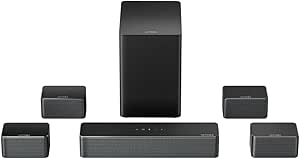 | Best for Multiple Rear Speakers | Audio channels: 7.1 virtual surround | Peak power: 410 W | Included speakers: Soundbar and 4 wired surround speakers | VIEW LATEST PRICE | See Our Full Breakdown |
| Yamaha YHT-4970U 5.1-Channel Home Theater System with Dolby Atmos and 4K/120, 8K/60 HDMI |  | Best Receiver-Based System for Gaming | AV receiver: Yamaha RX300A | Audio channels: 5.1 | Audio formats: Dolby Atmos, DTS Virtual:X | VIEW LATEST PRICE | See Our Full Breakdown |
| wireless surround sound system | Connectivity | Audio channels |
|---|---|---|
| ULTIMEA 5.1.2-Channel Dolby At | HDMI eARC, Bluetooth 5.4 | — |
| Ultimea Aura A40 7.1ch Sound B | Bluetooth 5.3, optical, AUX, USB | 7.1 virtual surround |
| Redragon GS822 5.1.2CH Dolby A | HDMI eARC, Bluetooth 5.3, optical, AUX, USB | 5.1.2 |
| Bobtot KW88 Wireless 5.1 Surro | TV ARC, optical, AUX, USB, DVD, Bluetooth 5.3, dual 1/4-inch microphone inputs | — |
| 4.2-Channel Home Theater Sound | HDMI ARC, optical, AUX, USB, Bluetooth | — |
| LG S40TR 4.1-Channel Soundbar | — | — |
| TCL S65K 5.1-Channel Soundbar | Bluetooth, USB, Wi-Fi, HDMI | 5.1 |
| Sony BRAVIA Theater System 6 5 | Bluetooth, HDMI | — |
| ULTIMEA Poseidon D50 Pro 5.1 C | HDMI ARC, Bluetooth, optical, AUX | — |
| Yamaha YHT-4950U 4K 5.1-Channe | HDMI, Ethernet, coaxial, optical, USB, auxiliary, Bluetooth | — |
| Sony HT-S40R 5.1-Channel Home | HDMI, optical, analog, Bluetooth, USB | 5.1 |
| ULTIMEA Skywave X50 5.1.4-Chan | — | 5.1.4 |
| ULTIMEA Poseidon D70 7.1-Chann | HDMI ARC, optical, AUX, USB, Bluetooth | 7.1 virtual surround |
| Yamaha YHT-4970U 5.1-Channel H | — | 5.1 |
More Details on Our Top Picks
ULTIMEA 5.1.2-Channel Dolby Atmos Soundbar System with Subwoofer
The ULTIMEA stands out here for combining 5.1.2-channel Dolby Atmos with two surround speakers and up-firing drivers, giving height effects a clearer role than a conventional 5.1 layout. Its HDMI eARC connection supports lossless audio transmission, while the app lets you adjust surround levels and shape the sound with a 10-band EQ. Compared with the Redragon GS822, this model offers more detailed app tuning and a slimmer soundbar, but its wired subwoofer and DTS incompatibility narrow placement and format flexibility. It is a better fit for a TV setup centered on Atmos content than for a mixed-format library that depends on DTS. I’d choose it over the Ultimea Aura A40 when height-channel effects and eARC matter more than having four surround speakers.
Pros:- Up-firing drivers and two surround speakers add height and rear effects to the sound field.
- HDMI eARC supports lossless 5.1.2-channel audio transmission.
- App includes a 10-band EQ and 13-step surround-level adjustment.
- CEC can synchronize power, volume, and input with a compatible TV.
Cons:- Does not support DTS audio.
- The subwoofer requires a wired connection, limiting placement.
Best for: TV owners who watch Dolby Atmos content and want height effects, eARC, and app-based sound adjustment in a compact soundbar system.
Not ideal for: Viewers with a DTS-heavy movie collection or anyone who needs a wireless subwoofer for flexible placement.
- Channels:5.1.2
- Audio format:Dolby Atmos
- Surround technology:SurroundX
- Subwoofer:5.25-inch wired
- Connectivity:HDMI eARC, Bluetooth 5.4
- App adjustment:13-step surround adjustment, 10-band EQ, 121 preset sound settings
- Dimensions:31.5 x 1.81 x 3.54 inches
Our verdict“Choose this ULTIMEA for Atmos-focused TV viewing with eARC and adjustable height effects, but skip it if DTS support or a wireless subwoofer is a priority.”
Ultimea Aura A40 7.1ch Sound Bar with Subwoofer and 4 Surround Speakers
The Aura A40’s defining advantage is its four surround speakers, including wireless rear speakers, which offer more flexibility for arranging rear coverage than the two-surround ULTIMEA 5.1.2 system. Its 7.1-channel virtual surround processing and 121 app EQ presets give buyers room to tailor sound by content and listening position. The tradeoff is a conspicuous one: there is no HDMI connection, so TV hookup relies on optical or other listed inputs rather than eARC or ARC. That makes it less convenient for a modern TV-first setup than the Redragon GS822, which has HDMI eARC and Dolby Atmos height channels. The A40 makes more sense when speaker placement and app customization matter more than Atmos or a one-cable HDMI connection; its wired subwoofer still needs a suitable spot near its connection.
Pros:- Four surround speakers provide more placement options than systems with two surrounds.
- Rear speakers connect wirelessly, reducing long speaker cables across the room.
- App offers 121 EQ presets and a 10-band equalizer.
- Optical, AUX, USB, and Bluetooth support a range of source devices.
Cons:- No HDMI connection, which limits straightforward hookup to many modern TVs.
- The subwoofer is wired and restricts placement.
- Rear speaker pairing may require manual steps if automatic pairing fails.
Best for: Home theater owners who want four surround speakers, flexible wireless rear placement, and extensive app sound tuning.
Not ideal for: Buyers seeking HDMI ARC or eARC, Dolby Atmos height channels, or a wireless subwoofer.
- Audio channels:7.1 virtual surround
- Surround speakers:Four; front wired and rear wireless
- Subwoofer connection:Wired
- Connectivity:Bluetooth 5.3, optical, AUX, USB
- HDMI support:No
- App equalization:121 EQ presets and 10-band equalizer
- Mounting:Tabletop or wall
Our verdict“Pick the Aura A40 for adjustable rear coverage and app tuning, but choose the Redragon GS822 instead if HDMI eARC and Dolby Atmos are more important.”
Redragon GS822 5.1.2CH Dolby Atmos Sound Bar with Wireless Subwoofer
The Redragon GS822 pairs 5.1.2-channel Dolby Atmos with a wireless 6.5-inch subwoofer, a useful combination for buyers who want height effects but cannot place a subwoofer beside the soundbar. Its HDMI eARC connection is also a stronger match for a current TV setup than the Ultimea Aura A40, which lacks HDMI altogether. The surround speakers are wired, however, so the wireless subwoofer does not make the whole system cable-free; those rear connections still need room planning. Compared with the ULTIMEA 5.1.2 system, the GS822 adds optical, AUX, and USB inputs and uses a physical remote with scene EQ modes, but offers less listed app-based fine tuning. It is a practical pick for varied sources and easier bass placement, provided tabletop installation and speaker-wire routing suit the room.
Pros:- Dolby Atmos and dedicated height channels create a multidimensional sound field.
- Wireless 6.5-inch subwoofer allows more flexible bass placement.
- HDMI eARC, optical, AUX, USB, and Bluetooth support multiple sources.
- Wired surround speakers provide stable connections, with remote-accessible scene EQ modes.
Cons:- Wired surround speakers require cable routing across the room.
- Tabletop mounting is listed, with no wall-mount option specified.
- Controls rely on a remote rather than an app-based EQ system.
Best for: TV, console, and PC users who want Atmos and a wireless subwoofer but can route cables to wired surround speakers.
Not ideal for: Buyers who need wireless rear speakers, wall-mount flexibility, or detailed app-based equalizer controls.
- Audio channels:5.1.2
- Audio format:Dolby Atmos
- Peak power:400W
- Subwoofer:Wireless, 6.5-inch
- Surround speakers:Wired
- Connectivity:HDMI eARC, Bluetooth 5.3, optical, AUX, USB
- Control:Remote control with scene-optimized EQ modes
Our verdict“Choose the GS822 if you want Atmos and a freely placed subwoofer with broad input support, and can accommodate wired rear speakers.”
Bobtot KW88 Wireless 5.1 Surround Sound System with 8″ Subwoofer
The Bobtot KW88 takes a more room-filling, entertainment-focused approach than the soundbar-led ULTIMEA and Redragon systems. Its 8-inch subwoofer, four wireless satellite speakers, and stated 1000W peak power suit buyers who want prominent bass and freedom to place satellites up to 32 feet away. The unusual extra is dual microphone inputs with echo effects, making it the clearest fit here for karaoke alongside TV audio. Its connection layout is less convenient than the Redragon GS822: the center speaker is wired to the subwoofer, and the product data lists TV ARC rather than HDMI eARC. This is not the pick for Atmos height effects or a tidy soundbar-only installation. I’d favor it for a larger shared room where wireless satellites and party use outweigh streamlined setup.
Pros:- Four wireless satellite speakers can be placed up to 32 feet away.
- 8-inch subwoofer and stated 1000W peak power suit bass-forward listening.
- Dual microphone inputs with echo add karaoke functionality.
- TV ARC, optical, AUX, USB, DVD, and Bluetooth 5.3 provide varied input options.
Cons:- The center speaker connects by wire, including to the subwoofer.
- No Dolby Atmos support is specified.
- The large system requires more room and placement planning than a soundbar-led setup.
Best for: Households wanting wireless satellite placement, strong bass presence, and microphone inputs for karaoke or group entertainment.
Not ideal for: Buyers seeking Dolby Atmos, a compact soundbar setup, or fully wireless speaker connections.
- Channel configuration:5.1 or 2.1
- Peak power:1000W
- Subwoofer:8-inch
- Satellite speakers:Four wireless speakers; 3-inch size
- Wireless range:32 feet
- Connectivity:TV ARC, optical, AUX, USB, DVD, Bluetooth 5.3, dual 1/4-inch microphone inputs
- Center speaker cable:13 feet
Our verdict“Choose the KW88 for wireless satellite placement, bass, and karaoke features, but opt for the Redragon GS822 if Atmos and HDMI eARC matter more.”
4.2-Channel Home Theater Sound Bar System with Surround Speakers and Dual Subwoofers
This 4.2-channel system stands apart through its two wired passive subwoofers and four surround speakers, a layout aimed at spreading bass and surround sound rather than adding Atmos height effects. HDMI ARC, optical, AUX, USB, and Bluetooth give it more TV and source options than the HDMI-free Ultimea Aura A40. In exchange, it is the least cable-light choice here: the surround speakers and both subwoofers connect by wire, so placement depends on where cables can reach. The listed setup guidance may also require selecting PCM and disabling Dolby or DTS on the TV when using ARC or optical, which is less plug-and-play than the ULTIMEA 5.1.2 system’s eARC approach. Its Movie, Music, and News modes offer simple adjustments, but this is not the choice for Atmos or wireless rear-speaker convenience.
Pros:- Two passive subwoofers add bass coverage alongside four surround speakers.
- HDMI ARC, optical, AUX, USB, and Bluetooth cover common TV and audio sources.
- Movie, Music, and News EQ modes offer straightforward sound selection.
- Remote, onboard buttons, wall-mount hardware, and connection cables are included.
Cons:- Surround speakers and both subwoofers connect by wire, limiting placement flexibility.
- Listed TV setup guidance may require PCM selection and disabling Dolby or DTS.
- No Dolby Atmos support is specified.
Best for: Viewers who want four surround speakers, two bass units, and several wired connection choices in a fixed tabletop setup.
Not ideal for: Buyers who need wireless speakers, Dolby Atmos height effects, or a simple cable-light installation.
- Channels:4.2
- Included speakers:Soundbar and four surround speakers
- Subwoofers:Two wired passive subwoofers
- Subwoofer diameter:4 inches
- Connectivity:HDMI ARC, optical, AUX, USB, Bluetooth
- EQ modes:Movie, Music, News
- Controls and mounting:Remote and onboard buttons; tabletop mounting
Our verdict“Pick this system for a fixed setup built around four surrounds and dual subwoofers, but choose the ULTIMEA 5.1.2 for Atmos and eARC.”
LG S40TR 4.1-Channel Soundbar with Wireless Subwoofer and Rear Speakers
The LG S40TR is a practical pick for LG TV owners who want genuine rear-channel sound without moving to a receiver-based setup. Its wireless subwoofer and included rear speakers add impact and a sense of sound behind the seating area, while Clear Voice Plus can make dialogue easier to follow. LG TV integration, including shared playback with select models, gives it an advantage for households already using compatible LG gear. Compared with the TCL S65K, this is a simpler 4.1-channel system rather than a 5.1 setup with Dolby Atmos and DTS:X support. The tradeoff is in the rear-speaker wiring: the rear units connect to each other by wire, and one needs AC power. Its optical and USB inputs also make it less suited to buyers who want HDMI-based connections.
Pros:- Includes rear surround speakers and a wireless subwoofer for a more enveloping setup than a soundbar alone.
- Clear Voice Plus and Smart Up-Mixer can improve dialogue intelligibility and broaden stereo playback.
- Compatible LG TVs can share speaker playback and control through WOW features.
- Three-band app equalizer provides basic sound adjustments.
Cons:- Rear speakers require a wired link between them, and one rear speaker needs AC power.
- Inputs are limited to optical and USB, with no HDMI listed.
- WOW Orchestra features work only with select LG TVs and soundbars.
Best for: LG TV owners who want included rear speakers, easier dialogue, and integrated control without a separate AV receiver.
Not ideal for: Buyers seeking wireless rear-speaker placement, HDMI connectivity, or Atmos and DTS:X support.
- Channels:4.1
- Included speakers:Soundbar, wireless subwoofer, rear surround speakers
- Audio formats:Dolby Digital, DTS Digital
- Sound features:Clear Voice Plus, Smart Up-Mixer, WOW Orchestra, WOW Interface
- Equalizer:3-band adjustment via LG Soundbar App
- Inputs:Optical input, USB port
- Soundbar dimensions:28.4 × 2.5 × 3.4 in
- Rear speaker connection:Wired connection between rear speakers; one rear speaker requires AC power
Our verdict“Choose the S40TR if you have a compatible LG TV and want rear surround speakers, but skip it if flexible wireless rear placement or HDMI is a priority.”
TCL S65K 5.1-Channel Soundbar System with Dolby Atmos, DTS:X, Wireless Subwoofer and Surround Speakers
For buyers who want a soundbar-led system with support for current spatial audio formats, the TCL S65K has a stronger format case than the 4.1-channel LG S40TR: it supports Dolby Atmos and DTS:X and includes a center channel, subwoofer, and surround speakers. That combination is aimed at giving movies clearer dialogue and a wider, more layered presentation without building around an AV receiver. AI Sonic room calibration is another useful fit feature, since it can tailor playback to the room rather than assuming ideal speaker placement. The 630-watt maximum output is listed, but it does not by itself describe how loud or balanced the system will sound in a particular room. The main caveats are corded power and ChoruSound’s dependence on a compatible TCL TV; Sony’s Theater System 6 also supports Atmos and DTS:X but offers a different, wired-subwoofer arrangement.
Pros:- Supports Dolby Atmos, DTS:X, and DTS Virtual:X for spatial audio playback.
- Includes a wireless subwoofer and surround speakers to add bass and rear-channel effects.
- Built-in center channel and tweeter are designed to keep dialogue and detail distinct.
- AI Sonic room calibration can tailor the system to its listening space.
Cons:- The system still requires corded electric power, so it is not a wire-free installation.
- ChoruSound requires a compatible TCL TV.
- The maximum output figure does not specify real-world performance for a particular room.
Best for: Movie and TV viewers who want Atmos and DTS:X support, dedicated surround speakers, and room calibration in a soundbar system.
Not ideal for: Buyers who need a fully cable-free speaker layout or want TCL-specific ChoruSound features without a compatible TCL TV.
- Audio channels:5.1
- Maximum output power:630 watts
- Audio technologies:Dolby Atmos, DTS:X, DTS Virtual:X
- Subwoofer driver:6.5 in
- Connectivity:Bluetooth, USB, Wi-Fi, HDMI
- Calibration:AI Sonic room calibration
- Mounting type:Wall mount
- Control method:Remote
Our verdict“Pick the S65K if Atmos and DTS:X support plus room calibration matter more than avoiding every power cable.”
Sony BRAVIA Theater System 6 5.1ch Soundbar with Subwoofer & Rear Speakers
The Sony BRAVIA Theater System 6 puts dialogue and format support near the center of its appeal. Its dedicated center channel is useful when speech gets lost in busy movie soundtracks, while Dolby Atmos and DTS:X support suits viewers with compatible content. Multi Stereo can spread audio across the included speakers, and the BRAVIA Connect app adds phone-based control and Bluetooth streaming. Compared with the TCL S65K, Sony lists a 10-speaker, 5.1-channel arrangement and a wired subwoofer; TCL instead specifies a wireless subwoofer and AI Sonic calibration. That wiring distinction matters for room layout: the Sony subwoofer needs a cable, so the system is not as flexible as a wireless-subwoofer setup. Some advanced functions, including Voice Zoom 3, also depend on a compatible BRAVIA TV.
Pros:- Dedicated center channel supports clearer dialogue in movies and TV.
- Dolby Atmos and DTS:X support adds compatibility with spatial audio content.
- Multi Stereo can distribute sound across the system for room-filling playback.
- Bluetooth streaming and BRAVIA Connect app offer convenient playback and control.
Cons:- The subwoofer connection is wired, limiting placement flexibility compared with wireless-subwoofer systems.
- Voice Zoom 3 and other advanced features require a compatible BRAVIA TV.
- The system needs corded electric power.
Best for: Viewers who prioritize clear dialogue, use Atmos or DTS:X content, and can place a wired subwoofer near the soundbar.
Not ideal for: Buyers who need a wireless subwoofer, want rear speakers free from power and cable constraints, or do not want BRAVIA-dependent features.
- Channel configuration:5.1-channel
- Speaker count:10
- Supported formats:Dolby Atmos, DTS:X
- Maximum output power:1000 watts
- Connectivity:Bluetooth, HDMI
- Dimensions:3.6 in D × 35.7 in W × 2.6 in H
- Mounting:Tabletop or wall mount
- Power source:Corded electric
Our verdict“Choose Sony’s Theater System 6 for center-channel dialogue and spatial-format support if a wired subwoofer fits your room.”
ULTIMEA Poseidon D50 Pro 5.1 Channel TV Sound Bar System with Wireless Subwoofer and Rear Speakers
The ULTIMEA Poseidon D50 Pro is the flexible-input, sound-tuning pick in this group. HDMI ARC, optical, AUX, and Bluetooth give it more ways to connect than the LG S40TR, whose listed inputs are limited to optical and USB. Its app-based EQ is built for listeners who want more control than a basic sound mode, while SurroundX can upmix stereo material for multi-channel playback. A wireless subwoofer brings bass without a cable running back to the soundbar, but the two rear speakers remain wired together with a supplied 19.6-foot cable. That makes rear placement more involved than the subwoofer connection suggests. Unlike the TCL S65K, the D50 Pro’s listed features do not include Dolby Atmos or DTS:X, so buyers focused on those formats should look elsewhere.
Pros:- Wireless subwoofer adds bass without requiring a wired connection to the soundbar.
- HDMI ARC, Bluetooth, optical, and AUX support a wide range of source devices.
- SurroundX upmixing can expand stereo material across the 5.1 system.
- App offers extensive EQ customization, including a 10-band equalizer and preset matrices.
Cons:- Rear speakers need a wired connection, which can complicate placement despite the long cable.
- Dolby Atmos and DTS:X support are not listed.
- Advanced equalizer adjustments depend on app control.
Best for: Listeners who want broad input options and detailed app EQ control, and can route a cable between rear speakers.
Not ideal for: Atmos or DTS:X-focused home theater buyers, or anyone who needs rear speakers with no connecting wire.
- Channel configuration:5.1
- Peak power:320 W
- Subwoofer:Wireless; 5.25 in diameter
- Rear speaker connection:Wired, with 19.6 ft cable
- Connectivity:HDMI ARC, Bluetooth, optical, AUX
- Control method:App
- Mounting type:Wall mount
- Equalizer:10-band equalizer and 121 preset EQ matrices
Our verdict“The D50 Pro suits buyers who value flexible connections and hands-on EQ more than Atmos support or fully wireless rear speakers.”
Yamaha YHT-4950U 4K 5.1-Channel Home Theater System with Bluetooth
The Yamaha YHT-4950U is the outlier here: it is a receiver-based 5.1 home theater package, not a wireless-speaker system. Its receiver, five speakers, subwoofer, and speaker wire give buyers a conventional surround layout with four HDMI ports, 4K/60 pass-through, and support for HDR formats including Dolby Vision. That makes it a better fit for a multi-source setup than the soundbar systems, such as the ULTIMEA Poseidon D50 Pro, which centers on HDMI ARC and simpler installation. Yamaha YPAO room optimization and virtual CINEMA FRONT offer some setup flexibility, but neither removes the need to run speaker wire. Bluetooth is for streaming audio, not wireless surround connections. I’d choose it for a planned, permanent theater layout, not for someone trying to keep cables out of sight.
Pros:- Includes an AV receiver, five speakers, subwoofer, and speaker wire for a complete 5.1 setup.
- Four HDMI ports and 4K/60 pass-through support a multi-source TV arrangement.
- Supports HDR formats including Dolby Vision and Hybrid Log-Gamma.
- YPAO room optimization and virtual CINEMA FRONT provide setup options.
Cons:- Surround speakers connect by wire; Bluetooth does not provide wireless speaker connections.
- Receiver and separate speakers require more space and setup work than the soundbar systems.
- The package is not waterproof.
Best for: Home theater buyers with several HDMI sources who want a receiver and separate 5.1 speakers and can route speaker wire.
Not ideal for: Anyone specifically seeking wireless surround speakers, a quick soundbar installation, or a low-cable setup.
- Audio configuration:5.1 channels
- Included components:AV receiver, five speakers, subwoofer, speaker wire
- HDMI ports:4
- Video support:4K Ultra HD pass-through at 60 frames per second; HDR, Dolby Vision, Hybrid Log-Gamma
- Connectivity:HDMI, Ethernet, coaxial, optical, USB, auxiliary, Bluetooth
- Power output:150 watts
- Frequency response:28 Hz–25 kHz
- Wireless functionality:Bluetooth audio streaming; no wireless functionality beyond Bluetooth
Our verdict“Choose the YHT-4950U for receiver-based surround and multiple HDMI sources, but skip it if wireless speaker connections are the priority.”
Sony HT-S40R 5.1-Channel Home Theater Soundbar System, Black
The Sony HT-S40R is a practical pick for buyers who want physical rear speakers without moving to a full AV receiver system. Its 5.1-channel layout gives movie and TV sound more room behind the listening position than a soundbar alone, while HDMI, optical, and analog inputs provide several ways to connect older and newer TVs. Bluetooth adds an easy route for music playback. Compared with the Yamaha YHT-4970U, the Sony is a simpler soundbar-based package, but it gives up the Yamaha’s receiver flexibility, gaming-focused HDMI features, and listed Atmos support. The Sony’s stated 600 watts is a headline power figure rather than a guarantee of room-filling performance, and the system still needs power cables. Choose it for accessible surround sound, not a cable-free room or advanced format support.
Pros:- 5.1-channel layout includes rear speakers for audible sound behind the seating area.
- HDMI, optical, and analog inputs work with a range of TV connection options.
- Bluetooth supports music streaming from compatible devices.
- Dialogue enhancement and selectable sound modes offer basic playback adjustments.
Cons:- The supplied information does not list Dolby Atmos or DTS support.
- Rear speakers and other components still require power, so setup is not cable-free.
- The 600-watt maximum output figure does not by itself describe real-world loudness or sound quality.
Best for: TV owners who want a soundbar-style 5.1 system with rear speakers and multiple connection choices, without assembling a receiver-and-speaker package.
Not ideal for: Buyers seeking Dolby Atmos or a highly flexible receiver setup; the Yamaha YHT-4970U lists Atmos support and modern HDMI gaming features.
- Audio channels:5.1
- Maximum output power:600 watts
- Connectivity:HDMI, optical, analog, Bluetooth, USB
- Wireless technology:Bluetooth
- Subwoofer connection:Wireless
- Sound controls:Selectable sound modes and dialogue enhancement
- Dimensions:13.66 × 33.22 × 9.76 in
- Warranty:1 year
Our verdict“Choose the HT-S40R if you want a relatively simple 5.1 soundbar system with rear speakers, but pick the Yamaha YHT-4970U for receiver-based flexibility and listed Atmos support.”
ULTIMEA Skywave X50 5.1.4-Channel Wireless Surround Sound System
The ULTIMEA Skywave X50 makes the strongest case here for buyers prioritizing immersive, height-oriented sound in a soundbar package. Its 5.1.4-channel design, Dolby Atmos support, and dual 5GHz wireless transmission pair surround and height effects with fewer audio cables between the main unit and surround speakers. The 8-inch subwoofer is specified to reach down to 28Hz, giving bass-heavy films a lower extension than the more basic Sony HT-S40R’s listed feature set conveys. The tradeoff is that wireless audio links do not remove the need for power outlets, and the soundbar still needs a corded supply. Compared with the Yamaha YHT-4970U, the Skywave emphasizes wireless speaker placement and four height channels; Yamaha instead offers a receiver, a conventional speaker package, and extensive gaming video support. Its 43.31-inch width also calls for suitable TV furniture.
Pros:- 5.1.4-channel design is intended to add height effects as well as surround sound.
- Dual 5GHz wireless transmission supports flexible placement of the surround speakers.
- Dolby Atmos support and an 8-inch subwoofer specified down to 28Hz suit immersive movie playback.
- 4K HDR pass-through supports high-resolution video connections.
Cons:- The surround system and soundbar still require corded power.
- Its 43.31-inch width may not suit narrow TV stands.
- Wireless speaker links still depend on suitable placement and do not eliminate room setup needs.
Best for: Movie and streaming viewers who want Dolby Atmos and wireless surround-speaker connections in a soundbar-based system, and have nearby outlets for the speakers.
Not ideal for: Buyers who need a compact bar, battery-powered speakers, or a receiver with the Yamaha YHT-4970U’s listed 4K/120 and 8K/60 support.
- Audio channels:5.1.4
- Peak power:760W
- Wireless transmission:Dual 5GHz
- Audio support:Dolby Atmos
- Subwoofer:8-inch; bass response down to 28Hz
- Video pass-through:4K HDR
- Audio processing:24-bit/192kHz
- Dimensions:43.31 × 2.76 × 3.94 in
Our verdict“Pick the Skywave X50 for a soundbar-based system with wireless surrounds and four-channel height effects, but choose the Yamaha YHT-4970U if receiver features and gaming connections matter more.”
ULTIMEA Poseidon D70 7.1-Channel Surround Soundbar System with 4 Surround Speakers and Wireless Subwoofer
The ULTIMEA Poseidon D70 suits buyers who want four separate surround speakers rather than relying on a bar to simulate a wider rear field. Its 7.1-channel layout includes a wireless-connected subwoofer, plus HDMI ARC, optical, AUX, USB, and Bluetooth inputs. App-based EQ adjustments let listeners tune bass and surround levels, a useful degree of control compared with the simpler Sony HT-S40R. There is a clear catch: the four surround speakers are wired, so this system needs careful cable routing even though the subwoofer avoids an audio cable back to the soundbar. It also lacks Dolby Atmos and DTS decoding, while the ULTIMEA Skywave X50 offers Atmos and a 5.1.4 layout with wireless surround transmission. The D70’s appeal is speaker count and adjustability, not height effects or a minimal-cable installation.
Pros:- Four surround speakers provide more separate rear-speaker placements than a basic soundbar package.
- Wireless subwoofer connection avoids an audio cable running from the subwoofer to the soundbar.
- HDMI ARC, optical, AUX, USB, and Bluetooth cover varied connection needs.
- App and remote controls include EQ and surround-level adjustments.
Cons:- The four surround speakers are wired, which can complicate placement and cable management.
- No Dolby Atmos or DTS decoding is listed.
- The subwoofer still requires a power outlet.
Best for: Viewers who want four discrete surround speakers, app-adjustable sound, and a broad choice of TV and media-player connections.
Not ideal for: Renters or anyone avoiding speaker-wire runs, and buyers who want Dolby Atmos or DTS decoding; the Skywave X50 lists Atmos and wireless surround transmission.
- Audio channels:7.1 virtual surround
- Peak power:410 W
- Included speakers:Soundbar and 4 wired surround speakers
- Subwoofer:6.5-inch; wireless connection; requires power outlet
- Connectivity:HDMI ARC, optical, AUX, USB, Bluetooth
- Audio formats:PCM; no Dolby Atmos or DTS decoding
- Controls:App and remote control
- Signal-to-noise ratio:102 dB
Our verdict“Choose the Poseidon D70 if four surround speakers and app-based tuning matter more than wireless rear-speaker connections or Atmos support.”
Yamaha YHT-4970U 5.1-Channel Home Theater System with Dolby Atmos and 4K/120, 8K/60 HDMI
The Yamaha YHT-4970U is the receiver-led choice for buyers who want a complete speaker package and modern TV or gaming connections, rather than a single soundbar. Its RX300A receiver drives five speakers and a powered subwoofer, while 4K/120, 8K/60, eARC, ALLM, and VRR make it especially relevant to current gaming setups. Automatic room correction can help tailor playback to the room, and Bluetooth Multipoint supports two paired source devices. Although Dolby Atmos and DTS Virtual:X are listed, the included package is still 5.1 and has no dedicated height speakers. That differs from the ULTIMEA Skywave X50, which specifies a 5.1.4 layout and wireless surround transmission. Yamaha’s conventional speakers also mean more wiring and a heavier, more involved setup than either soundbar system; its 50.4-pound package and included speaker wire reflect that commitment.
Pros:- Receiver, five speakers, powered subwoofer, and setup accessories come in one package.
- 4K/120, 8K/60, eARC, ALLM, and VRR suit modern gaming and video setups.
- Dolby Atmos and DTS Virtual:X processing support immersive audio formats.
- Automatic room correction and Bluetooth Multipoint add setup and streaming flexibility.
Cons:- The included 5.1 speaker package has no dedicated height speakers.
- Conventional surround speakers require wiring, unlike the Skywave X50’s wireless surround transmission.
- Receiver-based installation takes more space and setup effort than a soundbar system.
Best for: Console and home-theater buyers who want an AV receiver, a full five-speaker layout, automatic room correction, and support for high-refresh-rate video.
Not ideal for: People who need a compact soundbar or minimal speaker wiring, or buyers seeking dedicated height speakers included in the package.
- AV receiver:Yamaha RX300A
- Audio channels:5.1
- Audio formats:Dolby Atmos, DTS Virtual:X
- HDMI connectivity:4-in/1-out; HDMI eARC/ARC
- Video support:4K/120, 8K/60
- Gaming features:ALLM, VRR
- Included speakers:Two front, one center, two surround, one powered subwoofer
- Room correction:Automatic, with included setup microphone
- Bluetooth:Multipoint; pairs with two source devices
Our verdict“Choose the YHT-4970U if you want receiver-based surround sound with current gaming connections, but favor the Skywave X50 for a soundbar package with dedicated height channels and wireless surround links.”
How We Picked
I compared these 14 systems as complete home theater setups, not as isolated soundbars. The main criteria were the stated channel and speaker layouts, the roles of the subwoofer and rear speakers, the kinds of connections and formats named in each product listing, and the likely effort involved in placing and powering the system. I also weighed flexibility against convenience: a receiver-based package may offer a more traditional route to surround sound, while a soundbar kit can make the front of the room simpler.
The ranking favors systems that offer a useful balance of surround potential, room fit, and everyday practicality, rather than rewarding the largest channel count alone. Distinctive configurations, such as a 5.1.4 layout or a four-surround-speaker kit, earn attention when their added speakers serve a clear buyer need; they rank lower for people who would struggle to place them. The Yamaha receiver systems remain relevant for buyers who want conventional components, but their cabling demands count against them for shoppers seeking an easy wireless-style installation. Product names and stated features provide the basis for comparison, so I avoid claiming listening-test results or performance measurements that are not provided.
Factors to Consider When Choosing Wireless Surround Sound Systems
Choosing among these systems is less about finding the biggest channel number and more about matching the setup to your room, TV, and tolerance for installation work. I’d use the following checks before comparing feature lists.
What Does “Wireless” Mean in This System?
Wireless can describe the connection between the soundbar and subwoofer, or between the main unit and rear speakers; it rarely means every component works without a power cord. Check whether the rear speakers connect directly to the soundbar or to a separate powered module, since either arrangement may still need an outlet near the back of the room. A wireless audio link can cut long signal cables across the floor, but it does not solve power access. This distinction is especially relevant when comparing soundbar kits with Yamaha receiver-based packages, which use traditional speaker wiring. Before buying, map the outlet locations and the route speakers would take around the room. If a rear outlet is unavailable, a system with a rear module can still leave you managing a cable where you hoped to avoid one.
Choose Channel Count for Your Room, Not the Box
Channel labels describe a system’s intended speaker arrangement, but they do not say how easily that arrangement will fit your seating area. A 5.1 system may be a better match for a modest room than a larger layout whose rear or height speakers cannot be placed sensibly. Height-channel systems such as a 5.1.4 design need a room and placement plan that can make those channels useful; the label alone does not guarantee an overhead effect. Four surround speakers also need more wall, stand, and cable planning than a basic rear-pair arrangement. Avoid choosing by channel count alone: check whether the speakers can sit near the recommended listening positions without blocking walkways or furniture. A well-placed simpler layout is often a more practical choice than a larger system squeezed into the wrong space.
Check TV, Console, and Source Compatibility
A system’s advertised audio formats and HDMI capabilities only help if they match the devices you actually use. List your sources—TV apps, a streaming box, game console, or disc player—and decide which device should handle video switching and audio decoding. Then verify the specific ports and supported formats on both the system and your TV; a format named in a product title is not a substitute for checking the connection details. This matters especially when comparing soundbars with receiver packages, since the receiver can change how several sources connect to the display. If gaming features such as high refresh-rate video matter, confirm that the full signal path supports them, not just one component. Buyers using only built-in TV apps may have different priorities from someone routing several devices through a home theater system.
Account for Installation, Power, and Everyday Control
Installation effort affects whether a surround system feels convenient after the first setup. Soundbar packages generally keep the front of the room tidy, while separate receiver systems call for more component placement and speaker wiring. Count the pieces you must connect, the outlets they need, and the furniture or wall space available before deciding that a kit is simple. Also check how you’ll control volume and inputs: relying on multiple remotes or a hard-to-reach receiver can become a daily annoyance. Rear speakers should not be placed wherever a cable happens to reach if that puts them far from the listening area. If you rent, move often, or do not want to route speaker wire, a simpler soundbar-based arrangement may be worth choosing over a more flexible but more involved system.
Decide What Justifies a Higher-End Setup
Paying more is most defensible when an added capability solves a real limitation: a more elaborate speaker layout for an immersive room, broader connectivity for several sources, or receiver-based control for a system you may want to adapt. A higher channel count by itself is a weak reason to spend more if the room cannot accommodate the speakers. Similarly, a package with extra rear speakers can add placement and power demands that outweigh its benefits in a compact living room. Buyers who mainly want clearer, more spacious TV audio may prefer a simpler kit that is easier to live with. I’d reserve the more involved systems for people who can place the speakers as intended and will use their added flexibility. Match the feature to a known need rather than treating the most elaborate configuration as an automatic upgrade.
Frequently Asked Questions
Are the rear speakers in wireless surround sound systems completely wireless?
Usually, “wireless” refers to the audio connection, not the power supply. Rear speakers may need their own nearby outlets, or they may connect to a powered rear module that still needs electricity and a cable between speakers. Check the included connection diagram and installation notes for the exact model rather than assuming the product title describes every connection. If you cannot place a power source near the back of the room, that may rule out some kits or require a different layout. Plan power and speaker positions before purchase to avoid routing cables across walkways.
Should I choose a soundbar kit or a receiver-based system?
A soundbar kit is usually the more direct fit when you want a compact front setup and a coordinated package of subwoofer and rear speakers. A receiver-based system, such as the Yamaha options in this roundup, suits buyers who prefer separate components and are prepared to connect and place conventional speakers. Neither type is automatically better for every room: the receiver route can involve more wiring, while soundbar systems may offer less flexibility in component choice. Think about the number of sources you use and whether you want to manage a receiver alongside your TV. Your willingness to run speaker wire is often a more useful deciding factor than a channel-count comparison.
Is a 5.1.4 system a better choice than a 5.1 or 7.1 system?
Not automatically. A 5.1.4 layout adds height-channel capability, while 5.1 and 7.1 layouts focus on surround arrangements without the same stated height-channel count. The best fit depends on speaker placement, ceiling and room conditions, compatible content, and how the system handles the audio signal. A room that cannot support sensible height-speaker placement may make the added channels less useful than a simpler layout. Compare the installation requirements and the actual speaker arrangement, not just the numbers on the box. Choose the more elaborate format when your room and listening habits can make use of it.
What should I check before using one of these systems with a game console?
Start with the connection path from the console to the TV or receiver, then verify the supported video features and audio formats at each point. A system title mentioning 4K/120 or 8K/60 does not by itself establish that every input, output, and connected device supports those modes. Check whether the console can connect directly to the display while sending audio back to the sound system, or whether the system needs to pass the video signal through. Also review whether your TV supports the return-audio features required for your preferred setup. If gaming latency or high-refresh video is a priority, confirm the full chain in the product specifications before choosing.
How do I know whether a surround system will fit my living room?
Measure the wall space for the soundbar, the available area for the subwoofer, and the distances from the main seat to possible rear-speaker positions. Check whether speakers can sit behind or beside the listening area without obstructing doors, walkways, or regular seating. Then identify nearby outlets, since wireless audio links do not remove power requirements. A system with extra surround or height speakers can demand more planning than a basic kit, even if its main soundbar is compact. If your room is open-plan or the couch is against a wall, prioritize a layout that you can place sensibly over one with a larger channel count.
Conclusion
For most buyers, I’d start with the ULTIMEA Skywave X50 as the best overall choice in this roundup because its 5.1.4 layout gives it a distinct immersive-audio focus. For best value, compare the ULTIMEA Poseidon D50 Pro and other simpler 5.1 soundbar kits against your room and connection needs rather than paying for channels you cannot place. For a best premium-style, more elaborate setup, the ULTIMEA Poseidon D70’s four surround speakers or the Yamaha YHT-4970U’s receiver-based design may suit buyers willing to handle extra setup. For beginners, I’d favor a straightforward soundbar package such as the Sony BRAVIA Theater System 6 over a receiver and separate wired speakers. For specific needs, choose the Yamaha YHT-4970U if its stated HDMI capabilities match your sources, the LG S40TR if a 4.1-channel soundbar arrangement fits your room, or the Yamaha YHT-4950U if you want a conventional receiver system. Before deciding, confirm the exact connections, speaker placement, and power requirements for your space.