
To calculate reverberation time, you can use Sabine’s formula: T60 = 0.161 V / A, where V is your room’s volume and A is total sound absorption. To adjust acoustics, add sound-absorbing materials like panels, carpets, or curtains to reduce reverberation, or introduce reflective surfaces to increase it. Balancing these elements helps create an ideal environment, and exploring further will reveal how to fine-tune your space for excellent sound quality.
Key Takeaways
- Calculate reverberation time using Sabine’s or Eyring’s formula, considering room volume and total sound absorption.
- Measure sound absorption coefficients of materials and sum to find total absorption in the space.
- Use the reverberation time formula (RT60 = 0.161 V / A) to estimate sound decay duration.
- Adjust acoustics by adding or removing absorptive materials to modify total absorption and reverberation.
- Optimize room acoustics by balancing reflective and absorbent surfaces based on desired sound environment.
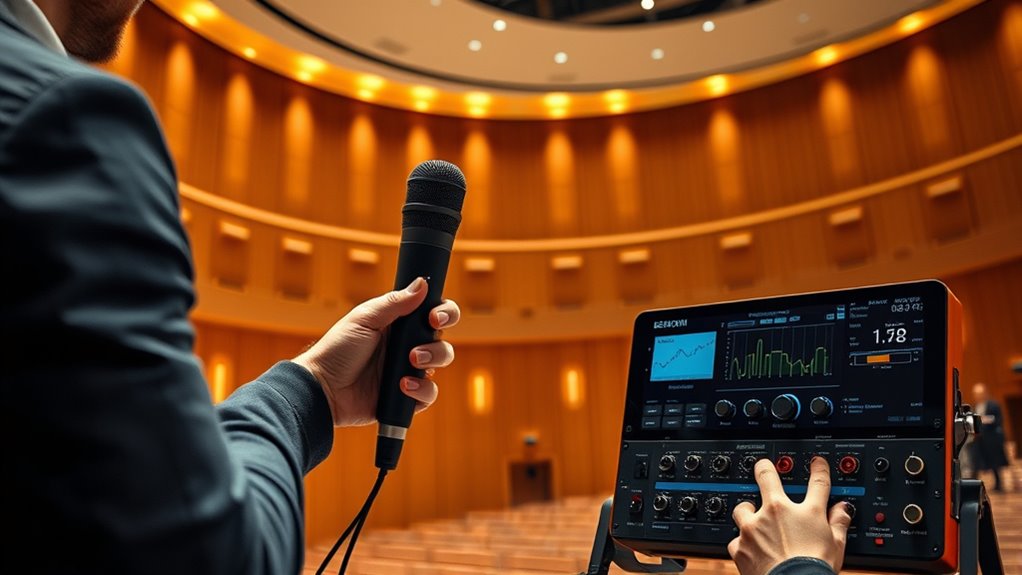
Have you ever wondered how the sound in a room lingers after the source stops? That’s the effect of reverberation, and it’s influenced heavily by the room’s sound absorption and its dimensions. When sound waves bounce off walls, ceilings, and floors, they create a complex web of echoes that determine how long the sound persists. The key to managing this lingering sound lies in understanding how sound absorption works within your space. Different materials absorb sound differently; soft furnishings like carpets, curtains, and acoustic panels can soak up sound waves, reducing reverberation. Conversely, hard surfaces like glass, concrete, or tiles reflect sound, causing longer reverberation times.
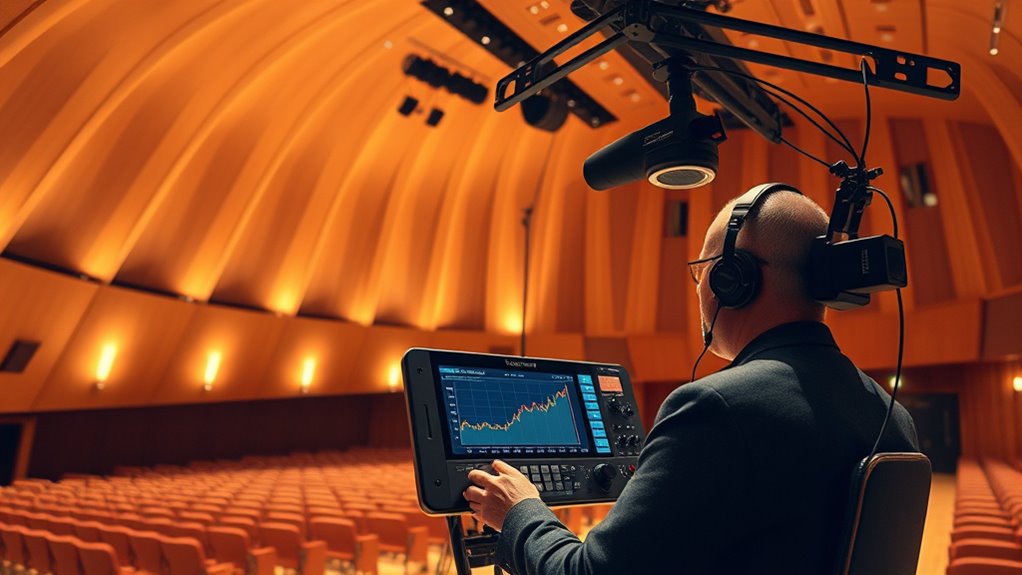
Your room’s dimensions also play an essential role. Larger rooms tend to have longer reverberation times because sound waves travel further before being absorbed or diffused. Narrow, small spaces often have shorter reverberation times, making them sound more intimate and controlled. To measure and control reverberation effectively, you need to evaluate both the room’s size and the materials inside it. For example, if you have a large hall with high ceilings and minimal soft furnishings, the sound will bounce around excessively, creating a muddy or echoey environment. On the other hand, a small, densely furnished room will absorb more sound naturally, resulting in shorter reverberation.
Larger rooms extend reverberation; small, furnished spaces absorb sound naturally for a more controlled environment.
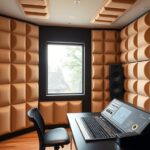
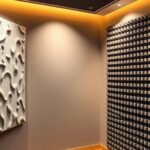
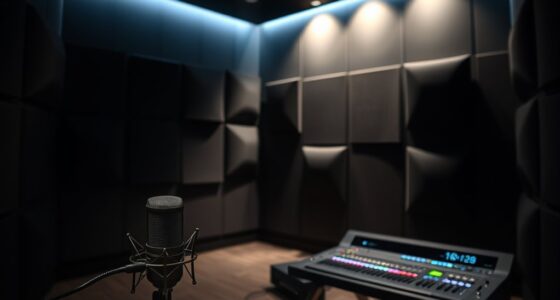
To optimize acoustics, start by analyzing your room dimensions and how they influence sound behavior. If the reverberation is too long, you can introduce strategically placed sound-absorbing materials. Acoustic panels, foam, or even bookshelves filled with books can considerably reduce echo. If your room is too dead, with very little reverberation, adding reflective surfaces or increasing its size can help restore a balanced sound. Calculating reverberation time involves understanding how long it takes for sound to decay by 60 decibels, which directly relates to how your room’s sound absorption and dimensions interact. Additionally, understanding sound reflection can help you better manipulate your space for optimal acoustics.
Adjusting acoustics isn’t just about adding materials; it’s about finding the right balance based on your space. By evaluating sound absorption and room dimensions, you can regulate reverberation time, making your space suitable for speech, music, or recording. Whether you want a lively environment or a quiet sanctuary, understanding these factors empowers you to craft the perfect acoustic setting.
Frequently Asked Questions
How Does Temperature Affect Reverberation Time Calculations?
Temperature effects influence reverberation time because as temperature rises, sound speed increases, causing sound waves to travel faster. This can shorten reverberation time, making spaces sound livelier. Conversely, cooler temperatures slow sound speed, lengthening reverberation time and creating a more muffled environment. When calculating reverberation time, you need to account for temperature effects to guarantee accurate acoustical design, especially in spaces with variable or extreme temperatures.
What Materials Are Best for Acoustic Absorption?
You should choose materials like acoustic panels and soundproof curtains for effective acoustic absorption. Acoustic panels are made from porous materials that trap sound waves, reducing echo and reverberation. Soundproof curtains, often crafted from dense fabrics, absorb sound energy and block noise transmission. Combining these materials helps you create a quieter, more controlled environment, perfect for recording studios, home theaters, or offices where sound clarity is essential.
Can Digital Models Accurately Predict Real-World Acoustics?
Think of digital simulation like a master painter capturing a landscape; it can be impressive but isn’t perfect. Acoustic modeling tools do a good job predicting real-world acoustics, yet they can’t account for every subtle detail. While they provide valuable insights, you should still validate predictions with on-site tests. These models serve as a helpful guide, but real-world acoustics may surprise you.
How Do Room Shape and Size Influence Reverberation?
Room shape and size greatly influence reverberation by affecting sound diffusion and how sound waves reflect. Larger rooms tend to have longer reverberation times, while irregular shapes can diffuse sound more evenly, reducing echoes. Architectural design plays a vital role in optimizing acoustics; by carefully considering room dimensions and shape, you can control reverberation, ensuring clarity and sound quality suited to the space’s purpose.
What Are Cost-Effective Ways to Improve Room Acoustics?
To improve room acoustics cost-effectively, try DIY solutions like adding heavy curtains, rugs, or wall hangings to absorb sound. Budget upgrades such as foam panels or DIY diffusers can also make a difference. Rearranging furniture to break up sound reflections helps. These simple, affordable steps can markedly enhance sound quality without expensive renovations, making your space more acoustically comfortable on a tight budget.
Conclusion
By understanding how to calculate reverberation time and adjust acoustics, you can create spaces that sound just right. Think of it like tuning a musical instrument—you want every note to be clear and harmonious. When you optimize acoustics, you’re shaping the sound environment to feel natural and comfortable. So, take control of your space’s sound, and watch it transform into a place where every word and note resonates perfectly.