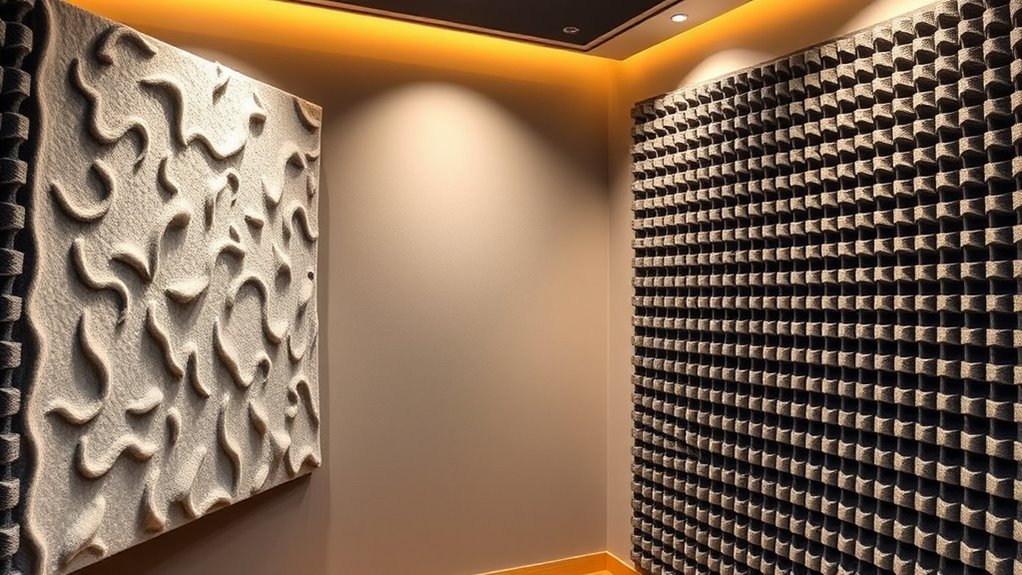
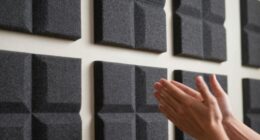
When deciding between diffusers and absorbers, consider your room’s purpose and sound qualities. Use absorbers to reduce harsh reflections, echo, or excessive reverberation, especially in recording studios or home theaters, to create clearer sound. Opt for diffusers when you want to scatter sound evenly, preserve liveliness, and prevent focused echoes in spaces like concert halls. Balancing both can optimize your acoustics—you’ll find several tips if you keep exploring these options.
Use absorbers to reduce harsh reflections and control reverberation in recording studios or home theaters.
Deploy diffusers in larger spaces like concert halls to scatter sound and maintain natural liveliness.
Combine absorbers and diffusers for balanced sound quality, preventing dullness and echo issues.
Choose absorbers on reflective surfaces where controlling echo is critical, and place diffusers where sound distribution is needed.
Avoid overusing absorbers to prevent a dull, lifeless room; use diffusers to preserve spaciousness and clarity.
When it comes to optimizing room acoustics, understanding the difference between diffusers and absorbers is essential. Your goal is to manage sound reflection effectively to create the ideal listening or recording environment. Sound reflection is a key factor in room acoustics, influencing how sound waves bounce around the space. If reflections are overly sharp or chaotic, they can muddy the sound, making it difficult to distinguish details, whether you’re listening to music or recording vocals. Absorbers and diffusers serve different purposes in controlling these reflections, and knowing when to use each will markedly improve your room’s sound quality.
Absorbers work by reducing sound energy, typically by converting it into a small amount of heat. When sound hits an absorber, it diminishes the amount of reflected sound, preventing excessive buildup and echo. You’ll often find absorbers in spaces where controlling reverberation is critical, such as in recording studios or home theaters. They’re especially useful on surfaces where sound tends to bounce directly back, like walls and ceilings. By softening the sound reflection, absorbers help create a more intimate and controlled acoustic environment, allowing for clearer vocals and more accurate sound reproduction. However, overusing absorbers can make a space sound dull or lifeless, so it’s essential to strike a balance. Use them where you need to tame harsh reflections or reduce echo, but don’t rely solely on absorbers for the entire room.
Diffusers, on the other hand, scatter sound waves in multiple directions, preserving the energy while preventing focused echoes. They don’t eliminate sound reflection but instead distribute it evenly across the room. This approach maintains a lively, natural sound without the deadening effect absorbers can produce. Diffusers are ideal in spaces where you want to retain some sense of space and clarity, such as in concert halls or mixing rooms. They help break up strong reflections that can cause comb filtering or flutter echoes, making your room sound more balanced and spacious. Unlike absorbers, diffusers don’t soak up sound—they manage it by dispersing it, which results in a more natural and engaging acoustic environment.
VEWIOR 2 Pack Air Purifiers for Home, Air Purifiers for Bedroom Large Room up to 1200 sq.ft with H13 HEPA Washable Filter, Aromatherapy, PM2.5 Display, Sleep Mode, Auto Mode for Dust, Smoke, Pets Hair
【High Valued & Efficiency Air Purifier】- VEWIOR air purifiers for home feature the 360° air intake technology, providing...
As an affiliate, we earn on qualifying purchases.
Frequently Asked Questions
How Do I Determine if My Room Needs Diffusers or Absorbers?
You determine if your room needs diffusers or absorbers by evaluating its acoustics. If your space has excessive sound reflection causing echo or muddiness, you likely need absorbers to tame the sound. If the room feels dull and lacks lively sound, diffusers can help distribute sound evenly. Use a sound level meter or listen carefully to identify problem areas, then choose the treatment that balances your room’s acoustics effectively.
Can Diffusers and Absorbers Be Used Together Effectively?
Yes, diffusers and absorbers can be used together effectively for room acoustic treatment. Combining them enhances sound reflection management, creating a balanced acoustic environment. Absorbers reduce unwanted echoes, while diffusers scatter sound evenly, improving clarity. This approach prevents dead spots and excessive reverberation. So, if you want ideal sound quality, don’t hesitate to mix diffusers and absorbers, as they complement each other perfectly for better room acoustics.
Are There Specific Materials Best Suited for Diffusers or Absorbers?
You should choose materials based on their acoustic properties and suitability for your needs. For diffusers, materials like wood, plastic, or foam with irregular surfaces work best, as they scatter sound effectively. Absorbers benefit from porous materials such as mineral wool, fiberglass, or foam panels that absorb sound waves. Selecting the right materials guarantees peak sound quality, whether you want to diffuse or absorb sound in your space.
How Does Room Size Influence the Choice Between Diffusers and Absorbers?
Your room size can feel like an ocean of sound, so choosing the right acoustic treatments is essential. For large spaces with vast dimensions, diffusers help scatter sound waves evenly, preventing echo islands. In smaller rooms, absorbers are your best allies, soaking up excess reflections. Match your room dimensions to these treatments for maximum sound quality. When in doubt, use a mix to create a balanced acoustic environment.
What Are the Cost Differences Between Installing Diffusers and Absorbers?
The cost comparison shows that absorbers generally have lower installation expenses than diffusers. Absorbers are simpler to install, making them budget-friendly for most spaces. Diffusers, with more complex designs and materials, tend to be pricier. If you’re planning your acoustic setup, consider your budget and needs—absorbers are a cost-effective choice for reducing echo, while diffusers might require a bigger investment for improving sound diffusion.
Air Purifiers for Home Bedroom, AromaRoom H13 HEPA Air Purifier Filter for Allergies, Pollen, Smoke, Dusts, Pets Dander, Odor, Hair, 22dB Quiet Air Cleaner for Room, Office, Dorm, AP100-B (Black)
EFFICIENT PURIFICATION: With brushless motor and 360-degree air intake design, Aroma Room air purifier can purify air twice...
As an affiliate, we earn on qualifying purchases.
Conclusion
When choosing between diffusers and absorbers, remember that diffusers are like storytellers, scattering sound to create a lively, natural space. Absorbers, on the other hand, are like silence keepers, reducing unwanted echoes and noise. Knowing when to use each helps you craft the perfect acoustic environment, much like a painter selecting the right brush for their masterpiece. By understanding their roles, you’ll design spaces that sound just right—clear, balanced, and inviting.
Air Purifiers for Home Large Room, Cover Up to 2400 Ft² with True HEPA Filter, Smart Mode, PM2.5 Air Quality Display, 22dB Sleep Mode, Aromatherapy with 2X-Purification & 360°Air Outlet, HAP603
【𝟐𝐗 𝐏𝐨𝐰𝐞𝐫 𝐅𝐢𝐥𝐭𝐫𝐚𝐭𝐢𝐨𝐧 𝐟𝐨𝐫 𝐋𝐚𝐫𝐠𝐞 𝐑𝐨𝐨𝐦𝐬】 The 2X-Power Filtration system purifies the air twice per hour for large...
As an affiliate, we earn on qualifying purchases.
Air Purifier for Home Up to 3500 Ft², Smart App Control, Air Quality PM2.5 Display, Ultra-Quiet Sleep Mode, Auto Mode, HEPA Air Purifier for Large Room
Air Purifier for Home Up to 3500 Ft², Smart App Control, Air Quality PM2.5 Display, Ultra-Quiet Sleep Mode,...
Ceiling treatment ideas for balanced sound combine stylish design with acoustic effectiveness—discover how to transform your space into a perfect harmony.
Acoustic Treatments for Small Rooms: Maximizing Performance
Optimize your small room’s sound with strategic acoustic treatments—discover how to reduce reflections and enhance clarity for the best listening experience.