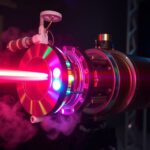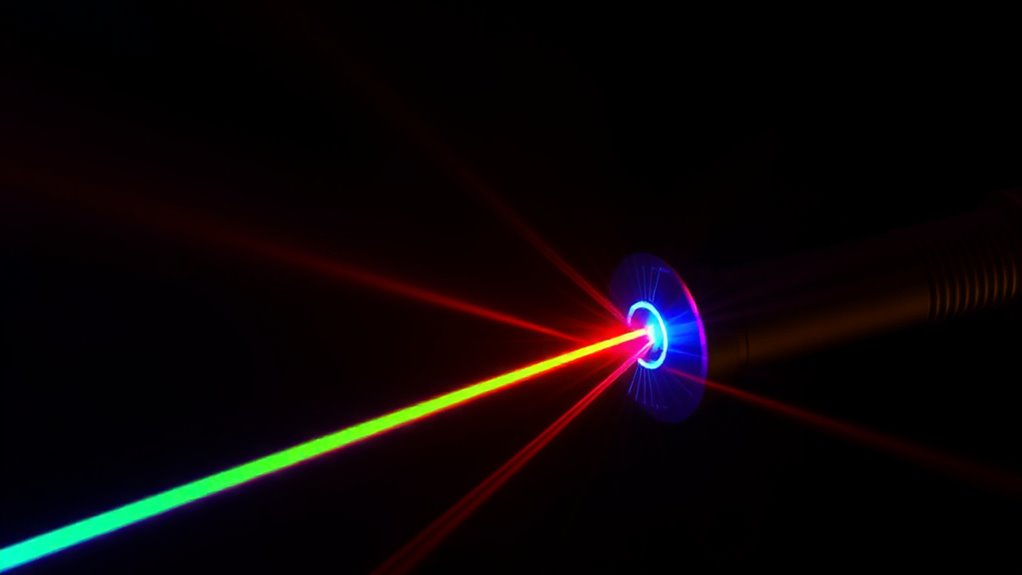

Laser light sources work by exciting atoms or molecules to higher energy states, where they emit photons that become synchronized through quantum coherence. This phase alignment produces a highly focused, monochromatic, and intense beam. Environmental factors like temperature and vibrations can disrupt this coherence, so controlled conditions are essential. Nonlinear effects at high intensities can also generate new frequencies, expanding laser capabilities. To understand how all these pieces come together for powerful, precise beams, keep exploring the science behind laser light sources.
Key Takeaways
- Laser light is produced through stimulated emission, where excited atoms emit photons in phase, creating coherent and monochromatic light.
- Quantum coherence ensures the phase relationship among photons, enabling the laser beam’s high focus and intensity.
- Environmental control is vital to prevent decoherence caused by thermal vibrations and external disturbances.
- Nonlinear effects in laser media, such as frequency doubling, allow generation of new wavelengths and ultrashort pulses.
- The combination of quantum coherence and nonlinear interactions underpins laser applications in industry, medicine, and communications.

Have you ever wondered how laser light sources work and what makes them so unique? At the core of a laser’s operation lies the fascinating interplay of quantum coherence. Unlike regular light, which emits photons randomly in all directions and phases, laser light is highly organized. The atoms or molecules within the laser medium are excited to higher energy states, and through a process called stimulated emission, they release photons that are in phase with each other. This phase alignment—quantum coherence—is what produces the coherent, monochromatic beam you see. It’s this precise phase relationship that allows laser light to be focused into an incredibly narrow, intense beam, unlike ordinary light sources that disperse energy in all directions. Achieving and maintaining this quantum coherence is critical; it requires a carefully controlled environment to prevent decoherence caused by thermal vibrations or external disturbances. Controlling environmental factors is essential for maintaining laser stability and performance.
But the story doesn’t end there. Nonlinear effects also play a crucial role in the science of laser light sources. These effects occur when the intensity of the laser beam is so high that the response of the medium becomes non-linear, meaning the material’s properties change with the light’s intensity. For example, in nonlinear optical materials, intense laser pulses can generate new frequencies of light through processes such as second-harmonic generation or four-wave mixing. These phenomena enable the production of wavelengths that wouldn’t be accessible with conventional sources, expanding the versatility of laser technology. Nonlinear effects are harnessed in various applications, from generating ultraviolet light for high-precision measurements to creating ultrashort pulses used in medical and scientific research. They also influence the stability and coherence of the laser beam, sometimes requiring sophisticated techniques to manage or exploit these effects for desired outcomes.
Understanding how quantum coherence and nonlinear effects work together helps you grasp why lasers are so powerful and versatile. The coherent emission ensures the beam remains intense and focused, while nonlinear interactions allow for the manipulation of light in ways that are impossible with traditional sources. By controlling these phenomena, engineers and scientists can tailor laser outputs for specific tasks—whether cutting through metal, performing delicate eye surgeries, or transmitting data across vast distances. Ultimately, these principles underpin the remarkable precision, efficiency, and adaptability of laser light sources, making them indispensable tools across countless fields. So next time you see a laser beam, remember that its brilliance is rooted in the complex yet elegant dance of quantum coherence and nonlinear effects at the microscopic level.

Epson Home Cinema 980 3-Chip 3LCD 1080p Projector 4,000 Lumens Color and White Brightness, Streaming/Gaming/ Media Room, Built-In Speaker, Auto Picture Skew, 16000:1 Contrast, 2 HDMI Ports
Exceptional Picture Quality — Provides stunning, detailed 1080p images and fast data processing that’s optimized for fast-action sports,...
As an affiliate, we earn on qualifying purchases.
Frequently Asked Questions
How Do Laser Light Sources Differ From Traditional Light Bulbs?
Laser light sources differ from traditional light bulbs because they produce highly focused, coherent light through mechanisms like dye lasers or solid-state lasers. Unlike bulbs that emit random, scattered light, lasers amplify light in a narrow beam. You’ll notice laser sources have a precise wavelength, making them ideal for applications requiring accuracy, such as medical procedures or cutting tools. This focused, intense beam sets them apart from everyday incandescent or LED bulbs.
What Materials Are Commonly Used to Generate Laser Light?
They say, “You are what you use,” and that’s true for laser materials. You’ll find doped crystals, like ruby or Nd:YAG, commonly used to generate laser light through stimulated emission. Semiconductor diodes are also popular, especially in compact devices, as they efficiently convert electrical energy into laser beams. Both materials are crucial, each suited for different applications, making laser technology versatile and powerful in various fields.
Are Laser Light Sources Safe for Everyday Consumer Use?
Laser light sources are generally safe for everyday consumer use when they meet regulatory standards. However, you should be aware of health concerns like eye injuries from direct exposure. Always follow safety guidelines, avoid staring directly into laser beams, and use products with proper safety features. Manufacturers design these devices to minimize risks, but staying informed and cautious guarantees safe, enjoyable use of laser products in your daily life.
How Does Coherence Impact the Functionality of Laser Light?
Think of coherence as the harmony in a choir, where every voice aligns perfectly. It guarantees your laser’s phase stability, maintaining consistent timing and wave relationship. This directly impacts beam quality, making the laser’s light sharp, focused, and precise. When coherence is high, your laser functions flawlessly, delivering powerful, uniform beams. Without it, the light becomes scattered and less effective, like a choir out of tune, losing clarity and purpose.
What Are the Environmental Effects of Laser Light Sources?
You should be aware that laser light sources can contribute to environmental effects like laser pollution, especially if used improperly or in excess. They also consume significant energy, leading to increased energy consumption and carbon footprint. When used responsibly with proper shielding and energy-efficient practices, you can reduce laser pollution and minimize environmental impact, helping protect ecosystems while benefiting from their precise and powerful illumination capabilities.
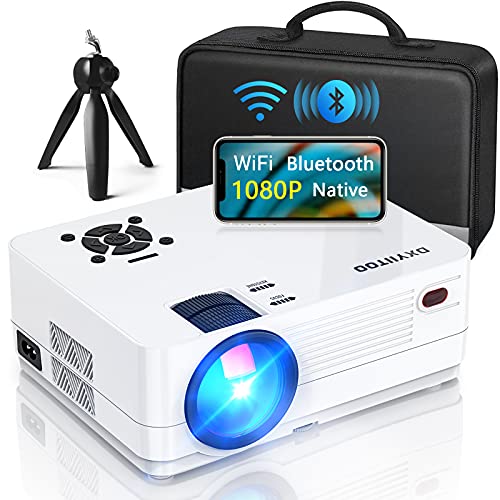
Native 1080P Projector with WiFi and Two-Way Bluetooth, Full HD Movie Projector for Outdoor Movies, 300" Display Projector 4k Home Theater, Compatible with iOS/Android/PC/XBox/PS4/TV Stick/HDMI/USB
【WiFi & Airplay & Screen Mirroring】Dxyiitoo WiFi projector supports the "Airplay" function and "Screen Mirroring" function when connected...
As an affiliate, we earn on qualifying purchases.
Conclusion
Now that you understand how laser light sources work, you see their power in precision, their beauty in brightness, and their potential in innovation. You can imagine the focused beam cutting through darkness, the vibrant glow illuminating new horizons, and the endless possibilities they bring to science and technology. With every laser, you witness the harmony of energy, coherence, and control—uniting to shape the future in a single, brilliant beam.
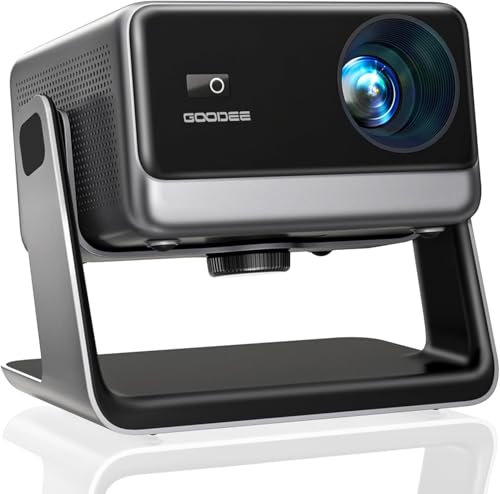
GooDee Video Projector With Wifi And Bluetooth, Smart Portable Projector Movie System Compatible With Netflix/Dolby Audio/Auto Focus & Keystone, 4k Video Decode & 1080p Native For Home Theater/Outdoor
「Smart TV Projector」The Goodee AC321 4K projector is officially licensed by mainstream streaming platforms such as Netflix/YouTube/Prime Video,...
As an affiliate, we earn on qualifying purchases.
![Projector with WiFi and Bluetooth, [Native 1080P Upgrade 240 ANSI] KSAN Portable Projector, Mini Movie Projector for Outdoor Use, Bedroom Ceiling Video Projector Compatible with Phone/TV Stick/PC/PS5](https://m.media-amazon.com/images/I/510G0dnRAtL._SL500_.jpg)
Projector with WiFi and Bluetooth, [Native 1080P Upgrade 240 ANSI] KSAN Portable Projector, Mini Movie Projector for Outdoor Use, Bedroom Ceiling Video Projector Compatible with Phone/TV Stick/PC/PS5
【True Native 1080P Projector】Enjoy crystal-clear visuals with Native 1080P resolution, 240ASNI Lumen brightness and 2000:1 contrast ratio. The...
As an affiliate, we earn on qualifying purchases.