

Before choosing between laser and lamp light sources, consider your needs for spectral purity, maintenance, and longevity. Lasers offer precise, monochromatic light with lower ongoing upkeep and longer lifespan, making them ideal for high-precision tasks and harsh environments. Lamps, meanwhile, are generally cheaper upfront but require frequent replacements and cleaning. Safety features and application environment also matter. To make an informed decision, explore the detailed factors that can influence your choice and what best fits your project.
Key Takeaways
- Assess the spectral purity required for your application to determine if laser or lamp sources are suitable.
- Consider maintenance needs, including replacement frequency and cleaning, for each light source type.
- Evaluate operational longevity and energy efficiency to estimate long-term costs and system reliability.
- Ensure safety protocols are in place, especially for laser systems with sophisticated security features.
- Match the environment and application demands to select the most robust and cost-effective light source option.
![Outdoor-Projector-4K with WiFi and Bluetooth:[3500 Bright/60W Dolby Audio/Official Licensed Apps],Smart-Projector with AI Auto Focus,ONOAYO ONO5Pro 2.0 Movie Projector for Indoor/Outdoor 2026New](https://m.media-amazon.com/images/I/41fylkjOTIL._SL500_.jpg)
Outdoor-Projector-4K with WiFi and Bluetooth:[3500 Bright/60W Dolby Audio/Official Licensed Apps],Smart-Projector with AI Auto Focus,ONOAYO ONO5Pro 2.0 Movie Projector for Indoor/Outdoor 2026New
[Hear the Difference–Hollywood-Grade Dual 60W Dolby Audio] Why spend more on a TV + soundbar or settle for...
As an affiliate, we earn on qualifying purchases.
Key Factors in Choosing Laser or Lamp Light Sources

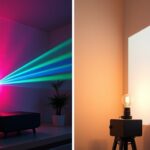
When choosing a light source for your applications, understanding the differences between laser and lamp systems is vital. One key factor to analyze is spectral purity. Lasers produce highly monochromatic light, meaning they emit light at a specific wavelength with minimal spectral bandwidth. This spectral purity guarantees precise targeting, ideal contrast, and consistent performance, which is essential in applications like medical procedures, scientific research, or high-precision manufacturing. In contrast, lamp systems generally emit broad-spectrum light, which contains multiple wavelengths. This can lead to less spectral purity, making lamps less suitable for tasks requiring exact wavelength control or high spectral resolution. If your application demands pinpoint accuracy and consistent spectral output, lasers are often the better choice.
Lasers offer superior spectral purity for precise, consistent, and high-resolution applications compared to broad-spectrum lamps.
Another vital aspect to evaluate is maintenance requirements. Laser systems tend to have lower ongoing maintenance because they have fewer moving parts and generally produce less debris or contamination. However, they do require periodic calibration and careful handling to maintain their spectral purity and output stability. Lamps, on the other hand, usually have higher maintenance needs. They often require regular bulb replacements due to filament burnout or degradation over time. Additionally, lamp systems may need frequent cleaning of optical components to remove dust, soot, or other residues that can diminish light quality. The overall maintenance effort for lamps can be more intensive and costly over the long term, especially in high-duty-cycle environments. Modern laser technology has also improved their durability and operational efficiency, making them more reliable for continuous use. Additionally, advancements in spectral control have enhanced laser precision, further supporting their suitability for demanding applications.
Furthermore, advancements in AI security have led to more sophisticated safety measures for laser systems, helping to prevent accidents and ensure consistent operation. Proper safety protocols are essential when working with laser sources to protect operators from potential hazards. When weighing these factors, consider the longevity and reliability of each light source. Lasers, with their focused output and consistent spectral characteristics, tend to offer longer operational lifespans with proper maintenance. They are also more energy-efficient, which can translate into lower operational costs over time. Conversely, lamps might initially seem more straightforward and less expensive to set up but can incur higher costs due to frequent replacements and cleaning. Also, think about the environment in which the light source will operate. In dusty or harsh conditions, the robustness of laser systems might prove advantageous, while lamps could need more frequent attention to sustain their performance.
Ultimately, your choice hinges on your application’s specific needs. If spectral purity, precise control, and lower maintenance are priorities, lasers are likely the better fit. If budget constraints or simpler setup are more important, and broad-spectrum light suffices, lamps could be suitable. Weighing these factors carefully guarantees you select a light source that aligns with your technical requirements and long-term operational goals.

【Now with Netflix & 3000ANSI】Smart 4K Projector with WiFi and Bluetooth, VISSPL 3D Dolby Audio and Auto Focus Portable Outdoor Projector, Movie Home Theater Projectors for Bedroom/Ceiling
[ Netflix Ready - No Extra Devices Needed ] – VISSPL Smart Projector: No TV stick, no casting,...
As an affiliate, we earn on qualifying purchases.
Frequently Asked Questions
How Long Do Laser and Lamp Light Sources Typically Last?
Laser light sources typically last around 10,000 to 20,000 hours, offering a longer lifespan compared to lamp light sources, which usually need replacement every 2,000 to 4,000 hours. When considering lifespan comparison, lasers require less frequent replacements, reducing downtime and maintenance costs. You should monitor your device’s usage and follow recommended replacement intervals to guarantee peak performance and avoid unexpected failures.
Are Laser Light Sources More Energy-Efficient Than Lamps?
Sure, laser light sources are more energy-efficient than lamps—it’s like comparing a sleek sports car to a gas-guzzling SUV. They consume less energy, which boosts sustainability and reduces operating costs. So, if you’re aiming to cut down energy consumption and be eco-friendly, lasers are your best bet. Plus, they last longer, making them a smarter, more sustainable choice that saves you money and planet Earth’s resources.
What Maintenance Is Required for Each Type of Light Source?
You need to follow specific maintenance routines for each light source. For laser sources, regularly clean the optics and check alignment to guarantee peak performance. Replacement intervals vary but generally occur after several thousand hours of use. For lamp-based systems, perform routine cleaning of filters and reflectors, and replace lamps typically every 1,000 to 2,000 hours. Consistent maintenance keeps both types functioning efficiently and extends their lifespan.
Can Existing Projectors Be Upgraded From Lamps to Lasers?
Upgrading your projector from lamps to lasers is like turning a classic car into a sleek, modern vehicle—you need to check projector compatibility first. Not all projectors support laser upgrade procedures, so review manufacturer guidelines and consult professionals. If compatible, you’ll replace the lamp module with a laser module, often involving internal adjustments. This upgrade boosts brightness, lifespan, and image quality, making your projector a more powerful, future-proof tool.
How Do Cost and Availability Compare Between Lasers and Lamps?
You’ll find that laser projectors generally have a higher cost comparison upfront, but they tend to offer longer-lasting performance and lower maintenance costs over time. Availability factors can influence your choice too; lamps are widely available and cheaper initially, making them more accessible for immediate needs. However, lasers are becoming more common, and their improved availability could balance out the higher initial investment in the near future.
![[Built-in Apps/4K Support] Smart Outdoor Projector with WiFi and Bluetooth, Movie Projector, DoIby Audio with Dual Speaker, Auto Focus w/ YouTube&PrimeVideo Proyector, Upgrad P62 Pro](https://m.media-amazon.com/images/I/51yAGv8VI7L._SL500_.jpg)
[Built-in Apps/4K Support] Smart Outdoor Projector with WiFi and Bluetooth, Movie Projector, DoIby Audio with Dual Speaker, Auto Focus w/ YouTube&PrimeVideo Proyector, Upgrad P62 Pro
[Upgraded Classic – P62 Pro Movie Projector] Building on the reliability and low return rate of the classic...
As an affiliate, we earn on qualifying purchases.
Conclusion
In the end, choosing between laser and lamp light sources feels like a lucky coincidence—you stumble upon the perfect match just when you need it most. Whether it’s precision or brightness guiding your decision, trusting your instincts and understanding your project’s needs will lead you there. Sometimes, the best choice isn’t planned; it’s the one you unexpectedly discover along the way. So, stay curious and open—you might just find the ideal light source when you least expect it.

Aurzen Roku TV Smart Projector with Wifi and Bluetooth, Roku TV Built-in, 1080P FHD, DoIby Audio, Auto Focus & Keystone, Zoom, Movie Portable Outdoor Mini Projector for Soccer Football Game, White
A Roku account and internet connection are required for activation (Creating an account is free). Note: Power Supply:...
As an affiliate, we earn on qualifying purchases.










![[Invitation] Galaxy Unpacked July 2026: A New Shape Unfolds](https://1hometheatreprojector.com/wp-content/uploads/2026/07/invitation-galaxy-unpacked-july-2026-a-new-shape-unfolds-featured-260x140.jpg)