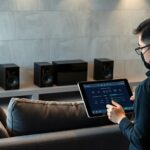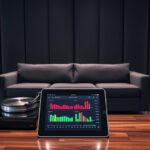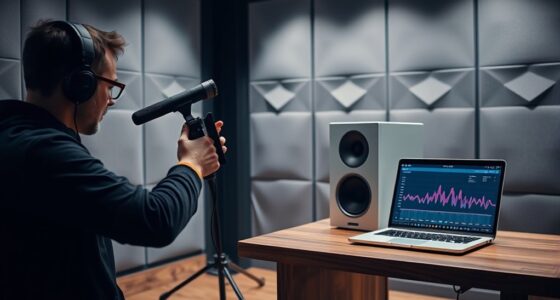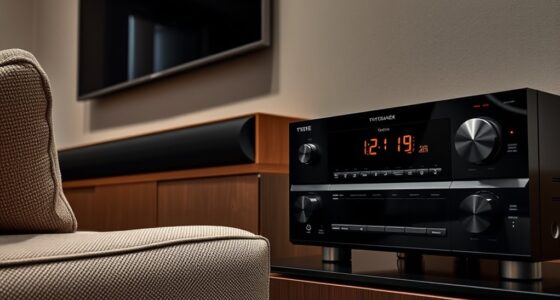
Audio calibration apps and tools help you optimize your sound setup by guiding you through speaker placement, analyzing room acoustics, and applying custom EQ adjustments. They use your smartphone microphone or specialized equipment to measure how sound interacts within your space. These tools simplify complex calibration tasks, saving you time while markedly improving clarity, balance, and imaging. Keep exploring how these solutions can transform your listening environment into a truly immersive experience.
Key Takeaways
- Calibration apps use microphone measurements to analyze room acoustics and optimize speaker placement and EQ settings.
- They provide step-by-step guidance for accurate calibration, enhancing sound clarity and balance.
- Virtual room simulations and placement suggestions help experiment without physical adjustments.
- Advanced algorithms apply room correction filters for precise sound optimization.
- Using calibration tools improves overall audio quality by accounting for room and speaker variables.

In today’s world of high-quality audio, guaranteeing your sound system is properly calibrated can make a significant difference in listening experience. One of the biggest factors affecting sound quality is room acoustics. Every room has its unique characteristics—size, shape, furnishings—that influence how sound waves travel and reflect. Without considering these factors, even the best speakers can produce muddled or uneven sound. That’s where calibration tools come into play, helping you optimize your setup by accounting for your room’s acoustics.
Proper calibration enhances sound quality by accounting for room acoustics and speaker placement.
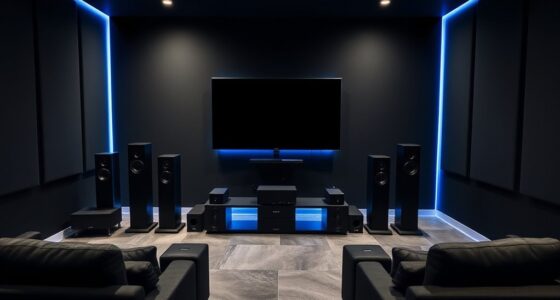
Speaker placement is equally vital. Proper positioning of your speakers ensures that sound reaches your ears with the intended balance and clarity. If your speakers are too close to walls or corners, they might cause exaggerated bass or unwanted reflections. Conversely, placing them too far apart or at incorrect heights can create gaps in soundstage and imaging. Many audio calibration apps and tools guide you through the process of finding the ideal speaker positions based on your room layout. They help you identify the best locations to minimize reflections and maximize sound coherence, giving you a more immersive listening experience.
Using these apps is straightforward. You typically start by running a calibration test that measures how sound interacts with your room. Some apps utilize your smartphone microphone, while others connect directly to your audio system with specialized equipment. As the app plays test tones, it records how sound reflects and resonates within your space. It then analyzes the data to suggest adjustments—such as repositioning speakers, adding acoustic treatments, or tweaking equalizer settings. This process guarantees your audio system compensates for room imperfections, providing a more balanced and accurate sound.
Many calibration tools also allow you to fine-tune speaker placement virtually. You can experiment with different positions and orientations without physically moving your gear, saving time and effort. Once the ideal setup is identified, the app often provides equalization curves or room correction filters to apply. These filters equalize frequency response and reduce problematic resonances, enhancing clarity and tonal accuracy.
In essence, leveraging these apps simplifies what can otherwise be a complex and technical task. They empower you to make informed decisions about speaker placement and room treatment, transforming your space into a listening environment that truly reflects your audio source’s quality. With proper calibration, you’ll notice richer bass, clearer vocals, and a more precise stereo image. Additionally, modern calibration techniques utilize advanced algorithms to optimize sound quality even further. In the end, it’s about making your listening experience as satisfying as possible—turning your room into a custom acoustic environment where every note and detail shines through.

Klipsch R-12SW Powerful Deep Bass Front Firing 12" Copper-Spun Driver 400W Digital Power Subwoofer 14" X 18.5" X 16"
Powerful 12" copper-spun front-firing woofer
As an affiliate, we earn on qualifying purchases.
Frequently Asked Questions
Can Calibration Apps Improve Sound Quality for All Headphone Types?
Calibration apps can improve sound quality for most headphone types by enhancing headphone consistency and enabling sound personalization. They adjust audio output to match your ear’s unique profile, ensuring a more balanced and immersive experience. While they work well with many headphones, some models may still have limitations. Overall, these apps help optimize your listening environment, but results vary depending on your headphones’ quality and compatibility.
Are There Free Calibration Tools Available for Professional Audio Engineers?
Yes, there are free calibration tools available for professional audio engineers. You can find software like REW (Room EQ Wizard) and ARTA that offer robust features without cost. These tools help you accurately calibrate your sound system, ensuring high-quality audio production. By using free tools, you save money while maintaining professional standards, making them an excellent choice for audio engineers looking to optimize their setups without investing in expensive software.
How Often Should I Recalibrate My Audio Setup Using These Apps?
You should recalibrate your audio setup every few months or whenever you notice changes in sound quality. Regular maintenance frequency guarantees your user experience remains consistent, avoiding unexpected issues. If you move your equipment or modify your setup, recalibrate sooner. Staying on top of calibration helps maintain ideal sound, preventing subtle issues from escalating into bigger problems. Trust your ears and these tools to keep your audio precise and professional.
Do Calibration Apps Work With Both Mac and Windows Operating Systems?
Yes, calibration apps work with both Mac and Windows operating systems thanks to their cross-platform compatibility. You just need to make certain your hardware requirements are met, such as a compatible microphone and audio interface. Most apps support multiple OS versions, making it easy to calibrate your setup regardless of your system. Just check the app specifications beforehand to confirm compatibility and hardware needs for a smooth calibration process.
Can Calibration Apps Correct for Room Acoustics and Speaker Placement?
Did you know that poor room acoustics can reduce audio clarity by up to 50%? Calibration apps can help, but they mainly optimize speaker output levels and frequency response. They don’t fully correct for room acoustics or speaker placement issues. To improve sound quality, you still need to address room setup, like speaker positioning and acoustic treatments, for the best listening experience.

Klipsch R-120SW Subwoofer, Black
12" high excursion spun-copper Imp woofer
As an affiliate, we earn on qualifying purchases.
Conclusion
Using audio calibration apps and tools can substantially improve your listening experience by ensuring accurate sound reproduction. Did you know that the global audio calibration market is projected to grow at a compound annual growth rate of 8.3% through 2027? This shows how essential these tools are becoming for both casual listeners and professionals. By investing in the right calibration app, you can enjoy clearer, more balanced sound, elevating your audio experience to the next level.

2000 ANSI 4K Decoding Projector with WiFi and Bluetooth, HAPPRUN Movie Home Theater with Auto Focus, 300'' Display for Indoor/Outdoor, Smart Proyector Compatible with Phone/TV Stick/PC/PS5
[EASIER OPERATION: AI Smart Screen Adjustment] HAPPRUN projector comes with auto focus and 6D auto-keystone technology, enjoy a...
As an affiliate, we earn on qualifying purchases.

Epson Home Cinema 980 3-Chip 3LCD 1080p Projector 4,000 Lumens Color and White Brightness, Streaming/Gaming/ Media Room, Built-In Speaker, Auto Picture Skew, 16000:1 Contrast, 2 HDMI Ports
Exceptional Picture Quality — Provides stunning, detailed 1080p images and fast data processing that’s optimized for fast-action sports,...
As an affiliate, we earn on qualifying purchases.