
Understanding crossover frequencies means knowing how your audio system splits sound signals among speakers to create clear, balanced audio. These settings decide which frequencies each speaker handles, ensuring everything sounds natural without gaps or overlaps. Properly setting the crossovers prevents damage and improves sound quality. If you want to learn how to set these frequencies correctly and optimize your system, you’ll find the details that can make a real difference.
Key Takeaways
- Crossover frequencies divide audio signals into specific ranges for different speakers to improve clarity.
- Proper crossover points prevent gaps or overlaps, ensuring seamless sound transition between drivers.
- Selecting suitable crossover frequencies matches speaker capabilities and enhances overall system performance.
- Correct crossover settings protect speakers from damage and reduce distortion by operating within optimal ranges.
- Understanding crossover frequencies helps optimize phase alignment and achieve a natural, balanced sound.

Have you ever wondered how audio systems seamlessly blend different speakers to produce a balanced sound? The secret lies in understanding crossover frequencies. These are specific points where an audio signal is divided so that various speakers handle only the frequencies they’re best equipped to reproduce. When you set up a multi-speaker system, guaranteeing proper crossover frequencies is essential for clarity and coherence. If the crossover points aren’t correctly chosen, you might notice sound gaps or overlapping that muddles the audio experience.
One essential factor to consider is phase alignment. When speakers aren’t properly aligned in phase, their sound waves can cancel each other out or reinforce unpredictably, leading to a hollow or boomy sound. Correct phase alignment ensures that all speakers work together harmoniously, producing a unified sound image. This involves adjusting the timing of signals so that the wave peaks and troughs match across all drivers. When you achieve good phase alignment, the result is a more precise and natural sound, with no unwanted dips or peaks that can distort the listening experience.
Proper phase alignment ensures harmonious sound and natural clarity across all speakers.
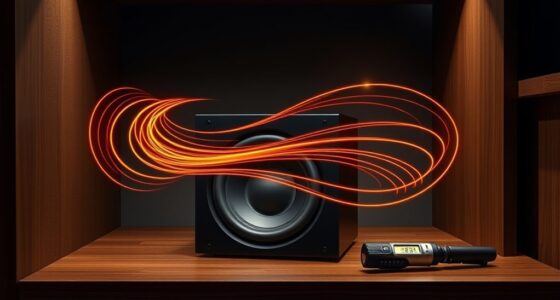
Speaker compatibility also plays a key role in crossover frequency effectiveness. Not all speakers respond the same way to specific frequencies, so matching the right speakers with the correct crossover points is important. For instance, a subwoofer is designed to handle low frequencies, while tweeters focus on high-frequency sounds. If you set a crossover frequency too high or too low for a particular speaker, it can strain the driver or cause distortion. Proper compatibility means selecting speakers that can comfortably handle the assigned frequency range, minimizing stress and maximizing performance.
When configuring your system, pay close attention to both the crossover frequency and the speaker’s capabilities. Many modern audio systems and amplifiers have built-in options to adjust these settings, but understanding the principles behind them helps you make better choices. For example, setting the crossover too high might cause the woofer to struggle with midrange sounds, while setting it too low could leave a gap in your sound spectrum. Properly matching the crossover frequency with speaker capabilities, along with guaranteeing phase alignment, results in a more seamless and immersive listening experience.
In addition, understanding the crossover frequencies helps prevent damage to your speakers by ensuring they operate within their optimal range. In essence, mastering crossover frequencies means you’re taking control of how your system divides sound. By focusing on phase alignment and speaker compatibility, you guarantee that each component contributes to a cohesive, balanced sound. This not only enhances clarity but also prolongs the life of your equipment by preventing undue stress on individual drivers. When you get these elements right, your audio system becomes a finely tuned instrument that delivers pure, accurate sound every time.
Frequently Asked Questions
How Do Crossover Frequencies Affect Soundstage and Imaging?
Crossover frequencies directly impact your soundstage and imaging by shaping how well different drivers blend their timbre. When set correctly, they guarantee smooth timbre blending, creating a more cohesive and realistic stereo imaging. If too high or low, they can cause gaps or overlaps, muddling the soundstage and making it harder to pinpoint instruments. Proper crossover settings enhance clarity, depth, and precise stereo imaging, giving you a richer listening experience.
Can Improper Crossover Settings Damage Speakers or Amplifiers?
Did you know that improper crossover settings can cause about 15% of speaker damage cases? When you set crossover frequencies incorrectly, you risk stressing your speakers and amplifier, potentially leading to damage. Poorly configured crossovers can push components beyond their safe limits, compromising amplifier safety and causing speaker damage. Always guarantee your crossover settings are precise to protect your gear and maintain ideal sound quality.
What Are the Differences Between Passive and Active Crossover Frequencies?
Passive crossovers use filters built into speakers, splitting frequencies after amplification, which can affect your system’s frequency response and signal processing. Active crossovers, however, divide frequencies before amplification, allowing more precise control and better signal clarity. The main difference lies in their placement and flexibility, impacting how accurately the crossover manages frequency response and signal processing for each speaker, ultimately influencing sound quality.
How Do Room Acoustics Influence Optimal Crossover Frequency Choices?
Did you know that room resonance can boost certain frequencies by up to 10 dB? Room acoustics heavily influence your crossover frequency choices. Poor speaker placement worsens resonance issues, causing uneven sound distribution. To optimize, position your speakers to minimize room resonance, which often involves angling them or adding acoustic treatments. Adjust your crossover frequency to compensate for room effects, ensuring a balanced sound and clearer bass, even in challenging spaces.
Are There Industry Standards for Crossover Frequencies Across Different Audio Setups?
Yes, industry standards for crossover frequencies exist, but they vary depending on your audio setup. You should focus on proper speaker calibration and achieving a smooth frequency response across your system. Typically, for home theaters, the low-pass filter for subwoofers is set around 80Hz, while in professional setups, it might differ. Adjust these settings based on your speakers’ capabilities and room acoustics to optimize sound quality.
Conclusion
Now that you understand crossover frequencies, think of them as the traffic cops guiding your audio signals smoothly from one speaker to another. When you set these frequencies correctly, your soundstage opens up like a vibrant canvas, filled with clarity and depth. Remember, mastering crossover points is like tuning a fine instrument—small adjustments can create harmony in your audio world. Keep experimenting, and your system will sing with the perfect balance of sound.