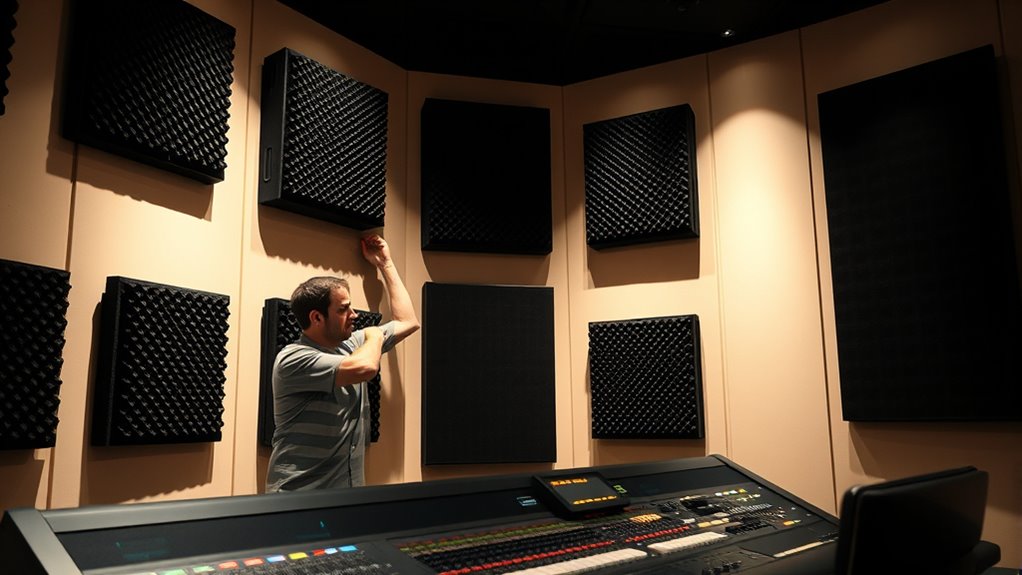
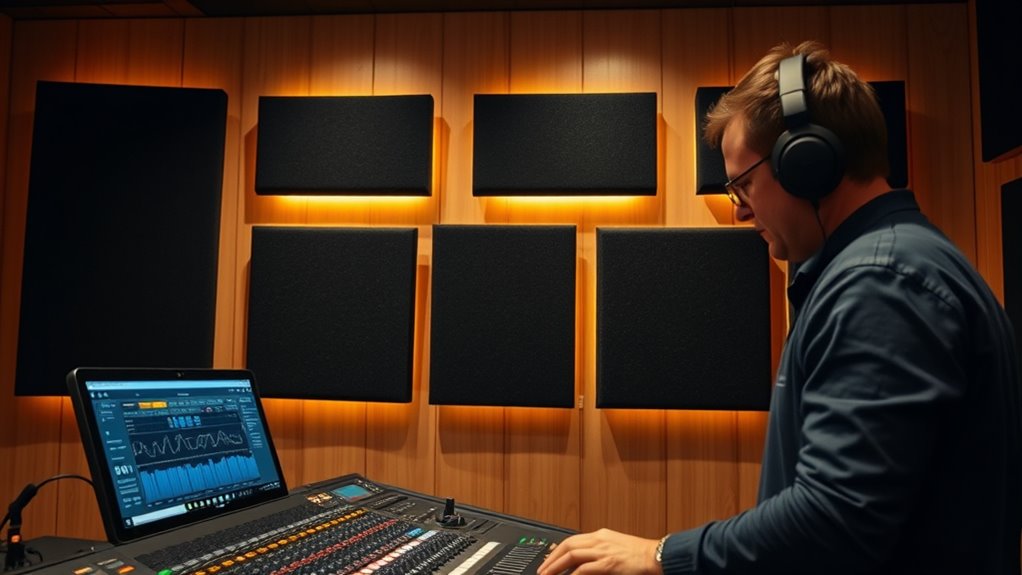
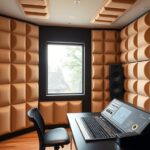
To dial in your bass traps and acoustic panels effectively, start by identifying problem areas using measurement tools and ears, focusing on reflections, corners, and low-frequency buildup. Place panels at first reflection points and bass traps in key corners. Continuously measure and adjust your setup to optimize sound clarity and balance. Fine-tuning this process can dramatically improve your room’s acoustics, so keep exploring these techniques to create a professional-grade listening environment.
Key Takeaways
Use measurement tools and software to identify room resonances and reflection points before placing bass traps and panels.
Install panels at first reflection points determined via the mirror method to effectively control early reflections.
Place bass traps in corners and low-frequency hotspots to absorb standing waves and improve bass response.
Conduct iterative testing and measurements to fine-tune placement and optimize acoustic treatment effectiveness.
Continuously adjust and verify with software analysis to ensure balanced sound, minimal reflections, and tight bass.
Achieving ideal sound quality in your studio or listening space begins with properly dialing in bass traps and acoustic panels. These elements are essential components of effective room treatment, helping you control reflections, reduce standing waves, and create a balanced acoustic environment. When you understand how to position and tune your acoustic treatment, you’ll notice a significant improvement in sound clarity and accuracy. It’s not just about installing panels randomly; it’s about strategic placement and fine-tuning to meet your space’s specific needs.
Start by identifying the problem areas in your room. Use a combination of acoustic measurement tools and your ears to detect where sound reflections and resonances are most prominent. Usually, these trouble spots are near walls, corners, and ceiling junctions where low-frequency buildup occurs. Incorporate bass traps into these critical areas—corners are prime spots—because they absorb low-frequency energy that tends to accumulate there. Proper room treatment isn’t just about installing bass traps and panels; it’s about understanding how sound interacts with your space and addressing those interactions directly.
Identify room problem areas with measurement tools and your ears, focusing on walls, corners, and ceiling junctions.
Soundproofing techniques come into play when you want to prevent external noise from entering or exiting your space, but they also contribute to better internal acoustics. For example, sealing gaps, using mass-loaded vinyl, or adding dense insulation can minimize unwanted noise intrusion, creating a more controlled environment. Keep in mind, though, that soundproofing and acoustic treatment serve different purposes. While soundproofing focuses on isolating your space from outside noise, room treatment aims to improve the quality of sound within the room. Combining both strategies ensures you get a quieter, more accurate listening environment.
When dialing in your acoustic panels, start by placing them at first reflection points—these are spots where sound waves bounce directly from your speakers to your ears. Use a mirror to locate these points by having a friend move a mirror along the wall while you sit in your listening position. Mark the spots and install panels there. For bass traps, focus on corners and low-frequency trouble spots; over time, you might need to adjust their placement or add additional trapping. Use measurement software to analyze your room’s response and verify your adjustments, ensuring you’re addressing the specific frequencies causing issues. Remember, understanding how low-frequency energy interacts within your space is crucial for effective treatment.
Fine-tuning your room treatment isn’t a one-and-done process. It requires patience, testing, and adjustments as your setup evolves. The goal is to create a space where sound waves are evenly distributed, reflections are minimized, and bass response is tight and controlled. With strategic placement of bass traps and acoustic panels, paired with soundproofing techniques, you’ll be well on your way to achieving a professional-grade listening environment that accurately reproduces your sound.
Taramp's Pro 2.4S DSP Crossover full Digital Signal Processor and Equalizer with sequencer 15-band Graphic Equalization 12 preset EQ 2-Channel in and 4-Channel Out
Band Equalizer: It has 15 bands of equalizaon, with aenuaon /boost of up to 12dB, at the center...
As an affiliate, we earn on qualifying purchases.
Frequently Asked Questions
How Do Room Dimensions Affect Trap Placement?
Your room dimensions considerably affect trap placement because room geometry determines bass node locations. You should identify these nodes, where bass frequencies naturally amplify, and place bass traps there to absorb excess energy. Larger rooms or irregular shapes create different node patterns, so understanding your room’s dimensions helps you position traps effectively. By targeting bass nodes based on your room’s geometry, you optimize acoustic treatment and reduce unwanted resonances.
What Tools Are Best for Measuring Acoustic Response?
You should use a measurement microphone and a real-time analyzer to gauge your acoustic response. Picture yourself holding a mic, capturing sound pressure levels across frequencies, revealing peaks and dips in your room’s frequency response. These tools help you identify problem areas and fine-tune your bass traps and panels, ensuring balanced sound. Accurate measurements allow you to calibrate your space effectively, creating an ideal listening environment.
Can Calibration Improve Both Recording and Listening Environments?
Yes, calibration can substantially improve both your recording and listening environments. By adjusting for bass response issues and optimizing sound absorption, you create a balanced sound. Proper calibration ensures clearer recordings and more accurate playback, reducing unwanted echoes and bass muddiness. This process helps you hear and capture sound more precisely, resulting in a more professional and enjoyable experience, whether you’re mixing tracks or simply enjoying your favorite music.
How Often Should Acoustic Treatments Be Recalibrated?
You should recalibrate your acoustic treatments whenever you notice changes in sound quality or after significant room modifications. Regularly check for issues that require frequency adjustments, and consider updating material selection if your environment’s acoustics shift. Typically, every 1-2 years, or when you add new equipment or furniture, is a good interval to reassess and fine-tune your bass traps and panels to maintain ideal sound calibration.
Are There Differences in Calibration Techniques for Small vs. Large Rooms?
Ever wondered if your room size impacts calibration techniques? For small rooms, focus on precise placement and balancing frequency response with sound absorption, while large rooms need broader coverage and diffusion. You adjust your bass traps and acoustic panels differently, targeting specific areas to minimize reflections and standing waves. The key is tailoring your approach to your room’s size, ensuring peak sound quality whether it’s compact or expansive.
Audyssey Official ACM1-X Individually Calibrated Microphone for MultiEQ-X Supported AV Receivers, Serialized Omnidirectional Microphone for Room Acoustics Measurement, Correction & Calibration Mic
PAIR WITH MULTEQ-X - Audyssey ACM1-X calibration microphone for AVR is exclusively designed for use with the MultEQ-X...
As an affiliate, we earn on qualifying purchases.
Conclusion
By dialing in your bass traps and acoustic panels, you improve your room’s sound quality, enhance clarity, and create a balanced listening environment. When you position them correctly, when you calibrate them carefully, when you fine-tune your setup regularly, you’ll notice a significant difference in your audio experience. Keep experimenting, keep adjusting, and keep listening. With patience and persistence, you’ll achieve the perfect acoustic balance that elevates your music, your mixes, and your enjoyment.
IK Multimedia ARC Studio Room Correction System with High-Precision Analysis Microphone, Advanced Room Correction Software, and Stand-Alone Correction Processor for Pro Audio
Professional-Grade Room Correction System: Includes a high-precision measurement microphone, advanced calibration software, and a dedicated stand-alone processor, delivering...
As an affiliate, we earn on qualifying purchases.
Dayton Audio DSP-408 4 Input 8 Output DSP Digital Signal Processor with Built in EQ Crossovers, Time Alignment, and in-Put/Output Mixing for Home and car Audio
The reason your surroundings feel invisible lies in how your brain filters and ignores constant stimuli, but understanding this can help you regain awareness.
Unlock the full potential of REW software by mastering setup and measurement techniques that transform your room acoustics—continue reading to learn how.