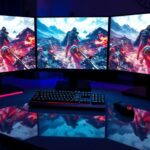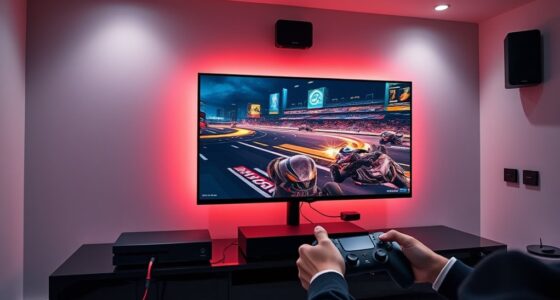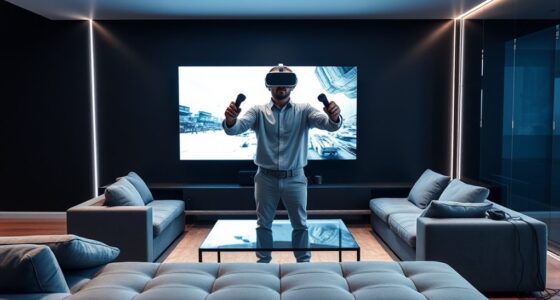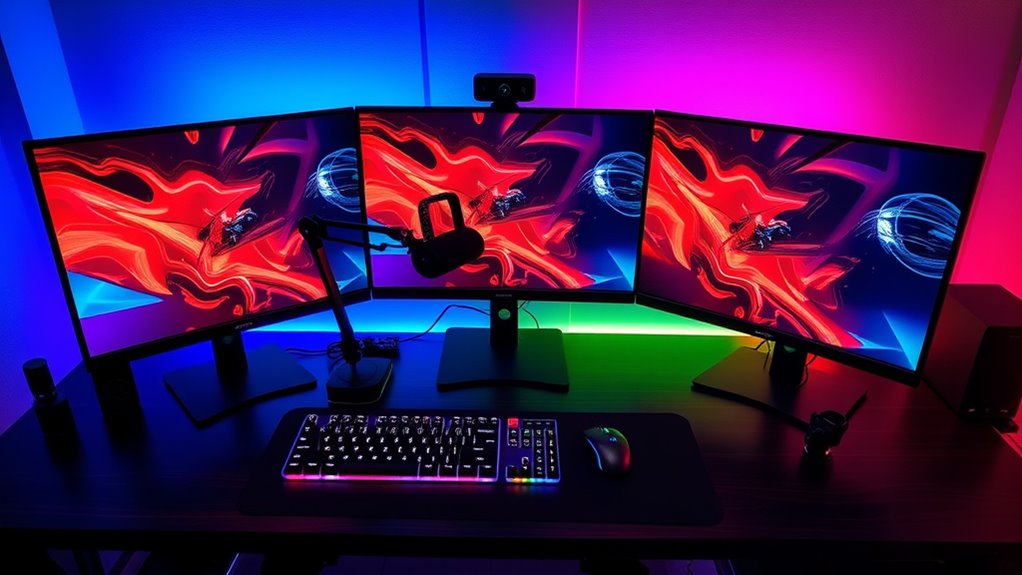
To set up a multi-screen gaming and streaming station, start by choosing a graphics card with at least three outputs like HDMI or DisplayPort to connect multiple monitors. Install powerful hardware, update your drivers regularly, and configure your display settings for ideal resolution and arrangement. Use streaming software to manage your screens effectively, keeping chat and controls accessible. Fine-tuning these components will help you create a seamless, high-performance setup—discover more tips to maximize your station’s potential.
Key Takeaways
- Select a graphics card with multiple HDMI or DisplayPort outputs to support several monitors simultaneously.
- Configure display layout and resolution in Windows or macOS for seamless multi-screen navigation.
- Update graphics drivers regularly and match monitor refresh rates for optimal performance and reduced lag.
- Use streaming software to assign chat, controls, and preview windows to secondary screens for easy access.
- Maintain hardware cooling, power, and compatibility to ensure stable, high-quality gaming and streaming experiences.

Creating a multi-screen gaming and streaming station can markedly enhance your setup, giving you more immersive gameplay and better broadcasting capabilities. To achieve this, you need to focus on hardware optimization and software configuration. These elements guarantee your system runs smoothly, handles multiple displays effectively, and provides a seamless experience whether you’re gaming or streaming. Start by selecting the right hardware. Your graphics card should have enough outputs—preferably three or more HDMI or DisplayPort connections—to support multiple monitors without strain. Opt for a powerful CPU and ample RAM to prevent bottlenecks during intensive tasks. Additionally, invest in a robust power supply and cooling system to keep everything running reliably under load. Once your hardware is in place, you can move on to software configuration. This involves setting up your operating system and display settings to recognize and optimize all monitors. For Windows, access display settings to extend your desktop across multiple screens, arrange them in the correct physical order, and adjust resolution for each display. For macOS, use the Display preferences to arrange and configure your screens efficiently. Properly calibrated settings guarantee smooth cursor movement and consistent image quality across all monitors. Hardware optimization also includes updating your graphics drivers regularly. Updated drivers improve compatibility, fix bugs, and enhance performance, which is essential when managing multiple displays. In addition, consider adjusting the refresh rate and resolution settings for each monitor to match your hardware capabilities, reducing lag and screen tearing during gameplay and streaming. Software configuration extends beyond display setup; it’s about ensuring your streaming software, such as OBS or Streamlabs, is configured to take advantage of your multi-screen setup. Position your streaming controls, chat window, or OBS preview on secondary screens to keep your primary gaming screen uncluttered. This setup lets you monitor your stream, chat, and system stats without interrupting gameplay. You’ll also want to optimize your streaming settings—bitrate, resolution, and encoder options—to match your hardware’s capabilities, ensuring high-quality broadcasts without lag. Managing your setup involves balancing hardware and software to maximize performance and reliability. Regularly update your drivers and streaming software, fine-tune display settings, and customize your workspace for efficiency. Additionally, consider the importance of a high refresh rate monitor, as it can significantly improve your gaming responsiveness and overall experience. This approach guarantees your multi-screen station functions seamlessly, delivering immersive gameplay experiences and professional-quality streams. By carefully optimizing your hardware and configuring your software, you’ll create a setup tailored to your gaming and streaming needs, elevating your overall experience and giving you a competitive edge.
Frequently Asked Questions
How Do I Synchronize Audio Across Multiple Screens?
To synchronize audio across multiple screens, start with audio calibration tools in your audio interface or software. Use these to adjust sound levels and timing, ensuring consistent audio output. Enable sound synchronization features in your streaming or gaming software, and consider using a hardware audio splitter or a multi-channel sound card for precise control. Regularly test and fine-tune your setup for seamless, synchronized audio across all screens.
What Are the Best Cable Management Tips for Multiple Displays?
Imagine your setup as a symphony—cable organization is the conductor. Use cable labels to keep things clear and easy to troubleshoot, then route cables along cable management clips or sleeves to hide clutter. Velcro straps or zip ties keep cords tidy without pinching. By planning your cable routes and labeling, you prevent tangles and create a sleek, professional look, making future upgrades or adjustments effortless.
How Can I Prevent Input Lag With Multi-Screen Setups?
To prevent input lag in your multi-screen setup, focus on refresh rate optimization by matching all monitors to the highest refresh rate possible. Additionally, calibrate each monitor properly to ensure consistent response times. Avoid using adapters or splitters that can add latency, and connect your display directly to your GPU. Keep your graphics drivers updated, and disable V-Sync if you experience input lag, making certain smoother gameplay and streaming performance.
What Are the Power Requirements for a Multi-Screen Gaming Station?
Your multi-screen gaming station needs a reliable power supply that can handle the total power consumption of all your components. Check the wattage ratings for your GPU, CPU, monitors, and peripherals, then add some overhead for safety. Aim for a power supply with at least 80% efficiency and sufficient wattage—typically, a 650W to 1000W unit works well—to guarantee stable performance without power issues.
How Do I Configure Streaming Software for Multi-Monitor Use?
To configure streaming software for multi-monitor use, start by calibrating each monitor for accurate display resolution and color. In your streaming software, set the main monitor as your primary display, then select the other screens for secondary content or chat overlays. Adjust the capture settings to include only the desired screens, and guarantee your scene layout is optimized for multiple displays. This setup helps deliver a seamless streaming experience across all monitors.
Conclusion
Now, imagine yourself immersed in a vibrant gaming universe, where multiple screens craft a panoramic portal into your favorite worlds. As you settle into your custom-built station, the glow of monitors dances across your face, and the hum of your powerful setup becomes a symphony of possibility. With everything perfectly aligned, you’re ready to conquer new heights, stream seamless adventures, and lose yourself in a enthralling, multi-dimensional experience that’s all yours.