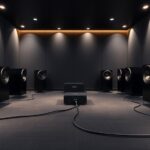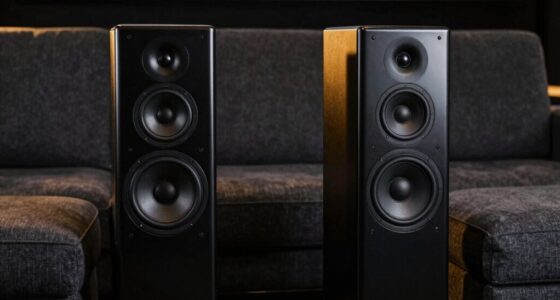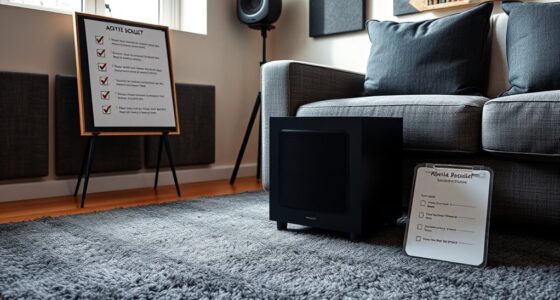

To connect subwoofers for tight bass, start by ensuring all subwoofers are set to the same phase, flipping the switch if needed, and match impedance with your amplifier to prevent overload. Use either parallel wiring for more volume or series wiring for safety, depending on your system’s needs. Connect through a dedicated subwoofer output or speaker-level connections, and fine-tune via built-in crossover controls. Keep these tips in mind to achieve the best sound—more details are just ahead.
Key Takeaways
- Start with all subwoofers set to 0° phase, then adjust to find the tightest bass sound.
- Use proper wiring (parallel or series) to match impedance with your amplifier’s recommended load.
- Connect subwoofers via dedicated output or speaker-level inputs, ensuring correct wiring and phase alignment.
- Confirm impedance ratings match your amplifier to prevent overload and ensure optimal performance.
- Fine-tune phase and crossover settings to synchronize subwoofers for cohesive, punchy bass.
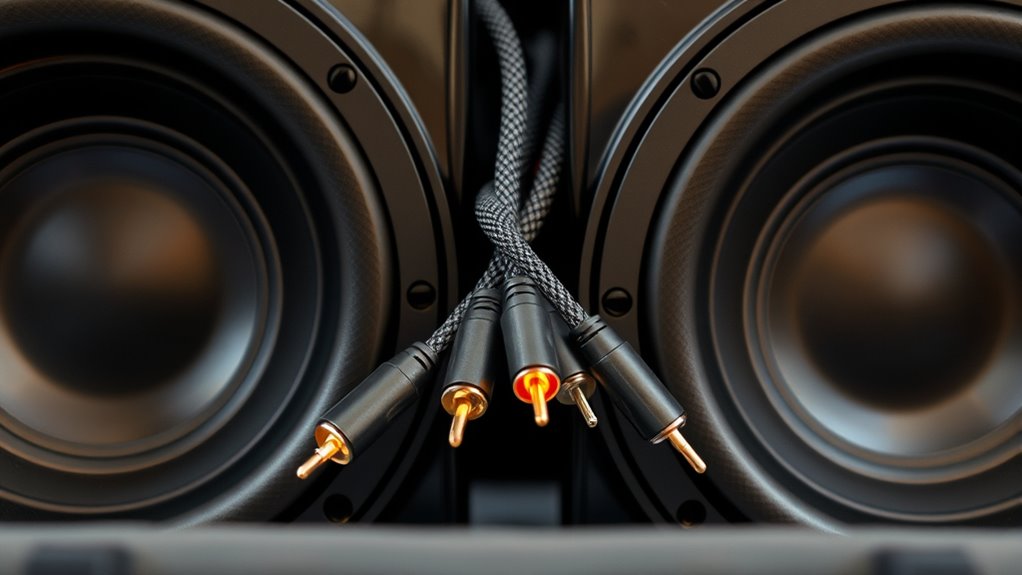
Connecting subwoofers properly is essential for achieving tight, punchy bass that enhances your overall sound experience. When setting up multiple subwoofers, paying attention to phase alignment is crucial. If your subwoofers aren’t in phase, you’ll notice a hollow or boomy sound instead of the clean, powerful bass you’re aiming for. To ensure phase alignment, start by setting all subwoofers to the same phase setting, usually 0 degrees, and listen carefully. If the bass sounds weak or out of sync, try flipping the phase switch to 180 degrees. This simple adjustment can often make a significant difference, bringing the subwoofers into harmony and creating a more cohesive bass response.
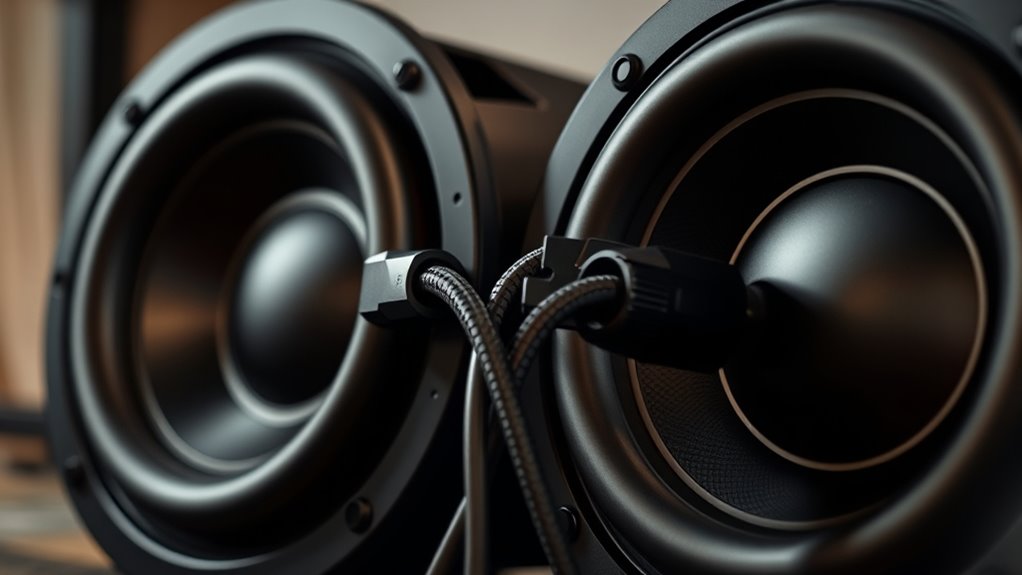
Impedance matching is another vital aspect of connecting multiple subwoofers. Your amplifier or receiver has a specific impedance rating, and matching your subwoofers’ impedance ensures you don’t overload or underutilize your equipment. Check the subwoofers’ impedance ratings, typically listed as ohms, and confirm they match your amplifier’s recommended load. If you’re wiring two subwoofers, wiring them in parallel can reduce the overall impedance, which might strain your amplifier if it’s not rated for lower impedance loads. Conversely, wiring them in series increases impedance, offering a safer load but potentially reducing overall volume. Proper impedance matching prevents damage to your gear and guarantees ideal power transfer, resulting in clearer, more controlled bass.
When connecting multiple subwoofers, consider whether your system allows for a dedicated subwoofer output or if you’ll need to use speaker-level connections. If you’re using a receiver with a dedicated subwoofer output, connecting each subwoofer directly is straightforward, and you can often use the subwoofer’s built-in crossover to fine-tune the sound. For systems without a dedicated output, you might need to split the signal using a Y-splitter or an external amplifier, making impedance matching even more critical. Always verify the wiring configuration to maintain proper phase alignment and impedance levels, ensuring your system delivers consistent, tight bass across all listening positions.

Official Licensed Google TV Smart Projector, HAPPRUN 4K UHD Home Theater with Dolby Sound, Wi-Fi & Bluetooth, Built-in Streaming Apps, Compatible with Games Consoles & Smartphone, Indoor & Outdoor Use
[ Built-in Official Licensed Google TV ] - Without additional equipment, the smart projector can directly access Netflix,...
As an affiliate, we earn on qualifying purchases.
Frequently Asked Questions
Can I Connect Multiple Subwoofers Without a Dedicated Amplifier?
You can connect multiple subwoofers without a dedicated amplifier, but you’ll need to ensure subwoofer wiring and amplifier requirements. Using a speaker-level or line-level splitter may work, but it can reduce sound quality and cause damage if not done properly. Generally, an amplifier designed for subwoofers guarantees ideal performance. Without one, you’re risking insufficient power and potential distortion, so investing in a suitable amplifier improves your setup’s reliability and bass tightness.
What Is the Best Placement for Tight Bass Performance?
Imagine your room as a symphony, and subwoofer placement as the conductor’s baton. For tight bass, position your subwoofer near walls or corners to amplify vibrations, but avoid placing it directly against walls to prevent muddiness. Experiment with room acoustics—aim for a spot where bass feels punchy and controlled. You’ll discover that thoughtful placement transforms your space into a bass-rich sanctuary, delivering that perfect, tight thump every time.
How Do I Prevent Phase Cancellation Between Subwoofers?
To prevent phase cancellation between subwoofers, focus on phase alignment by adjusting their wiring configurations. Use the same wiring method, like both in parallel or series, to keep them in sync. If you notice cancellation, try reversing the polarity of one subwoofer. Always test your setup with a bass-heavy track, listening for tight, punchy bass. Proper phase alignment ensures your subwoofers work together seamlessly for maximum sound.
Is It Necessary to Use a Crossover for Connecting Multiple Subs?
A crossover is essential when you’re wiring multiple subwoofers, especially for seamless bass. It helps direct low frequencies to each sub, preventing overlap and distortion. Without a crossover, your setup might struggle with phase issues or uneven sound. So, for best results, use a dedicated crossover for your multiple subwoofer wiring, ensuring tight, clear bass and balanced output across your system.
How Does Room Acoustics Affect Subwoofer Integration?
Room acoustics considerably impact your subwoofer integration by influencing how sound reflections and speaker placement interact. If your room has lots of reflections, bass can become muddled or boomy, making it harder to achieve tight, accurate sound. To improve, you should carefully consider speaker placement, aiming for positions that minimize reflections and optimize bass response. Using bass traps and acoustic treatments can further enhance the overall sound quality.
Aeotec Smart Home Hub, Works as a SmartThings Hub, Z-Wave, Zigbee, Matter Gateway, Compatible with Alexa, Google Assistant, WiFi
Connect & control your smart home — Easily link thousands of compatible devices from leading brands to create...
As an affiliate, we earn on qualifying purchases.
Conclusion
By connecting your subwoofers correctly, you’ll open a bass that hits like a lightning strike—tight, powerful, and clear. Whether you choose parallel, series, or a combination, remember that proper setup transforms your system into a symphony of deep, punchy lows. Think of it as tuning a fine instrument; with patience and the right connections, you’ll enjoy bass so precise it feels like it’s vibrating right through your bones. Get it right, and let the bass speak for itself.
![SmartThings Hub 3rd Generation [GP-U999SJVLGDA] Smart Home Automation Hub Home Monitoring Smart Devices - Alexa Google Home Compatible - Zigbee, Z-Wave, Cloud to Cloud Protocols – White](https://m.media-amazon.com/images/I/21hChu0ounL._SL500_.jpg)
SmartThings Hub 3rd Generation [GP-U999SJVLGDA] Smart Home Automation Hub Home Monitoring Smart Devices - Alexa Google Home Compatible - Zigbee, Z-Wave, Cloud to Cloud Protocols – White
Monitor and control compatible devices in your home using a single smartphone app for your phone
As an affiliate, we earn on qualifying purchases.
![[Built-in Official Apps/4K Support] Smart Outdoor Projector with WiFi and Bluetooth, 800ANSI Movie Projector, DoIby Audio with Dual Speaker, Auto Focus w/ YouTube&PrimeVideo Proyector, Upgrad P62 Pro](https://m.media-amazon.com/images/I/51h241YxtmL._SL500_.jpg)
[Built-in Official Apps/4K Support] Smart Outdoor Projector with WiFi and Bluetooth, 800ANSI Movie Projector, DoIby Audio with Dual Speaker, Auto Focus w/ YouTube&PrimeVideo Proyector, Upgrad P62 Pro
[Upgraded Classic – P62 Pro Movie Projector] Building on the reliability and low return rate of the classic...
As an affiliate, we earn on qualifying purchases.