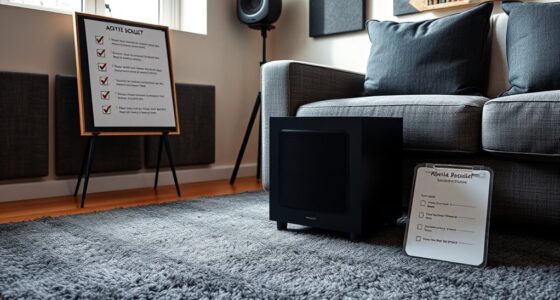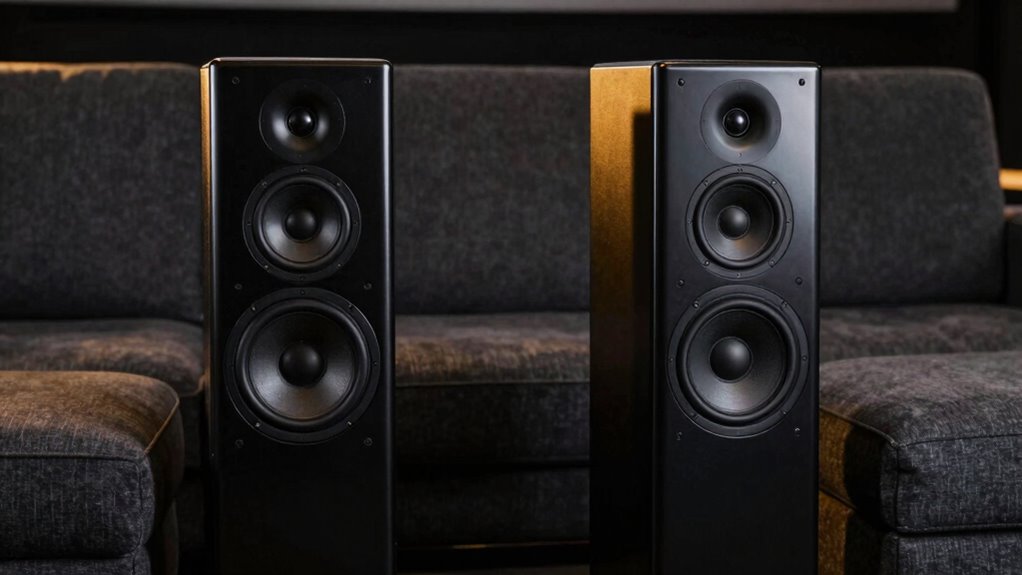

The “perfect” speaker height myth comes from the idea that speakers should be at ear level to guarantee ideal sound. However, this oversimplifies acoustic factors like room reflections, speaker angles, and placement. True quality depends more on room acoustics and positioning than height alone. By focusing on proper placement and acoustic treatment, you can markedly improve your sound. To learn how to fine-tune your setup, keep exploring these essential tips.

Get business pricing on your home office setup
- Business-only prices and quantity discounts
- Tax-exempt purchasing
- Multiple users, one account, clear invoices
Key Takeaways
- The idea that speakers must be at ear level is a simplified myth; room acoustics and placement matter more.
- Proper speaker angle and distance are more critical for sound quality than exact height.
- Room reflections and furniture placement significantly impact clarity, overshadowing height considerations.
- Optimizing speaker position involves forming an equilateral triangle with the listener, not just adjusting height.
- The myth persists because it overlooks complex acoustic variables and personal preferences influencing sound.
Where the ‘Perfect’ Speaker Height Myth Comes From

The myth of the “perfect” speaker height likely originates from the desire to maximize sound quality and aesthetic appeal. People often believe that adjusting the stand height to match the listener perspective will produce the best audio experience. This idea stems from the assumption that speakers should be at ear level for ideal sound dispersion. In reality, the stand height is just one factor influencing audio; it’s also about how your ears align with the speaker drivers. Many assume that a specific height guarantees optimal sound, but personal preferences and room characteristics matter more. This myth persists because it offers a simple, visual solution to complex acoustic variables, making it tempting to focus solely on stand height rather than the broader context of speaker placement and room acoustics. Recognizing the importance of listening position and how sound interacts with your environment is crucial for optimal audio performance. Proper speaker positioning can often achieve better results than focusing solely on height adjustments. Understanding acoustic variables and their impact can help you make more effective adjustments for your setup.
How Room Acoustics Impact Your Sound Quality
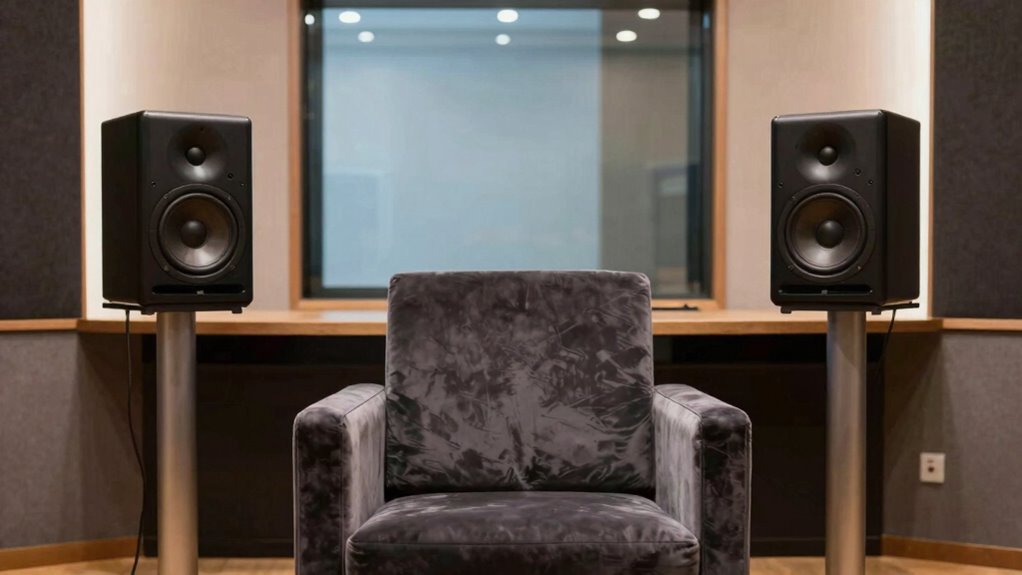
Room acoustics play a crucial role in how your sound actually reaches your ears, often outweighing the importance of speaker height or placement. Poor room acoustics can cause unwanted room echoes, muddling clarity and reducing sound quality. Ensuring speaker symmetry in your room helps create a balanced soundstage, preventing certain areas from being overly loud or quiet. When speakers are uneven or placed irregularly, reflections and echoes become more pronounced, degrading your listening experience. Controlling room echoes through proper positioning, acoustic treatments, and minimizing reflective surfaces can considerably improve clarity. Remember, even perfect speaker height can’t compensate for a room with poor acoustics. Focusing on proper room acoustics management creates a balanced environment to get the best possible sound from your setup. Additionally, understanding sound absorption techniques can further enhance your listening space by reducing unwanted reflections. Incorporating acoustic panels and diffusers effectively can help break up sound waves and improve overall sound quality.
Key Factors in Speaker Placement: Beyond Height

While speaker height matters, many other factors play a significant role in achieving ideal sound quality. One key aspect is adjusting the speaker angle so the drivers directly face your listening position, ensuring clearer and more focused sound. Proper speaker distance also matters; placing speakers too close or too far can distort sound balance and stereo imaging. Ideally, your speakers should form an equilateral triangle with your listening spot, maintaining consistent distance on both sides. Additionally, consider how reflections from walls and furniture impact sound. Proper placement minimizes unwanted echoes and enhances clarity. Remember, fine-tuning your speaker angle and distance can dramatically improve your listening experience, often more so than relying solely on height adjustments. Sound reflection can significantly influence audio clarity, so controlling how sound waves bounce around your space is crucial. Adjusting for room acoustics ensures that sound behaves predictably and benefits your overall listening environment. Paying attention to speaker placement can lead to a more immersive and balanced audio experience, making your setup truly optimal. Moreover, experimenting with speaker orientation can help you find the perfect alignment for your unique room setup and listening preferences.
Practical Tips to Optimize Your Speaker Setup

To get the most out of your speakers, start by positioning them so they form an equilateral triangle with your listening spot. This guarantees balanced sound. Next, consider these practical tips:
Position your speakers to form an equilateral triangle with your listening spot for balanced, optimal sound.
- Keep speakers at ear level for ideal sound clarity and to enhance speaker aesthetics.
- Use furniture placement to minimize reflections and avoid placing speakers against reflective surfaces.
- Avoid blocking speaker drivers with objects or furniture, which can distort sound.
- Experiment with slight angles to direct sound toward your listening position, improving overall experience.
- Proper speaker positioning can significantly influence sound quality and should be tailored to your space for optimal results. Additionally, understanding how speaker placement can affect sound dispersion helps in achieving a more immersive listening environment.
- Be mindful of room acoustics, as the size and materials of your space can greatly impact sound quality and the effectiveness of your speaker setup. Incorporating sound-absorbing materials can further enhance clarity and reduce unwanted echoes. Recognizing acoustic treatment options can provide additional control over sound reflections and improve overall listening quality.
Common Mistakes to Avoid When Positioning Speakers
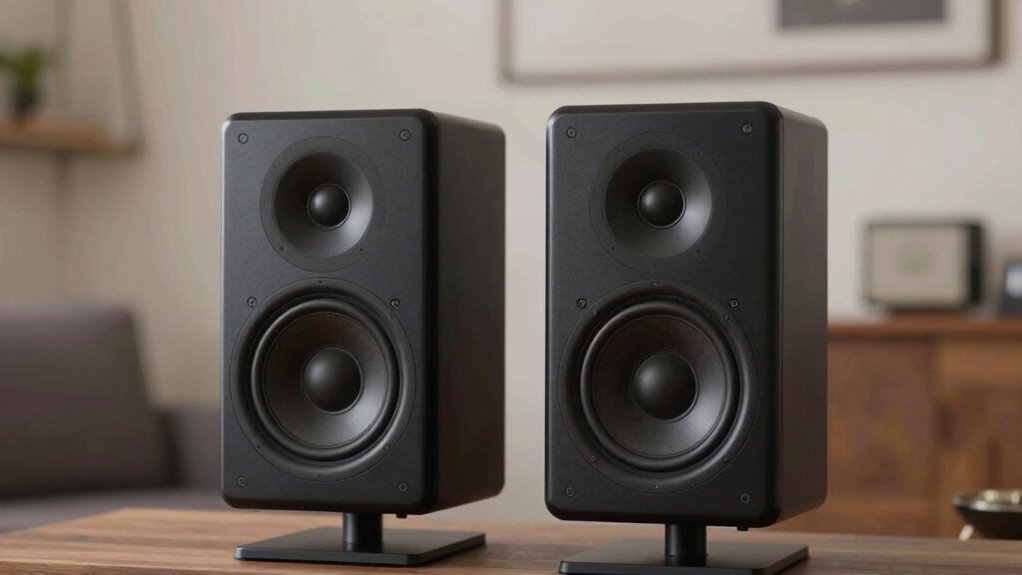
Many common mistakes can undermine your speaker setup, ultimately ruining your listening experience. One major error is poor speaker orientation, which can cause sound imbalances. Additionally, neglecting cable management leads to clutter and potential damage, affecting sound quality. Proper speaker placement is crucial for optimal sound, so avoid placing speakers too close or too far apart; proper spacing is essential. Don’t forget to angle speakers toward your listening position for best sound. Also, neglecting to secure cables can cause accidental disconnections or damage. Good sound quality depends on careful setup and attention to detail. Proper speaker positioning ensures the best listening experience, so take time to adjust your speakers accordingly. Regularly checking your audio calibration can help maintain optimal sound performance. Being aware of acoustic environment factors can also make a significant difference in sound quality. Here’s a quick overview:
| Mistake | Consequence | Tip |
|---|---|---|
| Incorrect speaker angle | Poor sound clarity | Angle speakers toward listening spot |
| Poor cable management | Interference, damage | Use clips or ties to organize cables |
| Too close or far apart | Imbalanced sound | Follow recommended spacing |
| Ignoring speaker orientation | Sound muddiness | Keep speakers aligned properly |
| Cluttered cables | Safety hazard, noise | Regularly tidy and secure cables |
Frequently Asked Questions
Does Speaker Height Affect Bass Response Significantly?
Yes, speaker height can affect bass response, but it’s often more about subwoofer placement and room acoustics. When your speakers are at the right height, it helps enhance sound waves and reduces unwanted reflections. Proper subwoofer placement ensures deep, powerful bass, while understanding room acoustics helps manage bass buildup or cancellation. Focus on positioning your speakers and subwoofer carefully, rather than obsessing over height, for the best bass performance.
How Do Personal Preferences Influence Optimal Speaker Placement?
Your personal preferences greatly influence ideal speaker placement, as you prioritize speaker aesthetics and listener comfort. You might prefer speakers at eye level for a sleek look or slightly higher for better sound dispersion. Experiment with placement, ensuring they complement your space and feel comfortable to listen to. Trust your instincts and adjust until you find a setup that balances visual appeal with exemplary sound quality, tailored to your preferences.
Can Adjustable Stands Improve Sound Quality Regardless of Height?
Yes, adjustable stands can improve sound quality regardless of height. By allowing you to fine-tune speaker positioning, they help you achieve ideal sound, which also enhances speaker aesthetics and complements your room decor. When you set your speakers at the right height, you get clearer sound and a more polished look. So, investing in adjustable stands ensures your setup sounds great and looks stylish in any space.
Is There a Universally Ideal Speaker Height for All Rooms?
There isn’t a universally ideal speaker height for all rooms because it depends on your space, speaker design, and aesthetic preferences. You should aim for an ergonomic setup where the tweeters are roughly at ear level for maximum sound. Consider speaker aesthetics to match your decor, and use adjustable stands to fine-tune height for the best listening experience. This personalized approach ensures sound quality and visual harmony.
How Does Speaker Orientation Compare to Height in Impact?
Like tuning a fine instrument, adjusting your speaker orientation often has a more immediate impact on sound quality than height. Properly aimed speakers enhance clarity and imaging, making your setup more aesthetically pleasing and less complex to install. While height influences distribution, fine-tuning angles can dramatically improve soundstage, ensuring your system sounds balanced and immersive. Focus on orientation first, then fine-tune height for an ideal, visually appealing setup.
Conclusion
Don’t buy into the myth that there’s a “perfect” speaker height. The truth is, ideal sound depends on your room, speaker type, and listening position. Focus on experimenting with placement rather than chasing a specific height. When you understand how room acoustics and positioning affect sound, you can create a setup that truly enhances your listening experience. Break free from myths—your perfect sound setup is about balance, not a mythic height.
Halloween Picks
halloween
As an affiliate, we earn on qualifying purchases.