
If your center channel feels like it’s doing all the work, it’s likely due to setup or calibration issues. Incorrect speaker placement, poor room acoustics, or improper receiver settings can make dialogue seem dominant and overload the center. Additionally, mix choices and crossover settings might push too much sound to that speaker. To fix this, you need to optimize placement, calibrate your system accurately, and consider room treatments. Keep exploring; you’ll discover simple ways to balance your sound for a more natural experience.

Get business pricing on your home office setup
- Business-only prices and quantity discounts
- Tax-exempt purchasing
- Multiple users, one account, clear invoices
Key Takeaways
- Incorrect speaker phase or wiring can cause phase cancellation, forcing the center channel to handle more sound than intended.
- Poor room acoustics and reflections can make the center channel seem overly dominant or overloaded.
- Improper calibration and crossover settings in your receiver may lead to imbalance, overloading the center speaker.
- Speaker placement issues, such as being too close to walls or not at ear level, can cause the center to carry excessive load.
- Content with unbalanced audio mixes or excessive dialogue emphasis can make the center channel work harder than other speakers.
Why Is My Center Channel So Loud Compared to Other Speakers?

If your center channel speaker sounds considerably louder than your other speakers, it’s often due to its primary role in delivering dialogue and vocals. One common issue is incorrect speaker phase, which can cause certain frequencies to reinforce each other, making the center stand out more. Check the speaker phase settings to guarantee they’re aligned correctly; reversing the polarity can reduce imbalance. Additionally, crossover settings play a vital role; if set too high or low, they can cause the center to dominate or be overshadowed. Adjusting the crossover frequency helps blend the center with the other speakers smoothly. Proper calibration of both speaker phase and crossover settings ensures a balanced sound field, preventing your center channel from overpowering the rest of your home theater system. Regularly inspecting and maintaining your speaker components can also help maintain optimal sound quality and balance. Ensuring your audio calibration is accurate is essential for a cohesive listening experience. Moreover, understanding room acoustics and how they influence speaker performance can further help in achieving a balanced sound. In addition, using measurement tools can assist in fine-tuning your setup for a more consistent audio experience. Paying attention to speaker placement can also significantly affect how well the center channel integrates with other speakers.
What Makes Dialogue Sound Overpowering in Home Theater Soundtracks?
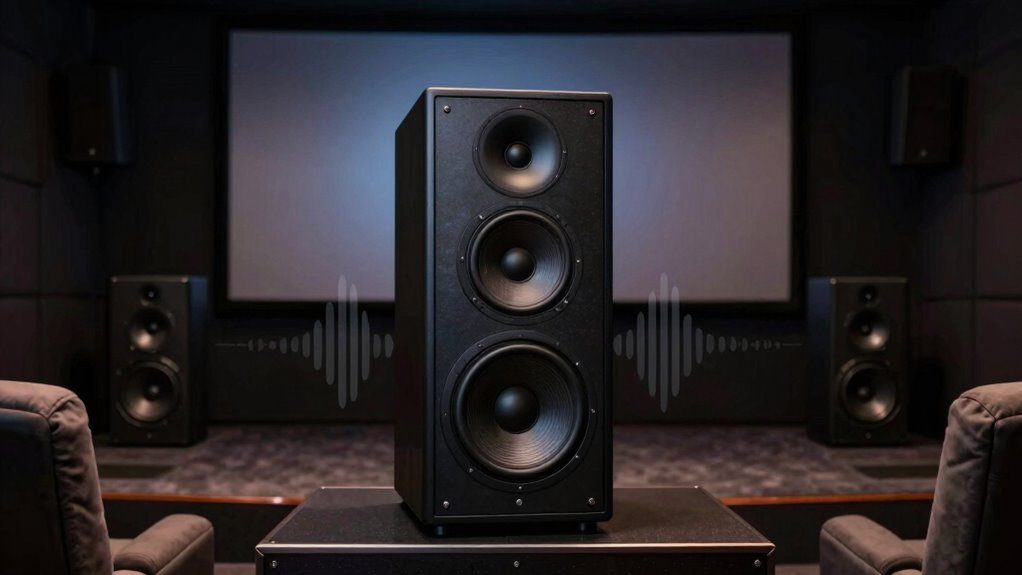
When dialogue sounds overpowering in home theater soundtracks, it often results from misbalanced audio settings or speaker placement issues. This can flatten the soundstage depth and reduce dialogue intelligibility, making voices seem too dominant. To visualize, consider this table:
| Issue | Effect |
|---|---|
| Center channel too loud | Overpowers other sounds, shrinks soundstage depth |
| Improper speaker placement | Narrow soundstage, muffled dialogue |
| Incorrect EQ settings | Excessive midrange boosts dialogue |
| Poor room acoustics | Echoes distort speech clarity |
| Lack of calibration | Imbalanced sound, overpowering voices |
Additionally, many home theater systems are designed with Free Floating audio configurations that require proper setup to prevent imbalance. Ensuring proper speaker positioning can significantly improve overall sound quality by creating a more balanced soundstage. Regularly sound system calibration ensures all components work harmoniously for optimal audio performance. Proper cabling solutions also play a crucial role in maintaining sound integrity and preventing signal loss or interference. Properly configuring and maintaining your system is essential for achieving a balanced audio environment, which enhances dialogue clarity and preserves soundstage depth, creating a more natural listening experience.
How Do Audio Mixes Contribute to a Dominant Center Channel?

Audio mixes play a significant role in shaping how the center channel sounds within a home theater. The mix balance determines how prominently dialogue and vocals sit in relation to other sounds, making the center channel feel more dominant. Adjusting the mix balance guarantees dialogue remains clear and centered, especially during action scenes or complex soundtracks. Frequency response also plays a vital role; engineers boost midrange frequencies to enhance vocal clarity, making sure voices cut through background effects. When these elements are carefully manipulated, the center channel becomes the primary source of dialogue and essential sounds, guiding your attention naturally. Additionally, understanding content formats helps sound engineers optimize how audio information is presented, further enhancing clarity and immersion. A well-crafted mix makes the center channel feel more immersive and essential, ultimately creating a seamless and engaging audio experience for you. Proper mixing techniques ensure that the center channel remains the focal point, even in complex auditory scenes. Moreover, audio calibration techniques help fine-tune the sound system to achieve the desired balance and clarity. Incorporating frequency response adjustments allows for more precise control over how different sounds are prioritized and perceived. A thorough understanding of audio engineering principles ensures that each element contributes effectively to the overall soundscape.
How Does Speaker Placement Impact Center Channel Clarity?
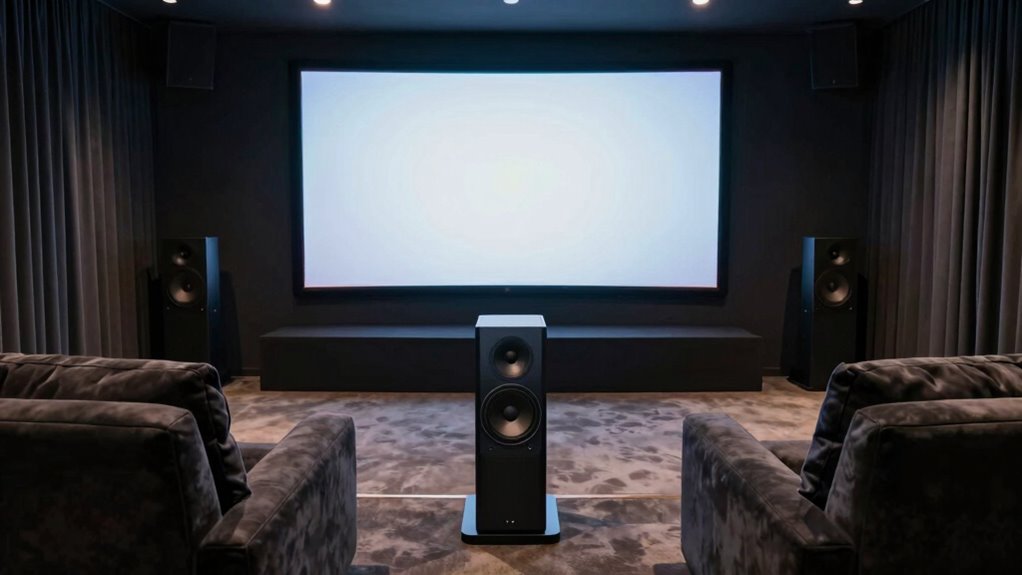
Proper speaker placement is essential for ensuring the center channel delivers clear and focused audio. Your speaker positioning plays a vital role in how well sound travels directly to your ears, affecting clarity and intelligibility. Placing the center channel at ear level and directly facing your listening position helps achieve ideal sound alignment. Additionally, acoustic treatment, such as diffusers and absorbers, minimizes reflections and unwanted echoes that can muddy the sound. When your speakers are correctly positioned, they create a cohesive soundstage, making dialogue and effects more natural and precise. Poor placement, on the other hand, can cause sound to become diffused or imbalanced, forcing your center channel to compensate and overload. Focus on proper speaker positioning and acoustic treatment to maximize clarity and prevent your center channel from doing all the work. Ensuring proper speaker placement enhances sound quality and reduces the need for your center channel to compensate for poor positioning.
Are Receiver Settings Causing My Center Channel to Overload?
If your center channel sounds overwhelmed or distorted, your receiver settings might be the culprit. Improper speaker calibration or incorrect audio adjustments can cause overloads and muddy sound. Checking and fine-tuning these settings can help restore clear, balanced audio.
Improper Speaker Calibration
When your center channel speaker seems to overload or distort, the culprit often lies in receiver settings that aren’t properly calibrated. Incorrect speaker equalization can boost certain frequencies excessively, making your center speaker work harder than necessary. Additionally, crossover settings that aren’t tuned correctly might send too much bass or midrange, overwhelming your speaker.
| Symptom | Possible Cause |
|---|---|
| Overloading or distortion | Improper speaker equalization |
| Muddled dialogue sound | Faulty crossover settings |
| Excessive bass or shrill highs | Incorrect calibration adjustments |
Fixing these settings guarantees your center channel isn’t overburdened, allowing it to perform smoothly without strain or distortion. Proper calibration balances your soundstage and preserves audio clarity.
Incorrect Audio Settings
Incorrect audio settings on your receiver can markedly impact your center channel’s performance, often causing overloads and distortion. Misconfigured settings may alter the audio frequency response or lead to incorrect speaker polarity, both of which strain your speaker. To troubleshoot, consider these key points:
- Check audio frequency levels – ensure the crossover settings aren’t too high, which forces your center to handle too much bass.
- Verify speaker polarity – confirm that positive and negative wires are correctly connected; reversed polarity causes phase issues.
- Review receiver settings – make sure the center channel is properly calibrated and not set to a level higher than other speakers.
Adjusting these settings can prevent overloads, improve clarity, and balance your home theater system.
How Room Acoustics Affect Center Channel Sound Quality
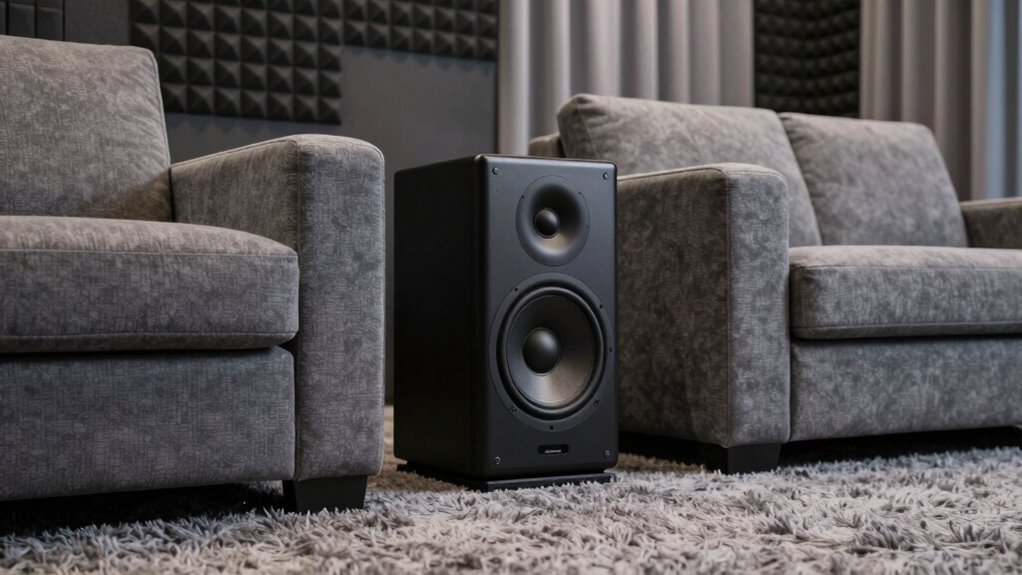
Room acoustics play a crucial role in how your center channel speaker performs, directly impacting sound clarity and dialogue intelligibility. When sound waves bounce off walls, ceilings, or furniture, they create room reflections that can muddy the audio. These reflections may cause phase cancellations or reinforcement, altering the intended sound. To combat this, acoustic treatments like panels, diffusers, or bass traps help absorb or scatter unwanted reflections, creating a cleaner sound environment. Properly managing room reflections ensures your center channel delivers clear dialogue and accurate sound imaging. Without these treatments, reflections can cause muddiness or uneven sound distribution, making it harder to follow conversations and enjoy your audio experience fully. Addressing room acoustics is essential for achieving ideal center channel performance.
Common Calibration Mistakes That Make Your Center Channel Too Loud

One common mistake that causes your center channel to be too loud is relying solely on receiver-based calibration without manual adjustments. This often overlooks critical factors like speaker phase and crossover frequency, which impact sound balance. To fix this, check these key areas:
- Speaker Phase: Ensure your center speaker’s phase matches your other speakers; misaligned phase can boost volume unnaturally.
- Crossover Frequency: Adjust the crossover frequency so the center channel blends seamlessly with your left and right speakers, avoiding excessive emphasis.
- Manual Calibration: Use an SPL meter and manual settings to fine-tune levels beyond what auto-calibration offers, preventing the center from dominating. Additionally, verifying the speaker setup can help identify issues affecting sound balance.
- Proper Room Acoustics: Addressing room acoustics and speaker placement can also significantly improve sound balance by reducing reflections and standing waves that distort perceived volume. Paying attention to speaker placement is essential for achieving a balanced soundstage and ensuring your center channel doesn’t overpower your system.
How to Adjust Your Setup for Balanced and Immersive Sound

To achieve balanced and immersive sound, you need to go beyond just auto-calibration and make manual adjustments to your entire setup. Focus on speaker isolation by decoupling your speakers from surfaces to reduce vibrations and distortion. Use acoustic treatment like bass traps and diffusers to control room reflections and improve clarity. Proper placement is key: position your speakers at ear level and form an equilateral triangle with your listening position. Adjust speaker angles and distances for even sound distribution. Additionally, room acoustics play a crucial role in sound quality and should be optimized accordingly. Incorporating regional audio flavors can also enhance your listening experience by tailoring sound profiles to your preferences. Here’s a quick guide:
| Adjustment Area | Recommended Action | Goal |
|---|---|---|
| Speaker Placement | Keep at ear level, form triangle | Balanced soundstage |
| Acoustic Treatment | Add panels, bass traps | Reduce reflections, enhance clarity |
| Speaker Isolation | Use pads or stands | Minimize vibrations |
Furthermore, understanding and implementing speaker decoupling techniques can significantly improve overall sound quality. Implementing effective decoupling methods can help prevent unwanted vibrations from affecting your speakers, leading to more natural sound reproduction. Optimizing speaker placement is essential for achieving a cohesive sound experience, as even minor adjustments can make a noticeable difference. These steps create a more natural, immersive listening experience.
Should You Upgrade Your Center or Surround Speakers?
Deciding whether to upgrade your center or surround speakers depends on how well your current sound balance and clarity meet your needs. Placement plays a big role in the impact and effectiveness of your speakers, so consider if repositioning might help before investing. Weigh the costs and benefits of upgrading to guarantee you’re making a choice that truly enhances your home theater experience.
Sound Balance and Clarity
If your center or surround speakers are outdated or lacking clarity, upgrading them can considerably improve your sound balance. Better speakers enhance dialogue clarity, making conversations more natural and intelligible. They also improve sound staging, creating a more immersive experience by accurately positioning audio cues. To optimize sound balance and clarity, consider these points:
- Upgrade to speakers with clearer, more detailed drivers for sharper dialogue.
- Choose models designed for precise sound staging to enhance spatial accuracy.
- Match new speakers with your existing setup to maintain consistent sound quality.
Impact of Speaker Placement
Proper placement of your center and surround speakers substantially influences your overall sound quality. Position your speakers at the appropriate speaker height to guarantee clear dialogue and immersive surround effects. The center channel should be aligned with your TV or screen, ideally at ear level when seated, to improve dialogue clarity. Surround speakers should be placed slightly above ear level and behind your listening area for an enveloping experience. Additionally, room symmetry plays an essential role; uneven distances or asymmetrical placement can cause sound imbalance and hinder immersion. Consistent placement on both sides of your listening zone ensures even sound distribution. Paying attention to speaker height and maintaining room symmetry can notably enhance your audio experience without necessarily upgrading your equipment.
Upgrading Cost and Benefits
Upgrading your center or surround speakers can greatly enhance your home theater experience, but it’s essential to weigh the costs against the benefits. Higher-quality speakers often offer improved speaker durability, ensuring they last longer and withstand daily use. Additionally, newer models may feature wireless compatibility, reducing clutter and simplifying setup. Consider these factors:
- Cost: Premium speakers can be expensive, but they often deliver better sound quality and durability.
- Sound Improvement: Upgraded speakers provide clearer dialogue and richer surround effects.
- Convenience: Wireless options eliminate cable clutter and ease integration into your system.
While the initial investment might be significant, the enhanced audio experience and long-term durability can justify the expense, especially if you value immersive sound.
Tips for Achieving a More Natural and Immersive Audio Experience
Achieving a more natural and immersive audio experience starts with carefully positioning your center channel speaker. Place it directly above or below your TV, ensuring it’s at ear level when seated. This positioning enhances dialogue clarity, making conversations sound more realistic and easier to follow. Additionally, maintain speaker symmetry by aligning your center channel with the other speakers in your setup. Symmetrical placement helps distribute sound evenly, creating a seamless soundstage. Experiment with slight adjustments to find the sweet spot that delivers the most natural sound. Avoid placing the speaker too far off-center or behind furniture, as this can distort audio quality. Proper positioning guarantees your center channel effectively anchors dialogue and blends smoothly with the surround sound, immersing you in the experience.
Frequently Asked Questions
How Can I Tell if My Center Channel Is Overpowered Intentionally or Due to Setup Issues?
You can tell if your center channel is overpowered by checking your speaker placement and calibration techniques. If it sounds considerably louder or clearer than your other speakers, it might be intentional, but setup issues could also be the cause. Use a sound level meter or receiver’s calibration tools to balance the volume. Adjust speaker placement and calibration settings to make certain of even sound distribution, avoiding unintentional overemphasis.
What Specific Speaker Configurations Can Help Balance the Center Channel With Other Speakers?
You can balance your center channel by adjusting speaker placement and crossover settings. Move your speakers closer or further away to improve sound distribution, ensuring they’re at ear level. Experiment with crossover adjustments in your receiver; lowering the crossover frequency can help blend the center with other speakers. Proper speaker placement and tailored crossover settings work together to create a more balanced, immersive soundstage, reducing the center channel’s dominance.
Are There Particular Room Treatments That Improve Center Channel Clarity?
Yes, adding acoustic panels and bass traps improves your center channel clarity by reducing reflections and controlling low-frequency resonances. Place acoustic panels at reflection points to minimize sound bouncing off walls, while bass traps absorb excess bass, preventing muddiness. These treatments create a cleaner soundstage, allowing your center channel to deliver clearer dialogue and precise imaging, giving you a more immersive listening experience without overworking your speakers.
How Do Different Audio Formats Affect the Prominence of the Center Channel?
Different audio formats crucially impact the prominence of your center channel in surround sound setups. Dolby Atmos and DTS:X, for example, offer more immersive soundscapes with dynamic voice placement, making calibration essential. Proper audio calibration guarantees your center channel remains clear and prominent, regardless of format. Keep in mind that some formats emphasize spatial effects, so adjusting speaker levels during calibration helps maintain balanced dialogue and effects for a better listening experience.
Can Upgrading My Receiver’s Audio Processing Features Reduce Center Channel Dominance?
Absolutely, upgrading your receiver’s audio processing can help reduce center channel dominance. When you perform speaker calibration, your receiver tweaks settings to balance sound across all channels, preventing the center speaker from taking over. Modern audio processing features, like dynamic range control and advanced equalization, fine-tune the sound stage. Think of it as hitting two birds with one stone—improving clarity while ensuring no single speaker dominates your setup.
Conclusion
If your center channel dominates, it can make your home theater feel unbalanced. For example, imagine watching a film where dialogue sounds clear but vocals are overwhelming, distracting from the overall experience. By adjusting your speaker placement, calibrating your receiver, or upgrading your setup, you can create a more natural, immersive sound. With a few tweaks, you’ll enjoy a balanced audio experience that makes every scene feel real and engaging.
Fall Picks
fall essentials
As an affiliate, we earn on qualifying purchases.