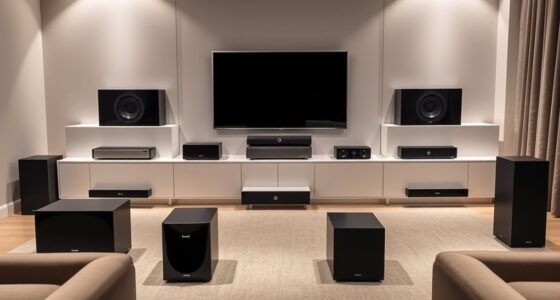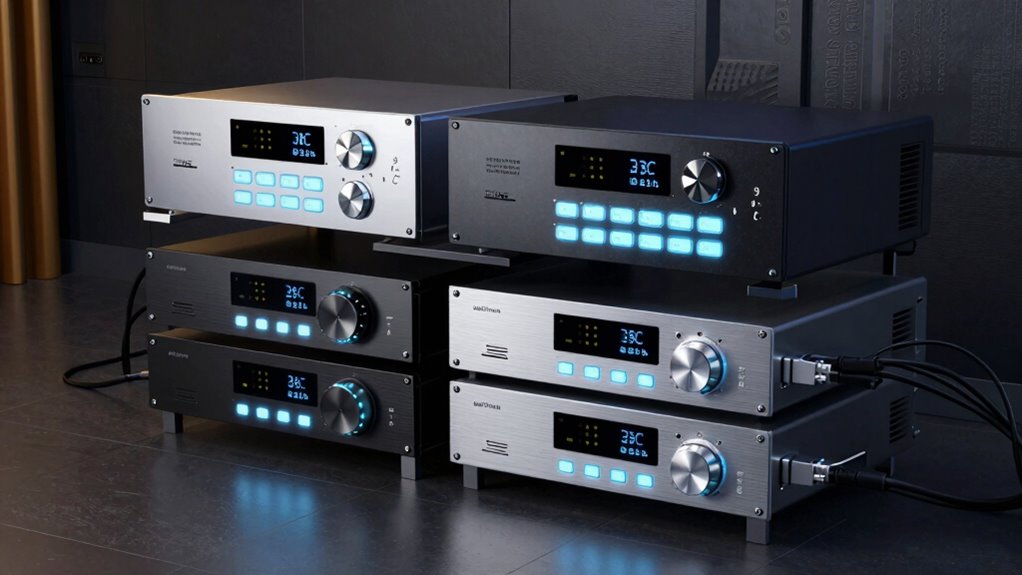

For most home theater racks, I’d start with the Monoprice 15A Power Conditioner and Sequencer: its three switched zones give a rack clear power-up stages without taking more than 1U. The Soundavo PMX-3300 is a strong alternative for buyers who want 10 outlets and a 15A rating, while the ART PS8-II suits a simpler eight-outlet setup. The main tradeoffs are outlet count versus rack space, staged sequencing versus basic power distribution, and advertised capacity versus what your circuit can safely supply. I compare all 15 options by those practical fit questions, so read on for the full breakdown and recommendations by rack type.

Get business pricing on your home office setup
- Business-only prices and quantity discounts
- Tax-exempt purchasing
- Multiple users, one account, clear invoices
Complete the kit


Key Takeaways
- Sequencing is the clearest separator: the Monoprice offers three zones, while products with independent switches can suit custom device groups but may require more hands-on operation.
- Outlet count alone does not determine usefulness: eight outlets may be enough for a receiver, processor, sources, and control gear; a 10-outlet unit helps only if its layout and load rating also fit.
- Rack height can change the decision: the Monoprice, QST QP-1, and FULODE 1U model are listed as 1U options, which can matter more than extra features in a full rack.
- Capacity claims need context: ratings such as 10A, 15A, and 20A are not interchangeable, and a sequencer cannot provide more power than the wall circuit feeding it.
- Displays and USB ports are convenience features, not substitutes for sequencing: voltage readouts and charging ports may help in daily use, but buyers should check protection, controls, and outlet configuration first.
| Monoprice 15A Power Conditioner and Sequencer, 8 Outlets, 3 Zones, 1U Rack Mount |  | Best Overall for Zoned Home Theater Racks | Switched outlets: 8 | Unswitched outlets: 2 front-panel outlets; unfiltered | Zones: 3 | VIEW ON AMAZON | See Our Full Breakdown |
| Sound Town STPS-1028 Rack-Mountable Power Conditioner and Sequencer |  | Best for At-a-Glance Rack Monitoring | Sequenced outlets: 8 | Always-on outlets: 2 | Maximum current: 15 A | VIEW ON AMAZON | See Our Full Breakdown |
| Depusheng D328 8-Outlet Power Conditioner, 10A/2200W, Digital Real-Time Voltage Display, Rack-Mountable, Black |  | Best for Short Sequencing Intervals | Outlets: 8 | Amperage: 10 A | Maximum power: 2200 W | VIEW ON AMAZON | See Our Full Breakdown |
| Professional 10 Socket Power Conditioner/Surge Sequencer with USB and Type-C Charger |  | Best for Larger Racks with Modern Charging Needs | Model: ST-368 | Number of sockets: 10 | Input voltage: 100–125 V | VIEW ON AMAZON | See Our Full Breakdown |
| ART PS8-II Power Sequencer |  | Best for Adjustable Sequence Timing | Rear-panel outlets: 8 sequenced AC outlets | Front-panel outlet: 1 unswitched AC outlet | Sequence delay: User-definable | VIEW ON AMAZON | See Our Full Breakdown |
| 10-Outlet Power Sequencer Conditioner, 2000W Professional Power Conditioner with USB Surge Protector |  | Best for Flexible Outlet Control | Power capacity: 2000W | Outlets: 10 total: 8 rear and 2 front | USB output: DC 5V, 800mAh | VIEW ON AMAZON | See Our Full Breakdown |
| Soundavo PMX-3300 Power Conditioner and Surge Sequencer, 10 Outlets, 15A |  | Best for Timed Rack Sequencing | Model: PMX-3300 | Outlets: 10 protected outlets | Switched outlet groups: 3 | VIEW ON AMAZON | See Our Full Breakdown |
| Bomaite SR-128 10-Outlet Rack-Mount Power Conditioner |  | Best for Individually Switched Outlets | Model: SR-128 | Outlets: 10 individually switched outlets | Protection: Transient, surge, and overload protection | VIEW ON AMAZON | See Our Full Breakdown |
| FULODE 2000W 10-Outlet Rack-Mount Power Conditioner with Voltmeter and USB |  | Best Compact 1U Pick | Brand and model: FULODE FL-1000 | Power capacity: 2000W | Outlets: 10 total: 8 rear and 2 always-on front | VIEW ON AMAZON | See Our Full Breakdown |
| FMUSER 10-Outlet Power Sequencer and Conditioner (US Outlet) |  | Best for Higher Stated Capacity | Model: M0039 | Outlets: 10 total; 8 rear outlets with independent switches | Input voltage: 110–240V | VIEW ON AMAZON | See Our Full Breakdown |
| QST QP-1 1U Rackmount 8-Channel Power Sequencer and Conditioner |  | Best for Hands-On Rack Control | Form factor: 1U rackmount | Channels: 8 | Outlets: 8 universal AC | VIEW ON AMAZON | See Our Full Breakdown |
| FULODE 1U Rack-Mount Power Conditioner and Sequencer, 10 Outlets, 2000W |  | Best for Outlet Capacity | Rack size: 1U | Outlets: 10 universal AC outlets: 2 front and 8 rear | Maximum power: 2000W | VIEW ON AMAZON | See Our Full Breakdown |
| Power Conditioner, 20 Amps, 10 Outlets, Rack Mount Power Sequencer for Audio Equipment, 2000W with 8 Independent Switches, Surge Protector, External Switch, Voltage Display |  | Best for Dedicated 20A Control | Form factor: Rack mount | Outlets: 10 total: 8 sequenced and 2 always-on | Independent switches: 8 | VIEW ON AMAZON | See Our Full Breakdown |
| Pyle PCO875 10-Outlet Power Sequencer |  | Best for Simple One-Button Operation | Model: PCO875 | Mounting: 1U rack mount | Outlets: 10: 8 rear and 2 always-on front | VIEW ON AMAZON | See Our Full Breakdown |
| FMUSER 10-Outlet Rack Power Sequencer and Conditioner |  | Best for Higher Stated Power Capacity | Model: M0039 | Mounting: Rack mount | Outlets: 10 total; 8 rear outlets with independent switches | VIEW ON AMAZON | See Our Full Breakdown |
| power sequencers for home theater rack | Outlets |
|---|---|
| Monoprice 15A Power Conditione | — |
| Sound Town STPS-1028 Rack-Moun | — |
| Depusheng D328 8-Outlet Power | 8 |
| Professional 10 Socket Power C | — |
| ART PS8-II Power Sequencer | — |
| 10-Outlet Power Sequencer Cond | 10 total: 8 rear and 2 front |
| Soundavo PMX-3300 Power Condit | 10 protected outlets |
| Bomaite SR-128 10-Outlet Rack- | 10 individually switched outlets |
| FULODE 2000W 10-Outlet Rack-Mo | 10 total: 8 rear and 2 always-on front |
| FMUSER 10-Outlet Power Sequenc | 10 total; 8 rear outlets with independent switches |
| QST QP-1 1U Rackmount 8-Channe | 8 universal AC |
| FULODE 1U Rack-Mount Power Con | 10 universal AC outlets: 2 front and 8 rear |
| Power Conditioner | 10 total: 8 sequenced and 2 always-on |
| Pyle PCO875 10-Outlet Power Se | 10: 8 rear and 2 always-on front |
| FMUSER 10-Outlet Rack Power Se | 10 total; 8 rear outlets with independent switches |
More Details on Our Top Picks
Monoprice 15A Power Conditioner and Sequencer, 8 Outlets, 3 Zones, 1U Rack Mount
I rank the Monoprice first for a home theater rack because its three-zone sequencing gives an installer a clear way to stagger power for different equipment groups. Five-second intervals separate startup, with shutdown in reverse order, a practical arrangement for managing turn-on surges across a system. Its 15 A capacity also exceeds the Depusheng D328’s 10 A limit, making it the more flexible fit for a rack with several components, though total load still needs to stay within the circuit rating.
Switched outlets get EMI/RFI filtering, while wiring-fault indicators and a front circuit breaker add useful checks at the rack. The tradeoff is that the two front outlets are unswitched and unfiltered, so they are not part of the sequence or filtering. Choose the Sound Town STPS-1028 instead if an LCD voltage display and USB charging matter more than Monoprice’s three-zone control.
Pros:- Three zones sequence equipment groups with five-second startup delays and reverse-order shutdown.
- 15 A maximum capacity is higher than the Depusheng D328’s 10 A rating.
- EMI/RFI filtering applies to the switched outlets.
- Wiring-fault indicators, a front circuit breaker, and removable rack ears support rack installation and basic checks.
Cons:- The two front-panel outlets are unswitched and unfiltered.
- Designed for 120 V power with a 15 A maximum; it is not a higher-capacity or 240 V solution.
Best for: Home theater owners grouping a receiver, source components, and other gear into separate startup zones, with a 120 V, 15 A rack circuit.
Not ideal for: Buyers who need every outlet sequenced and filtered, or who need compatibility with 240 V power.
- Switched outlets:8
- Unswitched outlets:2 front-panel outlets; unfiltered
- Zones:3
- Maximum current:15 A
- Voltage:120 V
- Sequence delay:5 seconds between zones
- Filtering:EMI/RFI filtering on switched outlets
- Rack height:1U
Our verdict“Choose the Monoprice if you want clear, three-zone sequencing and 15 A capacity for a fixed 120 V home theater rack.”
Sound Town STPS-1028 Rack-Mountable Power Conditioner and Sequencer
The Sound Town STPS-1028 suits a home theater rack where a quick voltage check is more useful than dividing equipment into several independently timed groups. Its front LCD voltage display puts a live readout where it can be seen without reaching behind the rack, and the unit sequences eight outlets. Two always-on outlets give a network device or other gear a place to stay powered outside the sequence; a USB port adds a convenient charging point.
Against the Monoprice, Sound Town has fewer documented sequencing zones, so it offers less control over the order of separate equipment groups. It does add stated spike and surge protection alongside EMI/RFI filtering, and its metal chassis is suited to rack installation. The main boundary is electrical: this US version supports 120 V only. Buyers seeking the Depusheng D328’s faster one-second intervals should also note that no sequence interval is specified here.
Pros:- Sequences power to eight outlets and provides two always-on outlets.
- Front LCD gives a real-time voltage readout at the rack.
- Includes stated spike and surge protection plus EMI/RFI filtering.
- Metal 1U chassis and a USB charging port suit a practical fixed rack setup.
Cons:- The US version supports 120 V and does not support 240 V.
- The supplied details do not specify multiple sequencing zones or the delay between outlets.
Best for: Home theater owners who want a rack-mounted sequencer with a visible voltage readout, two always-on outlets, and USB charging.
Not ideal for: Buyers who need 240 V compatibility, specified multi-zone sequencing, or a documented sequence interval.
- Sequenced outlets:8
- Always-on outlets:2
- Maximum current:15 A
- Voltage compatibility:US version: 120 V; not compatible with 240 V
- Display:Front LCD with real-time data readout
- Protection and filtering:Spike and surge protection; EMI/RFI filtering
- USB ports:1 charging port
- Rack size:1U
Our verdict“Pick the Sound Town if visible voltage monitoring and always-on outlets matter more than the Monoprice’s documented three-zone control.”
Depusheng D328 8-Outlet Power Conditioner, 10A/2200W, Digital Real-Time Voltage Display, Rack-Mountable, Black
The Depusheng D328 is a fit for racks where one-second sequencing intervals and a live voltage readout are the main priorities. Its digital display makes line voltage easy to check from the front, while the 1U aluminum frame keeps the unit within a standard rack footprint. The listed 30 A relay is intended to provide overload protection, but the unit’s stated output limit remains 10 A and 2200 W; the relay figure should not be mistaken for its usable current capacity.
That 10 A ceiling makes the D328 a narrower choice than the 15 A Monoprice or Sound Town for a rack with multiple high-draw components. Its one-second intervals are also shorter than the Monoprice’s five-second zone delays, but the product details do not explain the D328’s outlet grouping or provide specific surge-protection ratings. I would choose it for measured sequencing and monitoring, not as a substitute for a higher-capacity unit.
Pros:- One-second sequencing intervals provide a clearly specified timing step.
- Digital real-time voltage display makes line conditions easy to check.
- Aluminum 1U rack-mountable enclosure fits standard rack layouts.
- A listed 30 A relay is specified for overload and short-circuit protection.
Cons:- The 10 A/2200 W output limit is lower than the Monoprice and Sound Town units’ 15 A ratings.
- Surge-protection specifications are not detailed.
- The product information does not describe outlet groups or separate sequencing zones.
Best for: Home theater or AV installers who want one-second power intervals and a front voltage display for a rack with modest total draw.
Not ideal for: Owners running a higher-draw rack who need more than 10 A, or buyers who require clearly specified surge protection.
- Outlets:8
- Amperage:10 A
- Maximum power:2200 W
- Sequence interval:1 second
- Voltage display:Digital real-time readout
- Relay:30 A relay, listed for overload protection
- Enclosure:Aluminum, metal
- Form factor:1U rack-mountable
Our verdict“Choose the Depusheng for one-second sequencing and voltage monitoring when your rack can stay within its 10 A limit.”
Professional 10 Socket Power Conditioner/Surge Sequencer with USB and Type-C Charger
This 10-socket ST-368 is aimed at a more populated rack, especially one where extra charging connections and front-panel monitoring are useful. Its USB and Type-C ports can serve small devices without consuming AC sockets, while the LCD provides a voltage readout. Independent switches offer more direct outlet control than the supplied details describe for the Sound Town STPS-1028, which is better documented as a sequencer with eight sequenced outlets and two always-on outlets.
The ST-368’s stated power figures need careful reading: it lists 3300 W power output but also a 3000 W total maximum output, with a 10 A maximum per channel. I would use the lower total figure as the planning limit and confirm the sequencing behavior before buying, since its description does not give interval timing or zone details. At 8.63 pounds, it is less appealing for mobile racks than a simpler, lighter installation.
Pros:- Ten sockets provide more AC connections than the eight-outlet Monoprice and Depusheng.
- Independent switches allow direct control of connected equipment.
- LCD voltage monitoring and USB/Type-C charging add useful rack-side functions.
- Metal rack-mountable design is described as supporting durability and heat dissipation.
Cons:- The listed 3300 W output and 3000 W total maximum output are inconsistent; confirm the applicable limit before use.
- The supplied details do not specify sequencing delays or zone behavior.
- At 8.63 pounds, it is a less convenient choice for portable racks.
Best for: Home theater owners with a larger rack who want ten sockets, switched outlet control, voltage monitoring, and USB-C charging in one unit.
Not ideal for: Buyers who need clearly specified sequencing intervals, independently timed zones, or a lightweight unit for frequent transport.
- Model:ST-368
- Number of sockets:10
- Input voltage:100–125 V
- Maximum output per channel:10 A
- Total maximum output:3000 W
- Listed power output:3300 W
- Monitoring:LCD real-time voltage display
- Charging ports:USB and Type-C
Our verdict“Choose the ST-368 for socket count, independent switches, and USB-C charging, but verify its total power limit and sequencing behavior first.”
ART PS8-II Power Sequencer
The ART PS8-II stands apart from the Monoprice and Sound Town by making its sequence delay user-definable. That gives a home theater installer room to set power-up and power-down timing around the behavior of the connected components, rather than relying on the Monoprice’s fixed five-second zone intervals or an unspecified interval on the Sound Town. Its eight rear outlets are sequenced, and a rear terminal block supports remote control where the rack is operated from another location.
The tradeoff is a more utilitarian layout: there is only one unswitched front outlet, and the product details say each output’s delay is fixed once set rather than individually adjustable. Overload protection and EMI/RFI filtering add useful safeguards, but the available specs do not state a current rating, voltage, or rack height. I would confirm electrical compatibility and fit before choosing it over the more fully specified Monoprice.
Pros:- User-definable sequence delay allows timing to be set for the connected system.
- All eight rear-panel AC outlets are sequenced.
- Rear terminal block supports remote control.
- Includes overload protection and EMI/RFI filtering.
Cons:- Only one front-panel outlet is unswitched.
- Each output’s delay is fixed once configured, limiting per-outlet timing flexibility.
- The supplied product data does not state a current rating, voltage, or rack height.
Best for: Installers who want to set sequence timing for eight rear-panel outlets and control the unit remotely through a terminal block.
Not ideal for: Buyers who need a stated current rating, multiple always-on outlets, or clearly documented rack dimensions before purchase.
- Rear-panel outlets:8 sequenced AC outlets
- Front-panel outlet:1 unswitched AC outlet
- Sequence delay:User-definable
- Remote control:Rear-mount terminal block
- Protection:Overload protection
- Filtering:EMI/RFI filtering
- Construction:Metal
- Weight:11.97 lb
Our verdict“Choose the ART PS8-II if adjustable sequence timing and terminal-block remote control matter more than a clearly stated capacity and rack specification.”
10-Outlet Power Sequencer Conditioner, 2000W Professional Power Conditioner with USB Surge Protector
Independent outlet control is the main reason I’d choose this model for a home theater rack with components that need different power routines. It provides 10 outlets, USB charging, voltage monitoring, and several listed electrical protections, while its 2000W capacity sets a clear limit on the total load. Compared with the Soundavo PMX-3300, it offers USB charging and emphasizes individually controlled outlets, but the Soundavo has described delayed outlet groups and reverse sequencing—more useful when coordinated startup and shutdown are the priority. The front outlets and display add convenient access and monitoring, though the unit’s bulkier design may take up more room than a straightforward 1U rack option such as the FULODE FL-1000. I’d check the rack fit and combined equipment draw before choosing it.
Pros:- Ten outlets include eight rear and two front connections
- Independent outlet control supports separate component power management
- Real-time voltage display and USB charging add monitoring and convenience
- Lists voltage stabilization plus short-circuit, overheat, overcurrent, and overvoltage protection
Cons:- 2000W maximum capacity may constrain racks with higher combined loads
- Bulkier design may take up more rack or cabinet space
- The supplied specifications do not describe timed outlet sequencing
Best for: Home theater owners who want to switch individual components independently and keep a USB charging port close at hand
Not ideal for: Rack builders who need a slim, clearly specified 1U unit or whose equipment load may exceed 2000W
- Power capacity:2000W
- Outlets:10 total: 8 rear and 2 front
- USB output:DC 5V, 800mAh
- Outlet control:Independent control
- Display:Real-time voltage display
- Protection:Voltage stabilization, short circuit, overheat, overcurrent, and overvoltage protection
- Materials:Double-sided fiberboard and flame-retardant ABS
Our verdict“Choose this model if independent outlet control and front USB access matter more than timed sequencing or a compact rack footprint.”
Soundavo PMX-3300 Power Conditioner and Surge Sequencer, 10 Outlets, 15A
The three delayed outlet groups make the Soundavo PMX-3300 the clearest choice here for a home theater owner who wants components to power up in stages and shut down in reverse order. That sequencing behavior is more specifically documented than the outlet control on the Bomaite SR-128, which provides ten individually switched outlets but does not list timed sequencing. The Soundavo also combines multi-stage RFI filtering, surge protection, an LED voltage meter, and a retractable rack light, so it suits a rack where monitoring and cable-side illumination are useful. Its tradeoff is a narrower stated operating-voltage range of 90–140 VAC; buyers should check compatibility with their supply rather than assume broad input support. The pullout light is a practical extra, not a substitute for dedicated rack lighting.
Pros:- Three delayed outlet groups sequence startup and reverse the order at shutdown
- Multi-stage RFI filtering and surge protection are specified
- LED voltage meter and retractable rack light aid rack monitoring
- Aluminum enclosure and 19-inch rack dimensions suit standard rack installations
Cons:- Specified 90–140 VAC operating range may not suit every installation
- Outlets are managed in three groups rather than described as individually switched
- Rack illumination comes from a single retractable light
Best for: Home theater and AV rack owners who want delayed startup, reverse shutdown sequencing, and built-in voltage monitoring
Not ideal for: Buyers who need a wide-input-voltage unit or individually controlled outlets rather than three timed groups
- Model:PMX-3300
- Outlets:10 protected outlets
- Switched outlet groups:3
- Operating voltage:90–140 VAC
- Surge current:6,500 A
- Surge response time:1 nanosecond
- Delay interval:5 seconds
- Filtering and enclosure:Multi-stage RFI filtering; aluminum enclosure
- Dimensions:19 × 7.5 × 1.75 in
Our verdict“Pick the PMX-3300 when coordinated startup and shutdown matter more than individual outlet switching or broader stated voltage support.”
Bomaite SR-128 10-Outlet Rack-Mount Power Conditioner
For a rack owner who wants direct control over each connected component, the Bomaite SR-128 offers a straightforward advantage: all ten outlets are described as individually switched. That differs from the Soundavo PMX-3300, which groups outlets for delayed sequencing and reverse shutdown. The Bomaite instead puts emphasis on manual power management, with transient, surge, and overload protection alongside power factor correction, noise suppression, and a front LCD. Its single-rack-space metal housing is a tidy fit for a rack installation, but buyers should note that the product is intended for rack mounting, not a casual shelf setup. At 15A and 1800W, it also has less stated capacity than the 2000W FULODE FL-1000, so I’d match its rating to the full system load.
Pros:- Ten individually switched outlets offer component-by-component control
- Transient, surge, and overload protection are specified
- Metal single-rack-space housing conserves rack space
- Front LCD provides real-time readouts
Cons:- Timed outlet sequencing is not specified
- The intended installation requires rack mounting
- 15A, 1800W rating is lower than the 2000W FULODE FL-1000
Best for: Rack owners who want to switch each source, processor, and amplifier connection separately and monitor front-panel readouts
Not ideal for: Buyers seeking automatic timed power sequencing, a free-standing unit, or capacity above 1800W
- Model:SR-128
- Outlets:10 individually switched outlets
- Protection:Transient, surge, and overload protection
- Additional conditioning:Power factor correction and noise suppression
- Display:Front LCD
- Mounting and housing:Single rack space; metal housing
- Dimensions:19 × 1.75 × 7.75 in
- Item weight:3.94 lb
Our verdict“Choose the SR-128 for compact rack mounting and individually switched outlets, not for automatic startup sequencing or a higher power ceiling.”
FULODE 2000W 10-Outlet Rack-Mount Power Conditioner with Voltmeter and USB
The FULODE FL-1000 is a space-conscious choice for a home theater rack that needs ten connections without giving up more than 1U. Its eight rear outlets keep most power cables out of the way, while two always-on front outlets suit devices that need accessible, uninterrupted power. An LCD voltage monitor, USB port, and surge and overload protection round out the practical essentials. Compared with the Soundavo PMX-3300, the FULODE saves rack space and adds always-on front outlets, but the Soundavo is the better-documented option for delayed outlet groups and reverse sequencing. The FULODE’s stated 2000W capacity is also below the FMUSER model’s listed 3000W maximum. Its input is specified as 110V, so buyers should confirm that matches their installation rather than rely on vague international compatibility language.
Pros:- 1U rack format conserves space
- Ten outlets include eight rear connections and two always-on front connections
- LCD voltage monitor provides a visible supply readout
- USB port and specified surge and overload protection add practical utility
Cons:- Input voltage is specified as 110V
- Timed outlet sequencing is not listed
- 2000W capacity is below the FMUSER unit’s stated 3000W maximum
Best for: Home theater owners fitting ten outlets, voltage monitoring, and accessible always-on power into a single rack space
Not ideal for: Buyers who need documented timed sequencing, input-voltage flexibility beyond 110V, or a capacity above 2000W
- Brand and model:FULODE FL-1000
- Power capacity:2000W
- Outlets:10 total: 8 rear and 2 always-on front
- Rack size:1U
- Input voltage:110V
- Connectivity:USB
- Protection:Surge and overload protection
- Display and panel:LCD voltage monitor; aluminum panel
- Warranty:2 years
Our verdict“Choose the FL-1000 when a compact 1U footprint and two always-on front outlets matter more than timed sequencing or higher capacity.”
FMUSER 10-Outlet Power Sequencer and Conditioner (US Outlet)
The FMUSER stands out for its stated 3000W maximum output, the highest capacity listed among these five options. It also describes sequential startup and shutdown, a useful distinction from the FULODE FL-1000, whose 1U layout and always-on front outlets favor compact organization rather than documented timed sequencing. Eight rear outlets have independent switches, and a voltage display helps keep supply readings visible. The tradeoff is that the product description does not specify how many timed stages the sequence uses or give a delay interval, details the Soundavo PMX-3300 does provide with three groups and five-second delays. Only eight of the ten outlets are identified as independently switched, too. Its 110–240V input range is broader on paper, but I’d still verify the installation requirements for the US-outlet version.
Pros:- 3000W stated maximum output exceeds the capacities listed for the other four products here
- Sequential startup and shutdown are described
- Eight rear outlets have independent switches
- Voltage monitoring display and 110–240V input range are specified
Cons:- Only eight of the ten outlets are specified as independently switched
- The number of sequence stages and delay interval are not provided
- US outlet version may require buyers to check compatibility with their specific installation
Best for: Home theater rack owners with a higher combined load who want sequential startup and a listed 110–240V input range
Not ideal for: Buyers who need clearly documented delay stages, independent switching on all ten outlets, or a precisely specified sequence layout
- Model:M0039
- Outlets:10 total; 8 rear outlets with independent switches
- Input voltage:110–240V
- Maximum total output power:3000W
- Power control:Sequential startup and shutdown
- Display:Voltage monitoring display
- Mounting and outlet type:Rack mount; US outlet
- Item weight:5.3 lb
Our verdict“Choose the FMUSER if its 3000W rating suits your rack and you want sequencing, while accepting less detail about the sequence controls.”
QST QP-1 1U Rackmount 8-Channel Power Sequencer and Conditioner
The QST QP-1 is the strongest fit here for a home theater owner who wants to manage equipment channel by channel rather than rely on a single startup command. Its eight timed channels and individual controls can help stagger amplifier and processor startup, while the external switch port offers another way to trigger the rack. The front-panel voltage display and channel LEDs make power status easy to check without reaching behind equipment.
Compared with the FULODE 1U Rack-Mount Power Conditioner, the QP-1 lists a higher 3000-watt capacity, but it has eight outlets rather than ten. Its 15 A limit also calls for checking the combined load before connecting power-hungry components. The Type B plug is specified for North American connections, and the one-year warranty is a modest coverage period.
Pros:- Timed sequencing can stagger equipment startup and reduce simultaneous inrush.
- Individual channel controls make it easier to isolate or manage rack components.
- External switch port supports startup and shutdown from a separate control.
- Front-panel voltage display and channel LEDs show input and outlet status.
Cons:- Eight outlets may be limiting in a rack with many sources and accessories.
- The 15 A maximum current requires careful load planning.
- The listed Type B plug is specified for North American connections, and the warranty is one year.
Best for: Home theater rack owners who want timed startup, per-channel control, and a visible voltage readout for a system with up to eight connected devices.
Not ideal for: Buyers who need more than eight outlets, a specified current capacity above 15 A, or a power plug suited to connections outside North America.
- Form factor:1U rackmount
- Channels:8
- Outlets:8 universal AC
- Maximum power:3000 watts
- Input voltage:120–240 volts AC
- Current:15 A
- Surge protection:600 joules
- Control and monitoring:Timed sequencing, individual channel controls, external switch port, voltage display, and LED channel indicators
- Power plug:Type B, 3-pin North American
Our verdict“Choose the QP-1 if per-channel sequencing and control matter more than having the ten outlets found on the FULODE.”
FULODE 1U Rack-Mount Power Conditioner and Sequencer, 10 Outlets, 2000W
The FULODE 1U suits a home theater rack where outlet count and convenient access matter more than maximum power capacity. It provides ten universal outlets, with two on the front for gear that is frequently connected and eight at the rear. Individual switches and LEDs are specified for those rear outlets, giving owners clearer control than a simple shared bank.
Compared with the QST QP-1, FULODE offers two more outlets and a front USB charging port, but its stated 2000W ceiling is lower than the QP-1’s 3000 watts. Only the rear outlets have individual switches, so the front pair is less flexible for controlled rack power. The LCD voltage display is useful for checking incoming power, though the product data does not specify the sequencing timing or a separate external trigger found on the QST.
Pros:- Ten universal outlets include two convenient front-panel connections.
- Eight rear outlets have individual switches and LED indicators.
- LCD voltage display provides a live input-voltage check.
- Front 5V USB port adds a charging option without taking another AC outlet.
Cons:- The 2000W maximum is lower than the QST QP-1’s stated capacity.
- Only the eight rear outlets have individual control switches.
- The product data does not specify sequencing timing or an external switch port.
Best for: Home theater owners with several source components and accessories who want ten outlet positions, accessible front outlets, and individual control of rear-connected devices.
Not ideal for: Owners of high-draw systems who may exceed 2000W, or buyers who need independent switching across every outlet or a specified external sequencing trigger.
- Rack size:1U
- Outlets:10 universal AC outlets: 2 front and 8 rear
- Maximum power:2000W
- Rear outlet control:Individual switches with LED indicators
- Display:LCD real-time voltage display
- USB port:5V
- Dimensions:19 × 6.7 × 2.1 inches
- Weight:5.99 pounds
Our verdict“Pick the FULODE when ten outlets and front-panel access outweigh the QST QP-1’s higher stated power capacity and more explicit sequencing controls.”
Power Conditioner, 20 Amps, 10 Outlets, Rack Mount Power Sequencer for Audio Equipment, 2000W with 8 Independent Switches, Surge Protector, External Switch, Voltage Display
This rack unit’s clearest distinction is its 20 A rating paired with eight independent switches and an external switch. For a home theater rack whose owner wants hands-on outlet control and a separate trigger option, that combination is more specific than the FULODE’s ten-outlet layout, which only gives individual switches to its rear outlets. The stated arrangement of eight sequenced outlets plus two always-on ports can also keep a network or control device powered while the main system is off.
The tradeoff is a listed 2000W maximum, which does not match what some buyers may expect from a 20 A label; check the actual system load and installation requirements. The QST QP-1, by comparison, states 3000 watts but only 15 A. This product lists 110V input and output, so it is less clearly suited to installations needing broader voltage support.
Pros:- Eight sequenced outlets and two always-on ports separate controlled gear from devices that should stay powered.
- Eight independent switches support component-level power management.
- External switch and voltage display add control and monitoring options.
- Listed 20 A rating distinguishes it from the QST QP-1’s 15 A specification.
Cons:- Maximum power is listed as 2000W despite the 20 A rating, so buyers should verify load limits.
- Input and output are specified at 110V rather than a broad voltage range.
- No built-in battery backup is specified.
Best for: Home theater owners who specifically want eight independently switched, sequenced outlets, two always-on connections, and a 20 A rating in a rack unit.
Not ideal for: Buyers needing a clearly stated capacity above 2000W, broad input-voltage support, or backup power during an outage.
- Form factor:Rack mount
- Outlets:10 total: 8 sequenced and 2 always-on
- Independent switches:8
- Maximum power:2000 watts
- Amperage:20 A
- Input voltage:110 volts
- Output voltage:110 volts
- Dimensions:18.6 × 7.24 × 1.77 inches
- Features:Surge protection, external switch, and voltage display
Our verdict“Choose this model for its 20 A label and eight switched channels, but verify that its stated 2000W capacity fits your rack.”
Pyle PCO875 10-Outlet Power Sequencer
The Pyle PCO875 is aimed at owners who want a straightforward rack power routine: one-button operation, eight rear outlets, and two always-on front outlets. That layout works well when a theater needs a simple way to sequence its main components while keeping a small accessory or control device available. The digital voltage display and stated protection against surges, overload, noise, and voltage fluctuations give it a broader set of listed protections than the FULODE, whose description focuses on electrical protection without listing those categories individually.
Its main drawback is a meaningful specification conflict: the title says 3100W, while the description says 2000W. I would not choose it for a load near either limit without confirming the rating. Unlike the QST QP-1, the supplied details do not describe independent channel controls or an external switch. The USB port’s stated purpose is also inconsistent.
Pros:- Eight rear outlets and two always-on front outlets support both sequenced gear and continuously powered accessories.
- One-button operation keeps routine startup simple.
- Digital LCD voltage display provides an at-a-glance reading.
- Listed protection includes surge, overload, noise, and voltage-fluctuation protection.
Cons:- Power capacity conflicts between the 3100W title and 2000W description.
- The supplied details do not specify independent channel switching or an external trigger.
- The USB port is described inconsistently as a rack-lighting port or a charging port.
Best for: Home theater owners who prefer one-button sequencing, want two always-on front outlets, and can confirm the unit’s actual power limit before connecting equipment.
Not ideal for: Buyers who need dependable capacity documentation, per-channel switching, or a clearly defined USB function.
- Model:PCO875
- Mounting:1U rack mount
- Outlets:10: 8 rear and 2 always-on front
- Power capacity:Conflicting listings: 3100W in title; 2000W in description
- Current:13 A
- Display:Digital LCD voltage display
- Protection:Surge, overload, noise, and voltage-fluctuation protection
- Dimensions:18.9 × 8.3 × 1.9 inches
- Weight:5.95 pounds
Our verdict“Consider the PCO875 for simple one-button operation, but confirm its power rating before relying on it for a loaded theater rack.”
FMUSER 10-Outlet Rack Power Sequencer and Conditioner
The FMUSER M0039 stands out in this group for a stated 3000W total output alongside a 110–240V input range. For a home theater rack with several components, that capacity gives it an advantage over the FULODE and the 2000W model in this batch, provided the system’s actual draw stays within the unit’s limits. Its startup and shutdown sequencing is intended to reduce power-on noise and stress on amplifiers and speakers, while a voltage display gives a quick check of the incoming supply.
There are ten outlets, but the description only identifies eight rear outlets as independently switched; the control arrangement for the other two is not specified. That makes the QST QP-1 easier to evaluate if channel-by-channel management is the priority, though the QST has only eight outlets and a lower stated capacity. FMUSER’s package dimensions are also relatively large, so check rack clearance before ordering.
Pros:- 3000W stated total output exceeds the 2000W specifications of the FULODE and the 20 A model in this batch.
- 110–240V input range supports a broad range of supply voltages.
- Startup and shutdown sequencing targets amplifier and speaker power-on noise and stress.
- Voltage display provides input-power monitoring.
Cons:- Only eight of ten outlets are described as independently switched.
- The description does not specify detailed sequencing timing or controls for the remaining outlets.
- Package dimensions are listed, but specific rack-unit height and product dimensions are not provided.
Best for: Home theater owners with multiple components who want a stated 3000W capacity, broad input-voltage range, and sequencing for amplifier startup and shutdown.
Not ideal for: Buyers who need confirmed independent control of all ten outlets, detailed rack-mount dimensions, or clear per-channel sequencing specifications.
- Model:M0039
- Mounting:Rack mount
- Outlets:10 total; 8 rear outlets with independent switches
- Maximum total output power:3000W
- Input voltage:110–240V
- Display:Voltage monitoring
- Weight:5.3 pounds
- Package dimensions:21.5 × 10 × 3.5 inches
Our verdict“Choose the FMUSER if its 3000W rating and broad input range suit your rack, and eight independently switched outlets are enough.”

How We Picked
I compared the 15 listed products around the needs of a home theater rack: whether they actually provide power sequencing, how their outlet counts and switching arrangements map to typical components, and whether the stated amperage and wattage make sense for the intended installation. I also weighed rack format, usability features such as voltage displays and external controls, and practical flexibility for separating high-draw equipment from sources and control devices.
The ranking favors clear sequencing and useful rack fit over a long feature list. That puts the Monoprice first for its 15A rating and three-zone layout, with the Soundavo and ART as alternatives for different outlet and control needs. Products with less clearly differentiated sequencing, limited published detail, or capacity figures that need careful circuit matching rank lower—not because they cannot work, but because the buyer has fewer dependable details for planning a rack. I treat stated specifications as claims to verify against the current product listing and manual.
Factors to Consider When Choosing Power Sequencers For Home Theater Racks
Choosing a rack sequencer is less about collecting the most outlets and more about matching the unit to your rack’s power plan. I’d settle the load, switching order, and installation constraints before comparing convenience features.
Map the power-up order before counting outlets
List the gear that should start first, such as a processor or source devices, and the equipment that should start later, such as amplifiers. A sequencer is useful when its stages match those groups; a unit with many outlets but only one shared switching action may not solve the problem. Avoid putting an amplifier and sensitive source gear on the same delayed group if you want them to start at different times. Independent switches can offer flexibility, though they may not automate the order. Sketching the rack’s intended sequence before buying can expose a mismatch that an outlet-count comparison misses.
Match the rating to the wall circuit and actual load
Add up the equipment’s power needs from its labels or manuals, paying attention to amplifiers and other high-draw devices. The sequencer’s rating is only one limit: the branch circuit, plug, wiring, and any other devices on that circuit also constrain the available power. A product described as 20A does not make a standard lower-rated outlet a 20A source. Leave headroom rather than planning around the maximum printed figure, especially when amplifier demand can vary. If the circuit or plug type is unclear, check the manual and consult a qualified electrician before connecting the rack.
Check how outlets are grouped and controlled
Read the outlet diagram, not just the total outlet count. Some racks need several independently controlled groups; others need a simple master switch and a reliable start-up order. Look for whether front-panel outlets are always on, switched, or assigned to a particular stage, since those details affect where a network switch or control processor belongs. A large number of outlets can still leave you short on the group you need. Plan around the location and control behavior of each outlet, and keep the manual accessible for setup.
Treat rack space and cable access as part of the fit
A 1U unit conserves vertical space, but its rear outlets can become difficult to reach in a tightly packed rack. Before choosing a compact model, confirm the depth, mounting orientation, plug clearance, and room for thick power cords. A longer chassis or front-access control may be easier to service even if it occupies more space. Leave room for airflow around amplifiers and avoid using a power conditioner as a reason to crowd heat-producing gear. Measure the rack and cable bends, not just the listed rack height.
Separate surge protection from power conditioning claims
The words “conditioner” and “surge protector” do not tell you exactly what protection a product provides. Check the manual for the stated protection type, ratings, and any indicators that show when protection has been lost. A voltage display is useful for seeing a reading, but it does not by itself regulate voltage or protect equipment from every power problem. For a theater with costly gear or unstable utility power, compare the sequencer’s documented protection with a dedicated surge device or UPS. Choose based on the protection you can verify, rather than the number of features on the front panel.
Decide whether convenience features justify added complexity
USB charging ports, digital voltage displays, and external switches can make a rack easier to monitor or control, but they should support—not replace—the core sequencing job. USB ports may be handy for small accessories, yet they are not a reason to connect high-draw equipment in an unsuitable way. Extra controls also add setup steps and potential confusion if several people operate the system. For a simple theater, prioritize an understandable sequence and accessible master control. Pay for added features when they solve a real installation or monitoring need.
Frequently Asked Questions
Do I need a sequencer if my home theater has only one power amplifier?
Not always. A sequencer is most useful when you want different groups of equipment to power on or off in a planned order, such as sources first and an amplifier later. With one amplifier and a small number of components, a simpler switched power unit may meet your needs if it provides the protection and capacity you want. Check whether the amplifier’s manufacturer recommends a particular startup procedure. Choose sequencing for a real control need, not just because the rack has a spare 1U slot.
Can I connect a 20A-rated sequencer to a regular household outlet?
The unit’s rating does not raise the capacity of the circuit it plugs into. The plug type, receptacle, breaker, wiring, and other loads on that circuit all matter, so a 20A label alone does not make a standard circuit suitable for a 20A load. Check the product manual and the circuit rating before installation. Never modify a plug or outlet to make a connection fit. Ask a qualified electrician if the required circuit is uncertain.
Will a power sequencer prevent hum or improve picture and sound quality?
A sequencer’s primary job is controlling power order, not guaranteeing a change in picture or sound quality. Some units also advertise filtering or surge protection, but their effects depend on the design and the problem in the system. Ground loops, cable routing, and noisy connected equipment can cause hum that a sequencer will not fix. Check the specific protection and filtering documentation rather than relying on the word “conditioner.” If hum is the concern, diagnose the system before buying a rack power unit as a cure.
Should my amplifier go on a delayed outlet or an always-on outlet?
Follow the amplifier manufacturer’s instructions and the sequencer’s outlet-group guidance. In a typical staged setup, sources and control devices power up before amplifiers, which can reduce unwanted startup noise reaching speakers. Some products use different group arrangements, so do not assume that every outlet marked “switched” has the same delay. Check both startup and shutdown behavior, since order can matter in both directions. If the manual is unclear, ask the manufacturers before connecting expensive equipment.
Is a voltage display enough reason to choose one model over another?
A display can help you observe the voltage reading at the unit, but it does not automatically regulate voltage or establish that the connected circuit is safe. Treat it as a monitoring convenience and compare the product’s documented sequencing, load rating, protection details, and outlet groups first. A model without a display may be a better fit if it offers clearer staging or a more suitable rack layout. If voltage instability is a recurring issue, seek equipment designed for that problem rather than relying on a readout alone.
Conclusion
My best overall pick is the Monoprice 15A model for buyers who want a compact 1U unit with three sequencing zones. For best value, I’d compare the ART PS8-II and the Sound Town STPS-1028 against the rack’s actual outlet and control needs rather than paying for unused extras. The Soundavo PMX-3300 is my best fit for buyers seeking 10 outlets and a stated 15A rating; check its layout and circuit compatibility before purchase. For beginners, the simplest unit whose sequence and controls are easy to understand is the better choice—avoid choosing by outlet count alone. If space is the priority, look closely at the listed 1U models, while buyers who need custom device grouping should favor a documented independent-switch or multi-zone layout. My final recommendation is to confirm the circuit, load, outlet groups, and physical fit before choosing among the 15.