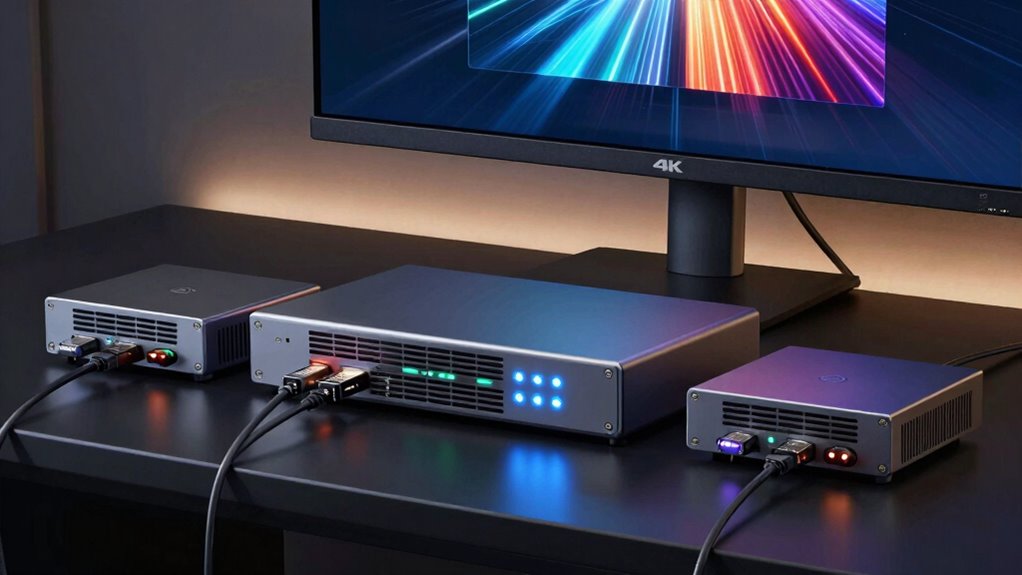

AV over IP 4K encoder decoder kits enable high-quality video transmission over IP networks, making them essential for modern AV setups. The best models balance 4K resolution support, low latency, and ease of use, but often require tradeoffs between price and features. The Zowietek ZowieBox stands out for affordability, while the J-Tech Digital HDMI Encoder offers robust streaming options. Buyers face choices around protocol support, latency, and complexity—so continue reading for a detailed breakdown to find your ideal kit.

Get business pricing on your home office setup
- Business-only prices and quantity discounts
- Tax-exempt purchasing
- Multiple users, one account, clear invoices
Complete the kit


Key Takeaways
- Top picks excel in balancing 4K support with low latency, crucial for live applications.
- Protocol compatibility varies widely, impacting ease of integration into existing systems.
- Price often correlates with feature set—more expensive kits typically support more protocols and offer better build quality.
- Ease of setup and management is a key differentiator for less technical users.
- Tradeoffs often involve choosing between advanced features and simplicity or cost.


More Details on Our Top Picks
Zowietek ZowieBox 4K HDMI Video Encoder/Decoder
The Zowietek ZowieBox stands out for its multifunctional capabilities as an encoder, decoder, and converter, making it highly adaptable for remote production and live streaming. Unlike the simpler Eaton Tripp Lite Series, which is primarily designed for high-quality AV distribution over Ethernet, the ZowieBox offers support for multiple protocols like SRT, RTMP, and RTSP, boosting its versatility. Its compact aluminum housing ensures durability in demanding environments, and hardware-based H.264/H.265 encoding reduces setup complexity. However, its setup can be challenging for users lacking technical skills, and limited UI info might hinder quick operation. Ideal for professionals needing a flexible, all-in-one device, especially in live event settings where multiple protocols are essential.
Pros:- Supports multiple streaming protocols including SRT, RTMP, and RTSP for broad compatibility
- Compact, durable aluminum housing suitable for professional environments
- Hardware H.264/H.265 encoding minimizes hardware costs and complexity
Cons:- Setup may require advanced technical knowledge, limiting accessibility for beginners
- Limited user interface details can hinder quick configuration
Best for: AV professionals managing remote broadcasts, live streaming setups, or multi-protocol environments
Not ideal for: Hobbyists or small-scale streamers seeking simple plug-and-play devices due to potential setup complexity
- Mounting Type:Tripod Mount
- Number of Pins:19
- Interface:HDMI
- Number of Channels:7
Our verdict“This device is best suited for professionals who need a versatile, multi-protocol AV over IP solution with robust build quality.”
Eaton Tripp Lite Series 4K Wireless HDMI Transmitter and Receiver Kit
The Eaton Tripp Lite Series excels in delivering reliable 4K signals over long distances within indoor venues, making it ideal for trade shows and conference centers. Its support for 4K@30Hz with low latency ensures high-quality visuals, comparable to the Video Encoder & Decoder kit but with a focus on multi-display setups through Ethernet and daisy-chain configurations. Its plug-and-play Ethernet-based approach simplifies deployment, but it requires additional receivers for multi-display configurations, which can add to costs. Also, it’s limited to indoor use, unlike the more portable WayPonDEV ENC1-V3P that offers POE and protocol flexibility. This kit is best for large, static indoor environments needing stable multi-display setups.
Pros:- Supports high-quality 4K@30Hz with low latency for sharp visuals
- Flexible multi-display and daisy-chain configurations over Ethernet
- Easy to set up with Ethernet AV over IP technology and control options
Cons:- Requires additional receivers for multi-display setups, increasing costs
- Limited to indoor environments, reducing portability
Best for: Event venues, large conference rooms, or indoor trade shows requiring multi-display setups over Ethernet
Not ideal for: Outdoor events or mobile setups due to its indoor-only design and reliance on Ethernet infrastructure
- Resolution:4K@30Hz
- Max Distance:393 feet / 120 meters
- Video Compression:Lossless
- Color Depth:12-bit per channel
Our verdict“Ideal for large indoor venues seeking a reliable, long-distance AV distribution system over Ethernet.”
WayPonDEV ENC1-V3P 4K HD HDMI Encoder NDI Decoder with Protocol Support, POE, Tally, Low Latency
The WayPonDEV ENC1-V3P offers impressive multi-protocol support, including SRT, RTMP, RTSP, and NDI, making it a versatile choice for live streaming and broadcasting. Its low latency of around 100ms ensures real-time performance, outperforming many competitors like the J-Tech Digital HDMI Encoder in speed. POE support simplifies installation, while tally lights aid live production workflows. Its internal storage (~6GB) is limited, but external options mitigate this. The setup can be complex, especially for users unfamiliar with network configurations, and NDI licensing adds extra costs. This pick makes the most sense for broadcasters and video producers needing protocol flexibility and low latency.
Pros:- Supports a wide range of protocols including SRT, RTMP, RTSP, and NDI
- Low latency (~100ms) suitable for live broadcasting
- POE support simplifies power management and installation
Cons:- NDI functionality requires an additional license cost
- Setup complexity may challenge less technical users
- Limited internal storage necessitates external solutions
Best for: Professional broadcasters, live event producers, or studios requiring multi-protocol, low-latency streaming
Not ideal for: Casual or small-scale streamers who do not need extensive protocol support or low-latency requirements
- Video Input:HDMI 1.4, up to 4K30fps
- Video Output:up to 4K30fps
- Max Resolution:4K30, 1080P, 720P
- Protocols Supported:RTSP, RTMP, SRT, NDI
Our verdict“This device is best for professionals who need low-latency, multi-protocol streaming capabilities in live production environments.”
J-Tech Digital HDMI Video Encoder H.264 H.265 IPTV Network Video Encoder 4K 30Hz with NDI, Audio Embed, PoE, Supports UDP, HTTP, RTSP, RTMP, ONVIF, NDI HX2 Protocols
The J-Tech Digital Encoder combines high-resolution 4K@30Hz support with multiple compression formats, offering broad compatibility for live streaming and IPTV applications. Its HDMI loop-out and audio embedding feature add convenience for professional setups, while the LCD interface makes control straightforward, unlike the more complex initial setup for Video Encoder & Decoder. However, achieving stable 4K@30Hz output may require correct EDID settings, and remote management features are somewhat limited. Price and availability can also fluctuate, affecting long-term planning. This option is well-suited for users needing flexible, easy-to-operate hardware for professional streaming and broadcasting.
Pros:- Supports 4K@30Hz resolution with HDMI loop-out for monitoring
- Multiple compression formats optimize bandwidth and quality
- Easy-to-use LCD display with stream control button
Cons:- Proper EDID configuration needed for consistent 4K@30Hz output
- Limited remote management features could hinder automation
Best for: Producers and broadcasters seeking a combination of user-friendly controls and multi-format support for 4K streaming
Not ideal for: Users requiring advanced remote management or extensive internal storage, as these features are limited
- Compatible Devices:Desktop, Camera, Laptop, Monitor, TV
- Connector Type:HDMI
- Number of Ports:2
- Model Number:JTECH-ENCH6
Our verdict“This encoder is ideal for professionals who want straightforward operation combined with multi-format, high-resolution streaming capabilities.”
Video Encoder & Decoder – HDMI/SDI Dual Input, 4K@30 Encoding, H.265/H.264, RTMP/SRT/RTSP Streaming, Multi-Protocol Decoding, ONVIF, USB Recording, Live Streaming Encoder
The Video Encoder & Decoder offers dual HDMI and SDI inputs with 4K@30 encoding, making it a highly flexible solution for both broadcast and surveillance applications. It supports a wide array of streaming protocols, including RTMP, SRT, and RTSP, putting it ahead of simpler single-input units like the Eaton Tripp Lite in terms of input versatility. Its multi-protocol decoding and ONVIF compatibility suit security and live event environments alike. Internal USB storage and web management extend its functionality, but the configuration process can be complex for non-technical users. Power consumption details are not fully specified, which could be a concern for long deployments. This device best suits professional broadcasters and surveillance operators needing multi-input support and comprehensive protocol compatibility.
Pros:- Supports dual HDMI and SDI inputs for maximum flexibility
- High-quality 4K@30Hz encoding with multiple protocols
- Rich features including USB recording and web management
Cons:- Setup complexity may challenge less experienced users
- Limited detailed user feedback available
Best for: Broadcast stations, security systems, or large-scale live event productions requiring dual inputs and multi-protocol support
Not ideal for: Small-scale or casual streamers lacking technical resources for complex setups
- Inputs:HDMI×1, SDI×1, USB×1, 4 network inputs
- Outputs:HDMI/SDI
- Max Resolution:4K@30
- Protocols Supported:RTMP, RTSP, SRT, H.265/H.264
Our verdict“This dual-input, multi-protocol encoder and decoder is best for advanced users needing high flexibility for professional broadcast or security applications.”
J-Tech Digital HDMI Encoder, 4K 60Hz Input, 1080P 60Hz Output, IPTV Network Video Encoder
This J-Tech Digital model stands out for supporting 4K@60Hz HDMI input while delivering 1080P@60Hz output, making it suitable for high-quality streaming setups. Compared with the B0GX7PFTT7, it’s more straightforward for those primarily working with HDMI sources, but it requires some technical skill to optimize. Its compatibility with multiple protocols like RTMP, HLS, and RTSP offers flexibility, though it’s limited to HDMI input only—no SDI or other interfaces. The remote control over video and audio settings adds convenience for professional environments, and the included lifetime technical support enhances confidence in deployment. However, setup complexity and configuration nuances might deter less experienced users. If you need a reliable, HDMI-focused encoder with broad protocol support, this makes a solid choice.
Pros:- Supports 4K HDMI input and high-quality streaming
- Compatible with multiple streaming protocols
- Offers remote control over video and audio settings
- Includes lifetime technical support and warranty
Cons:- Requires technical knowledge for optimal setup
- Limited to HDMI input, no other input options
Best for: AV professionals and content creators needing flexible HDMI streaming with professional features
Not ideal for: Beginners or those seeking multi-input solutions beyond HDMI due to setup complexity
- Compatible Devices:Television
- Connector Type:HDMI
- Number of Ports:1
- Input Voltage:12 volts
- Power Plug Type:No Plug
- Best Sellers Rank:#771 in Video Converters
Our verdict“Ideal for professionals who need reliable HDMI streaming with protocol versatility and are comfortable with configuration tasks.”
4K30 DisplayPort Video Streaming Encoder with Multiple Protocols and Live Broadcast Support
This 4K30 DisplayPort encoder excels for live broadcasts needing UHD input and output, offering advanced image processing like noise reduction and overlay options. It is better suited for users who want more control over the broadcast appearance compared to the simpler H.265 encoders like the EXVIST B08FDZ2VNZ. Its support for multiple protocols such as SRT, RTSP, and UDP makes it compatible with platforms like OBS and VLC, but the setup can be intricate for those unfamiliar with network streaming. Its support for complex features like de-interlacing and overlay customization makes it ideal for professional broadcasters, yet the lack of detailed hardware compatibility information might cause hesitation. For experienced streamers seeking top-tier image quality and protocol flexibility, this encoder is a compelling choice.
Pros:- Supports 4K UHD input and output
- Supports multiple streaming protocols for versatile broadcasting
- Includes advanced image processing and overlay options
- Ideal for high-quality live streaming
Cons:- Complex setup may require technical expertise
- Limited info on hardware compatibility
Best for: Professional broadcasters and content creators needing advanced image processing and multi-protocol support
Not ideal for: Users new to live streaming or those seeking a straightforward plug-and-play device due to its setup complexity
- Video Resolution:4K UHD
- Output Streams:4
- Supported Protocols:SRT, RTSP, RTMPS, UDP, NVR
- Features:De-interlacing, noise reduction, overlay
- Compatibility:OBS, VLC, Flash Player
Our verdict“Best suited for experienced broadcasters who want detailed control over their 4K live streams and multi-protocol options.”
EXVIST H.265 1080P HDMI Video Encoder with SD Card Slot, Supports RTSP, TS, HLS, Compatible with CCTV Surveillance
This EXVIST encoder is tailored for security applications, converting HDMI signals into reliable network streams with efficient H.265 compression. Compared to higher-resolution options like the B0GS9CFZD6, it’s limited to 1080P, but its built-in SD card slot offers standalone recording—an advantage for surveillance setups. Its support for multiple protocols like RTSP, TS, and HLS makes it versatile for integration into CCTV systems, yet its resolution cap might not suit high-end broadcast needs. The web-based configuration simplifies setup, but the device’s focus on 1080P and surveillance limits its usefulness for professional AV streaming. For security-focused environments needing straightforward, reliable encoding with local storage, this is a suitable choice.
Pros:- High-quality H.265 compression for bandwidth efficiency
- Built-in SD card slot allows standalone recording
- Supports multiple network protocols for surveillance integration
- Web-based interface for easy setup
Cons:- Limited to 1080P resolution
- Requires network setup for operation
Best for: Security professionals and small surveillance setups requiring embedded recording and network streaming
Not ideal for: High-resolution broadcast or AV production users seeking 4K support or multi-input options
- Video Resolution:1080P
- Video Compression:H.265, H.264
- Input:HDMI
- Network Protocols:RTSP, TS, HLS, SRT
- SD Card Slot:Yes, up to 128GB
Our verdict“Best for security and surveillance applications needing reliable streaming and local recording within 1080P limits.”
J-Tech Digital HDMI IPTV Encoder, 4K 60Hz Input, 1080p 60Hz Output, H.264/H.265, Supports PoE and Multi-Platform Streaming
This J-Tech Digital IPTV encoder supports 4K@60Hz input and delivers 1080p output, combining high-quality video with flexible streaming protocols like RTMP, RTSP, and SRT. Its support for Power over Ethernet (PoE) simplifies installation, especially in large or distributed setups, making it more convenient than models like the B0761X6L3C that lack PoE. Its multi-platform support broadens audience reach, but it requires a PoE network switch, which can add to setup complexity. The device is ideal for professional AV deployments that demand high input resolution and easy installation, yet detailed user reviews and comprehensive hardware info are limited. For those seeking a robust, network-ready encoder with PoE, this model makes sense.
Pros:- Supports 4K input and full HD output
- Multiple codecs including H.264 and H.265
- PoE support for streamlined installation
- Multi-platform streaming capabilities
Cons:- Requires PoE network switch for power
- Limited detailed user reviews for comprehensive performance insights
Best for: AV professionals and broadcasters requiring high-res input with simplified installation via PoE
Not ideal for: Users without PoE infrastructure or those preferring simple plug-and-play solutions
- Resolution:1080p
- Input Resolution:4K 60Hz
- Video Codecs:H.264, H.265, MJPEG
- Connectivity:Ethernet, HDMI, RJ45
- Power:PoE
Our verdict“Great for AV setups needing high input resolution and PoE-powered convenience, especially in larger installations.”
4K HDMI Video Encoder Decoder, H.264/H.265, Supports RTMP RTSP SRT HLS UDP Multicast, HDMI Loopout, Multi-Platform Live Streaming, IPTV & GB28181 ONVIF Compatible
This 4K HDMI encoder/decoder offers a comprehensive feature set for multi-platform streaming, supporting dual codecs and multiple protocols including RTMP, RTSP, and SRT. Its support for local multi-view layouts and HDMI loopout makes it highly versatile for broadcast, education, or digital signage. Compared to the B0GX7PFTT7, it provides more input options and multi-view capabilities, but it’s slightly larger and requires technical setup. Its robust feature set and durable all-metal chassis make it suitable for continuous operation, although the price and setup complexity might be barriers for some users. If multi-view layouts, local recording, and multi-protocol support are priorities, this device stands out as a comprehensive solution.
Pros:- Supports 4K live streaming with dual codecs
- Enables multi-view layouts and local recording
- Supports a wide range of protocols including ONVIF
- Compact, durable all-metal chassis
Cons:- Requires technical setup and configuration
- Limited input options beyond HDMI
Best for: Broadcast professionals and digital signage operators needing multi-view and multi-platform streaming
Not ideal for: Casual users or small-scale AV applications that don’t require multi-view layouts or complex features
- Video Resolution:4K@30fps
- Encoding Codecs:H.264, H.265
- Input Ports:2 HDMI
- Supported Platforms:YouTube, Twitch, Zoom, OBS
- Additional Features:OSD overlay, local recording
Our verdict“Best for professional broadcast and signage environments demanding multi-view capability and multi-platform support.”

How We Picked
The products were evaluated based on performance, build quality, protocol support, ease of use, and value for money. Priority was given to devices that reliably support 4K resolution over IP networks with minimal lag, as well as those with flexible connectivity options. We also considered user interface design, firmware updates, and overall reliability. Kits that strike a good balance between advanced features and straightforward setup rank higher, ensuring they meet both professional and intermediate user needs.Factors to Consider When Choosing Av Over Ip 4k Encoder Decoder Kits
Selecting the right AV over IP 4K encoder decoder kit depends on several key factors that influence performance, compatibility, and ease of use. Understanding these factors helps prevent costly mistakes and ensures the system you choose will reliably meet your needs over time. From protocol support to scalability, each consideration plays a role in shaping your ideal setup.Protocol Compatibility and Network Support
Make sure the kit supports the streaming protocols your network and devices use, such as RTSP, RTMP, SRT, or ONVIF. Compatibility ensures seamless integration with existing systems and future expandability. Choosing a device with multi-protocol support offers flexibility but may come at a higher cost. Avoid kits that lock you into proprietary protocols unless they offer clear advantages, as this can limit compatibility with other equipment.
Resolution Support and Latency
4K support is a must for modern high-resolution displays, but verify the maximum supported frame rate and whether the device maintains low latency for live applications. High latency can cause lip-sync issues or lag in interactive setups, so prioritize models that specify low-latency performance. Cheaper options might cut corners here, leading to delayed or degraded video quality, especially at higher frame rates.
Ease of Setup and Management
Ease of installation and configuration can save hours of troubleshooting. Devices with intuitive user interfaces, web-based management, or auto-discovery features tend to be more accessible for non-technical users. Complex systems might require dedicated AV technicians, increasing overall costs. Consider whether firmware updates and remote management are supported for future-proofing your investment.
Build Quality and Reliability
Durability matters, especially in commercial or demanding environments. Look for kits with solid construction, good heat dissipation, and reputable brand support. Cheaper models may save money upfront but could suffer from overheating or connectivity issues over time. Reliability ensures consistent performance, reducing downtime and maintenance costs.
Scalability and Future-Proofing
Assess whether the system can grow with your needs—more inputs, outputs, or higher resolutions—without requiring a complete overhaul. Modular designs or multi-channel support can provide this flexibility. Investing in a system that scales smoothly can save money long-term, but it might mean paying a premium upfront.
Frequently Asked Questions
Can these kits support multiple displays simultaneously?
Yes, most AV over IP 4K encoder decoder kits support multi-display setups, but capabilities vary. Some kits allow daisy-chaining or multiple outputs from a single encoder, while others need dedicated decoders for each display. Ensure the kit you select explicitly states multi-output support if that’s a priority. Compatibility with your network infrastructure is also key to managing multiple streams efficiently.
Do I need a dedicated network for AV over IP systems?
While it’s possible to run AV over IP on existing networks, dedicated networks are recommended for critical applications to prevent interference from other traffic. Using a separate VLAN or managed switches can ensure stable bandwidth and reduce latency. For small setups or testing, existing networks might suffice, but for professional or real-time uses, dedicated infrastructure enhances reliability.
What is the typical latency range I should expect?
Latency in AV over IP 4K systems generally ranges from less than 100 milliseconds to over 200 milliseconds, depending on the device and network conditions. Low-latency kits under 100ms are preferable for live events or interactive applications, while higher latency might be acceptable for static displays or monitoring. Always check the manufacturer’s specifications for latency figures relevant to your intended use.
Are these kits compatible with existing IP infrastructure?
Most AV over IP 4K encoder decoder kits are designed to work with standard network equipment, but compatibility depends on protocol support and network configuration. Devices supporting common standards like RTSP or ONVIF tend to integrate smoothly. Confirm that your network hardware can handle the required bandwidth and multicast or unicast streaming to avoid issues during deployment.
What’s the difference between H.264 and H.265 encoding in these kits?
H.264 and H.265 are video compression standards, with H.265 offering roughly double the compression efficiency of H.264. This means H.265 can deliver 4K video at lower bitrates, reducing network load and storage requirements. However, H.265 encoding demands more processing power, which can increase latency or hardware costs. Choose H.265 support if you need efficient streaming over limited bandwidth, but ensure your devices and network support it fully.
Conclusion
For most professional AV setups requiring reliable 4K streaming, the Zowietek ZowieBox 4K HDMI Video Encoder/Decoder offers a compelling balance of affordability and performance, making it ideal for small to medium-sized installations. The J-Tech Digital HDMI Encoder with 4K 60Hz suits users seeking high frame rate support with straightforward setup, perfect for broadcasters or live events. Budget-conscious buyers should consider models like the Eaton Tripp Lite Series, which deliver core features at a lower price point, though with some limitations in protocol support. For those with complex or large-scale needs, investing in a more scalable, feature-rich solution will help future-proof your infrastructure, especially if low latency and multi-protocol support are priorities. Your choice should align with your specific use case, budget, and technical expertise to ensure seamless, high-quality AV delivery over your IP network.
As an affiliate, we earn on qualifying purchases.Halloween Picks

10-Foot Halloween Inflatable Double-Headed Dragon Archway

JOYIN 5-Foot Halloween Animatronic Drinking Skeleton

Jenaai 5.3-Foot Motion-Activated Halloween Animatronic Skeleton