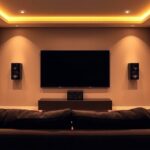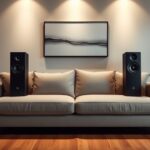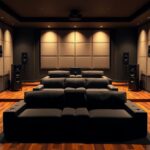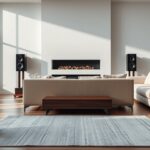
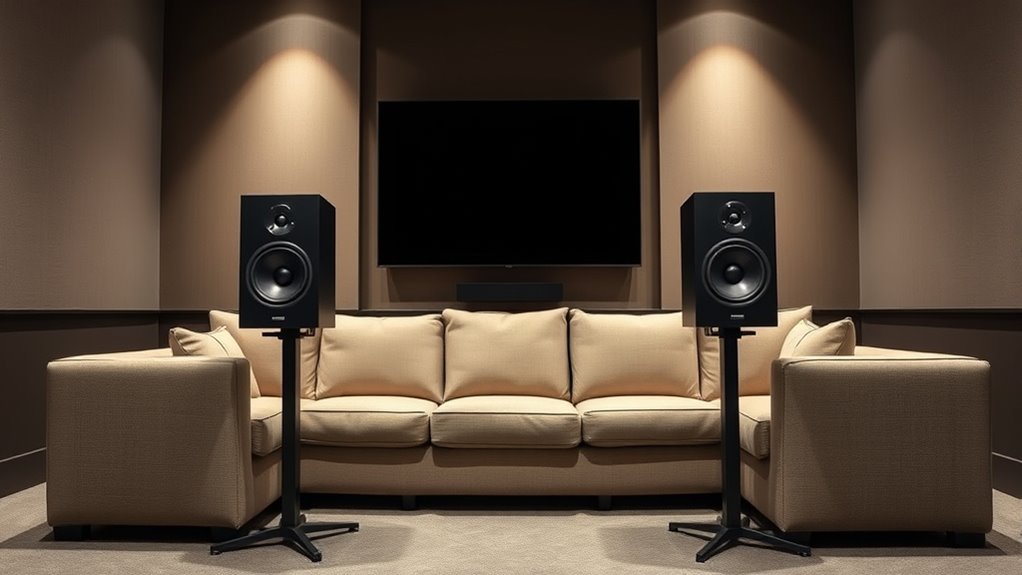
To achieve balanced sound, position your speakers in an equilateral triangle with the listening spot, keeping them at ear level and aimed toward you. Avoid placing them close to walls or corners to reduce reflections and echoes. Experiment with angles and distances until you notice clear, even sound across your space. Proper room setup and calibration make a big difference. If you keep adjusting, you’ll discover even better ways to optimize your sound experience.
Key Takeaways
- Arrange speakers at ear level, aiming directly toward the listening position for clarity.
- Position speakers at equal distances from the listener to create a balanced soundstage.
- Form an equilateral triangle between speakers and the listening spot for optimal immersion.
- Keep speakers away from walls and corners to minimize reflections and standing waves.
- Adjust angles and height for precise aiming and improved sound clarity and depth.
Have you ever wondered why your favorite movies sound so immersive? The secret often lies in how well your speakers are placed and how their sound interacts with your room acoustics. Proper speaker placement isn’t just about setting up equipment; it’s about creating a balanced soundstage that makes you feel like you’re right there in the scene. One of the most important steps in achieving this is understanding how your room acoustics influence sound. Every room has its own unique characteristics—wall angles, furniture, and materials—that affect how sound waves bounce and decay. If your space has hard surfaces or irregular shapes, echoes and dead spots can distort your listening experience. To counteract this, you need to experiment with speaker placement, aiming to reduce unwanted reflections and standing waves. Positioning your speakers away from walls and corners can help, but it’s also essential to *think about* how sound interacts with your specific room.
Once you’ve found a good spot, speaker calibration becomes the next critical step. This process involves adjusting your speaker settings to compensate for room effects and ensure balanced sound. Many modern audio systems include calibration tools or room correction software that analyze how sound behaves in your space. These tools can automatically tweak volume levels, equalization, and delay settings to optimize sound quality. But even without advanced tech, you can manually calibrate by listening carefully and making small adjustments. For example, if your audio sounds muddy or overly bright, tweak the balance between speakers or adjust their angles slightly. The goal is to create a seamless soundstage where dialogue, music, and effects blend naturally without one element overpowering the others. Additionally, understanding the impact of room acoustics can help you make more informed decisions about speaker placement and calibration.
Achieving balanced sound also involves paying attention to speaker placement relative to your seating position. Ideally, speakers should form an equilateral triangle with your listening spot, with each speaker roughly the same distance from you. This setup helps deliver sound evenly across your ears, enhancing clarity and depth. Don’t forget to consider the height and angle of your speakers—aiming them toward your ears can drastically improve sound clarity. After placing them, run a calibration or listen critically, adjusting as needed. Remember, the key is patience and fine-tuning; small tweaks can make a significant difference. When your room acoustics are managed well and your speakers are calibrated correctly, you’ll notice a marked improvement in how immersive and balanced your audio experience becomes, making every movie or song more engaging and true to life.

Klipsch R-12SW Powerful Deep Bass Front Firing 12" Copper-Spun Driver 400W Digital Power Subwoofer 14" X 18.5" X 16"
Powerful 12" copper-spun front-firing woofer
As an affiliate, we earn on qualifying purchases.
Frequently Asked Questions
How Does Room Acoustics Affect Speaker Placement?
Room acoustics substantially influence your speaker placement by affecting sound reflections and absorption. If your room has hard surfaces, reflections can cause echo and muddiness, so you should position speakers away from walls and add sound absorption materials like rugs or panels. Proper placement minimizes unwanted reflections, ensuring clearer sound. You can experiment with placement to find a spot that reduces reflections and enhances sound quality, giving you a balanced listening experience.
What Is the Ideal Height for Placing Speakers?
Sure, because everyone loves a good game of “Guess the Perfect Height,” right? The ideal speaker height is roughly ear level when you’re seated at your listening level. This guarantees sound hits your ears directly, not from above or below. Adjust your speakers so their tweeters are aligned with your ears. It’s simple—your ears deserve the best, not a surprise from speaker placement.
Can Furniture Placement Influence Sound Balance?
Yes, furniture placement can definitely influence sound balance. Your decor impact, such as large couches or bookcases, can absorb or reflect sound waves, affecting clarity and stereo imaging. Positioning furniture thoughtfully helps prevent sound from becoming muffled or uneven. You should consider spacing and material choices to optimize acoustics, ensuring your room’s decor not only looks good but also enhances overall sound quality.
How Do Different Speaker Types Require Different Placements?
Different speaker types require varied placements to optimize sound dispersion and speaker isolation. For example, bookshelf speakers should be placed at ear level and slightly angled towards you to enhance clarity, while floor-standing speakers need more space around them to prevent sound muddiness. Subwoofers benefit from being placed near walls to reinforce bass, but avoid corners for cleaner sound. Adjust placement carefully to balance sound and reduce interference.
What Tools Can Help Optimize Speaker Positioning?
Did you know that proper speaker calibration can improve sound clarity by up to 50%? To optimize your speaker positioning, use tools like a sound level meter or room calibration software. Acoustic treatment panels also help reduce reflections and echoes, enhancing audio accuracy. These tools guide you in fine-tuning placement, ensuring balanced sound across your space, and creating an immersive listening experience you’ll love.

Klipsch R-120SW Subwoofer, Black
12" high excursion spun-copper Imp woofer
As an affiliate, we earn on qualifying purchases.
Conclusion
By carefully positioning your speakers, you create a soundstage as balanced as a tightrope walk. When your speakers are placed just right, they become the bridge that connects you to immersive, crystal-clear audio. Think of your setup as the heartbeat of your listening experience—small adjustments can turn a good sound into a symphony. Keep experimenting, and let your sound system be the steady anchor in your musical journey.

Denon AVR-X1700H 7.2 Channel AV Receiver - 80W/Channel, Advanced 8K HDMI Video w/eARC, Dolby Atmos, DTS:X, Built-in HEOS, Amazon Alexa Voice Control
HIGH-PERFORMANCE 7-CHANNEL AMPLIFIER WITH NEXT-GEN MOVIE IMMERSION - Enjoy Denon sound in movies, games, and music with full...
As an affiliate, we earn on qualifying purchases.

Rockville Rock Shaker 15" Powered Subwoofer, 1000W Peak / 500W RMS, Class-D, MDF Enclosure, RCA, Speaker Inputs, Phase & Crossover Control, Black, for Home Theater & Studio
POWERFUL 1000W SUBWOOFER - 1000 watts peak / 500 watts RMS delivers deep, thumping bass ideal for home...
As an affiliate, we earn on qualifying purchases.