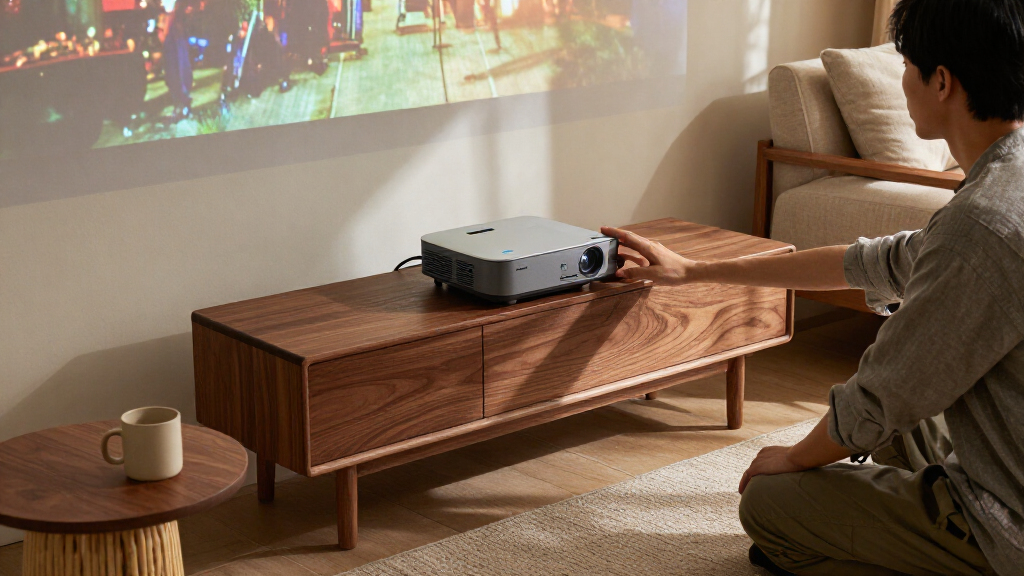

Ultra short throw projectors put a large image close to the wall, helping you avoid a ceiling mount and long cable runs. My best overall pick is the Hisense PX3-PRO, whose stated brightness, gaming features, and broad screen-size range make it the most adaptable choice in this lineup. The AWOL Aetherion Pro stands out for its claimed contrast and color coverage, while the Epson LS650 is a bright 3LCD option for buyers who value room flexibility. The main tradeoffs are image performance in ambient light, the cost and fit of a UST screen, and how much gaming, smart-TV, or portability features matter to you. Read on for the full comparison and a guide to choosing the right projector for your room.

Get business pricing on your home office setup
- Business-only prices and quantity discounts
- Tax-exempt purchasing
- Multiple users, one account, clear invoices
Complete the kit


Key Takeaways
- The Hisense PX3-PRO is the most balanced pick: its listed 3,000 lumens, 80–150-inch image range, and gaming-focused features cover more use cases than the more specialized models.
- Brightness figures alone do not settle the room-fit question: the Epson LS650 lists 3,600 lumens, but screen material, placement, and the room’s light still shape the result.
- Gaming separates the PX3-PRO from theater-first choices: its stated high-refresh capability and Xbox positioning make it the clearest fit for players.
- Laser and color claims vary widely across the group: the AWOL Aetherion Pro, JMGO O2S, and AWOL LTV-3000 Pro offer triple-laser designs, while Epson’s 3LCD models use a different imaging approach.
- Not every UST here is a living-room TV substitute: the Optoma ML1080UST is portable and 1080p, and the Epson PowerLite 760W is a 16:10 business-oriented model rather than a conventional 4K home theater pick.
| AWOL Aetherion Pro 4K Ultra Short Throw Triple Laser Projector |  | Best for Maximum Screen Size and Picture Control | Native resolution: 3840 × 2160 | Light source: Triple laser | Brightness: 2,600 ISO lumens in title; 3,000 lumens in listed specifications | VIEW LATEST PRICE | See Our Full Breakdown |
| XGIMI AURA 2 GTV Black UST Laser Projector |  | Best for Built-In Streaming and Easy Setup | Native resolution: 3840 × 2160 | Brightness: 2,300 ISO lumens | Dynamic contrast ratio: 1,000,000:1 | VIEW LATEST PRICE | See Our Full Breakdown |
| WEMAX Nova Pro 4K Ultra Short Throw Projector |  | Best for Family Streaming and Everyday Entertainment | Native resolution: 3840 × 2160 | Display technology: DLP with ALPD laser light source | Brightness: 2,100 ISO lumens | VIEW LATEST PRICE | See Our Full Breakdown |
| Hisense PX3-PRO Ultra Short Throw Triple Laser Projector |  | Best for Gaming and Bright, Colorful 4K | Native resolution: 3840 × 2160 | Light source: Triple laser with Hisense LPU TriChroma technology | Brightness: 3,000 lumens | VIEW LATEST PRICE | See Our Full Breakdown |
| Epson PowerLite 760W Ultra Short Throw 3LCD Projector |  | Best for Classrooms and Bright Presentation Spaces | Native resolution: 1280 × 800 WXGA | Display technology: 3LCD | Brightness: 4,100 lumens | VIEW LATEST PRICE | See Our Full Breakdown |
| Epson EpiqVision Ultra LS650 Ultra Short Throw 3-Chip 3LCD Smart Streaming Laser Projector, 4K PRO-UHD, HDR, 3,600 Lumens, up to 120″, Android TV, Sound by Yamaha – Black (Renewed) |  | Best for Bright Living Rooms | Resolution: 3840 × 2160 maximum; 4K PRO-UHD pixel-shift processing | Display technology: 3-chip 3LCD | Brightness: 3,600 lumens | VIEW LATEST PRICE | See Our Full Breakdown |
| Optoma ML1080UST Photon GO Ultra Short Throw 1080p Portable Projector |  | Best Portable UST | Native resolution: 1920 × 1080 | Brightness: 650 lumens | Display technology: Triple RGB laser | VIEW LATEST PRICE | See Our Full Breakdown |
| JMGO O2S Ultra 4K Ultra Short Throw Triple Laser Projector 3600 ISO Lumen |  | Best for Maximum Screen Size | Native resolution: 3840 × 2160 | Display technology: RGB triple laser | Brightness: 3,600 ISO lumens | VIEW LATEST PRICE | See Our Full Breakdown |
| AWOL VISION LTV-3000 Pro 4K 3D Ultra Short Throw Triple Laser Projector, Dolby Vision & Atmos, HDR10+, 150″ UST Laser TV Home Theater Projector |  | Best for Dedicated Home Theater | Native resolution: 3840 × 2160 | Display technology: Triple laser | Maximum brightness: 3,000 ANSI lumens | VIEW LATEST PRICE | See Our Full Breakdown |
| ultra short throw projector | Native resolution | Brightness | Maximum image size | Display technology |
|---|---|---|---|---|
| AWOL Aetherion Pro 4K Ultra Sh | 3840 × 2160 | 2,600 ISO lumens in title; 3,000 lumens in listed specifications | 200 inches | — |
| XGIMI AURA 2 GTV Black UST Las | 3840 × 2160 | 2,300 ISO lumens | — | — |
| WEMAX Nova Pro 4K Ultra Short | 3840 × 2160 | 2,100 ISO lumens | 150 inches | DLP with ALPD laser light source |
| Hisense PX3-PRO Ultra Short Th | 3840 × 2160 | 3,000 lumens | — | — |
| Epson PowerLite 760W Ultra Sho | 1280 × 800 WXGA | 4,100 lumens | 150 inches | 3LCD |
| Epson EpiqVision Ultra LS650 U | — | 3,600 lumens | 120 inches | 3-chip 3LCD |
| Optoma ML1080UST Photon GO Ult | 1920 × 1080 | 650 lumens | 100 inches | Triple RGB laser |
| JMGO O2S Ultra 4K Ultra Short | 3840 × 2160 | 3,600 ISO lumens | 150 inches | RGB triple laser |
| AWOL VISION LTV-3000 Pro 4K 3D | 3840 × 2160 | — | 150 inches | Triple laser |
More Details on Our Top Picks
AWOL Aetherion Pro 4K Ultra Short Throw Triple Laser Projector
The Aetherion Pro is the standout here for buyers who want a very large 4K image without moving the projector far from the wall: its listed image range reaches 200 inches, beyond the 150-inch ceiling of the Hisense PX3-PRO and WEMAX Nova Pro. Its triple-laser color system, stated 110% Rec.2020 coverage, and adjustable iris target viewers who care about wide color and shadow detail in a dedicated theater room. For gaming, the advertised 1 ms latency, VRR, and ALLM are a stronger feature set on paper than the XGIMI AURA 2’s 20 ms latency. The tradeoffs are its lower listed brightness than the Hisense and Epson, plus a large screen that will make room light and screen choice matter. The listing also gives conflicting brightness figures, so I would verify the exact specification before buying.
Pros:- Listed image size reaches 200 inches, larger than the 150-inch maximum stated for the Hisense PX3-PRO and WEMAX Nova Pro.
- Triple-laser color with stated 110% Rec.2020 coverage and a six-level iris offers substantial picture-tuning potential.
- Advertised 1 ms latency, VRR, and ALLM make it the most gaming-focused option in this group on paper.
- Dolby Vision, HDR10+, HDR10, and HLG support cover several major HDR formats.
Cons:- Its stated 2,600 ISO lumens are below the Hisense PX3-PRO’s listed 3,000 lumens and Epson 760W’s 4,100 lumens.
- The product information conflicts on brightness, listing 2,600 ISO lumens in the title and 3,000 lumens in the specs.
- A 200-inch image needs a suitable wall or screen and a light-controlled room to show its detail well.
Best for: Home-theater buyers with a darkened room who want a 4K ultra short throw image larger than 150 inches, plus gaming features and detailed picture adjustments.
Not ideal for: People projecting in a bright room or anyone who needs a clearly confirmed brightness specification before choosing; the listing states both 2,600 ISO lumens and 3,000 lumens.
- Native resolution:3840 × 2160
- Light source:Triple laser
- Brightness:2,600 ISO lumens in title; 3,000 lumens in listed specifications
- Maximum image size:200 inches
- Minimum image size:80 inches
- Contrast:Up to 6,000:1 native contrast with iris; up to 60,000:1 viewing contrast stated in description
- Color gamut:110% Rec.2020
- Light-source life:25,000 hours
Our verdict“Choose the Aetherion Pro if a 200-inch-capable 4K image, extensive picture controls, and responsive gaming matter more than a straightforward brightness specification.”
XGIMI AURA 2 GTV Black UST Laser Projector
The AURA 2 makes a strong case for buyers who want an ultra short throw projector to behave more like a ready-to-use TV. Its Google TV with licensed Netflix reduces the need for a separate streaming box, while Dolby Vision, IMAX Enhanced, and built-in Harman Kardon audio give it a convenient living-room focus. Compared with the WEMAX Nova Pro, which also includes Google TV, the AURA 2 claims a much higher dynamic contrast ratio and adds IMAX Enhanced certification. Its 0.177:1 throw ratio supports close placement, though its maximum image size is 150 inches—short of the AWOL Aetherion Pro’s stated 200 inches. At 2,300 ISO lumens, it is also less bright on paper than the Hisense PX3-PRO. The 20 ms gaming latency suits casual play better than latency-sensitive gaming.
Pros:- Google TV and licensed Netflix are built in, reducing reliance on an external streaming device.
- Dolby Vision and IMAX Enhanced support suit film and streaming-focused use.
- Harman Kardon speakers and Dolby Atmos support provide an integrated audio option.
- 0.177:1 throw ratio supports placement close to the projection surface.
Cons:- The 150-inch maximum image size is smaller than the AWOL Aetherion Pro’s stated 200-inch maximum.
- Its 2,300 ISO lumens are lower than the Hisense PX3-PRO’s listed 3,000 lumens.
- The stated 20 ms latency is less suited to competitive play than the AWOL Aetherion Pro’s advertised 1 ms latency.
Best for: Living-room viewers who want built-in Netflix and Google TV, integrated speakers, and a close-placement 4K setup with minimal extra equipment.
Not ideal for: Competitive gamers seeking the lowest listed latency, or buyers who want an image larger than 150 inches or more brightness than the Hisense PX3-PRO lists.
- Native resolution:3840 × 2160
- Brightness:2,300 ISO lumens
- Dynamic contrast ratio:1,000,000:1
- Throw ratio:0.177:1
- Image size:80–150 inches
- Minimum throw distance:0.13 m
- Maximum throw distance:0.38 m
- Gaming latency:20 ms
- Connectivity:Bluetooth, HDMI, USB, and Wi-Fi
Our verdict“Pick the AURA 2 if integrated streaming, recognizable HDR formats, and built-in sound matter more than maximum brightness, screen size, or competitive gaming response.”
WEMAX Nova Pro 4K Ultra Short Throw Projector
The Nova Pro is a practical family-room choice because it combines 4K resolution, Google TV, and native Netflix with a 150-inch maximum image. Its 0.23:1 throw ratio is designed for compact spaces, and the stated 49 cm distance for a 150-inch picture gives buyers a concrete placement reference. Compared with the XGIMI AURA 2, it offers a similar built-in streaming approach while adding stated active 3D playback and a broader set of physical connections, including HDMI 2.1, optical audio, and LAN. It falls behind the Hisense PX3-PRO in listed brightness and the AWOL Aetherion Pro in maximum screen size and gaming latency. The 2,100 ISO lumens are best suited to controlled lighting; direct sunlight or a bright room will make a large projected image harder to enjoy.
Pros:- Google TV and native Netflix provide built-in access to streaming without a separate player.
- The 0.23:1 throw ratio supports a large image in a compact room.
- Active 3D and MEMC add options for 3D films and smoother-looking motion.
- Dual 15 W speakers and HDMI 2.1, optical, LAN, USB, Wi-Fi, and Bluetooth connections support a flexible family setup.
Cons:- The 2,100 ISO-lumen rating is below the XGIMI AURA 2 and Hisense PX3-PRO figures supplied.
- Its 150-inch limit is smaller than the AWOL Aetherion Pro’s listed 200-inch maximum.
- The description recommends minimizing direct sunlight or pairing it with an ALR screen, limiting its appeal for bright rooms.
Best for: Families setting up a compact-room movie and sports space who want Google TV, Netflix, built-in audio, and occasional 3D playback.
Not ideal for: Viewers who need strong performance in a sunlit room, want a screen larger than 150 inches, or prioritize the lowest gaming latency.
- Native resolution:3840 × 2160
- Display technology:DLP with ALPD laser light source
- Brightness:2,100 ISO lumens
- Throw ratio:0.23:1
- Maximum image size:150 inches
- Maximum throw distance:0.49 m
- Contrast ratio:3,000:1
- Audio:Dual 15 W speakers with Dolby Audio and DTS-HD
- Connectivity:HDMI 2.1, USB, optical audio, LAN, Wi-Fi, and Bluetooth
Our verdict“Choose the Nova Pro for a compact family setup with built-in streaming and 3D, provided the room can be kept reasonably dark.”
Hisense PX3-PRO Ultra Short Throw Triple Laser Projector
The PX3-PRO is the most balanced pick for buyers who want an ultra short throw projector that can handle both films and games. Its 3,000-lumen rating exceeds the figures supplied for the XGIMI AURA 2 and WEMAX Nova Pro, while triple-laser color, Dolby Vision, IMAX Enhanced, and Google TV make it well equipped for varied viewing. Hisense also identifies it as designed for Xbox and lists a 240 Hz high-refresh-rate capability, giving it a more explicit gaming focus than those streaming-first alternatives. Its 80–150-inch range fits many TV-replacement setups, but it cannot match the AWOL Aetherion Pro’s stated 200-inch ceiling. The tradeoff is that brightness alone does not remove the need to manage room light, and the listed 3,000:1 contrast is less ambitious than the headline contrast figures on some rivals.
Pros:- Its 3,000-lumen specification is higher than the supplied brightness figures for the XGIMI AURA 2 and WEMAX Nova Pro.
- Triple-laser light source and stated 110% BT.2020 color gamut target vivid, wide-gamut images.
- Dolby Vision, Dolby Atmos, and IMAX Enhanced support serve a broad home-cinema mix.
- Designed-for-Xbox positioning and 240 Hz high-refresh-rate specification make gaming a clear use case.
Cons:- The 150-inch maximum image is smaller than the AWOL Aetherion Pro’s stated 200-inch maximum.
- The listed 3,000:1 contrast ratio is far below the dynamic contrast headline on the XGIMI AURA 2, though the figures use different stated contrast types.
- A high-refresh-rate specification does not by itself establish the projector’s input lag at every resolution and mode.
Best for: Console gamers and movie viewers who want a 4K ultra short throw projector with strong listed brightness, broad HDR support, and Google TV.
Not ideal for: Buyers who need a projected image larger than 150 inches or who put highest priority on the headline contrast figure rather than gaming and brightness features.
- Native resolution:3840 × 2160
- Light source:Triple laser with Hisense LPU TriChroma technology
- Brightness:3,000 lumens
- Image size:80–150 inches
- Contrast ratio:3,000:1
- Maximum refresh rate:240 Hz stated
- Color gamut:110% BT.2020 stated
- Light-source life:25,000 hours
- Connectivity:Bluetooth 5, Ethernet, HDMI, USB 3.0, and Wi-Fi
Our verdict“Choose the PX3-PRO if gaming, 4K HDR support, and a higher stated brightness rating outweigh the desire for a screen beyond 150 inches.”
Epson PowerLite 760W Ultra Short Throw 3LCD Projector
The PowerLite 760W serves a different job from the home-cinema models in this roundup: it is a bright, wide-format WXGA display built for classrooms and presentations, not 4K film viewing. Its 4,100-lumen rating is higher than the supplied figures for the Hisense PX3-PRO and other laser home-theater picks, while 3LCD technology provides color and white brightness. The ultra short throw design helps reduce shadows from presenters standing near the screen, and wireless casting and split-screen support suit group instruction. Compared with the Hisense or WEMAX, though, its 1280 × 800 resolution gives up the fine detail expected for 4K movies and gaming. It also uses a 16:10 presentation format and reaches up to 150 inches, making it a better fit for shared content than a cinematic TV replacement.
Pros:- The 4,100-lumen rating is the highest listed brightness among these five products.
- Ultra short throw placement helps limit shadows when a presenter stands near the display.
- Wireless casting supports up to 50 devices, and split screen can show up to four connected devices.
- The laser light source is rated for 20,000 hours and does not require lamp replacement.
Cons:- 1280 × 800 WXGA resolution is substantially below the 4K resolution of the Hisense PX3-PRO and other home-cinema options.
- Its 16:10 format and classroom-focused features are less suited to a dedicated film and gaming setup.
- The stated laser life is 20,000 hours, shorter than the 25,000 hours listed for the AWOL Aetherion Pro and Hisense PX3-PRO.
Best for: Teachers, trainers, and meeting-room presenters who need a bright ultra short throw image, wireless device sharing, and reduced presenter shadows.
Not ideal for: Home-theater buyers seeking native 4K detail, cinematic HDR formats, or a projector optimized for console gaming.
- Native resolution:1280 × 800 WXGA
- Display technology:3LCD
- Brightness:4,100 lumens
- Aspect ratio:16:10
- Maximum image size:150 inches
- Minimum image size:60 inches
- Light-source life:20,000 hours
- Connectivity:Ethernet, HDMI, USB, and Wi-Fi
- Wireless sharing:Casting support for up to 50 devices; split-screen display for up to four devices
Our verdict“Pick the PowerLite 760W for bright classrooms and presentations, but choose a 4K home-cinema model if movies and games are the priority.”
Epson EpiqVision Ultra LS650 Ultra Short Throw 3-Chip 3LCD Smart Streaming Laser Projector, 4K PRO-UHD, HDR, 3,600 Lumens, up to 120″, Android TV, Sound by Yamaha – Black (Renewed)
The LS650 is the sensible pick when an ultra short throw projector needs to compete with everyday room light. Its 3,600 lumens and three-chip 3LCD design are aimed at keeping color and white brightness strong, while the short placement distance helps fit a large image into a living room without a ceiling mount. Compared with the portable Optoma ML1080UST Photon GO, this Epson is built for a fixed home setup: it offers 4K PRO-UHD pixel-shift processing and a maximum 120-inch image rather than battery-powered portability and 1080p resolution. Android TV and Yamaha 2.1 audio also reduce the number of extra devices needed. The tradeoffs are its 120-inch ceiling, a separately sold ambient-light-rejecting screen for the strongest daytime contrast, and the added uncertainty of buying a renewed unit.
Pros:- 3,600-lumen 3LCD output is suited to rooms with some ambient light.
- Ultra short throw placement supports a large image without a long room.
- Android TV and Yamaha 2.1 sound provide streaming and audio onboard.
- HDMI eARC can pass supported audio formats to a receiver or soundbar.
Cons:- Maximum image size is 120 inches, below the 150-inch options from JMGO and AWOL.
- 4K PRO-UHD is produced with pixel shifting rather than native 4K imaging.
- Renewed condition may not suit buyers who prefer a new unit.
Best for: Living-room viewers who want a large, bright image, built-in streaming, and usable onboard sound without adding a separate source device.
Not ideal for: Buyers who need a 150-inch image, native 4K, or the assurance of a new projector; this model tops out at 120 inches, uses 4K pixel shifting, and is renewed.
- Resolution:3840 × 2160 maximum; 4K PRO-UHD pixel-shift processing
- Display technology:3-chip 3LCD
- Brightness:3,600 lumens
- Maximum image size:120 inches
- Minimum image size:60 inches
- Maximum throw distance:0.41 feet
- Smart platform:Android TV
- Audio:Built-in Yamaha 2.1 virtual surround system
- Connectivity:HDMI, USB; one HDMI port supports eARC
Our verdict“Choose the LS650 for a bright, convenient living-room setup if its 120-inch limit and renewed status fit your plans.”
Optoma ML1080UST Photon GO Ultra Short Throw 1080p Portable Projector
The Photon GO makes the most sense when portability matters more than resolution or daytime punch. Its built-in battery, compact format, and ability to make a 100-inch image from less than a foot away give it a role none of the fixed living-room models here can match. Google TV and Google Cast keep casual streaming simple, while the 20-watt speakers and Bluetooth add flexibility for a bedroom, dorm, or outdoor viewing spot. Against the Epson LS650, however, it gives up both 4K PRO-UHD and the Epson’s much higher 3,600-lumen output: the Optoma is 1080p and rated at 650 lumens, so a dim room is the better setting. Battery life is listed at up to 1.5 hours, which makes cordless viewing practical for shorter sessions, not a full evening without a power source.
Pros:- Built-in battery supports viewing without a nearby outlet for up to 1.5 hours.
- Projects a 100-inch image from less than one foot away.
- Google TV, Google Cast, and certified Netflix and Disney+ apps simplify streaming.
- Auto focus, auto keystone, and 20-watt speakers help make portable setup easier.
Cons:- 1080p resolution gives up detail compared with the 4K-capable Epson, JMGO, and AWOL models.
- 650-lumen brightness is less suited to rooms with ambient light.
- The 100-inch maximum image is smaller than the 120- and 150-inch alternatives.
Best for: Dorm residents, apartment dwellers, and travelers who want a quick, battery-powered big-screen setup for shorter viewing sessions.
Not ideal for: Home-theater buyers who prioritize 4K detail, a 120- to 150-inch screen, or bright-room viewing; its 1080p resolution, 650-lumen rating, and 100-inch maximum are limiting.
- Native resolution:1920 × 1080
- Brightness:650 lumens
- Display technology:Triple RGB laser
- Maximum image size:100 inches
- Minimum image size:60 inches
- Throw distance:0.34-foot minimum; 0.81-foot maximum
- Battery life:Up to 1.5 hours
- Smart platform:Google TV with Google Cast
- Built-in audio:20-watt stereo speakers
Our verdict“Pick the Photon GO when cordless portability and easy short-throw setup matter more than 4K resolution or a large fixed-screen image.”
JMGO O2S Ultra 4K Ultra Short Throw Triple Laser Projector 3600 ISO Lumen
If screen size is the main reason for choosing ultra short throw, the O2S Ultra has one of the strongest cases in this group: it supports images up to 150 inches and lists a 0.16:1 throw ratio, bringing a very large picture to a close-set installation. Its 4K resolution, RGB triple-laser light source, Dolby Vision, and claimed 3,600 ISO lumens make it a more ambitious home-cinema option than the portable 1080p Optoma Photon GO. Google TV with native Netflix support also makes it more ready for everyday streaming. The appeal comes with practical limits: the listed minimum throw distance is 1 meter, so buyers should check their cabinet and screen geometry rather than assume “inches away” means no clearance. Its 4,000:1 native contrast figure is also a more modest claim than the AWOL LTV-3000 Pro’s listed brightness and format emphasis suggests for a dedicated cinema comparison.
Pros:- Supports up to a 150-inch image, matching the largest stated screen size in this set.
- 4K UHD resolution and RGB triple-laser imaging target detailed, vivid home-cinema picture.
- Dolby Vision support and a stated 3,600 ISO-lumen output suit a feature-rich fixed setup.
- Google TV and native Netflix integration reduce reliance on an external streamer.
Cons:- The listed minimum throw distance is 1 meter, so cabinet placement still needs careful measurement.
- No built-in battery is specified, unlike the portable Optoma Photon GO.
- The stated 4,000:1 native contrast may be less compelling to buyers focused on deep blacks.
Best for: Home-cinema buyers who want a 4K triple-laser UST with Google TV and a potential 150-inch image in a carefully measured room.
Not ideal for: People seeking a genuinely cordless projector or a proven choice for bright daytime viewing; the listing gives no battery specification, and room-light performance depends on setup and screen conditions.
- Native resolution:3840 × 2160
- Display technology:RGB triple laser
- Brightness:3,600 ISO lumens
- Contrast ratio:4,000:1 native
- Throw ratio:0.16:1
- Maximum image size:150 inches
- Minimum image size:80 inches
- Minimum throw distance:1 meter
- Audio:20W Dynaudio integrated speakers; Dolby Atmos and DTS:X support
Our verdict“Choose the O2S Ultra if you want a 4K triple-laser UST designed for a 150-inch image and can plan placement around its throw geometry.”
AWOL VISION LTV-3000 Pro 4K 3D Ultra Short Throw Triple Laser Projector, Dolby Vision & Atmos, HDR10+, 150″ UST Laser TV Home Theater Projector
The LTV-3000 Pro is the most cinema-focused pick here for buyers building around a fixed screen and external equipment. Its 4K triple-laser image supports Dolby Vision, HDR10+, and 3D, while the unusual built-in center-channel mapping aims to keep dialogue anchored to the screen instead of requiring a separate center speaker. It also reaches 150 inches, matching the JMGO O2S Ultra’s stated maximum, and adds home-automation support through PJ Link. Placement still needs care: AWOL lists a 0.25:1 throw ratio, with roughly 8.54 inches for 100 inches and 12.84 inches for 150 inches, so a shallow cabinet may not work. The listed 3,000-lumen maximum is below the Epson LS650’s 3,600 lumens, and the product description says darker rooms or an ALR screen are preferable for stronger contrast.
Pros:- 4K triple-laser imaging supports Dolby Vision, HDR10+, and 3D content.
- Built-in center-channel mapping is designed to place dialogue at the screen.
- Supports images up to 150 inches and PJ Link integration for compatible control systems.
- The specified throw measurements help buyers plan cabinet depth and screen size.
Cons:- A 0.25:1 throw ratio still requires specific cabinet clearance for larger images.
- The listing recommends a darker room or an ALR screen for better contrast in ambient light.
- No built-in smart TV platform is specified, so streaming may require an external device.
Best for: Home-theater builders who want 4K triple-laser projection, 3D and HDR format support, plus a projector that can integrate with home automation.
Not ideal for: Casual buyers looking for an all-in-one streaming projector or a simple bright-room TV replacement; its listing emphasizes source devices and room or screen planning rather than built-in streaming.
- Native resolution:3840 × 2160
- Display technology:Triple laser
- Maximum brightness:3,000 ANSI lumens
- Brightness listed in product specifications:2,000 lumens
- Contrast ratio:2,500:1
- Throw ratio:0.25:1
- Maximum image size:150 inches
- Light-source life:25,000 hours
- Supported formats and features:Dolby Vision, HDR10+, 3D
Our verdict“Choose the LTV-3000 Pro for a planned home-cinema installation where 3D, HDR support, and dialogue-focused sound integration matter more than a simple all-in-one setup.”

How We Picked
I ranked these ultra short throw projectors by how well their listed features serve distinct buyer needs: home theater picture ambitions, gaming, bright-room flexibility, setup simplicity, portability, and business use. I gave weight to resolution, stated brightness, contrast and color claims, supported image size, and the presence of useful formats or platform features. I also treated product fit as a real factor: a 16:10 classroom-oriented projector should not rank as a direct replacement for a 4K home theater model simply because both sit close to a wall.
The Hisense PX3-PRO leads for its mix of brightness, screen-size range, and gaming credentials. The AWOL Aetherion Pro and LTV-3000 Pro appeal more to theater-focused buyers, while Epson’s LS650 puts greater emphasis on brightness and 3LCD projection. Models with more specialized roles rank below all-around picks, and listed specifications are not a guarantee of identical performance in every room. I also considered practical drawbacks such as refurbished condition, lower resolution, and whether a model’s strengths match the typical living-room setup.
| ultra short throw projector | Connectivity |
|---|---|
| AWOL Aetherion Pro 4K Ultra Sh | — |
| XGIMI AURA 2 GTV Black UST Las | Bluetooth, HDMI, USB, and Wi-Fi |
| WEMAX Nova Pro 4K Ultra Short | HDMI 2.1, USB, optical audio, LAN, Wi-Fi, and Bluetooth |
| Hisense PX3-PRO Ultra Short Th | Bluetooth 5, Ethernet, HDMI, USB 3.0, and Wi-Fi |
| Epson PowerLite 760W Ultra Sho | Ethernet, HDMI, USB, and Wi-Fi |
| Epson EpiqVision Ultra LS650 U | HDMI, USB; one HDMI port supports eARC |
| Optoma ML1080UST Photon GO Ult | — |
| JMGO O2S Ultra 4K Ultra Short | — |
| AWOL VISION LTV-3000 Pro 4K 3D | — |
Factors to Consider When Choosing Ultra Short Throw Projectors
Choosing among ultra short throw projectors is less about finding the biggest spec and more about matching the image, room, and source devices. These factors can prevent a mismatch that a feature list alone will not reveal.
Measure the Wall and Screen Before Choosing
A UST projector still needs precise spacing between its lens and the screen, and a small change in placement can move the image noticeably. Check the manufacturer’s placement chart for your intended screen size, then measure the projector’s depth and the furniture it will sit on. Do not assume a listed maximum image size will fit your wall or look equally sharp at every size. A flat, stable surface matters because alignment can be fiddly, particularly when the image must meet a fixed screen border. If furniture or room layout may change, favor a model and setup with a practical range of supported image sizes rather than planning around the largest one.
Choose the Screen for Your Room, Not Just the Projector
A projector’s brightness does not remove the effects of daylight, lamps, or wall color. A dedicated UST ambient-light-rejecting screen can help in a brighter room, but it adds cost and must be designed for the steep projection angle of UST models. A standard screen or painted wall may be easier to use in a dark room, though surface texture and color can affect the image. Avoid buying a screen based only on diagonal size: check its material, viewing angle, and compatibility with UST projection. If you cannot control room light, treat the screen and window coverings as part of the system budget.
Read Brightness Claims in Context
Brightness figures help compare products, but measurement standards and viewing conditions can differ, so a larger number alone does not prove a better picture. Projector output also interacts with image size: a larger image spreads the available light over more area. For a dark dedicated theater, contrast and black-level performance may matter more than maximum brightness. In a multipurpose living room, brightness and a suitable screen may take priority, though direct sunlight remains difficult for projection. Decide when and where you watch before paying extra for brightness you may rarely use.
Match Features to Your Sources and Gaming Habits
Smart-TV platforms can simplify streaming, but check whether your preferred services and external devices are supported before treating built-in software as a complete solution. For gaming, look for supported refresh rates, input connections, and the performance details that matter to your console or PC; a headline refresh-rate claim does not answer every latency question. A projector designed with gaming in mind may be a better fit than a theater-first model if it will serve as the main display for play. Also count the HDMI inputs you need for consoles, streaming devices, and sound systems. Buying for features you will not use can divert attention from screen fit and image quality.
Decide Whether You Need a Home Theater or a Special-Purpose Projector
Most UST buyers want a living-room theater, but some models are better matched to classrooms, meetings, or portable viewing. A 16:10 format can suit presentations and documents better than widescreen movies, while a portable 1080p model may trade resolution for easier transport. Check the aspect ratio and native resolution against the content you watch most often. For a fixed installation, also plan cable routing, ventilation, and access to the projector’s controls. Choosing a specialized model for the right job can be smarter than paying for theater features that do not improve your actual use.
Factor in Condition, Support, and Long-Term Setup
A renewed projector can offer a different ownership proposition from a new one, so check the seller’s condition description, included accessories, return terms, and warranty before purchase. For any model, confirm how software updates, replacement parts, and service are handled in your region. UST units sit within reach, which makes dust, accidental bumps, and cable access more relevant than with a ceiling-mounted projector. A screen and a stable cabinet can also become part of the long-term cost, even when neither is included. Compare the complete setup rather than judging the projector alone.
Frequently Asked Questions
Can an ultra short throw projector replace a television in a bright living room?
It can serve as a main display, but daytime performance depends on window light, screen choice, and image size. Even a projector with a high stated brightness can look washed out when sunlight falls on the screen. A UST-specific ambient-light-rejecting screen and curtains can improve the setup, but they add expense and will not make projection identical to a television in a sunlit room. If you often watch during the day with the curtains open, compare the full room setup before choosing projection. For mostly evening viewing, the tradeoff is easier to manage.
Do I need a special screen for an ultra short throw projector?
No, but a screen made for UST projection can help with image consistency and ambient light. UST projectors send light upward at a steep angle, so screen material designed for standard front projection may not perform as intended. A smooth wall may work for casual viewing, though its color and texture can affect the image. Before buying, confirm that the screen is designed for UST use and matches the projector’s placement and image size. In a dark room, a less specialized screen may be adequate; brighter rooms benefit more from careful screen selection.
Is a higher lumen rating always better for a home theater?
No. Greater brightness can help in a room with some ambient light or when projecting a larger image, but it is only one part of picture quality. In a dark room, contrast, black levels, color, and viewing habits may matter more. Brightness claims should also be compared carefully because specifications may use different measurement methods. Think about the size of the image and the light in the room before choosing a brighter model. Do not pay for extra output if your viewing space is already dark and your screen size is modest.
What should I check before buying a UST projector for gaming?
Check the supported refresh rate at the resolution you plan to use, available HDMI connections, and any published input-lag information. A high-refresh claim may apply only to particular settings or resolutions, so verify the exact compatibility with your console or PC. Consider whether you need streaming apps and home theater formats as well, or whether a gaming-first setup is enough. The Hisense PX3-PRO is the clearest gaming-oriented option in this roundup, but buyers should still verify the connection and performance details for their own devices. Also confirm that the projected image size and seating distance work for the games you play.
Should I choose a 4K UST projector over a portable 1080p model?
Choose based on where and how you will use it. A 4K model is the more natural fit for a permanent home theater and detailed, large-screen viewing, while a portable 1080p option can make more sense if easy transport matters most. A bigger resolution does not compensate for a poor room fit or a screen that is too large for the available light. Think about how often you will move the projector, what content you watch, and whether you need a fixed living-room installation. If portability is occasional rather than central, a dedicated home model may be the more satisfying long-term choice.
Conclusion
For most buyers seeking one projector for movies, streaming, and play, I recommend the Hisense PX3-PRO as best overall for its broad feature mix and gaming focus. The WEMAX Nova Pro is my simpler value-oriented pick for shoppers who want 4K and Google TV without prioritizing the higher-end theater claims of the AWOL models. For a premium theater setup, compare the AWOL Aetherion Pro with the AWOL LTV-3000 Pro based on the specific image and format features you want. Beginners who want a bright, straightforward living-room setup can start with the Epson LS650, while buyers with presentation needs should look at the Epson PowerLite 760W and portability-focused shoppers at the Optoma ML1080UST. My final advice is to settle screen size, room light, and placement first; those choices will narrow this lineup faster than any single headline specification.
Halloween Picks

Panefright Halloween Window Projector – Scary Projector for Spooky Decor

Jenaai 5.3-Foot Motion-Activated Halloween Animatronic Skeleton

DomKom 6 ft Halloween Inflatable Ghosts Roasting Marshmallows
As an affiliate, we earn on qualifying purchases.