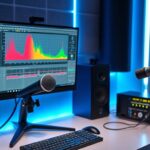
To evaluate room modes with measurement tools, you’ll first set up a measurement microphone at your listening position and use software to play test signals like sweeps or pink noise. Analyze the resulting frequency response, looking for peaks and dips that indicate resonance frequencies. By taking measurements at multiple spots, you can identify consistent problem areas. This process helps you target acoustic treatment effectively. Keep exploring to discover more tips for optimizing your room’s sound.
Key Takeaways
- Use measurement microphones and test signals like sweeps or pink noise to capture room response data.
- Analyze frequency response graphs and spectrograms to identify peaks indicating room resonances.
- Take measurements from multiple locations to map spatial variation and locate problematic room modes.
- Apply acoustic treatments such as bass traps and diffusers to reduce identified resonances at specific frequencies.
- Compare pre- and post-treatment measurements to verify the effectiveness of acoustic adjustments.
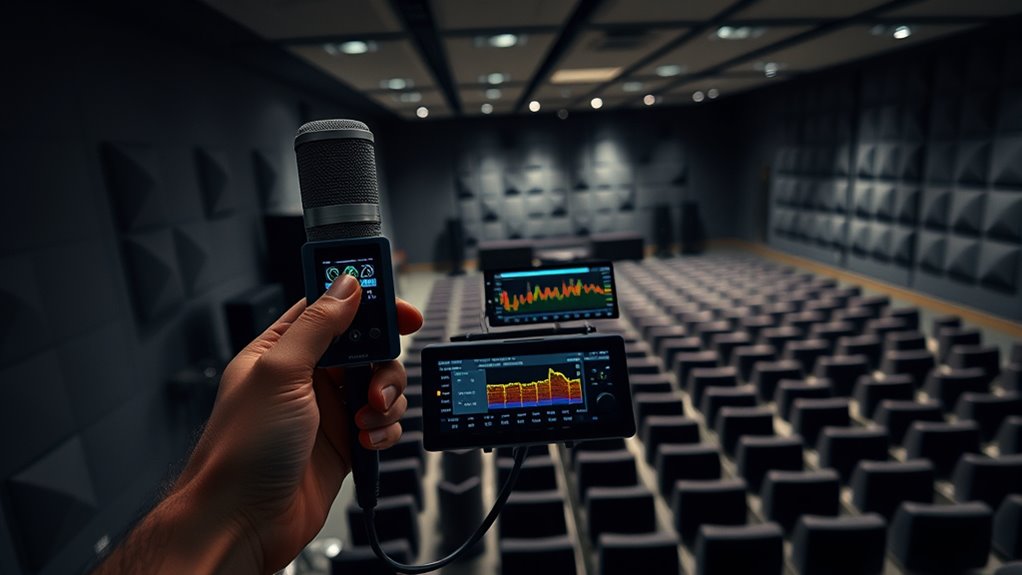
Understanding room modes is essential for achieving ideal sound quality in any space. These modes are the natural frequencies at which your room tends to resonate, often causing uneven sound distribution and muddiness. When you’re evaluating room modes, one of the main issues you’ll encounter is bass resonances, which can be especially problematic because they tend to build up in certain areas, creating boomy or muddy bass sounds. To effectively identify and address these problems, measurement tools are crucial. They let you analyze the frequency response of your space in real-time, revealing where these resonances occur and how they affect your overall sound.
Using a measurement microphone connected to a computer or audio interface, you can generate test signals—sweeps or pink noise—and record how your room responds. These tools produce spectrograms or frequency response graphs that highlight peaks and dips, pinpointing the problematic bass resonances. Once you see where these resonances are, you can plan your acoustic treatment more precisely. Acoustic treatment involves strategically placing bass traps, diffusers, and absorbers to tame these resonances, smoothing out the frequency response. For example, bass traps placed in corners can absorb excess low-frequency energy that tends to accumulate there, reducing boominess. By measuring before and after treatment, you get concrete data showing how effective your adjustments are, ensuring you’re not just guessing but making informed decisions.
Using measurement microphones and test signals reveals room resonances and guides precise acoustic treatment adjustments.
The process of evaluating room modes with measurement tools isn’t just about fixing the bass; it’s about understanding your space’s acoustic behavior holistically. You’ll want to take multiple measurements from different positions within the room to account for variations. This helps you identify “hot spots” where bass resonances are most pronounced and “dead spots” where sound may be dull or overly damped. As you analyze the data, you’ll notice that certain frequencies consistently cause issues across different locations. These are the frequencies you’ll want to target with specific acoustic treatments. Additionally, understanding room modes can help you optimize your speaker placement and listener positioning for the best sound experience.
In addition, measurement tools help you visualize how your room responds to different sound sources and placements. This insight lets you optimize speaker positioning and listener arrangement for the most balanced sound. Ultimately, by combining precise measurements with targeted acoustic treatment, you gain control over your room’s acoustics, transforming a problematic space into an accurate and enjoyable listening environment. This proactive approach ensures you’re not just reacting to issues but proactively shaping your space for the best possible sound quality.

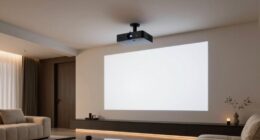
2000 ANSI 4K Decoding Projector with WiFi and Bluetooth, HAPPRUN Movie Home Theater with Auto Focus, 300'' Display for Indoor/Outdoor, Smart Proyector Compatible with Phone/TV Stick/PC/PS5
[EASIER OPERATION: AI Smart Screen Adjustment] HAPPRUN projector comes with auto focus and 6D auto-keystone technology, enjoy a...
As an affiliate, we earn on qualifying purchases.
Frequently Asked Questions
How Can I Identify Room Modes Without Specialized Tools?
You can identify room modes without specialized tools through DIY detection and acoustic intuition. Walk around your space and listen for areas where sound seems boomy or dead, indicating resonances. Clap or produce sounds at different points and notice how the sound quality changes. Trust your ears to detect these problematic spots; with practice, you’ll develop an instinct for common room modes and how to address them effectively.
What Is the Impact of Furniture on Room Mode Measurements?
Furniture can dramatically alter your room mode measurements, almost like magic. It acts as furniture damping and acoustic absorption, softening standing waves and reducing resonances. When you add plush sofas or thick curtains, they soak up excess sound energy, shrinking room modes. Conversely, sparse furniture amplifies these modes. So, your furniture choices directly influence how sound waves bounce, helping or hindering your effort to create a balanced acoustic environment.
Are There Software Programs That Can Simulate Room Modes?
Yes, there are software programs that can simulate room modes. These tools use acoustic modeling and software simulation to predict how sound behaves in a space, helping you identify potential problem areas. Programs like EASE, Room EQ Wizard, and CARA offer detailed simulations of room acoustics, allowing you to visualize and analyze room modes before making physical changes. This saves time and improves your room’s sound quality effectively.
How Often Should I Re-Evaluate Room Modes After Modifications?
Isn’t it worth checking for room mode stability after every significant modification? You should re-evaluate your room modes regularly, especially if you’ve made changes to the acoustics or layout. Typically, measurement frequency depends on the extent of your modifications, but a good rule is to do it after major adjustments and periodically thereafter. This helps guarantee your room maintains peak sound quality and prevents any unwanted resonances from developing.
Can Room Modes Affect Sound Quality in Home Theaters?
Yes, room modes can considerably affect sound quality in your home theater. Resonance frequencies caused by these modes can create uneven bass response, leading to boomy or hollow sounds. When certain frequencies resonate, they distort the audio experience, making it harder to hear dialogue or enjoy music fully. To improve sound quality, you’ll want to identify and address problematic room modes, especially those impacting bass response, for a clearer, more balanced sound.

LUXTORO Premium Universal Soundbar Wall Mount Bracket - Adjustable Depth 3.5-6.1 Heavy Duty Shelf Support for Samsung Bose Vizio Sony LG JBL Sonos - Black
1. [UNIVERSAL ADJUSTABLE DESIGN] Seamlessly fits major brands like Samsung, LG, Sony, Vizio, and JBL. The adjustable arms...
As an affiliate, we earn on qualifying purchases.
Conclusion
By now, you see how measurement tools can reveal the hidden quirks of your room’s acoustics. Identifying and addressing room modes is like tuning a fine instrument—you’ll find the sweet spot and make your space sing. Don’t let these resonances be the elephant in the room; instead, use your tools to tame them. With a little effort, you’ll turn your listening area from a minefield into a harmonious haven.
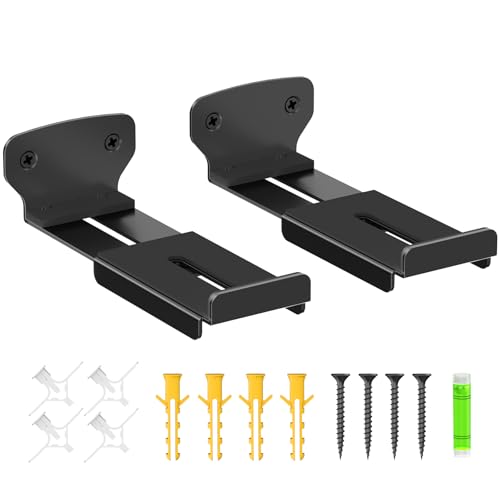
2-Pack Adjustable Soundbar Wall Mounts, Fit for Samsung, Bose, Vizio, LG Depth of 3.5"–6.3" Soundbars, Heavy-Duty Steel Holds up to 38 Lbs, With Anti-Slip Guardrail, Hardware Included Easy to Install
Wide Compatibility - This soundbar mounts are universally designed to fits most soundbars 3.54–6.3 in deep (no rear...
As an affiliate, we earn on qualifying purchases.

Perlegear Soundbar Mount with Adjustable Height, Sound bar Mount up to 15 lbs, Soundbar Mount Under or Above TV, Soundbar tv Mount Bracket with Detachable Long Extension Plates PGSM04B
Wide Compatibility: With strong metal construction, Perlegear soundbar mount can support up to 15 lbs for reliable stability....
As an affiliate, we earn on qualifying purchases.