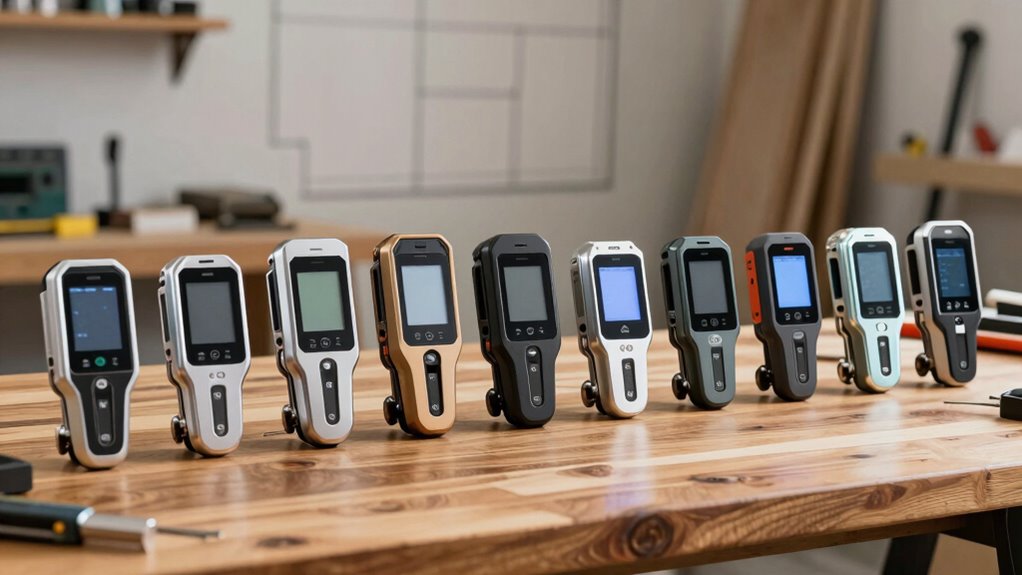

When it comes to mounting heavy items or installing shelving, choosing a stud finder pro grade for mounting is essential for accuracy and safety. The Zircon StudSensor Basic stands out as the best overall, offering reliable detection for both wood and metal studs. For those who need faster, more precise readings, the Franklin Sensors ProSensor M210 with 13 sensors provides exceptional coverage. However, these tools often involve tradeoffs between complexity and cost. Keep reading to see a detailed breakdown of the options that balance performance, usability, and value.

Get your home office setup delivered free — and shop member deals
- Fast, free delivery on millions of items
- Access to Prime Big Deal Days deals on October 6–7
- Prime Video, Amazon Music and more included
Complete the kit


Key Takeaways
- Pro-grade stud finders with multiple sensors deliver superior accuracy and coverage, especially in complex wall structures.
- Features like live wire detection and deep scanning are vital for safety and avoiding hidden hazards during mounting.
- Higher-end models tend to be more intuitive, but simple magnetic options still excel for basic tasks and quick checks.
- Tradeoffs often involve balancing advanced technology against ease of use and price, with premium models offering more speed and precision.
- Choosing a tool suited to your specific mounting needs can save time and reduce frustration, especially for heavy-duty projects.
| Zircon StudSensor Basic Stud Finder for Wood and Metal Studs |  | Best Budget-Friendly Basic Model for Quick Detecting | Weight: 2.99 ounces | Power Source: Battery Powered (requires 9V alkaline battery, not included) | Package Dimensions: 8.94 x 3.98 x 1.5 inches | VIEW ON AMAZON | See Our Full Breakdown |
| Franklin Sensors ProSensor M210 13-Sensor Stud Finder with Live Wire Detection |  | Best for Precision and Deep Scanning with Full Width Detection | Number of sensors: 13 | Detection depth: Up to 1.7 in | Stud types detected: Wood and metal | VIEW ON AMAZON | See Our Full Breakdown |
| Franklin Sensors ProSensor M150/X990 9-Sensor Stud Finder with AC Wire Warning |  | Best for Safe, Accurate Stud Location with No Calibration | Sensors: 9 | Detection depth: Up to 1.5 in | Stud types: Wood and metal | VIEW ON AMAZON | See Our Full Breakdown |
| Zircon StudSensor A100 Stud Finder with Live Wire Detection |  | Best LCD Screen and Versatile Wall Scanner for Safe Mounting | Detection Depth (Standard): 3/4 inch | Detection Depth (DeepScan): 1 1/2 inches | Detection: Live electrical wires up to 2 inches deep | VIEW ON AMAZON | See Our Full Breakdown |
| Magnetic Stud Finder PRO (Upgraded Version) – No-Battery, Deep Detection of Wood & Metal Studs in Drywall |  | Best No-Battery, Deep Magnetic Detection for Wall Mounting | Magnets: 3 neodymium magnets | Size: 4.72 x 1.18 x 1 inches | Battery: None (battery-free) | VIEW ON AMAZON | See Our Full Breakdown |
| Stud Finder Wall Scanner – 5 in 1 Stud Finder Tool with Smart Chip and HD LCD Display |  | Best for Versatile Wall Scanning and Precise Detection | Manufacturer: JAXWQ | Model Number: TH410 | Weight: 8.1 ounces | VIEW ON AMAZON | See Our Full Breakdown |
More Details on Our Top Picks
Zircon StudSensor Basic Stud Finder for Wood and Metal Studs
The Zircon StudSensor Basic stands out for its simplicity and ease of use, making it an ideal choice for DIYers who want reliable edge detection without complex features. Compared to more advanced models like the Franklin Sensors ProSensor M210, it offers less depth and fewer sensors, but at a lower price point. Its LED indicators, audio signals, and SpotLite Beam help ensure accurate marking, while the over-stud warning prevents false positives. However, it requires a 9V battery not included, and its detection is limited to drywall, plaster, and sheetrock surfaces, which may be restrictive for more demanding projects. This pick is perfect for homeowners hanging pictures or lightweight fixtures but less suited for professional-grade mounting tasks that demand deeper or more precise scanning.
Pros:- Simple to operate with clear visual and audio cues
- Accurately detects stud edges up to 3/4 inch deep
- Includes SpotLite Beam for precise marking
- Over-stud warning reduces false detections
Cons:- Requires a 9V battery not included, adding extra cost
- Limited to drywall, plaster, and sheetrock surfaces
Best for: Casual homeowners and renters needing a straightforward stud finder for occasional use
Not ideal for: Professionals or serious DIYers requiring deep, multi-surface detection and advanced features
- Weight:2.99 ounces
- Power Source:Battery Powered (requires 9V alkaline battery, not included)
- Package Dimensions:8.94 x 3.98 x 1.5 inches
- Item Model Number:73574
Our verdict“This model makes the most sense for casual users who need quick, reliable edge detection on standard drywall surfaces without extra features.”
Franklin Sensors ProSensor M210 13-Sensor Stud Finder with Live Wire Detection
The ProSensor M210 excels in accuracy thanks to its 13-sensor array, offering a significant upgrade over typical 1-2 sensor models like the Zircon StudSensor Basic. It detects the full width of studs up to 1.7 inches deep and displays results clearly on an LED screen, including the stud center. Its no-calibration-required design allows for immediate use, and it includes valuable features like live wire detection, a built-in bubble level, and a pencil caddy. Compared with the Franklin M150, the M210’s larger sensor array provides more detailed and reliable readings, especially for complex wall setups. The main tradeoff is that it runs on two AA batteries, which are not included, and the device is somewhat bulkier. It’s best suited for serious DIYers and professionals needing quick, accurate, and comprehensive wall scanning.
Pros:- 13 sensors deliver high accuracy and full-width detection
- No calibration required, ready to use immediately
- Detects studs in wood and metal up to 1.7 inches deep
- Includes live wire detection and bubble level
Cons:- Batteries not included, adding to upfront costs
- Bulkier design may be less convenient for small spaces
Best for: Experienced DIYers and contractors needing deep, full-width stud detection with added safety features
Not ideal for: Casual users or those on a tight budget who prefer simpler, less expensive tools
- Number of sensors:13
- Detection depth:Up to 1.7 in
- Stud types detected:Wood and metal
- Live wire detection:Yes
- Bubble level:Built-in
- Pencil caddy:Included
Our verdict“This pick is best for those who prioritize precise, comprehensive wall scanning and safety for mounting in complex wall environments.”
Franklin Sensors ProSensor M150/X990 9-Sensor Stud Finder with AC Wire Warning
The ProSensor M150/X990 offers a solid balance of accuracy and safety, featuring 9 sensors that provide full-width stud detection up to 1.5 inches deep. Its no-calibration design allows quick setup, and the addition of live AC wire detection enhances safety during mounting projects. Compared to the M210, it has fewer sensors but still delivers reliable results for standard wall applications. Its detection depth is slightly shallower, and it requires batteries (not included), which might be an inconvenience. Its compatibility with only AAA batteries and lack of rechargeable options could be limiting for frequent users. This model suits DIYers who want dependable accuracy with built-in safety features but don’t require the highest possible depth or sensor count.
Pros:- Nine sensors provide superior accuracy over traditional 2-sensor models
- No calibration needed—easy to start scanning
- Detects full stud width including double studs
- Includes live AC wire detection for safety
Cons:- Batteries not included, requiring additional purchase
- Limited detection depth of 1.5 inches
Best for: Homeowners and DIYers needing safe, accurate wall scanning without calibration fuss
Not ideal for: Professionals needing the deepest scan capabilities or multi-surface detection
- Sensors:9
- Detection depth:Up to 1.5 in
- Stud types:Wood and metal
- AC wire detection:Yes
- Batteries:2x AAA (not included)
Our verdict“This model is ideal for users seeking reliable, safe wall scanning with minimal setup and moderate depth detection.”
Zircon StudSensor A100 Stud Finder with Live Wire Detection
The Zircon StudSensor A100 offers a user-friendly experience with its LCD screen, multiple scanning modes, and live wire detection—features that make it a strong choice for safe mounting. Its detection depth of 3/4 inch for studs and 1 1/2 inches for deep scans is suitable for most standard walls, but it may fall short on very thick or lath and plaster walls. Compared to the Franklin M150, it provides a more intuitive interface with visual cues, though its depth limitations may be a drawback for thicker walls. The device requires a 9V alkaline battery, which is not included, and its detection range is somewhat limited. It’s best for homeowners who prioritize ease of use and safety over deep wall scanning.
Pros:- Clear LCD display enhances usability
- Multiple scanning modes adapt to different wall types
- Live wire detection adds safety during mounting
- Accurate edge detection for fixtures
Cons:- Requires a 9V battery not included
- Limited detection depth for thick or dense walls
Best for: Homeowners and DIYers who want an easy-to-read LCD and multiple modes for versatile wall detection
Not ideal for: Professionals needing deep, multi-layer wall detection in complex or older buildings
- Detection Depth (Standard):3/4 inch
- Detection Depth (DeepScan):1 1/2 inches
- Detection:Live electrical wires up to 2 inches deep
- Battery:9V alkaline
Our verdict“This tool is best suited for homeowners seeking an easy, safe, and versatile wall scanner for standard drywall projects.”
Magnetic Stud Finder PRO (Upgraded Version) – No-Battery, Deep Detection of Wood & Metal Studs in Drywall
The Magnetic Stud Finder PRO offers a battery-free alternative with three neodymium magnets that deeply and reliably locate wood and metal studs in drywall. Its manual sliding detection process, aided by transparent design and marking arrows, ensures precise placement without wall damage. Compared with electronic models like the Franklin M150, it provides a straightforward, always-ready solution but lacks the depth and sensor-based accuracy for thicker or more complex walls. Its reliance on manual detection means it may be less precise on very dense walls or in tricky spots, and it’s limited to drywall and similar surfaces. This tool is ideal for users who prefer a simple, maintenance-free device for basic mounting tasks in standard drywall environments.
Pros:- No batteries required, always ready to use
- Deep detection with three neodymium magnets
- Easy to operate without risking wall damage
- Transparent design with marking arrows for accuracy
Cons:- Less reliable on very thick or dense walls
- Manual sliding detection less precise than electronic models
Best for: Homeowners and DIYers who want a simple, battery-free tool for lightweight, drywall-based mounting
Not ideal for: Professional installers or those working on thick, plaster, or lath walls requiring precise electronic detection
- Magnets:3 neodymium magnets
- Size:4.72 x 1.18 x 1 inches
- Battery:None (battery-free)
Our verdict“This magnetic finder is best for quick, low-impact wall detection in standard drywall for light to moderate mounting tasks.”
Stud Finder Wall Scanner – 5 in 1 Stud Finder Tool with Smart Chip and HD LCD Display
This 5-in-1 wall scanner stands out for its ability to detect wood studs, metal, pipes, and live AC wires with remarkable speed and accuracy, thanks to its intelligent micro-sensor chip. Unlike simpler models like the Zircon StudSensor Basic, which only detect wood and metal, this scanner’s multiple modes—stud, deep, metal, and AC wire detection—offer comprehensive coverage for complex wall setups. The backlit LCD display not only shows precise stud edges and centers but also indicates battery life, making it easier to work in low-light conditions. The audio alerts further improve accuracy, especially when working in noisy environments where visual cues might be missed. However, its deep scan mode can sometimes struggle with very dense or thick walls, and the beep volume may be insufficient in loud settings. Compared to Franklin Sensors M210, which offers multi-sensor arrays for quick scanning, this model provides more detailed readouts but may take a bit longer to scan thoroughly. Overall, this pick is ideal for DIYers who want reliable, multi-material detection with user-friendly features.
Pros:- Accurately detects wood, metal, pipes, and live wires with rapid response
- HD backlit LCD display clearly shows stud edges, center, and battery status
- Multiple scanning modes increase versatility for different installation needs
Cons:- Deep scan mode may be less effective on very thick or dense walls
- Audio alerts can be too quiet in noisy environments
Best for: DIY homeowners and professionals needing accurate multi-material wall scans in varied wall types
Not ideal for: Users working on extremely thick or dense walls where deep scan reliability drops or those requiring ultra-quiet operation
- Manufacturer:JAXWQ
- Model Number:TH410
- Weight:8.1 ounces
- Package Dimensions:7.72 x 3.23 x 1.69 inches
- Color:Onion
- Power Source:Battery Powered (Alkaline)
- Scan Modes:Stud Scan, Deep Scan, Metal Scan, AC Wire Detection
Our verdict“This scanner suits users who need a versatile, detailed wall scanning tool that provides clear feedback and material differentiation.”
How We Picked
These products were selected based on their technical capabilities, build quality, ease of use, and overall reliability in pro-grade mounting scenarios. We focused on tools that offer the accuracy needed for heavy-duty or precision work, as well as features like live wire detection and deep scanning. Our ranking emphasizes value for professionals and DIYers who require consistent performance, while also considering cost and simplicity. Each product was evaluated through user feedback, versatility, and how well it balances advanced features with user-friendly operation.Factors to Consider When Choosing Stud Finders Pro Grade For Mounting
Choosing the right stud finder pro grade for mounting involves understanding several key factors that impact performance, safety, and convenience. High-quality tools can save time and prevent damage, but the wrong choice might lead to missed studs or hidden hazards. By considering these factors, you can select a device that matches your project complexity and skill level, ensuring a successful installation every time.Detection Accuracy and Sensor Technology
The core function of a pro-grade stud finder is accurate detection. Multi-sensor devices with multiple scanning zones offer superior coverage, especially in complex wall structures or thicker drywall. Sensors that detect both wood and metal studs are versatile, and models with deep scanning capabilities help locate studs behind multiple layers of wall material. Investing in a device with reliable sensors minimizes the risk of misalignment during mounting.
Additional Safety and Warning Features
Features like live wire detection and AC wire warnings are crucial for safety, preventing accidental electrical shocks or damage to wiring. These alerts help you avoid dangerous areas, especially when working in older or poorly documented walls. Devices lacking these features might be cheaper or simpler but increase the risk of errors and hazards during installation.
Ease of Use and Display
Pro-grade tools should balance advanced features with intuitive operation. Clear displays, such as LCD screens or visual indicators, help interpret readings quickly. Multi-sensor models often come with more complex interfaces, so user-friendly controls and instructions matter. Magnetic stud finders, while less precise, offer quick checks and are useful for beginners or quick tasks.
Build Quality and Durability
For frequent or professional use, a durable build reduces the risk of damage from drops or rough handling. Rubberized grips, robust casing, and reliable battery life are factors that contribute to long-term performance. Cheaper models may be more fragile or have shorter lifespans, making them less suitable for regular use or demanding projects.
Price and Value for Your Project
Higher-priced models typically offer more advanced features, faster detection, and greater accuracy, which are beneficial for heavy-duty or professional tasks. However, for occasional DIY projects, simpler or magnetic models may suffice and provide better value. Assess your frequency of use and project requirements to avoid overspending or underinvesting in a tool that won’t meet your needs.
Frequently Asked Questions
Can I use a stud finder to locate pipes or electrical wiring?
Most pro-grade stud finders with live wire detection can help identify electrical wiring and sometimes pipes, but their primary purpose is to locate studs. If your wall contains complex wiring or plumbing, choose a model with specific live wire and pipe detection features. Always turn off power when working near electrical systems, and use dedicated tools for precise plumbing or wiring detection when needed.
Are magnetic stud finders reliable for heavy-duty mounting?
Magnetic stud finders are simple and have no batteries, making them durable and quick for basic checks. However, they are less reliable for locating studs behind thick or multi-layer walls and cannot detect metal studs or wiring. For serious mounting projects, especially in challenging wall types, a multi-sensor electronic device offers much higher accuracy and safety.
How deep can pro-grade stud finders typically scan?
Most high-end models can scan up to 1.5-2 inches deep, which is sufficient for standard drywall and some thicker wall materials. Deeper scanning is available in models designed for dense walls or multiple drywall layers, often reaching 3 inches or more. Choosing a device with the right depth capability ensures you won’t miss studs in more complex wall structures.
Is it worth paying extra for a multi-sensor stud finder?
Yes, multi-sensor models generally provide more comprehensive detection, especially in walls with irregular stud spacing or multiple layers. They reduce false positives and give more reliable readings, saving time and effort during mounting. However, they are often more expensive and slightly more complex to operate, so consider your frequency of use and project complexity before investing.
Should I prioritize features like digital displays or simple indicators?
While digital displays can make readings clearer and more precise, simple indicator lights or sounds can suffice for quick checks. For professional or detailed work, a high-quality LCD screen helps interpret data accurately, especially in tricky wall conditions. Beginners or casual users might prefer straightforward models with minimal features, but for pro-grade work, investing in clear, detailed displays is often worthwhile.
Conclusion
For heavy-duty mounting or professional projects, the Zircon StudSensor Basic offers reliable performance as the best overall pick. DIYers or occasional users will find the Magnetic Stud Finder PRO to be a simple, cost-effective choice. The Franklin Sensors ProSensor M210 excels for those needing rapid, comprehensive detection and is ideal for more complex wall setups. Beginners should lean towards magnetic or basic electronic models, while pros should opt for multi-sensor, feature-rich devices that prioritize accuracy and safety. Each choice aligns with different project demands and experience levels, helping you find a tool that truly meets your mounting needs in 2026.
As an affiliate, we earn on qualifying purchases.Halloween Picks
halloween