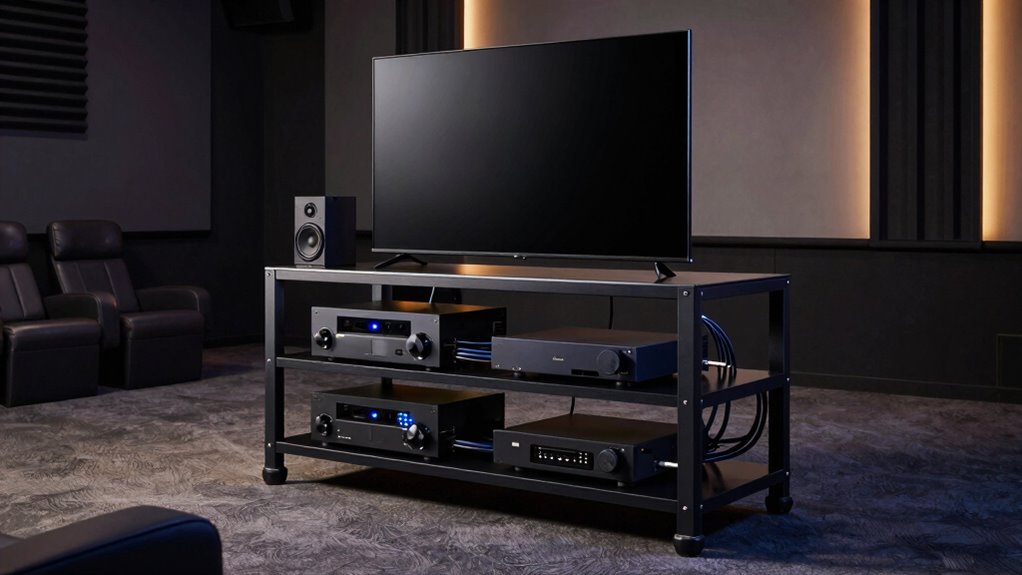

Shopping for rackmount AV racks for home theater heavy duty use means balancing three things: how much rack space your gear needs, how much weight the frame must hold, and whether you want open-frame accessibility or a locked, enclosed cabinet. My top overall pick is the VEVOR 16U Open Frame AV Rack, because it hits the sweet spot for most home theaters — enough rack units for an amplifier, processor, and streamers, a 500-pound-class frame, locking casters, and removable side panels for easy wiring. If your equipment list is long, the AxcessAbles 30U Rolling Open-Frame Rack offers the most headroom in this lineup, while the ECHOGEAR 10U is the smarter buy for smaller rooms where a full-size rack would dominate the space. The main tradeoff throughout this category is open frames versus enclosed cabinets: open racks run cooler and cost less but collect dust and expose cables, while cabinets like the 27U wall-mount unit look cleaner in living spaces but need active ventilation. Keep reading for the full breakdown of all 13 options.

Get business pricing on your home office setup
- Business-only prices and quantity discounts
- Tax-exempt purchasing
- Multiple users, one account, clear invoices
Complete the kit


Key Takeaways
- Open-frame racks dominated this comparison for home theater use — 10 of the 13 picks — because passive airflow matters more for AV amplifiers than the dust protection enclosed cabinets provide.
- The VEVOR 16U won best overall by combining removable side panels, locking casters, and a mid-size capacity that fits amplifiers, processors, and source components without monopolizing a room.
- Depth is the most commonly mishandled spec: pro audio amps and universal component shelves often need 20+ inches, which ruled out several shallower 18-inch racks for buyers with deep receivers.
- The 27U wall-mount cabinet and Tecmojo 18U cabinet are the only enclosed options — they make sense when the rack lives in a visible living area, but their included fans add noise a dedicated theater room doesn’t need.
- Weight capacity separated the true heavy-duty picks from the rest: the AxcessAbles 30U (550 lb) and Sound Town 2-post (built for pro audio) handle large amplifiers, while lighter-duty 12U frames flex under concentrated amp loads.


More Details on Our Top Picks
VEVOR 16U Open Frame AV Rack with Locking Caster Wheels and Removable Side Panels
The VEVOR pairs a 16U frame with an 18-inch depth, giving home theater owners room for standard rack gear while keeping wiring and servicing accessible from both sides. Its 200 lb capacity is a useful step up from the RackPath 16U, which supports 150 lb and includes two shelves for devices that lack rack ears. VEVOR instead supplies removable side panels and a blank panel, plus four locking casters for moving the rack into position and keeping it steady afterward. The open layout helps with cable access, though it leaves equipment more exposed to dust than the locking cabinet in the 27U Wall-Mount Server Rack. Assembly is required, and no warranty is listed in the supplied product details. This makes the VEVOR a practical choice for accessible, moderately loaded theater systems.
Pros:- Supports up to 200 lb, more than the RackPath 16U’s 150 lb capacity
- Open front and back simplify wiring and equipment access
- Four locking casters make the rack movable and stationary when needed
- Includes removable side panels, a blank panel, screws, cage nuts, and a wrench
Cons:- Open-frame design offers less dust protection than an enclosed cabinet
- Requires assembly and equipment installation
- No warranty is listed in the supplied product details
Best for: Home theater owners with rack-mountable components who want a movable 16U frame and frequent access for wiring or maintenance.
Not ideal for: Buyers who need a closed, dust-shielding cabinet or who need shelves for several non-rack-mount components.
- Rack height:16U
- Depth:18 inches
- Material:Q235 carbon steel
- Maximum weight capacity:200 lb (90.7 kg)
- Design:Open front and back; removable side panels
- Casters:4 locking caster wheels
- Included accessories:40 screws, 24 cage nuts, wrench, blank panel, user manual
Our verdict“Choose the VEVOR if you want a mobile 16U rack with easy access and more stated capacity than the shelf-equipped RackPath alternative.”
27U Wall-Mount Server Rack Cabinet, 24-Inch Deep, with Fan, PDU, Shelves, Casters, and Locking Mesh Door
For a home theater that shares space with a network or security system, this 27U cabinet offers something the open VEVOR and RIVECO racks do not: a locking mesh door and removable sides around the equipment. The mesh panels and included fan support airflow, while the included PDU and two shelves help organize gear that does not mount directly to rails. It can be wall-mounted or used freestanding with its casters and feet, giving it more placement flexibility than a conventional floor-only frame. Its 24-inch depth suits many systems, but buyers should check the depth of their components and cable clearance; the RIVECO 22U adjusts out to 38 inches. Assembly and installation add effort, and a loaded cabinet needs a suitable wall or floor setup. This is the enclosure-focused pick, not the best fit for deep equipment.
Pros:- Locking mesh door and removable side panels enclose equipment
- Includes fan, PDU, two shelves, and cable management accessories
- Mesh panels support airflow around installed equipment
- Can be wall-mounted or used freestanding with included casters and feet
Cons:- 24-inch depth may not fit deeper equipment with room for cables
- Assembly and installation are required
- A loaded cabinet needs an appropriate wall or floor mounting arrangement
Best for: Home theater and home-lab owners who want a lockable enclosure with shelves, cooling, and space to combine AV, network, and security equipment.
Not ideal for: Buyers with deep components or limited installation options who need a deeper adjustable frame like the RIVECO 22U.
- Rack capacity:27U
- Depth:24 inches
- Mounting width:19 inches
- Door:Locking mesh
- Panels:Removable side panels
- Included accessories:Fan, PDU, 2 shelves, cable management accessories, casters, feet
- Mounting options:Wall-mounted or freestanding
Our verdict“Pick this cabinet if you want a lockable, accessory-equipped enclosure and your equipment fits within its 24-inch depth.”
RIVECO 12U Adjustable-Depth Open-Frame Server Rack
The RIVECO 12U earns its place through a 20–30-inch adjustable depth, which gives buyers more room to match different equipment lengths than the fixed-depth VEVOR 16U. That range is useful when a theater rack will also hold networking hardware, though the 12U height provides less expansion space than either 16U option. The riveted 2.0 mm cold-rolled steel frame comes with casters, leveling feet, cable management rings, and assembly hardware, so it can be moved for setup and then leveled in place. Its stated caster and leveling-foot load figures are substantial, but they describe the supports rather than a specified overall rack equipment capacity. Unlike the 27U cabinet, this is an open frame with no door or dust barrier. I’d choose it when depth flexibility matters more than enclosure or extra rack height.
Pros:- Adjusts from 20 to 30 inches deep to fit varied equipment
- Riveted 2.0 mm cold-rolled steel frame
- Includes casters, leveling feet, cable management rings, and installation tools
- Leveling feet support a stated capacity of up to 880 lb
Cons:- 12U height offers less expansion room than the VEVOR and RackPath 16U racks
- Open-frame design does not enclose equipment
- Requires assembly, and the listed support-load figures are not an overall rack capacity
Best for: Home theater owners combining standard rack gear of different depths who want a compact, adjustable open frame with cable-routing hardware.
Not ideal for: Buyers needing a closed dust barrier, substantial vertical expansion, or an explicitly stated overall equipment capacity.
- Capacity:12U
- Mounting width:19 inches
- Adjustable depth:20–30 inches
- Material:2.0 mm cold-rolled steel
- Frame connection:Riveted structure
- Caster load capacity:660 lb static load
- Leveling feet capacity:Up to 880 lb
- Included accessories:M6 and M5 screws, cable management rings, casters, leveling feet, installation tools
Our verdict“Choose the RIVECO 12U when adjustable depth and a compact footprint matter more than enclosure or future rack height.”
RIVECO 22U Adjustable-Depth 4-Post Server Rack with Casters
Among these five options, the RIVECO 22U has the strongest stated support figures: up to 1,700 lb on leveling feet and 1,200 lb static load on casters. Its four-post steel frame and adjustable L rails make it the heavy-duty choice for a theater installation with substantial equipment, while its 24–38-inch depth accommodates longer components than the VEVOR 16U or the 24-inch-deep cabinet. It also offers more height than the 12U RIVECO, leaving room for a larger system. The tradeoff is an open frame with no enclosure, so it will not shield equipment from dust or casual access like the 27U cabinet. The casters’ stated capacity is lower than the leveling feet figure, which matters if the rack will be moved while loaded. This pick favors load and adjustability over protection.
Pros:- Leveling feet have a stated maximum load of 1,700 lb
- Adjustable 24–38-inch depth accommodates longer equipment
- 22U capacity provides more rack space than either RIVECO 12U or the 16U frames
- Includes casters, leveling feet, adjustable L rails, guidebook, and screws
Cons:- Open-frame design leaves equipment exposed
- Static caster load capacity is lower than the leveling-foot capacity
- Large 22U footprint requires dedicated floor space
Best for: Home theater installers building a tall, heavy equipment stack with deep components and a stable floor location.
Not ideal for: Buyers who need a lockable enclosure, expect to roll a heavily loaded rack often, or have limited floor space.
- Rack capacity:22U
- Mounting width:19 inches
- Adjustable depth:24–38 inches (60–95 cm)
- Material:2.0 mm cold-rolled steel
- Maximum load with leveling feet:1,700 lb
- Static load on casters:1,200 lb
- Caster size:3 inches
- Warranty:2 years
Our verdict“Choose the RIVECO 22U for a deep, high-capacity equipment stack that can stay on its leveling feet once positioned.”
RackPath 16U Open Frame Network Rack with 2 x 14 in Vented 1U Shelves, Wall Mount/Floor Standing
The RackPath is the most ready-made option here for a system that mixes rack-mountable hardware with loose components. Its standout detail is two 14-inch vented shelves with rear support brackets, which can hold items such as a modem, DVR, or UPS without requiring rack ears. The VEVOR 16U offers a higher stated capacity at 200 lb and locking casters, while this RackPath supports 150 lb and instead gives buyers shelves and a choice of wall or floor mounting. That flexibility can suit a network closet, but wall mounting depends on suitable wall support, especially once equipment is installed. The open frame keeps gear accessible and gives less dust protection than the 27U locking cabinet. With only two shelves included, larger collections of non-rack devices may need more support. I’d pick it for a modest hybrid AV and network setup.
Pros:- Includes two vented 1U shelves with rear support brackets
- Can be wall-mounted or floor-standing
- Supports up to 150 lb with a cold-rolled steel frame
- Includes rack mounting screws and wood screws
Cons:- 150 lb capacity is lower than the VEVOR 16U’s stated 200 lb
- Open-frame design offers little protection from dust
- Only two shelves are included, and wall mounting needs suitable support
Best for: Home theater owners with a modest load of rack gear plus a modem, DVR, or UPS that needs shelf support.
Not ideal for: Buyers with heavier systems, many shelf-only components, or a need for a closed cabinet and dust protection.
- Rack height:16U
- Included shelves:2 x 1U vented shelves
- Shelf depth:14 inches
- Load capacity:150 lb
- Material:Cold-rolled steel
- Finish:Black powder-coated
- Mounting type:Wall mount or floor standing
- Compatibility:Standard 19-inch rack-mountable devices
Our verdict“Choose the RackPath if your theater rack needs supported shelves for a few non-rack devices and the 150 lb capacity fits your load.”
12U Open Frame Server Rack with Caster Wheels and Adjustable Steel Shelf, 500lb Capacity
Among the floor-standing open frames in this roundup, this 12U rack stands out for its 500 lb load rating — roughly double what the Sound Town ST2PF-12HD can hold, which matters if you’re stacking amplifiers, a UPS, and a NAS in one tower. The adjustable steel shelf is the real differentiator: non-rackmount gear like routers and CCTV recorders usually gets left dangling in open-frame setups, and here it gets a proper home. Compared with the Rockville RAC12U, this rack trades angled access for raw capacity and mobility via its lockable caster set. The tradeoff is the usual one for open frames: zero security and no dust protection, and the 17.7-inch depth rules out deeper chassis-style servers.
Pros:- 500 lb load capacity handles amplifier stacks and UPS units with headroom
- Adjustable shelf accommodates non-rackmount gear like NAS drives and routers
- Lockable casters make relocation and rear cable access easy
- 360° open ventilation noticeably reduces heat buildup versus enclosed cabinets
Cons:- No physical security or dust protection for exposed equipment
- 17.7-inch mounting depth excludes deeper servers and some pro amplifiers
Best for: Home theater owners with heavy amplifiers, NAS drives, and mixed non-rackmount gear who want to roll the whole rack out for cable work
Not ideal for: Households with curious kids or pets — the open frame leaves every component exposed to fingers and dust
Our verdict“This pick makes the most sense for buyers who need maximum load capacity and mixed-gear shelving in a mobile, well-ventilated floor rack.”
Rockville RAC12U 12U 19-Inch Open Frame Pro Audio Rack
The Rockville RAC12U solves a problem most racks in this roundup ignore: seeing and reaching your front panels. Its angled frame tilts equipment toward you, which is genuinely useful when you’re tweaking amplifier gain knobs or patching inputs behind a TV. Compared with the 12U rack with casters and adjustable shelf, it gives up wheels and the 500 lb rating in exchange for that ergonomics and a fold-flat, tool-free design that assembles with six hand knobs — no screwdriver marathon. It works as a floor-standing or desktop unit, so it suits smaller media consoles where a full tower won’t fit. The obvious costs: open frame means no security or dust protection, and there’s no locking mechanism at all.
Pros:- Angled design improves visibility and access to front-panel controls
- Tool-free assembly with six hand-tightening knobs, plus fold-flat storage
- Flexible floor-standing or desktop placement
- Standard 19-inch mounting fits pro audio, server, and AV gear
Cons:- Open frame provides no protection from dust or physical contact
- No locking or enclosure security for valuable equipment
Best for: Audio-first home theater enthusiasts who frequently adjust amps, EQs, or patch points and want gear tilted toward them
Not ideal for: Buyers storing expensive components in shared spaces — the open, lockless frame offers no protection whatsoever
Our verdict“Choose this if you tweak your gear often and want tilted, tool-free access; skip it if your priority is protecting or securing components.”
ECHOGEAR 10U Open Frame Rack, 20.4-Inch Depth
For getting gear off the floor entirely, the ECHOGEAR 10U is the most approachable wall-mount option here. Unlike the Tecmojo 18U wall cabinet, it’s an open frame — lighter, cheaper to ship, and easier to cable — but it keeps up on depth with 20.4 inches of room, accepting components up to 19 inches deep. The two included vented 1U shelves are the quiet win, catching gear that isn’t rackmountable, something the Sound Town ST2PF-12HD doesn’t offer at all. The modular stacking design lets you bolt two units together for 20U if your system grows. Realistically, 150 lbs wall-mounted means you’ll want serious stud anchoring, and assembly is on you. Ten racks’ worth of screws come in the box, which saves a hardware-store trip.
Pros:- 20.4-inch depth accommodates components up to 19 inches deep
- Includes two vented 1U shelves plus all wall-mount and rack screws
- Modular design allows stacking two racks for expanded capacity
- Open frame with vented shelves keeps passive cooling strong
Cons:- Assembly required before mounting
- 150 lb load limit depends heavily on wall anchoring quality
Best for: Apartment or small-room home theater owners who want a clean wall-mounted rack with shelves for a mix of rack and non-rack gear
Not ideal for: Buyers with heavy amplifiers or UPS units — the 150 lb wall-mount ceiling and stud dependency limit safe loads
Our verdict“This model is better suited to lighter, wall-mounted AV and networking setups that value depth and included shelves over capacity.”
Tecmojo 18U Wall Mount Rack Network Cabinet for 19″ IT Equipment
If your priority is keeping hands, dust, and dust-covered hands off your gear, this is the only fully enclosed, lockable option in this batch. The mesh door and side panels lock, which no open frame here — not the ECHOGEAR 10U, not the AxcessAbles rolling racks — can claim. The built-in top cooling fan addresses the heat problem enclosures create, and the numbered U positions on adjustable rails make rack planning less error-prone. Compared with the ECHOGEAR, you get 8 more rack units and compliance with EIA standards plus a three-year warranty. The catch is depth: 14.2 inches of inner mountable depth is tight, excluding deeper amplifiers and many servers, and the 110 lb limit is modest for an 18U cabinet. It also ships flat-packed, so expect an assembly session.
Pros:- Lockable mesh door and side panels secure equipment from tampering and dust
- Built-in top cooling fan actively manages enclosure heat
- Reversible door and adjustable rails with numbered U positions aid installation
- 18U capacity with EIA/ECA-310-E compliance and a 3-year warranty
Cons:- 14.2-inch inner mountable depth is too shallow for much pro AV gear
- Ships flat-packed and requires full assembly
Best for: Home theater and network owners in busy households who need lockable, dust-protected storage for switches, streamers, and patch panels
Not ideal for: Owners of deep pro amplifiers or full-size servers — the 14.2-inch inner depth won’t fit them
Our verdict“Pick this when security and dust protection outweigh raw depth — it’s the enclosed, lockable choice in a lineup of open frames.”
Sound Town ST2PF-12HD 12U 2-Post Heavy-Duty Open-Frame Rack
The Sound Town ST2PF-12HD is the no-frills backbone of this lineup: a 2-post steel frame rated for 260 lbs with cage nuts and screws in the box, so you’re mounting the same day it arrives. Compared with the 12U rack with casters, you give up 240 lbs of capacity, wheels, and the adjustable shelf — but you gain a simpler, lighter frame that’s easier to tuck beside a media console or inside a closet. The black powder-coated cold-rolled steel construction feels appropriately rigid for amplifiers, switches, and a UPS, and the 2-post layout leaves rear cabling completely unrestricted. The flip side of that openness is total exposure: no dust shield, no security, no shelves for non-rack gear, and assembly is required. As a budget-friendly core for standard 19-inch equipment, it earns its place.
Pros:- 260 lb load capacity on a rigid cold-rolled steel frame
- Cage nuts and screws included for immediate mounting
- Open 2-post design maximizes airflow and rear cable access
- Versatile mounting for AV gear, servers, UPS systems, PDUs, and switches
Cons:- No shelves or accommodation for non-rackmount equipment
- Open frame provides no dust or physical protection
- Assembly required
Best for: Budget-conscious home theater builders with standard rackmount gear who want a sturdy, ventilated frame without paying for wheels or shelves
Not ideal for: Buyers with mixed non-rackmount equipment — there’s no shelf, and the 2-post frame offers no protection or mobility
Our verdict“This option stands out as the straightforward value pick for standard rack gear where ventilation and rigidity matter more than frills.”
Tecmojo 20U Open-Frame Network Rack with Two 1U Shelves
Most racks in this roundup are floor-standing only, but the Tecmojo 20U stands out for its genuine dual-mount design — it works as a floor rack or anchors to a wall, which makes it the smartest pick here for home theater owners short on floor space. Compared with the RackPath 16U, another wall/floor hybrid, the Tecmojo offers four more rack units and a 260 lb floor-standing capacity that comfortably handles a stack of amplifiers and AV processors. The tradeoff is real, though: drop it on a wall and capacity halves to 130 lbs, and the open frame offers none of the dust protection or locked-door security of an enclosed cabinet like the Tecmojo 18U wall cabinet. Two ventilated shelves and Velcro straps arrive in the box, so non-rackmount gear is covered out of the box.
Pros:- True dual mounting: floor-standing at 260 lbs or wall-mounted at 130 lbs
- Two ventilated shelves included for non-rackmount components
- Open frame allows free airflow and easy rear cabling access
- 3-year warranty is longer support than most open-frame rivals
Cons:- Wall-mount capacity drops to half the floor-standing rating
- No panels or door, so equipment is exposed to dust and touch
Best for: Home theater owners who want to keep heavy AV gear off the floor by mounting a full 20U rack in a closet or utility room
Not ideal for: Anyone with deep amplifiers or gear over 18 inches deep, or who needs dust protection and security for expensive components
- Brand:Tecmojo
- Rack size:20U
- Compatibility:19-inch networking and AV equipment
- Material:Cold-rolled steel
- Mounting options:Floor-standing or wall-mounted
- Load capacity:260 lbs floor-mounted; 130 lbs wall-mounted
- Included accessories:Two ventilated shelves, shelf stops, Velcro straps, mounting hardware
- Warranty:3 years
Our verdict“This is the rack to buy when floor space is the constraint and you want a full 20U of heavy-duty AV capacity on the wall.”
AxcessAbles 30U 19-Inch Rolling Open-Frame Network Server Rack, 18-Inch Depth, 550 lb Capacity
When the rest of the lineup tops out around 20U–22U, the AxcessAbles 30U is the clear choice for builders with serious gear counts. Its 550 lb static capacity (440 lbs on wheels) beats everything else in this roundup, including the 500 lb 12U rack, while offering more than double the rack space. The locking 3-inch casters let you roll a fully loaded rack across carpet for rear cabling — something fixed frames like the RIVECO 22U can’t match as easily — and vented removable side panels give it a more finished look than naked two-post frames. The catch: 18 inches of depth support rules out some pro amplifiers and deeper chassis, and there’s no door, so dust and curious hands reach your components. At 59 inches tall, it also demands a dedicated equipment room.
Pros:- 550 lb static capacity is the highest in this roundup
- 30U of space accommodates large, growing AV systems
- Locking casters roll a fully loaded rack on carpet
- Includes both 5mm and 6mm hardware plus a 1U blank panel
Cons:- No door, leaving equipment exposed to dust and tampering
- Capacity drops to 440 lbs when the wheels are installed
Best for: Home theater enthusiasts with many amplifiers, processors, and network components who need maximum capacity and the ability to roll the rack out for service
Not ideal for: Small apartments or living-room setups where a 59-inch open rack of exposed gear would dominate the space
- Brand:AxcessAbles
- Rack height:30U
- Width standard:19 inches
- Equipment depth support:Up to 18 inches
- Assembled dimensions:20 x 18 x 59 inches with wheels
- Weight capacity:550 lbs without wheels; 440 lbs with wheels
- Wheels:Front-locking 3-inch casters
- Side panels:Vented, removable
- Compatibility:10-32 and 6mm rack standards; 19-inch accessories
Our verdict“If your rack will hold more than 20U of gear or push past 400 lbs, this is the frame built for that job — provided you have the room for it.”
AxcessAbles 22U Open Frame Network & AV Rack with Caster Wheels, 3 2U Shelves, and Mounting Hardware
This 22U rack earns its spot by arriving more complete than anything else in this roundup: three 2U shelves, locking casters, cage nuts, a cage nut tool, and even a wall-mount kit come in the box. That matters for a first rack build — with the Tecmojo 20U you get two smaller 1U shelves, and with the VEVOR 16U you’re buying shelves separately if you own non-rackmount gear like game consoles or streaming boxes. Capacity is solid at 330 lbs on wheels (440 lbs stationary), comfortably above smaller 12U options like the Rockville RAC12U, though well short of its bigger 30U AxcessAbles sibling. The compromises are familiar: assembly is required before shelves go in, there’s no door, and the wall-mount kit only supports floor-level installation — this is not a hang-on-the-wall solution despite the included hardware.
Pros:- Three 2U shelves included for non-rackmount AV components
- Complete accessory kit: cage nuts, tool, screws, casters, wall kit
- 330 lb rolling capacity handles a mid-size theater stack
- Vented side panels aid airflow while softening the open-frame look
Cons:- Full assembly required before shelves can be installed
- Wall mounting limited to floor-level use only
- No door or front enclosure for dust and security
Best for: First-time home theater rack builders who want shelves, wheels, and every mounting accessory included in one purchase
Not ideal for: Buyers who need a true wall-mounted rack — this unit’s wall kit is only for floor-level stabilization
- Brand:AxcessAbles
- Model:RK22U-3T
- Rack height:22U
- Width standard:19 inches
- Assembled dimensions:18 x 20 x 47.2 inches with wheels
- Weight capacity:330 lbs with wheels; 440 lbs without
- Shelves:Three 2U shelves
- Rail compatibility:10-32 and M5 cage nuts
- Supported depth:Up to 18 inches
Our verdict“The best turnkey package for a first dedicated home theater rack — everything you need ships in one box, as long as it lives on the floor.”

How We Picked
I evaluated every rack against four criteria that matter most for heavy-duty home theater use. First, structural capacity: I looked at stated weight ratings, post construction (4-post versus 2-post), and whether the frame could handle a large Class AB amplifier sitting low in the rack, since concentrated amp weight is the stress point in most home setups. Second, capacity and depth: I checked rack-unit counts against typical home theater loads — an AVR, amplifier, power conditioner, and streaming sources — and flagged racks too shallow for full-size receivers. Third, ergonomics: casters, adjustable rails, cable management, and side-panel access all affect how easily you can wire and reconfigure a system, which home theater owners do far more often than IT admins. Fourth, fit for the environment: an open frame in a closet behaves very differently from a fan-cooled cabinet in a family room.
The ranking order reflects a simple logic: racks that balance capacity, strength, and everyday usability for typical home theater gear sit at the top, while single-purpose options — ultra-compact frames, wall-mount cabinets, pro-audio 2-post racks — are positioned for the specific buyer they serve best rather than ranked as inferior products.
Factors to Consider When Choosing Rackmount Av Racks For Home Theater Heavy Duty
Before choosing a rack, it helps to understand the tradeoffs that shape this entire category. The right pick depends less on which rack is ‘best’ and more on your room, your gear, and how often you plan to touch the wiring.Open Frame vs. Enclosed Cabinet
The single biggest decision in this category is open frame versus enclosed cabinet, and each suits a different home theater. Open racks — most of this lineup — allow heat to rise away from amplifiers naturally, give you unrestricted access for cable swaps, and cost less per rack unit. The tradeoff is dust accumulation on components and visible cabling, which matters if the rack sits in a living area rather than a closet or equipment room. Enclosed cabinets flip those tradeoffs: they protect gear, hide wiring behind a locking mesh door, and look intentional in shared spaces, but they trap heat and typically need fan kits, which introduce a low hum that a quiet theater room will expose. A common mistake is buying an enclosed cabinet for high-wattage amplifiers without budgeting for active cooling — the included fans on budget cabinets are often the loudest part of a home theater.
Rack Units: Buy More Than You Need
Capacity mistakes in this category almost always run in one direction: buying too small. A receiver (4U–5U with breathing room), a multi-channel amplifier (2U–3U), a power conditioner (1U–2U), plus streamers and consoles adds up faster than most first-time buyers expect. My advice is to add 30–50 percent spare capacity above your current equipment list, because blank rack panels are cheap and rack space cannot be added later without replacing the frame. At the same time, don’t default to the biggest rack available — a 30U frame in a small media niche looks industrial and wastes floor space. Match the rack to a realistic five-year equipment plan, not just what’s on the shelf today.
Depth and Adjustable Rails
Depth is the spec that causes the most returns in this category. Full-size AV receivers and amplifiers commonly run 17–19 inches deep, and once you add rear connector clearance and cable bend radius, a minimum internal depth of 20 inches is the practical floor for home theater use. Several racks in this lineup offer adjustable-depth rails, which lets you shrink the footprint for shallow gear or extend it for deep amplifiers — a genuine advantage if your equipment mix might change. Universal shelf users should check shelf depth separately, since a shelf mounted in an 18-inch rack may overhang the rear posts. Measure your deepest component, add three inches for connectors, and reject any rack that falls short.
Weight Rating and Where the Weight Sits
Stated weight capacity tells only part of the story — where the load sits matters just as much. A 500-pound rating assumes a distributed load; a single 80-pound amplifier concentrated on the bottom shelf stresses the frame differently than 500 pounds of servers spread across every rail. Four-post racks handle concentrated loads better than 2-post designs, which is why pro-audio 2-post racks work best when heavy amps sit at the bottom, directly over the base. Also check whether the casters are included in the load rating — some budget racks list frame capacity and wheel capacity separately, and cheap casters are the first failure point on a rolling rack loaded with amplifiers.
Mobility, Access, and Future Wiring
Home theater racks get rewired far more often than IT racks — every new source device, amplifier swap, or cable upgrade means reaching behind the rack. Locking casters let you pull the whole system away from the wall, which is genuinely underrated compared with crawling behind a fixed rack. Removable side panels serve the same purpose for mid-wiring changes, letting you route cables without pulling components out. Wall-mount cabinets save floor space but lock you into working in a cramped vertical orientation, and once mounted, adding a shelf means supporting the entire load while you work. If you upgrade gear regularly, prioritize access features over raw capacity.
Room Placement and Noise
Where the rack lives should shape what you buy. A dedicated closet or equipment room tolerates any open frame, dust and all. A rack beside the seating position changes the math: fan noise from enclosed cabinets, caster rattle on hard floors, and visible cable runs all become daily irritations. Vented shelves help passive cooling, and locking casters with rubber wheels reduce both vibration transfer and floor noise. If the rack will sit in the theater itself, an open frame with clean cable management usually beats a budget cabinet with noisy fans — dedicated theater rooms already have acoustic treatment, and a whirring fan defeats that investment.
Frequently Asked Questions
How many rack units does a typical home theater actually need?
Most dedicated home theaters land between 12U and 16U once everything is mounted. A full-size receiver takes 4U–5U (including ventilation space), a multi-channel amplifier takes 2U–3U, a power conditioner takes 1U–2U, and each source component adds another 1U–2U. Consoles and game systems often sit on shelves rather than rails, but if you rack them, add space for airflow on all sides. My recommendation is to tally your current gear, add breathing room between heat-generating components, then add 30 percent spare capacity. If you’re between sizes — say, 14U of gear — step up to a 16U or 22U frame rather than filling a 12U rack to the last rack unit.
Are open-frame racks a problem for dust in a home theater?
Dust is real but manageable, and for most home theaters the tradeoff favors open frames anyway. Amplifiers and receivers generate substantial heat, and open racks let it dissipate passively without fans — which matters more in a quiet theater than the dust issue. Enclosed cabinets force you into active cooling, and budget cabinet fans are frequently the loudest component in a home audio setup. If you choose an open frame, plan on blowing the gear out with compressed air a few times a year and positioning the rack out of direct carpet-adjacent airflow. If anyone in your household has allergies or the rack sits in a dusty room, an enclosed cabinet with quality aftermarket fans becomes the better call despite the noise tradeoff.
Can I use a network/IT server rack for AV equipment?
Yes, and most of the racks in this roundup are exactly that — the 19-inch mounting standard is shared between IT and AV gear. The catch is depth and access: server racks are designed for shallow, front-serviceable equipment, while AV receivers are deep and need rear access for the tangle of HDMI, speaker wire, and XLR cables. Look for adjustable or extra-deep rails (20 inches plus), open rear access, and cable management features. Also confirm the rack includes or accommodates universal shelves if your components aren’t rack-mountable natively — most streamers and consoles aren’t, so you’ll be shelf-mounting more than you expect. IT surplus racks can be bargains, but check that the mounting holes match standard 19-inch spacing rather than proprietary square-hole patterns without included cage nuts.
Is a wall-mount rack sturdy enough for a heavy amplifier?
Generally no — and this is a common and expensive mistake. Wall-mount cabinets and racks are rated for distributed loads of network gear, typically well under 100 pounds total, and a single large amplifier can exceed that on its own. There’s also the wall itself: even a well-anchored stud mount transfers vibration and lever-arm stress that drywall and standard studs weren’t designed for. Wall-mount racks make sense for lightweight gear — network switches, a streamer, a small power strip — in rooms where floor space doesn’t exist. If your home theater includes a serious amplifier, use a floor-standing 4-post rack and save the wall-mount option for the network side of your system.
Do I need the casters, or should I bolt the rack down?
For home theater use, locking casters are almost always worth having. Unlike a server room, a home rack gets rewired every time you add a source, swap a streamer, or re-run speaker wire, and casters let you roll the entire system out for rear access instead of crawling behind it. The failure mode people worry about — cheap casters under heavy loads — is real, so check whether the wheels are rated for the loaded weight and whether the rack includes leveling feet as a backup. Bolt the rack down only if you have small children who might climb it, you live in a seismic zone, or the rack will hold extreme weight up high. Otherwise, lock the casters during use and enjoy the access.
Conclusion
Mapping these 13 racks to real buyers: for best overall, the VEVOR 16U Open Frame AV Rack balances capacity, casters, and side-panel access for a typical home theater, with the RIVECO 22U 4-Post Rack as the stronger alternative if your amplifier weight is serious. For best value, the RIVECO 12U Adjustable-Depth and the 12U rack with 500 lb capacity deliver the fundamentals without paying for features you won’t use. For best premium, the 27U enclosed wall-mount cabinet with its fan, PDU, and locking door is the most complete package — best suited to gear displayed in a shared living space. For beginners, the ECHOGEAR 10U keeps the first rack build simple and affordable, while the RackPath 16U adds flexibility with its wall-or-floor mounting. For specific needs: the AxcessAbles 30U for expandable multi-zone systems, the Sound Town 2-post for pro-audio amplifiers, and the Tecmojo 18U cabinet for enclosed protection on a floor-standing footprint. Measure your deepest component first, buy 30 percent more rack space than you need, and the right pick from this list becomes obvious.
Halloween Picks
halloween
As an affiliate, we earn on qualifying purchases.