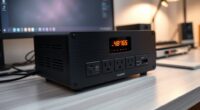
Shopping for front stage speakers under 3000 means choosing between two very different paths: powered cabinets with built-in amps and DSP, or passive speakers that let you pick your own amplification. The Yamaha DBR15 earns the best overall spot thanks to its professional-grade build, clean 1000W amplification, and DSP tuning that works straight out of the box. The Monoprice Stage Right SRD215 stands out as the value leader in the powered camp, packing a 1400W Class D amp and Bluetooth into a single cabinet, while the Rockville RSG15 pair is the strongest passive option if you already own an amp and want raw 15-inch output per dollar. The main tradeoff in this category is convenience versus control — powered speakers cost more per watt but need nothing else, while passive pairs demand a compatible mixer-amp and careful impedance matching. Read on for the full breakdown of all seven options.

Get business pricing on your home office setup
- Business-only prices and quantity discounts
- Tax-exempt purchasing
- Multiple users, one account, clear invoices
Complete the kit


Key Takeaways
- The lineup splits cleanly into two camps: two powered cabinets (Yamaha DBR15, Monoprice SRD215) and five passive options, and the right choice depends almost entirely on whether you already own amplification.
- The Yamaha DBR15 wins on build and sound quality rather than raw specs — its 1000W rating outperforms higher-wattage competitors because of DSP tuning and driver quality, proving wattage numbers alone mislead buyers.
- Passive 15-inch pairs like the Rockville RSG15 deliver the loudest output per dollar in this comparison, but only if your amp can handle an 8-ohm stereo load at reasonable power.
- The Rockville RSG15.24 dual-15 design is the outlier: a 4-ohm cabinet built for sheer volume in large venues, which makes it the wrong pick for small rooms and modest amplifiers.
- 12-inch options (Rockville RSG12, Acoustic Audio CR12) trade deep bass reach for lighter weight and faster setup — a smarter buy for mobile DJs and karaoke hosts than for bass-heavy music reproduction.
| Monoprice Stage Right SRD215 15-Inch Powered Speaker |  | Best Value Powered Pick | Speaker Size: 15 inches | Power: 1400W Class D | DSP Presets: 5 | VIEW ON AMAZON | See Our Full Breakdown |
| WMQ 8-Inch Passive Speaker Pair |  | Best for Beginners | Speaker Size: 8 inches | Peak Power: 800W | Configuration: 3-way, passive | VIEW ON AMAZON | See Our Full Breakdown |
| Yamaha DBR15 15″ Powered Speaker Cabinet |  | Best Overall | Woofer Size: 15 inches | Power Output: 1000W | Max SPL: 132 dB | VIEW ON AMAZON | See Our Full Breakdown |
| Acoustic Audio CR12 Passive 12-Inch 3-Way Speaker Pair |  | Best Balanced Passive Pair | Configuration: Passive 3-way, pair | Woofer: 12-inch polymer-treated cone | Tweeter: 7 x 3-inch compression driver | VIEW ON AMAZON | See Our Full Breakdown |
| Rockville RSG15 15-Inch 3-Way Passive PA Speakers (2-Pack) |  | Best for Big Loud Budget Sound | Quantity: 2 speakers | Type: 3-way passive DJ/PA | Woofer Size: 15 inches | VIEW ON AMAZON | See Our Full Breakdown |
| Rockville RSG15.24 Dual 15-Inch 3-Way 4-Ohm Passive DJ Speaker |  | Best Maximum Output Per Cabinet | Peak Power: 3000 watts | Woofers: Dual 15-inch | Tweeters: 3 piezo bullet tweeters with piezo compression horn | VIEW ON AMAZON | See Our Full Breakdown |
| Rockville RSG12 12″ 3-Way 8-Ohm Passive PA Speaker (2-Pack) |  | Best Value Stereo Pair | Speaker Size: 12 inches | Configuration: 3-way passive, sold as a 2-pack | Power: 500W RMS / 1000W peak per speaker | VIEW ON AMAZON | See Our Full Breakdown |
| front stage speakers under 3000 | Configuration | Impedance |
|---|---|---|
| Monoprice Stage Right SRD215 1 | — | — |
| WMQ 8-Inch Passive Speaker Pai | 3-way, passive | 8 Ohms |
| Yamaha DBR15 15" Powered Speak | — | — |
| Acoustic Audio CR12 Passive 12 | Passive 3-way, pair | 8 ohms |
| Rockville RSG15 15-Inch 3-Way | — | — |
| Rockville RSG15.24 Dual 15-Inc | 3-way passive | 4 ohms |
| Rockville RSG12 12" 3-Way 8-Oh | 3-way passive, sold as a 2-pack | 8 ohms |
More Details on Our Top Picks
Monoprice Stage Right SRD215 15-Inch Powered Speaker
The SRD215 makes the list because it bundles 1400W of Class D amplification, five DSP presets, Bluetooth streaming, and multiple input options into one self-contained box at an aggressive price. Compared with the Yamaha DBR15, it gives you more convenience features for casual and hybrid use — Bluetooth alone changes how quickly you can set up a backyard event or karaoke night. The angled cabinet doubles as a floor monitor, which the Acoustic Audio CR12 pair can’t do without extra stands. The tradeoff is refinement: Yamaha’s FIR-X Tuning delivers cleaner, more controlled sound at volume, and the Monoprice’s Bluetooth convenience comes at the cost of the tighter signal chain professionals prefer. At 44 lbs, it also lands in the awkward middle ground between portable and installed.
Pros:- 1400W Class D amplification built in — no separate amp to buy or match
- Five DSP presets let you tune for mains, monitors, or speech quickly
- Bluetooth streaming plus XLR/TRS, RCA, and subwoofer mix-out connectivity
- Angled cabinet works as both front-of-house main and stage monitor
Cons:- 44 lbs is cumbersome for solo loading at frequent gigs
- Sound tuning is less refined than Yamaha’s FIR-X processing at high volumes
Best for: Mobile DJs and event hosts who want an all-in-one powered speaker with app-free wireless streaming and monitor flexibility
Not ideal for: Sound professionals who need pristine wired signal paths and refined DSP — Bluetooth adds latency and compression risk
- Speaker Size:15 inches
- Power:1400W Class D
- DSP Presets:5
- Connectivity:Bluetooth, XLR/TRS combo inputs, RCA, XLR mix output
- Weight:44 lbs
- Enclosure:Rugged portable design, angled for monitor use
Our verdict“Buyers who want maximum functionality per dollar in a powered speaker — and can live with average transport ergonomics — get the most from this pick.”
WMQ 8-Inch Passive Speaker Pair
For anyone building a first karaoke or home-PA setup, this 8-inch 3-way pair is the gentlest entry point in the lineup. The dedicated woofer, midrange, and tweeter split means vocals stay clear and forward — the single most important quality for karaoke — without demanding audiophile gear behind it. Compared with the Acoustic Audio CR12, the smaller woofers and compact MDF cabinets trade raw output and bass depth for easy placement on desks, stands, or overhead brackets. The real catch is that these are passive speakers: budget for an amplifier or receiver, plus cables and mounts, none of which are included. Peak power ratings of 800W sound impressive on paper, but realistic output is modest — fine for a living room, underpowered for a hall.
Pros:- 3-way driver design keeps vocals clear and balanced for karaoke
- Compact footprint with flexible mounting on stands, desks, or overhead
- Thick MDF enclosure reduces resonance and tightens bass
- Stereo pair included, delivering a complete left/right image out of the box
Cons:- Requires a separate amplifier or receiver to function at all
- Cables and mounting accessories are not included, adding hidden cost
- Modest real-world output compared with 12- and 15-inch options here
Best for: Karaoke enthusiasts and home entertainers setting up their first system in a living room or small gathering space
Not ideal for: Mobile DJs playing medium venues — the 8-inch woofers simply can’t move enough air for dance-floor bass
- Speaker Size:8 inches
- Peak Power:800W
- Configuration:3-way, passive
- Impedance:8 Ohms
- Enclosure:MDF
- Dimensions:9.1″ D x 17.72″ W x 10.62″ H
Our verdict“This is the starter pick: a clear-vocal stereo pair for home karaoke, provided you already own or budget for an amp.”
Yamaha DBR15 15″ Powered Speaker Cabinet
The DBR15 earns the top spot because it solves the reliability problem that hangs over every other option here. A 1000W internal amplifier, 132 dB max SPL, and Yamaha’s FIR-X Tuning mean it plays loud and stays clean where the Monoprice SRD215 starts to sound processed and the passive Rockville RSG15 depends entirely on whatever amp you pair with it. The built-in DSP manages crossover and phase alignment precisely, which is why vocals and instruments sound coherent at gig volume rather than merely loud. Then there’s the 7-year warranty — nobody else in this roundup comes close, and it reflects Yamaha’s track record in working venues. The honest downside: it’s a big, heavy single box, and it’s arguably more speaker than a coffeehouse open mic actually needs.
Pros:- FIR-X Tuning delivers noticeably cleaner, phase-coherent sound at high volume
- 1000W and 132 dB SPL handle large rooms without strain
- Doubles as a floor monitor or front-of-house main
- 7-year warranty dwarfs the coverage on every other pick here
Cons:- Large 15-inch cabinet is heavy and awkward for one person to move
- More power and size than small events and home use require
Best for: Working musicians, bands, and DJs who need a main speaker that survives nightly use and fills mid-to-large rooms
Not ideal for: Buyers with compact cars or small home setups — the 15-inch cabinet is heavy and acoustically oversized for a den
- Woofer Size:15 inches
- Power Output:1000W
- Max SPL:132 dB
- DSP Tuning:FIR-X Tuning
- Use Modes:Main PA or floor monitor
- Warranty:7 years
Our verdict“If you want one front-stage speaker you can buy once and trust for years, this is the one that justifies its position at the top.”
Acoustic Audio CR12 Passive 12-Inch 3-Way Speaker Pair
The CR12 pair occupies the smart middle ground between the compact WMQ 8-inch set and the bulky Rockville RSG15 15-inch pair. A 12-inch woofer, 5-inch midrange, and compression tweeter with an internal crossover give it genuine full-range coverage (32 Hz–30 kHz on paper) while staying lighter and easier to pole-mount than the Rockvilles. The 92 dB sensitivity is honest and workable, and the connectivity is refreshingly flexible — raw wire, banana plugs, 1/4-inch jacks, plus a daisy-chain output so you can expand to a third cabinet without extra cabling runs. The tradeoff is the same one all passive speakers carry: you must supply an amplifier matched between 20 and 500 watts per channel, and mismatching it is the fastest way to blow the compression drivers.
Pros:- 3-way design with compression tweeter covers vocals and highs cleanly
- Multiple input types plus 1/4-inch daisy-chain output for easy expansion
- Rugged MDF cabinets with carpet covering, corners, grills, handles, and pole mounts
- 12-inch size balances output against weight and storage better than 15-inch rivals
Cons:- Requires an external amplifier carefully matched between 20 and 500W per channel
- Cabinets are still bulky for small rooms and tight vehicle packing
Best for: DJs and karaoke hosts who already own a compatible amp and want a versatile stereo pair for stage and PA duty
Not ideal for: Buyers wanting a plug-and-play system — without an external amplifier and careful power matching, these cabinets are silent
- Configuration:Passive 3-way, pair
- Woofer:12-inch polymer-treated cone
- Tweeter:7 x 3-inch compression driver
- Frequency Response:32 Hz – 30 kHz
- Impedance:8 ohms
- Recommended Amp Power:20–500W per channel
- Inputs:Raw wire, banana plug, 1/4-inch jack
Our verdict“This pair is the balanced passive choice — full-range stereo coverage for amp-owning buyers who find 15-inch cabs excessive.”
Rockville RSG15 15-Inch 3-Way Passive PA Speakers (2-Pack)
When the goal is maximum volume per dollar, the RSG15 pair plays a role nothing else here covers. With 15-inch woofers, horns, and piezo tweeters driven by a claimed 1500W peak per cabinet and a 102 dB sensitivity rating, these boxes are built to thump — the WMQ 8-inch pair can’t come close on bass, and even the Acoustic Audio CR12 gives up low-end authority to them. The SpeakON and 1/4-inch parallel connections make wiring a multi-cabinet rig straightforward, and recessed handles with a 35 mm pole mount help with the practical realities of moving two large cabs. Caveats are real: sensitivity and peak figures from budget brands tend to flatter, the 1-year warranty is thin next to Yamaha’s seven, and piezo tweeters sound harsher at the top end than the compression drivers on the CR12.
Pros:- Twin 15-inch woofers deliver serious bass output for dance music
- SpeakON and 1/4-inch parallel in/out wiring supports flexible multi-speaker rigs
- Carpet-covered MDF cabinets with steel grills and recessed handles survive gig transport
- 35 mm pole-mount sockets make standard stand deployment simple
Cons:- Passive design requires a separate high-power amplifier
- Piezo tweeters sound harsh at high volumes compared with compression drivers
- Only a 1-year warranty — the weakest coverage in this lineup
Best for: Budget-conscious DJs and event hosts who already own a beefy amplifier and prioritize raw loudness and bass for parties
Not ideal for: Buyers seeking refined sound or long-term assurance — piezo treble is harsh and the warranty lasts only a year
- Quantity:2 speakers
- Type:3-way passive DJ/PA
- Woofer Size:15 inches
- Peak Power:1500W per speaker
- Frequency Response:40 Hz – 22 kHz
- Sensitivity:102 dB @ 1W/1m
- Connectors:SpeakON and 1/4-inch parallel in/out
- Pole Mount:35 mm socket
Our verdict“Choose this pair when loud, bass-heavy stereo coverage matters more than refinement or warranty length, and you already own the amp to drive it.”
Rockville RSG15.24 Dual 15-Inch 3-Way 4-Ohm Passive DJ Speaker
If your front stage needs to hit hard from a single cabinet per side, this dual 15-inch design is the heavy artillery of this lineup. Where the Rockville RSG15 2-pack spreads output across two boxes, the RSG15.24 concentrates two woofers, three piezo bullet tweeters, and a compression horn into one enclosure — which means fewer trips from the van and a denser low-end punch per side. The 4-ohm load also lets a compatible amp deliver more power than it would into the 8-ohm RSG12 pair.
The tradeoffs are real: at 61.7 lbs, this is a two-person lift for most gigs, and the passive design means you’re budgeting for a serious amplifier to feed its 3000-watt peak rating. Compared with the powered Yamaha DBR15, you lose plug-and-play convenience but gain flexibility to scale amplification as your rig grows.
Pros:- Dual 15-inch woofers deliver high-output bass from a single cabinet
- Rugged MDF cabinet with reinforced steel grille and corner protectors survives gig transport
- Dual speakON and 1/4-inch connectors support professional pass-through wiring
- Ergonomic handles and rubber feet aid carrying and stable stage placement
Cons:- At 61.7 lbs, it’s one of the heaviest options here and awkward for solo load-ins
- Passive design requires a separate, suitably powerful amplifier — an added cost and setup step
Best for: DJs and bands running large venues who want maximum sound pressure from one cabinet per side and already own (or plan to buy) a high-power amplifier
Not ideal for: Solo performers or mobile entertainers who load in alone — the 61.7 lb weight and passive amp requirement make it impractical for one-person setups
- Peak Power:3000 watts
- Woofers:Dual 15-inch
- Tweeters:3 piezo bullet tweeters with piezo compression horn
- Configuration:3-way passive
- Impedance:4 ohms
- Connectors:Dual speakON and 1/4-inch in/out
- Cabinet:MDF with reinforced steel grille
- Weight:61.7 lbs
Our verdict“Buy this if you need maximum per-cabinet output for big rooms and already have amplification; skip it if you value portability or an all-in-one powered setup.”
Rockville RSG12 12″ 3-Way 8-Ohm Passive PA Speaker (2-Pack)
This two-speaker package solves the problem most front-stage buyers actually have: getting true stereo coverage without buying cabinets individually. Compared with the single-cabinet Rockville RSG15.24, the RSG12 pair trades raw per-box output for a wider, more even soundstage across the stage — the trapezoidal cabinets and 99dB sensitivity help them disperse cleanly at angles where a single box would beam.
The 12-inch woofers still reach down to 45Hz, respectable for this size class, and 500W RMS per speaker is plenty for small-to-mid venues. The compromises mirror the rest of Rockville’s passive lineup: you’ll need an external amp, and the piezo tweeters can turn edgy at high volumes where a compression-driver design like the Yamaha DBR15 stays smoother. Still, as a value proposition for a complete stereo front stage, this pair is hard to beat within budget.
Pros:- Complete stereo pair delivers 2000W combined peak output for full-stage coverage
- High-density MDF with aviation-grade carpet and corner protectors handles gig wear
- 99dB sensitivity produces loud, clear output from modest amplifier power
- Both 1/4-inch and SpeakON connectors fit a range of mixer and amp setups
Cons:- Passive design requires purchasing and transporting a separate amplifier
- Piezo tweeters can sound harsh at high volumes compared with compression-driver speakers
Best for: Working DJs and small venues building a complete stereo front stage on a budget, with an amplifier already in the rack
Not ideal for: Buyers who want powered plug-and-play simplicity — these passives need external amplification and extra cabling before making a sound
- Speaker Size:12 inches
- Configuration:3-way passive, sold as a 2-pack
- Power:500W RMS / 1000W peak per speaker
- Combined Peak Power:2000 watts
- Impedance:8 ohms
- Sensitivity:99dB @ 1W/1m
- Frequency Response:45Hz–22kHz
- Inputs:1/4-inch in/out and SpeakON
- Enclosure:High-density MDF with aviation-grade carpet
Our verdict“This pair makes the most sense for budget-conscious DJs who want a full stereo front stage in one purchase and can supply their own amplification.”

How We Picked
I evaluated each speaker against four criteria that actually matter at this budget: real-world output quality (not just peak wattage claims, which are marketing numbers), total cost of ownership (a passive speaker still needs an amp, cables, and sometimes a mixer), build and portability (weight, cabinet material, handle placement), and fit for the front-stage role — meaning vocals, spoken word, and live-sounding reproduction where clarity beats sheer loudness. Powered cabinets got judged on their onboard DSP and input flexibility; passive models got judged on driver layout, impedance load, and how demanding they are on an external amplifier.
The ranking order follows a simple logic: the Yamaha DBR15 leads because professional components and tuning beat spec-sheet flash. The Monoprice SRD215 sits close behind as the best powered value. The passive models are then ordered by output-per-dollar and versatility, with the Rockville RSG15 pair third, the more specialized RSG15.24 fourth, and the 12-inch and karaoke-focused options filling roles for lighter-duty buyers.
Factors to Consider When Choosing Front Stage Speakers Under 3000
Before picking a specific model, it helps to understand the bigger decisions that shape this purchase. These are the factors that separate a satisfying front-stage setup from an expensive mismatch.
Powered vs. Passive: The First Fork in the Road
This is the single biggest decision, and it shapes everything downstream. A powered speaker like the DBR15 or SRD215 contains its own amplifier, so you connect a mixer or phone and you’re done — but you need power outlets at stage level and you’re locked into the built-in amp’s sound. A passive pair costs less upfront but assumes you already own or will buy a power amp, speaker cables, and ideally a mixer with EQ. Buyers who forget this often blow their budget on speakers alone and end up underpowering them, which sounds thin and can damage drivers through clipping. My rule of thumb: if you don’t own an amp and don’t want to learn impedance math, go powered. If you already have a capable amplifier, passive pairs deliver noticeably more hardware per dollar.
Wattage Numbers Lie — Here’s What to Read Instead
Every speaker in this roundup claims hundreds or thousands of watts, and those figures are nearly useless for comparison. Peak power ratings assume brief bursts under lab conditions; continuous (RMS) power is the honest number, and it’s often a third of the headline figure. Driver quality and cabinet tuning matter more: the DBR15’s modest-looking 1000W outperforms higher-rated budget boxes because the woofer, compression driver, and DSP are engineered as a system. When comparing, look at sensitivity (dB) — a speaker with 3 dB higher sensitivity needs half the amplifier power to hit the same volume. A 98 dB passive cabinet with a 300W amp can out-scream a 92 dB cabinet fed 600W.
Impedance Matching Can Make or Break a Passive Setup
Most of the speakers here are 8-ohm, which works with virtually every PA amplifier ever made — this is the safe default. The Rockville RSG15.24 at 4 ohms is the exception, and that number changes what your amp must deliver. An amp rated for more power at 4 ohms will drive it harder, but an amp only stable at 8 ohms can overheat or shut down mid-gig. If you’re chaining two cabinets per side, impedances parallel down and halve, so two 8-ohm speakers per channel present a 4-ohm load. Check your amplifier’s minimum impedance spec before buying anything passive — this is the most common and most expensive mistake in the category.
Speaker Size: Where 15 Inches Isn’t Always Better
A 15-inch woofer moves more air and reaches lower, which is great for DJ sets and bass-heavy genres, but the tradeoffs are real: heavier cabinets, larger vehicles needed for transport, and slower transient response that can smear vocals. 12-inch models like the RSG12 and CR12 are easier to lift, fit in a hatchback, and often sound tighter on spoken word and acoustic material. For front-stage duty — vocals, presentations, karaoke — a well-designed 12 with a good horn often beats a cheap 15. Choose 15-inch only if low-frequency reach or room size genuinely demands it. Also check the horn design: a proper compression driver on a wide-dispersion horn covers audiences far better than a paper cone tweeter, which is what separates 3-way budget designs from professional cabinets.
Bluetooth and DSP: Convenience Features Worth Paying For
Onboard Bluetooth, found on the Monoprice SRD215, turns a PA speaker into a rehearsal and party unit with zero cabling — genuinely useful if the speaker doubles as a casual playback system. DSP (digital signal processing) is the less flashy but more valuable feature: it applies crossover points, limiting, and feedback control that protect drivers and clean up the sound without manual tuning. The Yamaha DBR15’s DSP is a major reason it tops this list. On passive speakers you get none of this — your mixer and amp must provide EQ and limiting. If you’re a beginner who doesn’t want to learn system tuning, a powered DSP speaker removes an entire skill requirement from the purchase.
Cabinet Construction and Long-Term Durability
MDF enclosures (like the WMQ pair) sound fine in climate-controlled rooms but swell and crumble if they get wet or take regular transport abuse — a real problem for mobile performers. Polypropylene or plywood cabinets with metal grilles survive van life, spilled drinks, and clumsy volunteers. Check the small stuff too: fly points if you’ll ever rig the speakers, recessed handles that protect knuckles, and whether replacement drivers are available. Front-stage speakers live at the edge of the stage where they get kicked, bumped, and rained on. Spending slightly more on a road-ready cabinet usually costs less than replacing a budget speaker after its first season of gigs.
Frequently Asked Questions
Do I need a separate amplifier for these speakers?
It depends entirely on which model you choose. The Yamaha DBR15 and Monoprice SRD215 are powered cabinets with built-in amplification — you only need a sound source and power outlets. Every other option in this roundup (the WMQ, Acoustic Audio CR12, and all three Rockville models) is passive and requires an external power amplifier plus speaker cables. If you go passive, size the amp to deliver roughly 1.5 to 2 times the speaker’s continuous power rating at its impedance, which gives clean headroom without stressing the drivers. Buyers who pair a big passive speaker with a tiny amp often mistake the resulting thin, distorted sound for a speaker problem when it’s really an underpowered amplifier clipping the signal.
Can I use front stage speakers for karaoke at home?
Yes, and the WMQ 8-inch karaoke pair is designed exactly for that use, with a compact MDF enclosure suited to living-room volumes rather than venue-level output. For home karaoke, smaller speakers are actually preferable — a 15-inch PA cabinet at close range is overwhelming and wastes money on bass reach you don’t need indoors. What matters more is having a mixer with microphone inputs and some EQ, since controlling feedback is the real challenge of karaoke. If you also host outdoor parties or want DJ-level volume, stepping up to the powered Monoprice or a Rockville passive pair gives you room to grow. Match the speaker size to your actual room, not to how impressive the box looks.
Is a single 15-inch speaker enough, or do I need a pair?
A single 15-inch powered cabinet can cover a small venue, backyard event, or rehearsal space without trouble, and buying one first lets you add a second identical unit later for true stereo and better coverage. A passive pair like the Rockville RSG15 or RSG12 two-packs makes sense when you want stereo spread from the start or need to cover a wider audience area — two cabinets placed apart deliver far more even coverage than one loud central speaker. The exception is the RSG15.24, which is a single dual-15 cabinet built for maximum output in one position; it’s a splurge for large rooms rather than a starter option. For front-stage vocal reinforcement, one good speaker per side of the stage is the standard setup, so a pair eventually makes sense for live performance even if you start with one.
What’s the difference between the Rockville RSG15 and RSG15.24?
The RSG15 is a single 15-inch woofer in an 8-ohm cabinet, sold as a two-pack, meaning you run them as a stereo pair from a standard amplifier — this is the flexible, all-purpose choice. The RSG15.24 stacks two 15-inch woofers plus a horn into one large 4-ohm cabinet designed for maximum output from a single position, which suits big DJ rigs and large halls. The 4-ohm load demands an amplifier rated to drive it safely, and the sheer size and weight make it awkward for anyone without a vehicle and a hand truck. Unless you specifically need maximum volume from one cabinet, the standard RSG15 pair is easier to place, easier to power, and more useful across different venues.
Why does the Yamaha DBR15 rank above speakers with higher wattage?
Because wattage is the least reliable indicator of how a speaker actually sounds. The DBR15’s 1000W rating is backed by a genuinely well-engineered woofer, a proper compression driver, and onboard DSP that manages crossovers and limiting so the system stays clean at high volume. Higher peak-wattage budget speakers often use cheaper drivers and no processing, which means they distort and get harsh well before their paper specs suggest. Yamaha’s professional division also builds these cabinets to survive touring, so the long-term durability justifies the price difference over generic brands. If sound quality and reliability are the priority, the DBR15 is the safe pick; if you need maximum output per dollar and already own amplification, the passive Rockville options close that gap fast.
Conclusion
The right pick here depends less on specs and more on what you already own and where you’ll use it. For the best overall choice, the Yamaha DBR15 delivers professional sound, protection, and reliability in a single powered cabinet — the safest buy for anyone doing paid gigs. The Monoprice Stage Right SRD215 takes best value in the powered category, offering more raw power and Bluetooth convenience for less commitment, which also makes it the best pick for beginners who want plug-and-play simplicity. If you’re chasing the best premium raw output and already own serious amplification, the Rockville RSG15 pair delivers the most stage presence per dollar, with the RSG15.24 reserved for large-venue DJ setups that genuinely need dual 15s. For smaller gigs and lighter loads, the Rockville RSG12 pair hits the portability sweet spot, the Acoustic Audio CR12 suits casual DJ and party duty on a tight budget, and the WMQ 8-inch pair is the right call for home karaoke rather than stage work. Decide whether you need convenience or control first, and the rest of the decision makes itself.
Columbus Day / Indigenous Peoples' Day Picks
long weekend sales
As an affiliate, we earn on qualifying purchases.