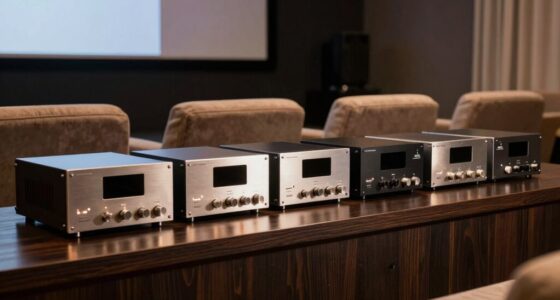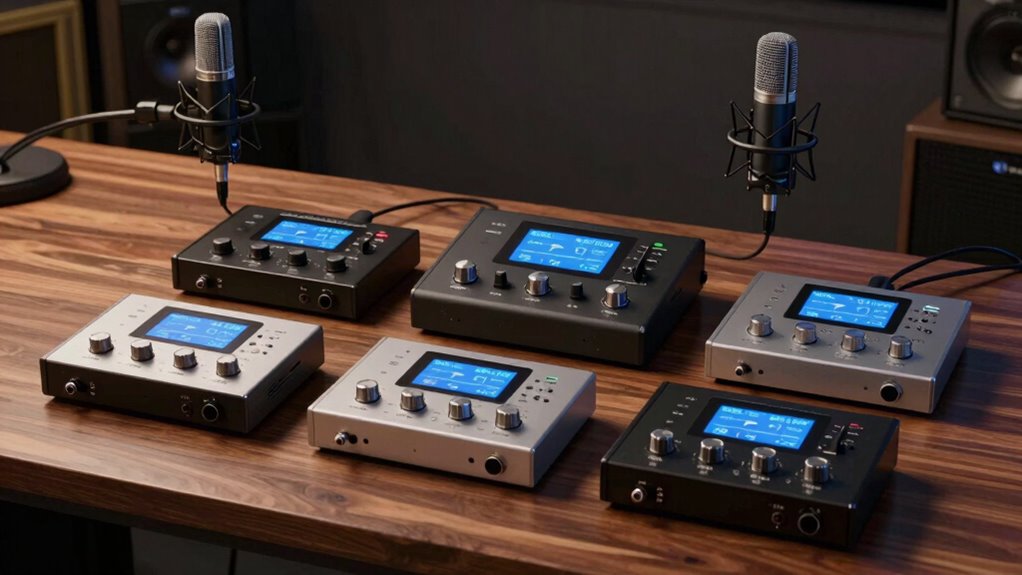

Choosing an audio interface for a measurement mic depends less on studio extras and more on clean mic input, phantom power, practical monitoring, and enough channels for the job. My strongest all-around pick is the Focusrite Scarlett 2i2 4th Gen, with two preamps and helpful level-setting tools. The Behringer UMC202HD offers a straightforward two-input alternative, while the RME Fireface UFX III bundle is the specialist choice when the included measurement microphone, calibration software, and extensive I/O fit a larger system.

Get your home office setup delivered free — and shop member deals
- Fast, free delivery on millions of items
- Access to Prime Big Deal Days deals on October 6–7
- Prime Video, Amazon Music and more included
The main tradeoff is scale: basic two-input interfaces can serve single-mic room checks without paying for a large routing platform, but they do not bring the included calibration package found in the RME bundle. I rank these picks by how well their stated capabilities suit measurement-mic workflows, not by recording extras alone. I also distinguish features that may help manage a measurement session from accuracy claims the supplied product information does not establish.
Complete the kit


Key Takeaways
- The Scarlett 2i2 4th Gen combines two mic inputs with 69 dB of stated analogue gain and Auto Gain, making it the most balanced general-purpose pick here.
- The RME Fireface UFX III bundle is the only option listed with both a measurement microphone and SONARWORKS SoundID Reference calibration software.
- The Behringer UMC202HD and M-Audio M-Track Duo each offer two inputs; Behringer specifies 24-bit/192 kHz, while M-Audio is listed up to 48 kHz.
- The RØDE AI-1 is compact and supplies phantom power, but its single input limits two-mic or simultaneous measurement-and-loopback setups.
- A high sample-rate specification does not establish measurement accuracy by itself; microphone calibration, input behavior, software, and workflow also matter.
| Focusrite Scarlett 2i2 4th Gen USB-C Audio Interface |  | Best Overall | Generation: 4th Gen | Connection: USB-C | Inputs: Two microphone/instrument inputs | VIEW ON AMAZON | See Our Full Breakdown |
| Behringer UMC202HD 2×2 USB Audio Interface with Midas Mic Preamplifiers |  | Best Value Two-Input Pick | Inputs/outputs: 2×2 | Resolution: 24-bit/192 kHz | Connection: USB | VIEW ON AMAZON | See Our Full Breakdown |
| M-Audio M-Track Duo USB Audio Interface |  | Best Simple Portable Option | Connectivity: USB | Compatibility: Mac and PC | Audio resolution: Up to 48 kHz | VIEW ON AMAZON | See Our Full Breakdown |
| RØDE AI-1 USB Audio Interface, Black |  | Best Compact Single-Input Choice | Model: AI-1 | Connectivity: USB | Channels: 1 | VIEW ON AMAZON | See Our Full Breakdown |
| RME Fireface UFX III 188-Channel Audio Interface Bundle with SONARWORKS SoundID Reference Calibration Software and Microphone |  | Best Premium Calibration Bundle | Channels: 188 total, 94 inputs / 94 outputs | Connectivity: USB 3.0 | Maximum sample rate: 24-bit/192 kHz | VIEW ON AMAZON | See Our Full Breakdown |
| audio interfaces for measurement mic | Warranty | Phantom power | Connectivity |
|---|---|---|---|
| Focusrite Scarlett 2i2 4th Gen | Three years | — | — |
| Behringer UMC202HD 2×2 USB Aud | — | Supported | — |
| M-Audio M-Track Duo USB Audio | — | Yes | USB |
| RØDE AI-1 USB Audio Interface | 1 year | Yes | USB |
| RME Fireface UFX III 188-Chann | Limited 2-year manufacturer warranty | — | USB 3.0 |
More Details on Our Top Picks
Focusrite Scarlett 2i2 4th Gen USB-C Audio Interface
The Scarlett 2i2 4th Gen is my best overall pick because it balances two microphone inputs with a clearly stated 69 dB of analogue gain and a 120 dB dynamic-range specification. Two inputs give a measurement setup room to grow: you can connect a mic and a second source, or reserve the spare channel for a workflow that needs another input. Compared with the single-channel RØDE AI-1, this is more flexible; compared with the much larger RME, it is easier to justify for a basic desktop system.
Auto Gain and Clip Safe are useful setup aids when you are preparing a recording, but I would not treat them as substitutes for controlled measurement levels. Air mode is aimed at adding presence to vocals and guitars, so it is not a reason to choose this interface for acoustic measurements. Its strength here is the combination of two preamps, USB-C connectivity, and sensible level assistance—not a claim that it includes calibration software or a measurement mic.
The included recording applications and plugins make it a versatile general-purpose interface beyond measurement tasks. Its tradeoff against the Behringer UMC202HD is that the Behringer explicitly lists 24-bit/192 kHz, while the supplied Scarlett details emphasize gain and dynamic range instead. I would choose the Scarlett for a polished two-input everyday setup, but skip it if the first priority is an included calibration microphone and software package.
Pros:- Two low-noise mic preamps and a stated 69 dB of analogue gain.
- Auto Gain and Clip Safe assist with setting recording levels.
- USB-C connection and an amplified headphone output with independent level control.
- Includes recording software and plugins, with a three-year warranty.
Cons:- No measurement microphone or speaker-calibration software is listed as included.
- Air mode targets vocal and instrument character rather than measurement work.
- The supplied specifications do not state a maximum sample rate.
Best for: Buyers who want a two-input USB-C interface for a measurement mic plus occasional recording or other audio sources.
Not ideal for: People seeking an included measurement microphone, calibration software, or extensive multi-channel routing.
- Generation:4th Gen
- Connection:USB-C
- Inputs:Two microphone/instrument inputs
- Dynamic range:120 dB
- Analogue gain:69 dB
- Features:Auto Gain, Clip Safe, Air mode
- Included software:Pro Tools Intro+, Ableton Live Lite, Cubase LE, Hitmaker Expansion
- Warranty:Three years
Our verdict“I recommend the Scarlett 2i2 as the most balanced two-input choice when you want a capable general interface rather than a bundled calibration system.”
Behringer UMC202HD 2×2 USB Audio Interface with Midas Mic Preamplifiers
The Behringer UMC202HD is a practical two-input option for buyers who want a straightforward interface with a clearly stated high-resolution recording format. Its listed 24-bit/192 kHz support, phantom power, and Midas mic preamps make it a strong alternative to the Scarlett, especially when sample-rate specification is a priority on paper. Both have two mic inputs, but the Scarlett adds USB-C and level-assistance features, while this Behringer emphasizes direct monitoring and a metal chassis.
For measurement work, direct monitoring can help you hear an input path without depending on software monitoring latency. It does not, by itself, improve the accuracy of a recorded measurement. The level-controlled headphone output is useful for checking playback, and the impact-resistant chassis is a sensible feature for a unit that may travel between a desk and a test location.
I place it below the Scarlett because the supplied details give less information about gain range and recording conveniences, not because the 192 kHz figure should be taken as proof of superior measurements. It also does not come with the measurement mic and calibration software that distinguish the RME bundle. Choose the UMC202HD when you want two inputs, phantom power, direct monitoring, and a rugged enclosure; look elsewhere if you need an explicitly included calibration workflow or the Scarlett’s stated level-setting tools.
Pros:- Two inputs and phantom power support a flexible microphone setup.
- Midas mic preamps and a stated 24-bit/192 kHz recording format.
- Direct monitoring and a level-controlled headphone output.
- Impact-resistant metal chassis.
Cons:- The supplied details do not specify analogue gain or dynamic range.
- No measurement microphone or calibration software is listed.
- USB connectivity is specified without a USB-C connection being stated.
Best for: Buyers seeking a two-input interface with phantom power, direct monitoring, and a stated 24-bit/192 kHz format.
Not ideal for: Users who want calibration software and a measurement mic in the box, or who need clearly documented gain and noise figures.
- Inputs/outputs:2×2
- Resolution:24-bit/192 kHz
- Connection:USB
- Preamplifiers:Midas mic preamplifiers
- Phantom power:Supported
- Monitoring:Direct monitor select
- Chassis:Impact-resistant metal
Our verdict“I would choose the UMC202HD for a sturdy, direct-monitoring two-input setup, while treating its sample-rate figure as a format specification rather than an accuracy guarantee.”
M-Audio M-Track Duo USB Audio Interface
The M-Audio M-Track Duo makes sense when portability and simple monitoring matter more than a high stated sample rate. It provides two combo inputs with phantom power, so it can accommodate an XLR measurement mic and leave another input available. Its USB/Direct switch offers zero-latency monitoring, a practical convenience for listening to the input path without relying on software playback.
Compared with the Behringer UMC202HD, the M-Track Duo is specified up to 48 kHz, rather than 24-bit/192 kHz. That difference may matter for a particular recording workflow, but the higher number on the Behringer does not alone establish better measurement results. The M-Audio listing also identifies Mac and PC compatibility, stereo outputs, and MPC Beats software, making its role clearer for a user who wants an interface that can cover basic recording or streaming as well as measurements.
This is the simpler choice in the lineup, not the most fully specified one: the product information does not give gain, dynamic-range, or converter-performance figures. Unlike the Scarlett, it does not list Auto Gain or Clip Safe; unlike the RME bundle, it does not include calibration software or a measurement mic. I would pick it for a compact, general-purpose two-input rig, but choose another model if stated high-resolution support or bundled calibration is central to the purchase.
Pros:- Two combo XLR/line/instrument inputs with phantom power.
- USB/Direct switch supports zero-latency monitoring.
- Portable design with headphone and stereo outputs.
- MPC Beats software is included, and Mac and PC compatibility is stated.
Cons:- Listed audio resolution tops out at 48 kHz.
- The supplied information does not state gain or dynamic-range figures.
- No measurement mic or calibration software is listed.
Best for: Portable users who need two phantom-powered combo inputs and a direct-monitoring switch for basic measurement and general recording.
Not ideal for: Buyers who specifically need a stated rate above 48 kHz, detailed published input performance, or bundled calibration tools.
- Connectivity:USB
- Compatibility:Mac and PC
- Audio resolution:Up to 48 kHz
- Inputs:Two combo XLR/line/instrument inputs
- Phantom power:Yes
- Preamps:Crystal Preamps
- Monitoring:USB/Direct switch for zero-latency monitoring
- Included software:MPC Beats
Our verdict“I recommend the M-Track Duo for a portable, no-frills two-input system, not for buyers who need detailed performance specifications or a complete calibration bundle.”
RØDE AI-1 USB Audio Interface, Black
The RØDE AI-1 earns a place for buyers who need one microphone input and want to keep the setup compact. Its Neutrik combo jack accepts an XLR microphone or a quarter-inch source, and phantom power is listed for compatible microphones. It also supports sampling up to 96 kHz and includes a headphone output with level control, covering the basics without the extra channel count of the Scarlett, Behringer, and M-Audio units.
That one-input limit is the defining compromise. For a single-mic room response check, one input may be enough; a second channel can matter if you need to capture another source at the same time or keep a more involved measurement setup connected. In that respect, the RØDE is less flexible than every other general-purpose interface in this group, all of which list two inputs. It also lacks the bundled calibration tools and mic found with the RME package.
I rank it below the two-input models because the single-channel design narrows future options, even though its compact footprint and 96 kHz support may suit a simple rig. The supplied description does not state gain range, dynamic range, or measurement-specific calibration. Choose the AI-1 when one mic input is genuinely all you need; skip it if you expect to expand, compare two simultaneous signals, or want a ready-made calibration package.
Pros:- Combo input accepts XLR microphones and quarter-inch instruments.
- Phantom power is available for compatible microphones.
- Supports sample rates up to 96 kHz.
- Compact body with a headphone output and level control.
Cons:- Single input limits simultaneous recording and expansion.
- The supplied details do not state gain range or dynamic range.
- No measurement microphone or calibration software is listed, and the stated warranty is one year.
Best for: A buyer building a small one-microphone setup who values a combo input, phantom power, and a controlled headphone output.
Not ideal for: Anyone who needs two simultaneous inputs, bundled calibration software, or a measurement mic included.
- Model:AI-1
- Connectivity:USB
- Channels:1
- Input:Neutrik combo jack, XLR and 1/4-inch
- Phantom power:Yes
- Maximum sample rate:96 kHz
- Dimensions:3.94 x 4.88 x 1.5 inches
- Warranty:1 year
Our verdict“I would choose the AI-1 for a compact one-mic setup, but a two-input interface is the safer buy if your measurement workflow may grow.”
RME Fireface UFX III 188-Channel Audio Interface Bundle with SONARWORKS SoundID Reference Calibration Software and Microphone
The RME Fireface UFX III bundle is the specialist option here: it pairs a large-format interface with SONARWORKS SoundID Reference calibration software and a measurement microphone. That makes it the only pick in this lineup described as a bundled calibration system, rather than a general-purpose interface that could be used with a separately sourced mic and software. Its 188-channel I/O, USB 3.0 connection, and 1 RU form factor suit complex recording or installation workflows far beyond a single desktop mic check.
Against the Scarlett 2i2 or UMC202HD, the UFX III is not simply a more elaborate version of the same purchase. Its value depends on needing extensive routing and the included calibration components. The listing describes MADI, dual optical ADAT, XLR AES3, balanced quarter-inch line I/O, XLR outputs, and direct USB recording. Those connections can support a larger system, but they add little to someone who only needs one microphone preamp and a simple analysis path.
There are meaningful caveats: the listing specifies Windows and personal-computer compatibility, so I would check platform fit before buying, and an Advanced Remote Control USB is sold separately. The supplied details also do not state microphone input gain or dynamic range, so the channel count and sample rate should not be mistaken for a complete measurement-performance specification. I rank it fifth as a broad recommendation because its scale can be excessive, while naming it best for buyers who specifically want the included mic and calibration software with extensive I/O.
Pros:- Bundle includes SONARWORKS SoundID Reference calibration software and a measurement microphone.
- Extensive 188-channel I/O with MADI, ADAT, AES3, and analogue connections.
- Supports up to 24-bit/192 kHz and DURec direct USB recording.
- Rack-mountable 1 RU design for a larger system.
Cons:- The 188-channel platform may be excessive for a basic one- or two-mic setup.
- Advanced Remote Control USB is sold separately.
- Listing specifies Windows; confirm that the stated platform support fits your computer.
Best for: Studio, integrator, or calibration-focused buyers who can use the included measurement mic and software alongside extensive multichannel I/O.
Not ideal for: A first measurement-mic setup that needs only one or two inputs, or users who need confirmed compatibility beyond the stated Windows listing.
- Channels:188 total, 94 inputs / 94 outputs
- Connectivity:USB 3.0
- Maximum sample rate:24-bit/192 kHz
- I/O:MADI, dual optical ADAT, XLR AES3, balanced 1/4-inch line I/O, XLR 3-pin outputs
- Recording support:DURec direct USB recording
- Form factor:1 RU
- Compatible devices and operating system:Personal computer; Windows listed
- Warranty:Limited 2-year manufacturer warranty
Our verdict“I recommend the UFX III bundle only when you will use its included calibration components and broad routing, since smaller interfaces are a more proportionate fit for simple measurements.”

How We Picked
I ranked these interfaces around the needs of measurement-mic work: a microphone input that can supply phantom power where needed, useful channel count, stated recording capability, and practical monitoring or system integration. I gave extra weight to the RME bundle because its listing explicitly includes a measurement microphone and calibration software, a meaningful distinction from the four general-purpose interfaces.
I treated convenience features such as Auto Gain, direct monitoring, headphone control, and included recording software as secondary. They can make setup or listening easier, but they do not replace a microphone calibration file, a suitable analysis application, or a known signal path. I did not infer unlisted specifications such as input noise, converter linearity at measurement levels, loopback capability, or Windows and macOS compatibility beyond what each product description states.
The order reflects the likely fit for a reader who wants to connect a measurement mic and build a usable system without buying an oversized control hub. The Scarlett leads as the balanced two-input option; Behringer follows for its stated high-resolution format and direct monitoring; M-Audio is a simpler portable alternative; RØDE suits a one-input setup; and RME ranks as a specialized bundle rather than a sensible default for every measurement task. That placement recognizes its unusual bundle value in capability, while accounting for its scale and specialist nature.
| audio interfaces for measurement mic | Phantom power | Connectivity |
|---|---|---|
| Focusrite Scarlett 2i2 4th Gen | — | — |
| Behringer UMC202HD 2×2 USB Aud | Supported | — |
| M-Audio M-Track Duo USB Audio | Yes | USB |
| RØDE AI-1 USB Audio Interface | Yes | USB |
| RME Fireface UFX III 188-Chann | — | USB 3.0 |
Factors to Consider When Choosing Audio Interfaces For Measurement Mics
For measurement work, I would start by matching the interface to the microphone and the measurement method, then compare channel count and workflow. The interface is one link in a chain that also includes the mic, its calibration data, the computer, and the analysis software.
Check the microphone connection and phantom-power requirement
Confirm whether your measurement microphone uses an XLR connection and requires phantom power, or whether it has a different power arrangement. The Scarlett 2i2, UMC202HD, M-Track Duo, and AI-1 all list phantom power; the RME bundle includes a measurement mic, though the supplied details do not specify its power needs. A combo jack can accept more than one plug type, but that does not confirm every microphone will work without the right cable or power.
I would also check the microphone maker’s documentation for calibration-file support and connection requirements. Phantom power is an electrical supply feature, not proof of calibration or accuracy. Do not infer microphone sensitivity, input noise, or compatibility from a general-purpose interface description alone.
Choose channel count for the measurements you plan to make
A one-input interface can be enough for a basic single-mic measurement, which is where the compact RØDE AI-1 fits. Two inputs offer more flexibility for a second microphone or another simultaneous signal; the Scarlett, Behringer, and M-Audio each list two inputs. For a large system with many sources and routing needs, the RME UFX III has far more I/O than the other options.
I would not buy a high channel count just because it sounds future-proof. Extra inputs are useful when a real workflow needs them; otherwise, they can add setup complexity without changing a simple measurement session. If you expect to compare multiple channels at once, verify that the application and signal chain support your planned method.
Interpret sample rate and bit depth carefully
The product details list 24-bit/192 kHz for the Behringer and RME, up to 96 kHz for the RØDE, and up to 48 kHz for the M-Audio. The Scarlett listing provides dynamic range and gain figures but no maximum sample rate. These are useful format distinctions, yet they do not establish overall measurement accuracy or tell you how an interface behaves at the levels your microphone produces.
Before deciding, check the requirements of your analysis software and the measurement method you intend to use. A higher maximum sample rate is not a substitute for microphone calibration, suitable gain staging, a stable connection, or published input-performance data. If those figures matter to your work, look for documentation beyond the brief product descriptions.
Separate monitoring convenience from measurement quality
Direct monitoring appears on the Behringer and M-Audio, while the Scarlett and RØDE list headphone outputs with level control. These features help you monitor a signal or playback, but they do not change the captured measurement data by themselves. The Scarlett’s Auto Gain and Clip Safe may help with recording setup; for controlled measurements, I would still set and document levels with the chosen method rather than relying on an automatic feature.
Think about how you will inspect results. Headphone control is handy during setup, but calibration software and analysis tools determine different parts of the workflow. The RME bundle stands apart because calibration software and a measurement microphone are explicitly included; the other four are interface choices that may need compatible items sourced separately.
Buy for the whole calibration chain, not one specification
A measurement interface does not independently calibrate a room, loudspeaker, or headphone. The microphone, its calibration information, the software, signal routing, and the listening or measurement environment all affect the process. The RME bundle is the clearest ready-made package in this group, while the Scarlett, UMC202HD, M-Track Duo, and AI-1 leave more of that system to the buyer.
For a modest setup, my shortlist would begin with two inputs if flexibility matters and one input if compact simplicity matters. For a larger calibration or studio system, investigate whether the UFX III’s routing and included software match your actual workflow. In every case, confirm operating-system compatibility and any required drivers, cables, microphone power, and calibration files before making the final choice.
Frequently Asked Questions
Do I need phantom power for a measurement microphone?
It depends on the microphone. Many XLR measurement microphones require phantom power, while other models use a different power supply or connection. The Scarlett 2i2, Behringer UMC202HD, M-Audio M-Track Duo, and RØDE AI-1 list phantom power, but I would check the microphone manufacturer’s requirements and cable guidance before connecting it. Phantom power does not provide calibration data or certify measurement performance.
Is a higher sample rate automatically better for measurement?
No. The Behringer and RME list up to 24-bit/192 kHz, the RØDE lists up to 96 kHz, and the M-Audio lists up to 48 kHz, but those figures alone do not establish accuracy. The measurement microphone, calibration information, input performance, signal levels, and analysis software all matter. I would match the format to the software and method rather than choosing on sample rate alone.
Can I use a regular recording interface with a measurement mic?
A general-purpose interface can be suitable if it has the required microphone connection and power, works with your software, and fits the measurement process. Four interfaces here list phantom power, but none of those general-purpose product descriptions includes a measurement microphone or calibration package. The RME bundle is the exception, with a measurement mic and SONARWORKS SoundID Reference listed. I would still confirm the included mic and software meet the specific task.
Should I choose one input or two?
One input may be enough for a basic single-microphone measurement, which makes the RØDE AI-1 a compact option. Two inputs provide room for another simultaneous source or a future change in workflow, as with the Scarlett, Behringer, and M-Audio. The right choice depends on the measurement method and software, not simply on having more inputs. If you are unsure, two inputs offer more flexibility without moving to the RME’s much larger system.
Which interface here includes a measurement microphone and calibration software?
The RME Fireface UFX III bundle is the only listed option that includes both a measurement microphone and SONARWORKS SoundID Reference calibration software. The Scarlett 2i2, Behringer UMC202HD, M-Audio M-Track Duo, and RØDE AI-1 are presented as general-purpose interfaces, with no measurement mic or calibration software listed. I would compare the RME’s package against your required computer platform, channel needs, and routing plans before choosing it over a simpler interface.
Conclusion
For most buyers connecting a measurement mic while keeping a flexible everyday interface, I would start with the Focusrite Scarlett 2i2 4th Gen: its two inputs, stated gain range, and level-setting tools make it the best-balanced recommendation. Choose the Behringer UMC202HD if direct monitoring, a rugged chassis, and its listed 24-bit/192 kHz format matter more. The M-Audio M-Track Duo is a sensible portable option for basic two-input work, while the RØDE AI-1 suits a compact single-mic setup.
If your priority is getting a measurement mic and calibration software in the same package, look to the RME Fireface UFX III bundle—but only if its extensive I/O, Windows listing, and specialist scale suit your system. I would not treat sample rate, phantom power, or channel count alone as a measure of accuracy. Match the interface to your microphone, calibration data, and analysis workflow.
Halloween Picks
halloween
As an affiliate, we earn on qualifying purchases.