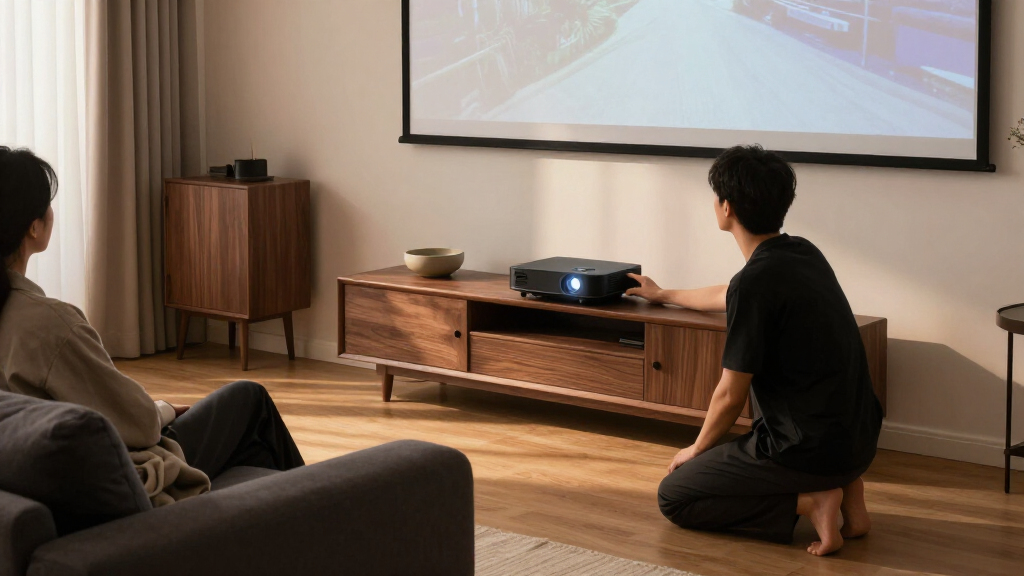

Short throw projectors for home theaters solve one specific problem: getting a huge, cinematic picture in a room where a traditional projector mount just isn’t practical. Whether you live in an apartment with limited wall depth or you want a 100-inch image without shadows from people walking past, this category lets you place the projector inches from the wall instead of across the room. The Hisense PX3-PRO stands out as my best overall pick thanks to its triple-laser color performance and flexible setup, while the WEMAX Nova Pro makes a strong case with its built-in Google TV and the AWOL VISION LTV-3000 Pro pushes into true premium territory with 3D support and reference-grade brightness. The main tradeoff you’ll face in this category is price versus resolution and light source: triple-laser 4K models cost considerably more, while sub-$1,000 options often compromise on brightness, contrast, or smart features. Below the flagship tier, the decision gets harder — compact laser models like the Optoma GT2000HDR trade resolution for portability, and budget smart projectors trade image quality for convenience. Keep reading for the full breakdown of all 14 models.

Get business pricing on your home office setup
- Business-only prices and quantity discounts
- Tax-exempt purchasing
- Multiple users, one account, clear invoices
Complete the kit


Key Takeaways
- Ultra short throw laser models (Hisense PX3-PRO, WEMAX Nova Pro, AWOL VISION LTV-3000 Pro) dominated the top of this comparison because they deliver the easiest home theater setup — inches from the wall, no mounting, no shadow interference.
- Budget picks like the TOPTRO A2 and Smart 1080p Projector with Google TV proved that smart platforms and convenience are now cheap, but brightness and contrast gaps mean they suit dim rooms and casual viewing rather than dedicated home theaters.
- The Optoma lineup showed a clear pattern: you’re choosing between compact portability (GT2000HDR, Photon Go ML1080UST) and maximum brightness for lit rooms (GT3500HDR, GT2400HDR) — no single Optoma model does both.
- The BenQ TH671ST is the only true short throw (not ultra short throw) in the lineup, which means it still needs a few feet of throw distance — a real limitation for buyers with shallow rooms, despite its strong gaming credentials.
- 3D support is rare in this category: only the AWOL VISION LTV-3000 Pro offers it, which matters if you have a 3D Blu-ray collection and narrows your premium choices considerably.
| Hisense PL2 4K Ultra Short Throw Laser Projector |  | Best Overall | Projection technology: X-Fusion laser, DLP | Resolution: 4K UHD | Brightness: 2,700 lumens | VIEW LATEST PRICE | See Our Full Breakdown |
| WEMAX Nova Pro 4K Ultra Short Throw Laser Projector with Google TV |  | Best All-in-One Streaming Pick | Resolution: 3840 x 2160 (DLP) | Brightness: 2,100 ISO lumens | Throw ratio: 0.23:1 | VIEW LATEST PRICE | See Our Full Breakdown |
| Smart 1080p Projector with Google TV, 360° Stand, Wi-Fi 6 and Bluetooth 5.4 |  | Best Budget-Friendly Starter | Native resolution: 1080p with 4K decoding | Brightness: 500 ISO ANSI | Throw ratio: 1.17:1 | VIEW LATEST PRICE | See Our Full Breakdown |
| BenQ TH671ST 1080p Short-Throw Home Entertainment Projector |  | Best for Bright Rooms and Gaming Value | Projection system: DLP | Resolution: 1080p (1920 × 1080) | Brightness: 3,000 ANSI lumens | VIEW LATEST PRICE | See Our Full Breakdown |
| Optoma GT3500HDR 1080p Full HD Ultra Short Throw Laser Projector |  | Best for Gamers | Resolution: 1080p Full HD (4K HDR input compatible) | Brightness: 3,800 lumens | Contrast ratio: 500,000:1 | VIEW LATEST PRICE | See Our Full Breakdown |
| GO2 Upgrade 4K Short Throw Projector with VIDAA OS, 65W Dolby Audio, and Auto Focus |  | Best All-in-One Smart Pick | Resolution: 4K | Throw Ratio: Short throw (100″ image from 8 feet) | Audio: 65W stereo speakers with Dolby Audio | VIEW LATEST PRICE | See Our Full Breakdown |
| Optoma GT2400HDR Short Throw Laser Projector |  | Best for Bright Rooms | Brightness: 4,200 ANSI lumens | Native Resolution: 1920 x 1080 (4K input compatible) | Light Source: DuraCore laser, 30,000 hours | VIEW LATEST PRICE | See Our Full Breakdown |
| Optoma GT2000HDR Ultra-Compact Short-Throw Full HD Laser Projector |  | Best Compact Value | Native Resolution: 1920 x 1080 (4K HDR input compatible) | Brightness: 3,500 lumens | Light Source: DuraCore laser, up to 30,000 hours | VIEW LATEST PRICE | See Our Full Breakdown |
| AWOL VISION LTV-3000 Pro 4K 3D Triple Laser Ultra Short Throw Projector |  | Best Premium Movie Experience | Resolution: 4K UHD | Projection Type: Ultra short throw (0.25:1) | Light Source: Triple laser | VIEW LATEST PRICE | See Our Full Breakdown |
| Hisense PX3-PRO 4K Ultra Short Throw Triple Laser Projector |  | Best Big-Screen Gamer | Resolution: Native 4K UHD | Projection Size: 80 to 150 inches | Light Source: Triple laser (red, blue, green) | VIEW LATEST PRICE | See Our Full Breakdown |
| Optoma Photon Go ML1080UST 1080p Ultra Short Throw Triple Laser Projector |  | Best Portable Ultra Short Throw | Native resolution: 1920 x 1080 | Brightness: 650 ANSI lumens | Light source: RGB triple laser, 20,000-hour life | VIEW LATEST PRICE | See Our Full Breakdown |
| BenQ TK700 4K HDR Home Entertainment Gaming & Movie Projector |  | Best for Console Gaming | Native resolution: 3840 x 2160 (4K) | Brightness: 3200 ANSI lumens | Input lag: 4.2ms | VIEW LATEST PRICE | See Our Full Breakdown |
| Portable Smart Projector with Google TV, Native 1080p, 4K Support, Wi-Fi 6, and Bluetooth |  | Best Beginner Pick | Resolution: Native 1080p; supports 4K decoding | Throw ratio: 0.8:1 | Screen size: 60–120 inches | VIEW LATEST PRICE | See Our Full Breakdown |
| TOPTRO A2 4K-Decoding Smart Projector with VIDAA, Dolby Audio, Wi-Fi 6, and Voice Control |  | Best Built-In Audio | Operating system: VIDAA Smart OS | Resolution: Native 1080p; supports 4K decoding | Brightness: 650 ANSI lumens | VIEW LATEST PRICE | See Our Full Breakdown |
| short throw projectors for home theater | Brightness | Resolution | Connectivity | Light source |
|---|---|---|---|---|
| Hisense PL2 4K Ultra Short Thr | 2,700 lumens | 4K UHD | HDMI, Ethernet, Bluetooth, Wi-Fi 6E | — |
| WEMAX Nova Pro 4K Ultra Short | 2,100 ISO lumens | 3840 x 2160 (DLP) | HDMI 2.1, USB, optical, LAN, Wi-Fi 6, Bluetooth | ALPD laser |
| Smart 1080p Projector with Goo | 500 ISO ANSI | — | — | — |
| BenQ TH671ST 1080p Short-Throw | 3,000 ANSI lumens | 1080p (1920 × 1080) | — | — |
| Optoma GT3500HDR 1080p Full HD | 3,800 lumens | 1080p Full HD (4K HDR input compatible) | 2x HDMI 2.0, USB-A, 3.5mm audio, RS232, RJ45 | DuraCore laser, up to 30,000 hours |
| GO2 Upgrade 4K Short Throw Pro | — | 4K | WiFi, Bluetooth, 2x HDMI 2.1, 2x USB, AV, 3.5mm jack | — |
| Optoma GT2400HDR Short Throw L | 4,200 ANSI lumens | — | HDMI, RCA | DuraCore laser, 30,000 hours |
| Optoma GT2000HDR Ultra-Compact | 3,500 lumens | — | HDMI, USB, 3.5mm audio, RCA | DuraCore laser, up to 30,000 hours |
| AWOL VISION LTV-3000 Pro 4K 3D | — | 4K UHD | — | Triple laser |
| Hisense PX3-PRO 4K Ultra Short | 3,000 lumens | Native 4K UHD | — | Triple laser (red, blue, green) |
| Optoma Photon Go ML1080UST 108 | 650 ANSI lumens | — | — | RGB triple laser, 20,000-hour life |
| BenQ TK700 4K HDR Home Enterta | 3200 ANSI lumens | — | — | — |
| Portable Smart Projector with | — | Native 1080p; supports 4K decoding | Wi-Fi 6, Bluetooth 5.3, HDMI ARC/CEC, USB | — |
| TOPTRO A2 4K-Decoding Smart Pr | 650 ANSI lumens | Native 1080p; supports 4K decoding | — | — |
More Details on Our Top Picks
Hisense PL2 4K Ultra Short Throw Laser Projector
This option stands out for combining true 4K resolution, Dolby Vision HDR, and Google TV in a package that sits inches from the wall. The 2,700-lumen X-Fusion laser delivers enough punch for evening viewing without a dedicated dark room, and the 25,000+ hour light source means no lamp swaps for a decade of regular use. Compared with the Optoma GT3500HDR, the Hisense accepts and displays genuine 4K rather than downconverting it, which matters for anyone watching modern streaming content. Wi-Fi 6E and Dolby Atmos support round out a future-proofed feature set. The tradeoff is that its 3,000:1 contrast ratio is modest for the price bracket, and listings cite conflicting 120- versus 150-inch maximum sizes, so buyers should verify screen fit before committing to a large ALR screen.
Pros:- True 4K UHD resolution with AI upscaling for older content
- Dolby Vision plus multiple HDR formats for richer streaming picture quality
- Laser light source rated for 25,000+ hours with no lamp replacements
- Google TV, Wi-Fi 6E, and Dolby Atmos support make it a complete smart hub
Cons:- Conflicting listed maximum screen sizes (120 vs 150 inches) create purchase uncertainty
- 3,000:1 contrast ratio is modest for a home theater centerpiece
Best for: Home theater buyers who want a true 4K ultra short throw that replaces a TV without wiring a dark, dedicated room
Not ideal for: Viewers who watch mostly in bright daytime rooms — 2,700 lumens can’t fully overcome direct sunlight, and contrast is only average
- Projection technology:X-Fusion laser, DLP
- Resolution:4K UHD
- Brightness:2,700 lumens
- Projection size:80–150 inches
- Light source lifespan:25,000+ hours
- HDR support:Dolby Vision and multiple HDR standards
- Smart platform:Google TV
- Connectivity:HDMI, Ethernet, Bluetooth, Wi-Fi 6E
Our verdict“The most balanced pick here: 4K, HDR flexibility, and smart features in one wall-hugging unit, ideal for a living-room theater.”
WEMAX Nova Pro 4K Ultra Short Throw Laser Projector with Google TV
Where the Hisense PL2 leans on Dolby Vision, the Nova Pro leans on convenience: native Netflix built into Google TV, MEMC motion smoothing for sports, and dual 15W speakers with Dolby Audio and DTS-HD that genuinely fill a room. A 0.23:1 throw ratio means a 150-inch image from just 49 cm away, so shadows and mounting headaches mostly disappear. HDMI 2.1 adds headroom for consoles. The catch is brightness — at 2,100 ISO lumens it sits below both the Hisense and the Optoma GT3500HDR, so this model is better suited to a controlled-lighting media room than a family room with open windows. Compared with the BenQ TH671ST, it skips the lamp entirely, so long-term ownership costs stay low.
Pros:- Native Netflix and Google TV apps eliminate external streaming sticks
- 150-inch image from only 49 cm away thanks to the 0.23:1 throw ratio
- Dual 15W Dolby Audio and DTS-HD speakers reduce the need for external audio
- MEMC motion smoothing improves sports and fast-action content
Cons:- Lower brightness than competing ultra short throws in this lineup
- Direct sunlight noticeably degrades the image
Best for: Stream-first movie watchers who want Netflix, Google TV, and decent built-in sound without adding a soundbar
Not ideal for: Bright, sunlit living rooms — the 2,100 ISO lumens output washes out without light control
- Resolution:3840 x 2160 (DLP)
- Brightness:2,100 ISO lumens
- Throw ratio:0.23:1
- Image size:80–150 inches
- Light source:ALPD laser
- Audio:Dual 15W speakers, Dolby Audio, DTS-HD
- Connectivity:HDMI 2.1, USB, optical, LAN, Wi-Fi 6, Bluetooth
- Features:Google TV, Netflix, HDR10, HLG, MEMC, Active 3D
Our verdict“A streaming-first ultra short throw that trades brightness for convenience — best in a dimmable media room.”
Smart 1080p Projector with Google TV, 360° Stand, Wi-Fi 6 and Bluetooth 5.4
This model makes the most sense for buyers testing the projector waters without a big outlay. The 360° rotating stand plus a 1.17:1 short-throw lens means it can sit on a coffee table, aim at a ceiling, or squeeze into a corner — placement freedom none of the wall-hugging options like the WEMAX Nova Pro can match. Google TV 14.0 with live channels and a 30W speaker round out a self-contained package. The honest tradeoff: this is native 1080p, so 4K content gets decoded down, and 500 ISO ANSI lumens demand a genuinely dark room — roughly a sixth of the BenQ TH671ST’s output. For a bedroom movie night, that’s acceptable. For daytime viewing, it isn’t.
Pros:- 360° rotating stand enables ceiling, wall, or angled projection anywhere
- Google TV 14.0 with streaming apps and live channels built in
- AI auto focus and keystone correction make setup nearly effortless
- 30W speakers and bidirectional Bluetooth 5.4 handle audio without extras
Cons:- Native 1080p panel — 4K content is decoded and displayed at 1080p
- Only 500 ISO ANSI brightness, requiring a fully dark room
Best for: First-time projector owners and casual bedroom-movie households who value flexible placement over image muscle
Not ideal for: Anyone wanting true 4K or daytime viewing — 1080p native resolution and 500 ISO lumens limit both
- Native resolution:1080p with 4K decoding
- Brightness:500 ISO ANSI
- Throw ratio:1.17:1
- HDR:HDR10
- Operating system:Google TV 14.0
- Speaker output:30W
- Wireless:Wi-Fi 6, Bluetooth 5.4
- Warranty:2 years
Our verdict“A low-commitment entry point for dark-room casual viewing, not a substitute for a laser home theater unit.”
BenQ TH671ST 1080p Short-Throw Home Entertainment Projector
At 3,000 ANSI lumens with over 92% Rec. 709 coverage, the TH671ST produces a brighter, more accurate picture than any smart-focused model here, and it does so at a lower price class than the laser units. It needs about five feet for a 100-inch image — not ultra short throw like the Optoma GT3500HDR, but still short enough to avoid ceiling mounts in most rooms. Low input lag makes it a solid console-gaming pick, and the 10,000:1 contrast ratio beats the Hisense PL2 and WEMAX Nova Pro on paper. The compromises are old-school: a lamp-based light source that lasts just 4,000 hours in Normal mode, a token 5W speaker, and no smart platform — you’ll want a streaming stick and external audio.
Pros:- 3,000 ANSI lumens handle rooms with some ambient light
- Over 92% Rec. 709 color coverage for accurate movie reproduction
- Low input lag suits console and PC gaming
- 10,000:1 contrast ratio exceeds the laser ultra short throws here
Cons:- Lamp life drops to 4,000 hours in Normal mode
- 5W built-in speaker is effectively unusable for home theater
Best for: Budget-conscious buyers with brighter rooms or gaming setups who already own a soundbar and streaming device
Not ideal for: Set-and-forget viewers — no smart OS, a weak 5W speaker, and lamp replacements every few years add hassle
- Projection system:DLP
- Resolution:1080p (1920 × 1080)
- Brightness:3,000 ANSI lumens
- Contrast ratio:10,000:1
- Throw ratio:0.69–0.83
- Image size:30–300 inches
- Lamp life:4,000 hrs Normal; up to 15,000 hrs LampSave
- Inputs:2x HDMI, VGA, USB-A, 3.5mm audio
- Warranty:3-year limited
Our verdict“The pragmatic pick for bright rooms and gamers on a budget, provided you bring your own audio and streaming.”
Optoma GT3500HDR 1080p Full HD Ultra Short Throw Laser Projector
This model is the clear pick for serious gaming: 8ms input lag at 1080p 120Hz is the fastest response in this batch, and 3,800 lumens is the brightest, edging out even the BenQ TH671ST while adding an ultra short throw chassis that banishes shadows during motion-controlled play. The DuraCore laser’s 30,000-hour lifespan and 500,000:1 contrast ratio outspec the WEMAX Nova Pro on longevity and black depth alike. The honest weaknesses: the panel is native 1080p — 4K input is accepted but downconverted — and there’s no smart platform, so streaming is on you. Unlike the Hisense PL2, you give up true 4K resolution; what you get back is responsiveness, brightness, and installation freedom that gamers and sports fans will feel immediately.
Pros:- 8ms input lag at 1080p 120Hz for highly responsive gaming
- 3,800 lumens — the brightest output among these picks
- DuraCore laser rated up to 30,000 hours with no lamp swaps
- Projects 100 inches from under a foot away, eliminating shadows
Cons:- Native 1080p resolution despite accepting 4K input
- No built-in smart platform — external streaming required
Best for: Console and PC gamers in small rooms who prioritize low input lag and shadow-free big-screen play over 4K resolution
Not ideal for: Cinephiles focused on 4K detail — the native 1080p panel downconverts 4K sources, and brightness trails dedicated high-end theater models
- Resolution:1080p Full HD (4K HDR input compatible)
- Brightness:3,800 lumens
- Contrast ratio:500,000:1
- Throw type:Ultra short throw
- Input lag:8ms @ 1080p 120Hz
- Light source:DuraCore laser, up to 30,000 hours
- Speaker power:15W
- Connectivity:2x HDMI 2.0, USB-A, 3.5mm audio, RS232, RJ45
Our verdict“The gamer’s ultra short throw: fastest response and highest brightness here, at the cost of true 4K and smart features.”
GO2 Upgrade 4K Short Throw Projector with VIDAA OS, 65W Dolby Audio, and Auto Focus
This option stands out as the most self-contained choice in the lineup — where the Optoma GT2400HDR assumes you’ll bring your own streaming box and sound system, the GO2 arrives with the VIDAA smart platform, 65W Dolby stereo speakers, and voice control already built in. That makes it a genuine plug-and-play home theater rather than a projector-and-accessories project. The 65W audio output is unusually strong for this category and does real work: most buyers can skip a soundbar entirely. The tradeoff is image quality in anything but a dim room — it falls behind the 4,200-lumen GT2400HDR the moment curtains are open. And unlike Google TV models such as the Hisense PX3-PRO, VIDAA is a narrower app ecosystem, so buyers deep in a particular streaming service should verify support before committing.
Pros:- Fast VIDAA OS boots quickly and runs official apps without lag
- 65W Dolby stereo speakers eliminate the need for external audio
- Short-throw lens produces a 100-inch image from just 8 feet
- HDMI 2.1 ports and AirPlay support keep modern sources and consoles connected
Cons:- Image quality depends on low-light conditions; it struggles in bright rooms
- VIDAA has fewer apps and less community support than Google TV or Android TV platforms
Best for: Buyers who want a complete smart home theater in one box with no external speakers or streaming devices needed
Not ideal for: Living rooms with daytime ambient light, where its low-light-dependent image will look washed out next to brighter laser models
- Resolution:4K
- Throw Ratio:Short throw (100″ image from 8 feet)
- Audio:65W stereo speakers with Dolby Audio
- Contrast Ratio:50,000:1
- Operating System:VIDAA
- Connectivity:WiFi, Bluetooth, 2x HDMI 2.1, 2x USB, AV, 3.5mm jack
- Image Size Range:50″ to 500″
Our verdict“This is the pick for viewers who value a one-box setup with serious built-in sound over raw brightness.”
Optoma GT2400HDR Short Throw Laser Projector
If your home theater doubles as a family living room, 4,200 lumens of brightness is the number that matters most here — it’s the brightest option among this batch’s Optoma short throws and comfortably outshines lamp-style smart projectors like the GO2. Paired with the 30,000-hour DuraCore laser, this model is built to run in daylight without lamp swaps, and its low input lag makes it a natural fit for gaming or golf simulation, something the movie-first AWOL VISION LTV-3000 Pro doesn’t prioritize. The honest tradeoff: native resolution is 1080p, so while it accepts 4K input, fine detail won’t match the native 4K Hisense PX3-PRO. Connectivity is also spartan — essentially HDMI and RCA — so plan on a streaming stick or external box to fill the smart-feature gap.
Pros:- 4,200 lumens handles rooms with ambient light better than most rivals here
- 30,000-hour DuraCore laser removes lamp replacement costs
- Low input lag suits gaming and golf simulation
- Projects a large image from as little as 2.6 feet away
Cons:- Native 1080p resolution trails native 4K models like the PX3-PRO for fine detail
- No smart platform and limited ports mean you must supply your own streaming source
Best for: Households and gamers who watch in daytime or ambient light and want bright, low-lag projection without lamp maintenance
Not ideal for: Cinephiles who want true native 4K detail and built-in streaming — this is a display-only device with 1080p resolution
- Brightness:4,200 ANSI lumens
- Native Resolution:1920 x 1080 (4K input compatible)
- Light Source:DuraCore laser, 30,000 hours
- Throw Distance:2.6 to 3.7 feet
- Connectivity:HDMI, RCA
- Weight:9.4 pounds
Our verdict“The practical choice for bright, multipurpose rooms where visibility matters more than maximum resolution.”
Optoma GT2000HDR Ultra-Compact Short-Throw Full HD Laser Projector
Think of the GT2000HDR as the space-efficient sibling of the GT2400HDR: it gives up 700 lumens but delivers a tighter footprint, a 300,000:1 contrast ratio that’s dramatically higher than its stablemate, and a 120-inch image from just over four feet away. That contrast advantage means darker, more cinematic shadow detail in a light-controlled room, even if raw brightness falls short for daytime viewing. It also adds IPX6 dust resistance, a durability touch that matters for floor or shelf placement. Compared with smart-enabled units like the GO2, this is still a dumb display — you’ll plug in a console or streaming stick — and 1080p native resolution puts it behind the AWOL VISION LTV-3000 Pro for outright sharpness. For buyers with a small media nook and a modest budget, the balance here is hard to beat.
Pros:- Compact chassis fits shelves and tight installations easily
- 300,000:1 contrast ratio produces deep blacks in dark rooms
- 30,000-hour laser source with IPX6 dust resistance for durability
- 120-inch image from roughly 4 feet 4 inches away
Cons:- 1080p native resolution caps fine detail versus 4K rivals
- No smart platform — external streaming hardware required
- 3,500 lumens is only moderate for rooms with ambient light
Best for: Apartment dwellers or anyone with a small media space who wants big-screen laser projection at an accessible price point
Not ideal for: Bright-room viewers or 4K purists — its 3,500 lumens and 1080p panel will feel limiting in either case
- Native Resolution:1920 x 1080 (4K HDR input compatible)
- Brightness:3,500 lumens
- Light Source:DuraCore laser, up to 30,000 hours
- Contrast Ratio:300,000:1
- Short Throw:120″ image from 4’4″
- Connectivity:HDMI, USB, 3.5mm audio, RCA
- Dust Resistance:IPX6
Our verdict“A sensible mid-range pick for small rooms where contrast and convenience outweigh resolution bragging rights.”
AWOL VISION LTV-3000 Pro 4K 3D Triple Laser Ultra Short Throw Projector
This is the pick where home theater stops being casual and starts being cinematic. The triple laser covers 107% of BT.2020 — a wider color gamut than the already strong Hisense PX3-PRO — and support for Dolby Vision, HDR10+, and Dolby Atmos positions it firmly as a film-lover’s machine. The built-in center channel speaker is a genuinely thoughtful touch, solving the muffled-dialogue problem that plagues projector setups. Its 0.25:1 ultra short throw means it sits inches from the wall, which is a completely different installation philosophy from the Optoma GT2400HDR’s few-feet-away placement. The catch is light sensitivity: like the GO2, it demands a dark room, and bright-space viewing realistically requires an ambient light rejecting screen — an added expense. 3D support is a rarity worth having, but it needs active shutter glasses and compatible content.
Pros:- Triple laser covers 107% BT.2020 for reference-grade color
- Dolby Vision, HDR10+, and Dolby Atmos support end to end
- Built-in center channel speaker noticeably improves dialogue clarity
- 0.25:1 throw ratio places the unit inches from the wall
Cons:- Requires a dark room or an added ambient light rejecting screen for best results
- 3D playback needs active shutter glasses and compatible source material
Best for: Dedicated home theater enthusiasts with light-controlled rooms who want maximum color fidelity, 3D, and Atmos-level immersion
Not ideal for: Casual daytime viewers and budget-limited buyers — dark-room requirements and likely ALR screen costs add up quickly
- Resolution:4K UHD
- Projection Type:Ultra short throw (0.25:1)
- Light Source:Triple laser
- HDR Formats:Dolby Vision, HDR10+
- 3D Support:Yes (active shutter glasses required)
- Audio:Dolby Atmos with built-in center channel speaker
- Color Gamut:107% BT.2020, 147% DCI-P3
- Smart Home:PJ Link IP control
Our verdict“For a light-controlled theater room, this delivers the most immersive picture in the batch — provided you can keep it dark.”
Hisense PX3-PRO 4K Ultra Short Throw Triple Laser Projector
The PX3-PRO splits the difference between the cinephile AWOL VISION LTV-3000 Pro and the brightness-first Optoma models, then adds a trick none of them have: a 240 Hz refresh rate designed with Xbox in mind. For competitive gaming on a 150-inch screen, that responsiveness is unmatched in this lineup. Its color credentials are serious too — 110% BT.2020 coverage and a factory-calibrated ΔE≈0.9 mean out-of-the-box accuracy that film fans will appreciate, and native 4K with AI upscaling beats the 1080p Optoma GT2400HDR on sharpness. Google TV built in also removes the streaming-stick requirement that plagues both Optomas. Two honest caveats: the 3,000-lumen rating trails the GT2400HDR for daytime tolerance, and the sparse 3,000:1 contrast ratio plus unspecified speaker details mean audiophiles and black-level purists should plan on external gear.
Pros:- 240 Hz high refresh rate purpose-built for gaming on huge screens
- Native 4K with triple laser and ΔE≈0.9 color accuracy
- Google TV built in with Dolby Vision, Atmos, and IMAX Enhanced support
- Projects 80 to 150 inches from just inches away
Cons:- 3,000:1 contrast ratio trails dedicated cinema models for dark-scene depth
- 3,000 lumens limits daytime viewing versus brighter Optoma rivals
- Built-in speaker quality and full connectivity details are not clearly specified
Best for: Gamers and sports fans who want a massive native 4K image, high refresh rates, and built-in Google TV without extra boxes
Not ideal for: Deep-black cinephiles and bright-room viewers — modest contrast and lumens favor controlled lighting and an external sound setup
- Resolution:Native 4K UHD
- Projection Size:80 to 150 inches
- Light Source:Triple laser (red, blue, green)
- Color Gamut:110% BT.2020, ΔE≈0.9 accuracy
- Brightness:3,000 lumens
- Gaming:240 Hz refresh rate, designed for Xbox
- Smart Platform:Google TV with Dolby Vision and IMAX Enhanced
Our verdict“The strongest pick here for gamers who refuse to choose between a giant screen and low latency.”
Optoma Photon Go ML1080UST 1080p Ultra Short Throw Triple Laser Projector
Ultra short throw technology almost never comes in a battery-powered package, and that alone makes this Optoma a rarity. It projects a 60–100 inch image from just inches off the wall, so unlike the standard-throw BenQ TK700 elsewhere in this lineup, it works in cramped rooms without long cable runs. The RGB triple laser light source delivers the wide color gamut and contrast normally reserved for living-room giants like the Hisense PX3-PRO — but at 650 ANSI lumens and native 1080p, it can’t compete with those models for dedicated theater brightness or resolution.
The built-in Google TV means no external streaming box, and the 20-watt speakers handle casual viewing fine. The honest tradeoff: the 1.5-hour battery covers a movie, barely, and this is a portable convenience feature rather than a full home theater replacement.
Pros:- Genuine ultra short throw from 0.34 feet — no ceiling mount or long throw distance needed
- RGB triple laser delivers high contrast and rich color in a portable body
- Built-in Google TV with Netflix and Disney+ eliminates extra streaming hardware
- Internal battery allows truly cordless movie nights
- 20,000-hour laser light source outlasts lamp-based projectors
Cons:- 1.5-hour battery life barely covers a single film
- Native 1080p resolution trails the 4K ultra short throw models in this roundup
- 650 ANSI lumens limits daytime viewing
Best for: Apartment dwellers and movie-night hosts who want a huge image from inches away and the freedom to move the projector between rooms or outdoors
Not ideal for: Buyers building a dedicated home theater — 650 ANSI lumens and native 1080p fall short of 4K laser models like the WEMAX Nova Pro for a permanent setup
- Native resolution:1920 x 1080
- Brightness:650 ANSI lumens
- Light source:RGB triple laser, 20,000-hour life
- Throw distance:0.34–0.81 feet
- Image size:60–100 inches
- Battery life:Up to 1.5 hours
- Speakers:20-watt stereo
Our verdict“This is the pick for people who want big-screen ultra short throw convenience they can actually carry — not the pick for a permanent, lights-out theater room.”
BenQ TK700 4K HDR Home Entertainment Gaming & Movie Projector
If gaming is central to your home theater, the 4.2ms input lag here is the number that matters most — nothing else in this roundup is built around latency the way the TK700 is. It pairs that responsiveness with native 4K resolution and 3200 ANSI lumens, making it bright enough for rooms that aren’t fully darkened, where portable 650-lumen options like the Optoma Photon Go wash out completely.
The catch is geometry: this is a standard throw projector, so a 100-inch image needs real distance between lens and wall. Compared with ultra short throw models like the Hisense PL2, that means ceiling mounting or a media cabinet across the room, plus cable management. The 4,000-hour lamp life is also a fraction of what laser competitors offer, and there’s no built-in streaming platform — you’ll want a console or streaming stick in the HDMI chain anyway.
Pros:- 4.2ms input lag is exceptionally low for responsive competitive gaming
- 3200 ANSI lumens handles ambient light far better than portable projectors
- Native 4K HDR with strong black detail for film viewing
- 3-year warranty backs a long-term setup
Cons:- Standard throw requires significant distance and usually ceiling mounting
- 4,000-hour lamp life trails the 20,000+ hours of laser rivals
- No built-in smart platform or wireless streaming
Best for: PS5 and Xbox players who prioritize low latency and 4K HDR detail in a mixed movie-and-gaming setup
Not ideal for: Small rooms or renters — the standard throw design demands several feet of clearance that short throw models eliminate
- Native resolution:3840 x 2160 (4K)
- Brightness:3200 ANSI lumens
- Input lag:4.2ms
- Throw type:Standard throw
- Contrast ratio:10,000:1
- Light source life:4,000 hours
- Warranty:3 years
Our verdict“The strongest choice in this roundup for gamers who have the throw distance — skip it if your room can’t accommodate a standard-throw layout.”
Portable Smart Projector with Google TV, Native 1080p, 4K Support, Wi-Fi 6, and Bluetooth
This is the projector I’d point a first-timer toward, because it removes nearly every setup headache that scares people away from projection. Autofocus, keystone correction, obstacle avoidance, and automatic screen fit mean the image squares itself up — a genuine quality-of-life advantage over manual-adjustment models like the BenQ TH671ST. The 0.8:1 short throw ratio lets you place it close to the wall in a bedroom or dorm, and the built-in rotatable stand handles angle tweaks without stacking books under it.
Compared with the Optoma Photon Go, you give up the battery and true ultra short throw, but you gain a lighter 2.6-pound body and a larger 60–120 inch image range. Be realistic about picture quality: 4K content is downscaled to native 1080p, and clarity softens as you push toward maximum screen size — fine for casual streaming, noticeable next to a dedicated 4K unit like the WEMAX Nova Pro.
Pros:- Fully automated setup with autofocus, keystone, obstacle avoidance, and screen fit
- Google TV with voice control and all major streaming apps built in
- Lightweight 2.6-pound body with a rotatable stand and ceiling-mount option
- 0.8:1 short throw ratio suits tight rooms
Cons:- 4K content is displayed at native 1080p resolution
- Image sharpness softens at larger projection sizes
Best for: First-time projector buyers and students who want an affordable, self-setting smart projector for streaming in small spaces
Not ideal for: Cinephiles chasing true 4K detail — this decodes 4K but displays everything at 1080p
- Resolution:Native 1080p; supports 4K decoding
- Throw ratio:0.8:1
- Screen size:60–120 inches
- Operating system:Android 14 / Google TV
- Connectivity:Wi-Fi 6, Bluetooth 5.3, HDMI ARC/CEC, USB
- Weight:2.6 lbs (1.2 kg)
- Warranty:2 years
Our verdict“The easiest entry point into short throw projection — buy it for convenience and smart features, not for reference-grade picture quality.”
TOPTRO A2 4K-Decoding Smart Projector with VIDAA, Dolby Audio, Wi-Fi 6, and Voice Control
Most projectors in this price tier treat sound as an afterthought; the A2’s dual 18W Dolby Audio speakers mean you can genuinely skip the soundbar for everyday viewing. That’s its defining advantage over similar smart portables — the Google TV model above relies on smaller built-ins that can’t fill a living room the same way.
The VIDAA Smart OS is a differentiator too, with native Netflix-style apps plus over 1,000 live TV channels, so it doubles as a cable replacement for news and sports. The 200° rotating stand and 1.0:1 throw ratio give flexible placement, though that ratio is longer than true short throw units — it sits closer to the Optoma GT2400HDR’s territory than the Photon Go’s near-the-wall projection. As with other budget smart projectors here, 4K is decoded but shown at 1080p, and at 650 ANSI lumens this wants a dim room. The body is also larger than its portable-seeming feature set suggests.
Pros:- 36W Dolby Audio dual speakers rival a compact soundbar
- VIDAA OS includes streaming apps plus 1,000+ live TV channels
- 200° rotating stand enables ceiling, wall, and tabletop angles
- Wi-Fi 6, Bluetooth 5.2, and AirPlay 2 cover every casting need
Cons:- 4K content displays at the projector’s native 1080p resolution
- 1.0:1 throw ratio needs more wall clearance than ultra short throw models
- Too large to qualify as a truly portable mini projector
Best for: Streamers who want one box that handles video and room-filling sound without buying a separate audio system
Not ideal for: Homeowners wanting true ultra short throw placement or native 4K panels — this is a 1080p short throw with a longer 1.0:1 ratio
- Operating system:VIDAA Smart OS
- Resolution:Native 1080p; supports 4K decoding
- Brightness:650 ANSI lumens
- Audio:36W Dolby Audio; dual 18W speakers
- Throw ratio:1.0:1
- Casting:AirPlay 2; Miracast
- Wireless:Wi-Fi 6; Bluetooth 5.2
Our verdict“Buy the A2 when audio matters as much as image — choose elsewhere if you need native 4K or inches-from-the-wall projection.”

How We Picked
I evaluated each projector through the lens of a home theater buyer first: how big and how good the image looks in a real living room, how close to the wall the unit can sit, and how much setup friction stands between unboxing and movie night. Throw ratio and placement flexibility were weighted heavily — an ultra short throw model that works inches from the wall simply solves the core problem better than a short throw unit that still needs several feet. I also compared light source type (single laser, triple laser, LED, lamp), native resolution, brightness in lumens, contrast, and input lag for anyone mixing gaming into their theater nights.
Beyond image quality, I weighed smart platform and audio integration, because a projector with Google TV or VIDAA built in replaces a separate streaming box, and onboard Dolby Audio can eliminate a soundbar in smaller rooms. Finally, I considered the total ownership picture: laser light sources last tens of thousands of hours with no lamp replacements, while cheaper LED models trade longevity for a lower entry cost. Products are ordered by how completely they serve a dedicated home theater use case, with budget and portable options ranked lower not because they’re bad, but because they ask more compromises from this specific buyer.
| short throw projectors for home theater | Light source |
|---|---|
| Hisense PL2 4K Ultra Short Thr | — |
| WEMAX Nova Pro 4K Ultra Short | ALPD laser |
| Smart 1080p Projector with Goo | — |
| BenQ TH671ST 1080p Short-Throw | — |
| Optoma GT3500HDR 1080p Full HD | DuraCore laser, up to 30,000 hours |
| GO2 Upgrade 4K Short Throw Pro | — |
| Optoma GT2400HDR Short Throw L | DuraCore laser, 30,000 hours |
| Optoma GT2000HDR Ultra-Compact | DuraCore laser, up to 30,000 hours |
| AWOL VISION LTV-3000 Pro 4K 3D | Triple laser |
| Hisense PX3-PRO 4K Ultra Short | Triple laser (red, blue, green) |
| Optoma Photon Go ML1080UST 108 | RGB triple laser, 20,000-hour life |
| BenQ TK700 4K HDR Home Enterta | — |
| Portable Smart Projector with | — |
| TOPTRO A2 4K-Decoding Smart Pr | — |
Factors to Consider When Choosing Short Throw Projectors For Home Theaters
Before settling on a specific model, it helps to understand the bigger forces at play in this category — the tradeoffs manufacturers make to hit different price points, and the mistakes buyers commonly regret.Throw Distance: Short Throw vs. Ultra Short Throw
This is the single most consequential spec, and buyers frequently confuse the two. A short throw projector like the BenQ TH671ST still needs roughly three to four feet of distance for a 100-inch image — fine for medium rooms, useless for a shallow wall. An ultra short throw (UST) model sits inches from the wall and projects upward, which eliminates shadows, hides cabling, and turns any blank wall into a theater. The tradeoff most people don’t anticipate: UST projectors are extremely sensitive to wall flatness. A bumpy wall produces wavy distortion that no keystone correction can fix, so serious UST buyers should budget for an ambient-light-rejecting (ALR) screen, which can add meaningfully to total cost. If you rent or can’t mount a screen, a standard short throw unit aimed at a flat painted wall may actually deliver a cleaner picture for less money.
Light Source and Brightness: What the Lumens Numbers Hide
Manufacturers quote brightness inconsistently, and this is where budget models most often disappoint. A projector claiming high ANSI lumens from an LED light source will look dramatically dimmer than a laser model with the same rating, because LED brightness falls off quickly at larger screen sizes. Laser light sources — especially triple-laser designs like those in the Hisense PX3-PRO and AWOL VISION LTV-3000 Pro — deliver wider color coverage, more consistent output over their 20,000-plus hour lifespan, and no lamp replacements. The honest question to ask yourself: will you watch with lights on or off? If your home theater room is fully darkened, a mid-range laser model is plenty. If family movie night happens with lamps on and curtains open, paying more for raw brightness matters more than paying for resolution.
Native Resolution vs. Marketing Resolution
One of the most common traps in this category is 4K support versus native 4K. Several budget models in this roundup accept a 4K signal but display it on a 1080p chip — the projector downscales the image rather than showing true 4K detail. That’s not necessarily bad: on screens under 100 inches at typical viewing distances, many viewers can’t distinguish native 4K from well-processed 1080p. But if you’re feeding the projector 4K Blu-rays or a high-end streaming source and sitting close to a 120-inch image, the difference becomes visible in fine detail and text sharpness. Check whether the spec sheet says native 4K, 4K UHD (which often means pixel-shifting from a lower-resolution imager), or 4K decoding — that last phrase almost always signals a 1080p panel.
Smart Platform and Audio: Convenience or Compromise?
Projectors with Google TV, VIDAA, or similar platforms built in eliminate a streaming stick and one remote, which genuinely simplifies a home theater setup. But the built-in experience varies widely — some platforms are snappy and well-supported with app updates, while others lag or lack major streaming apps, forcing you back to an external device anyway. Onboard audio follows the same pattern: Dolby Audio systems like the GO2 Upgrade’s 65W setup can credibly fill a bedroom or den, but no projector speaker replaces a proper sound system for a living-room theater. My advice: treat built-in smart features and speakers as bonuses that reduce cable clutter, not as reasons to choose a projector. Pick the image quality first, then decide whether the built-ins save you an accessory purchase.
Gaming Needs: Input Lag and Refresh
If your home theater doubles as a gaming room, two specs leap in importance: input lag and refresh rate support. Fast-paced games feel sluggish above roughly 30ms of lag, and only certain models in this category — the BenQ TH671ST and BenQ TK700 are designed with this in mind — publish low lag figures and support high refresh rates at 1080p. Ultra short throw laser projectors often process their image heavily for keystone and warping, which adds latency that movie watchers never notice but competitive gamers immediately feel. Also check HDMI bandwidth: older HDMI chipsets can’t pass 4K at 120Hz from modern consoles. A dedicated gaming projector at 1080p with low lag will feel better to play than a beautiful 4K model that adds a quarter-second delay to every button press.
Total Cost of Ownership Beyond the Sticker
The purchase price is rarely the full cost of a short throw home theater. Budget for three things most buyers forget: a screen or wall treatment (ALR screens for UST models can cost a significant fraction of the projector itself), audio if onboard speakers won’t cut it, and light source longevity. Lamp-based projectors are rare in this lineup precisely because laser and LED sources last 20,000 to 30,000 hours — at four hours a day, that’s over a decade of viewing. Also consider placement costs: UST units need a low console or media stand positioned precisely, and some rooms require furniture changes to make the geometry work. A cheaper projector that forces a $1,500 room rework isn’t actually the cheaper option.
Frequently Asked Questions
Do I need a special screen for an ultra short throw projector?
Strictly speaking, no — a UST projector will throw an image on any flat wall, and in a fully dark room a smooth, matte white or light gray wall can look quite good. The problem is that UST projectors project at an extreme upward angle, so a standard screen or wall reflects ceiling light directly at the viewer, washing out the image during daytime viewing. An ambient-light-rejecting screen designed specifically for UST projectors counters this by rejecting light from above while reflecting the projector’s light outward, which can make the difference between a watchable daytime image and one that’s only usable after dark. Wall flatness matters even more than screen material: because the projector sits so close, even minor wall imperfections show up as visible waves in the picture. If you skip the screen, at minimum test your wall at night before committing to a UST model.
Is a triple-laser projector actually better than a single-laser or LED model?
For color quality, yes — a triple-laser design uses separate red, green, and blue lasers to produce a much wider color gamut, often covering 100% or more of the BT.2020 cinema standard, which single-laser and LED models can’t approach. In practice, that means more saturated reds, deeper greens, and a more film-like image, especially with HDR content. The tradeoffs are real, though: triple-laser projectors command a substantial price premium, and some exhibit a faint rainbow-like artifact called speckle on certain surfaces that a small minority of viewers find distracting. Single-laser models like the Optoma GT3500HDR still look excellent and often prioritize brightness over color breadth, which may serve a well-lit family room better than a dark theater. Choose triple laser if color fidelity in a controlled room is your priority; choose single laser if brightness per dollar matters more.
Can I use a short throw projector in a small apartment?
Short throw projectors are arguably the best projection choice for apartments, but the details matter. An ultra short throw model is ideal because it sits directly against the wall you’re projecting on — no cable runs across the room, no ceiling drilling, and nothing to trip over. Check the minimum image size before buying, though: some UST models can’t focus below roughly 80 inches, which may overwhelm a narrow studio wall. Standard short throw units like the BenQ TH671ST need three or four feet of clearance, so measure your wall-to-furniture distance honestly. Apartment dwellers should also prioritize quieter fans, since the projector sits close to the seating area in compact spaces, and onboard audio can save you from noise complaints a soundbar might invite.
How much brightness do I actually need for a home theater?
It depends almost entirely on your light control and screen size. For a dedicated dark room with a 100-inch image, something in the range of 2,000 to 2,500 ANSI lumens is comfortable and lets HDR content show its range without eye strain. For a living room with curtains but some ambient light, aim higher — 3,000 lumens or more — or pair a moderately bright projector with an ALR screen. If you regularly watch daytime sports with blinds open, brightness becomes your most important spec, and models like the Optoma GT3500HDR justify their price on that basis alone. Be skeptical of marketing lumen figures that don’t specify ANSI or ISO measurement standards, as raw ‘light source lumens’ claims can be several times higher than what actually reaches the screen. And remember that larger images spread the same light thinner — a projector that looks great at 100 inches may look dim pushed to 120.
Are the budget smart projectors in this roundup good enough for movie nights?
For casual, occasional movie nights in a dark room, models like the TOPTRO A2 or the Smart 1080p Projector with Google TV are genuinely enjoyable — the built-in streaming platform, voice control, and Wi-Fi 6 make them effortless to use, and at typical apartment viewing distances their 1080p panels look sharp. Where they fall short of a home theater standard is brightness and contrast: dark scenes can look flat and grayish, and any ambient light will wash out the image noticeably. They also tend to use LCD panels with visibly weaker black levels than the laser DLP models higher up this list. My honest framing: treat them as convenience-first projectors for bedrooms, dorms, and backyard-adjacent setups. If movies are a primary reason you’re buying, and your budget allows, a laser model will deliver an experience the budget tier simply can’t match after sunset.
Conclusion
After comparing all 14 models, the right choice comes down to what kind of home theater you’re building. For the best overall, the Hisense PX3-PRO delivers the complete package — triple-laser 4K color, ultra short throw placement, and the kind of contrast that makes a dark room feel like a cinema. If you want the strongest premium statement piece, the AWOL VISION LTV-3000 Pro goes further with 3D support and reference-level brightness, provided your room and budget can support it. For best value, the WEMAX Nova Pro bundles Google TV and 4K laser projection in a package that undercuts the flagships while giving up less than you’d expect, while the Optoma GT2400HDR is the smarter value pick if you mainly need brightness in a lit room rather than maximum resolution.
Beginners and casual viewers should look at the GO2 Upgrade or the Smart 1080p Projector with Google TV — both minimize setup friction and forgive the learning curve that comes with screen alignment and room treatment. For specific needs: gamers get the lowest lag from the BenQ TH671ST (or the BenQ TK700 if 4K HDR gaming matters more than throw distance), frequent movers should grab the Optoma Photon Go ML1080UST or the ultra-compact GT2000HDR, and buyers who want maximum punch for a bright living room rather than a cave-like theater should shortlist the Optoma GT3500HDR. Whatever you choose, measure your wall, be honest about your ambient light, and match the projector to the room you actually have — not the one you imagine.
Fall Picks
fall essentials
As an affiliate, we earn on qualifying purchases.