The right home theater soundbar can transform flat TV audio into genuine cinematic sound, but the category spans everything from $80 stereo bars to $1,500 Atmos systems with dual subwoofers. My top pick overall is the JBL Bar 700MK2, which balances Dolby Atmos immersion, detachable battery-powered surround speakers, and a wireless sub in one polished package. For a tight budget, the ULTIMEA Poseidon M60 delivers surprising 5.1 Atmos performance, while the Bose TV Speaker remains the smart choice for anyone who wants dramatically better dialogue without complexity. The main tradeoffs you’ll face are channel count versus room size, subwoofer power versus neighbor tolerance, and price versus future-proofing features like eARC and Atmos support. Read on for the full breakdown.

Get business pricing on your home office setup
- Business-only prices and quantity discounts
- Tax-exempt purchasing
- Multiple users, one account, clear invoices
Complete the kit


Key Takeaways
- True Dolby Atmos support was the biggest divider in this lineup: only the amazon.com/dp/B0FJRM9GKQ?tag=1hometheatreprojector-20&ascsubtag=dc-956146″ target=”_blank” rel=”nofollow sponsored noopener”>JBL Bar 700MK2, Shockwafe 9.2.4, ULTIMEA Poseidon M60, and TCL S55H offer it, and they dominated for movie immersion as a result.
- Under $150, the Saiyin and ULTIMEA entry-level bars proved that a wireless subwoofer matters more than channel count — 2.1 setups consistently outperformed pricier 2.0 bars like the Sony S100F and Samsung HW-B400F for home theater use.
- The Shockwafe 9.2.4 with dual 10-inch subwoofers is overkill for apartments and small rooms; it only earns its price in dedicated spaces above roughly 250 square feet.
- Rear speakers made a bigger audible difference than any spec sheet suggests — the LG S40TR and ULTIMEA M60 both punched above their price because of them.
- Bose and Amazon Fire TV bars are dialogue-first picks: best for news, sports, and casual viewing, but the wrong choice if movie night is the priority.
| Sony S100F 2.0ch Compact and Slim Soundbar for TV with Bluetooth HTS100F |  | Best Compact Pick for Small Spaces | Speaker Configuration: 2.0 channels | Connectivity: Bluetooth, HDMI ARC, Optical | Design: Slim, wall-mountable | VIEW LATEST PRICE | See Our Full Breakdown |
| ULTIMEA 5.1CH Surround Sound Bar System with Dolby Atmos, Poseidon M60 |  | Best Value Atmos System | Power Output: 300W | Channels: 5.1 | Audio Formats: Dolby Atmos | VIEW LATEST PRICE | See Our Full Breakdown |
| Sound Bar for Smart TV with Bluetooth, ARC, Optical, AUX, Detachable Design, 80W |  | Best Budget Flexibility Pick | Power Output: 80W | Drivers: 4 high-performance drivers | Connectivity: Bluetooth 5.0, ARC, Optical, AUX | VIEW LATEST PRICE | See Our Full Breakdown |
| JBL Bar 700MK2 Soundbar with Subwoofer, Dolby Atmos Surround – Black |  | Best Premium All-in-One | Power: 780W | Channels: 7.1 | Audio Formats: Dolby Atmos, DTS Virtual:X | VIEW LATEST PRICE | See Our Full Breakdown |
| Shockwafe 9.2.4 Dolby Atmos/DTS:X Surround Soundbar System with Dual 10″ Subwoofers |  | Best Maximum Impact Thechoose | Power Output: 1300W | Channels: 9.2.4 | Audio Formats: Dolby Atmos, DTS:X | VIEW LATEST PRICE | See Our Full Breakdown |
| LG S40TR 4.1 Channel Home Theater Soundbar with Wireless Subwoofer and Rear Speakers |  | Best Budget True Surround | Channels: 4.1 | Wireless Subwoofer: Yes | Rear Surround Speakers: Yes, wireless | VIEW LATEST PRICE | See Our Full Breakdown |
| TCL S55H 2.1 Sound Bar with Wireless Subwoofer, Dolby Atmos, DTS:X, Auto Room Calibration, 220W |  | Best Value Atmos | Power: 220W | Sound Technology: Dolby Atmos, DTS:X, AI Sonic Auto Room Calibration | Connectivity: HDMI eARC/ARC, optical, Bluetooth, AUX | VIEW LATEST PRICE | See Our Full Breakdown |
| Samsung B-Series Soundbar HW B400F 2.0 ch with Built-in Subwoofer (2025 Model) |  | Best Minimalist Upgrade | Model: HW B400F (2025) | Channels: 2.0 | Built-in Subwoofer: Yes | VIEW LATEST PRICE | See Our Full Breakdown |
| Amazon Fire TV Soundbar, 2.0 Speaker with DTS Virtual:X and Dolby Audio |  | Best for Fire TV Homes | Speaker Configuration: 2.0 | Sound Technology: DTS Virtual:X, Dolby Audio | Connectivity: Bluetooth, HDMI eARC/ARC | VIEW LATEST PRICE | See Our Full Breakdown |
| 120W Bluetooth 5.3 Sound Bar with Subwoofer, Surround Sound System, Remote Control |  | Best Connectivity on a Budget | Power Output: 120W | Connectivity: Bluetooth 5.3, ARC, Optical, AUX | Subwoofer: Wired | VIEW LATEST PRICE | See Our Full Breakdown |
| ULTIMEA Sound Bar with Wireless Subwoofer, App Control, for Home Theater |  | Best for App-Based Tweakers | Power Output: 240W peak | Wireless Subwoofer: Yes | Driver Technology: Mica-reinforced diaphragms | VIEW LATEST PRICE | See Our Full Breakdown |
| Saiyin Sound Bar with Subwoofer, Home Theater Surround System for TV and PC |  | Best Budget Surround Starter | Subwoofer: Yes (dedicated) | Connection Types: Bluetooth, Optical, Auxiliary | Remote Control: Yes | VIEW LATEST PRICE | See Our Full Breakdown |
| Bose TV Speaker – Compact Soundbar with Bluetooth and HDMI-ARC Connectivity |  | Best Minimalist Dialogue Upgrade | Dimensions: 2.21″ H x 23.38″ W x 4.02″ D | Connectivity: Bluetooth, HDMI-ARC, Optical, AUX | Remote Control: Yes (4.1″ H x 1.6″ W x 0.5″ D) | VIEW LATEST PRICE | See Our Full Breakdown |
| Polk Audio Signa S2 Ultra-Slim Sound Bar with Subwoofer |  | Best Balanced All-Rounder | Drivers: 5 full-range | Height: Just over 2 inches | Wireless Subwoofer: Yes | VIEW LATEST PRICE | See Our Full Breakdown |
| home theater soundbar | Connectivity |
|---|---|
| Sony S100F 2.0ch Compact and S | Bluetooth, HDMI ARC, Optical |
| ULTIMEA 5.1CH Surround Sound B | HDMI eARC, Bluetooth 5.4 |
| Sound Bar for Smart TV with Bl | Bluetooth 5.0, ARC, Optical, AUX |
| JBL Bar 700MK2 Soundbar with S | — |
| Shockwafe 9.2.4 Dolby Atmos/DT | HDMI eARC, 3 HDMI inputs, Bluetooth aptX HD, optical, coaxial, 3.5mm aux |
| LG S40TR 4.1 Channel Home Thea | — |
| TCL S55H 2.1 Sound Bar with Wi | HDMI eARC/ARC, optical, Bluetooth, AUX |
| Samsung B-Series Soundbar HW B | Wireless TV pairing |
| Amazon Fire TV Soundbar | Bluetooth, HDMI eARC/ARC |
| 120W Bluetooth 5.3 Sound Bar w | Bluetooth 5.3, ARC, Optical, AUX |
| ULTIMEA Sound Bar with Wireles | — |
| Saiyin Sound Bar with Subwoofe | — |
| Bose TV Speaker | Bluetooth, HDMI-ARC, Optical, AUX |
| Polk Audio Signa S2 Ultra-Slim | HDMI (ARC), Optical, AUX, Bluetooth |
More Details on Our Top Picks
Sony S100F 2.0ch Compact and Slim Soundbar for TV with Bluetooth HTS100F
The Sony S100F is the model to pick when a soundbar needs to disappear into a small room rather than dominate it. Its slim, wall-mountable chassis fits under wall-hung TVs where bulkier options like the Polk Signa S2 would crowd the space, and its Bass Reflex speaker squeezes respectable low-end out of a 2.0 chassis without a separate sub. Voice enhancement is the standout feature here: dialogue and video calls come through cleaner than what the Amazon Fire TV Soundbar manages at a similar footprint.
The tradeoff is structural. There is no subwoofer and no true surround processing depth, so action movies lose the rumble that the ULTIMEA Poseidon M60 delivers at several times the complexity. This pick makes the most sense for apartments, bedrooms, and anyone who values simplicity over theater-scale impact.
Pros:- Slim, wall-mountable design that fits tight spaces and small TVs
- Voice enhancement noticeably improves dialogue and call clarity
- Multiple inputs (HDMI ARC, optical, Bluetooth) make setup forgiving
- Plug-and-play simplicity with no subwoofer placement to worry about
Cons:- 2.0-channel configuration lacks a subwoofer, so bass is shallow
- No surround sound processing depth for immersive movie nights
Best for: Apartment dwellers and bedroom TV owners who want clearer dialogue and modest bass without a subwoofer cluttering the room
Not ideal for: Home theater enthusiasts — 2.0 channels with no subwoofer can’t fill a large living room with cinematic sound
- Speaker Configuration:2.0 channels
- Connectivity:Bluetooth, HDMI ARC, Optical
- Design:Slim, wall-mountable
- Audio Features:Voice enhancement, S-Force Pro Front Surround
- Bass:Bass Reflex speaker (built-in)
Our verdict“Buy the S100F if you want the simplest possible upgrade to weak TV speakers in a small room; skip it if you crave real bass and surround effects.”
ULTIMEA 5.1CH Surround Sound Bar System with Dolby Atmos, Poseidon M60
For buyers who want Dolby Atmos without the premium tax, the ULTIMEA Poseidon M60 is the most convincing argument in this batch. Its 5.1-channel layout with a wired wooden subwoofer produces genuine low-end presence, something the Sony S100F simply cannot approach, while Bluetooth 5.4 and app-based EQ presets give it customization depth that budget rivals like the Saiyin sound bar leave out entirely.
Compared with the JBL Bar 700MK2, the gap is honesty about scale: the M60’s “surround” comes from DSP and beam steering rather than physical rear satellites, so the immersive effect is convincing in a small-to-mid room but softens in open floor plans. It also demands an HDMI eARC port on your TV — older sets are out of luck. Within its price bracket, though, few options pair Atmos decoding, a real subwoofer, and app control this cleanly.
Pros:- Real Dolby Atmos decoding at a budget-friendly price
- Wired wooden subwoofer adds genuine bass weight
- App control with customizable EQ presets is rare at this price
- Setup takes under a minute with HDMI eARC
Cons:- No physical rear speakers — surround is DSP-driven only
- Requires HDMI eARC, locking out older TVs
- Manufacturer specs on compatibility are sparse
Best for: First-time Atmos buyers in small-to-medium rooms who want a subwoofer and app control without spending flagship money
Not ideal for: Owners of older TVs without HDMI eARC, or listeners who insist on physical rear speakers for true surround
- Power Output:300W
- Channels:5.1
- Audio Formats:Dolby Atmos
- Frequency Response:45 Hz–18 kHz
- Max SPL:99 dB
- Connectivity:HDMI eARC, Bluetooth 5.4
- App Control:Yes (customizable presets)
Our verdict“The Poseidon M60 is the smart spend for Atmos-curious buyers who accept simulated rear channels in exchange for a dramatically lower price.”
Sound Bar for Smart TV with Bluetooth, ARC, Optical, AUX, Detachable Design, 80W
This unbranded 80W bar earns its slot through placement versatility that most budget competitors ignore. The detachable design lets it run horizontally under a TV, split vertically flanking a monitor, or wall-mount as two towers — a trick none of the other picks here offer, and one that makes it equally credible as a PC gaming audio upgrade or a TV companion. Against the 120W Bluetooth 5.3 bar elsewhere in this roundup, it trades raw power for flexibility and a more polished EQ system with dedicated Movie, Music, and News modes.
The compromises are predictable at this price. There’s no subwoofer, so the TCL S55H pulls ahead for bass-heavy movie nights, and ARC setup plus wall mounting assumes some technical comfort. Still, for a desk-and-den buyer who wants one device to serve two setups, this is the most adaptable cheap option in the lineup.
Pros:- Detachable design works horizontal, vertical, tabletop, or wall-mounted
- Four connection options cover virtually any TV, PC, or console
- Three EQ modes tailor sound to movies, music, and news
- 80W output is punchy for the price class
Cons:- No subwoofer, leaving bass noticeably thin for action films
- ARC configuration and wall mounting require some technical familiarity
Best for: Students and multi-use buyers who want one affordable bar to switch between a TV, monitor, and gaming setup
Not ideal for: Bass lovers and movie-first buyers — no subwoofer means thin low-end compared to dedicated 2.1 systems
- Power Output:80W
- Drivers:4 high-performance drivers
- Connectivity:Bluetooth 5.0, ARC, Optical, AUX
- Placement Options:Horizontal, vertical, tabletop, wall mount
- EQ Modes:Movie, Music, News
- Design:Detachable two-piece
Our verdict“Pick this bar if placement flexibility matters more than bass depth; choose a 2.1 system like the TCL S55H if movies come first.”
JBL Bar 700MK2 Soundbar with Subwoofer, Dolby Atmos Surround – Black
The JBL Bar 700MK2 is the pick when the goal is a genuine surround experience without running wires across the room. Its battery-powered detachable surround speakers pop off the bar’s ends for movie night and dock back for charging — a cleaner solution than the Shockwafe 9.2.4, whose rear satellites trail cables, and a more polished package overall than the LG S40TR‘s fixed rear speakers. With 780W of output and a wireless 10-inch subwoofer, it delivers the bass authority the ULTIMEA Poseidon M60 can only hint at.
The cost is literal and spatial. It’s one of the priciest items in this roundup, the sub and surround speakers demand real floor space, and buyers who just want louder TV audio will find its feature set overwhelming. But for a living room dedicated to movie nights, it’s the best balance of power, wireless convenience, and brand polish here.
Pros:- True 7.1-channel Dolby Atmos with DTS Virtual:X processing
- Wireless detachable surround speakers that recharge on the bar
- 10-inch wireless subwoofer delivers deep, room-filling bass
- Straightforward setup despite the flagship feature set
Cons:- Premium price puts it out of reach for most budgets
- Subwoofer and surround speakers require significant floor space
- Feature depth can overwhelm buyers who want simplicity
Best for: Homeowners with a dedicated media room who want true wireless surround sound and premium build without an AVR-based system
Not ideal for: Casual viewers and small-apartment renters — the price and footprint are overkill for everyday TV
- Power:780W
- Channels:7.1
- Audio Formats:Dolby Atmos, DTS Virtual:X
- Subwoofer:Wireless 10-inch
- Surround Speakers:Wireless detachable (battery-powered)
Our verdict“The Bar 700MK2 justifies its price for serious movie watchers who want wireless true surround; everyone else should step down to the ULTIMEA or TCL options.”
Shockwafe 9.2.4 Dolby Atmos/DTS:X Surround Soundbar System with Dual 10″ Subwoofers
If the question is “which option here hits hardest,” the Shockwafe 9.2.4 is the answer. With 1300W of output, dual wireless 10-inch subwoofers, and four modular surround satellites, it’s the only pick in this lineup built to fill a large, open living space with true object-based Atmos and DTS:X audio. Compared with the JBL Bar 700MK2, you get more subwoofers, more channels, and more physical speakers for similar money — the JBL counters with tidier wireless rear channels and easier day-to-day use.
The tradeoffs are space and effort. Those subs each stand 20 inches tall and weigh nearly 24 pounds, the satellites connect via cables rather than wireless, and placement planning takes real thought. This model is better suited to enthusiasts with a big room and patience for cabling than to anyone who wants a bar they can forget about, like the Bose TV Speaker crowd.
Pros:- 9.2.4 channel layout with four discrete surround satellites
- Dual wireless 10-inch subwoofers deliver exceptional bass headroom
- Both Dolby Atmos and DTS:X decoding for full format coverage
- Extensive inputs including HDMI eARC, 3 HDMI inputs, and aptX HD Bluetooth
Cons:- Surround satellites connect via cables, complicating placement
- Twin large subwoofers demand serious floor space
- Setup is more involved than one-bar alternatives
Best for: Enthusiasts with large living rooms or basements who want reference-level bass and full discrete surround from a soundbar package
Not ideal for: Small rooms and cable-averse buyers — two large subs and wired satellites demand space, planning, and patience
- Power Output:1300W
- Channels:9.2.4
- Audio Formats:Dolby Atmos, DTS:X
- Subwoofers:Dual wireless 10-inch (up to 600W each)
- Surround Speakers:4 modular wired satellites
- Soundbar Dimensions:3.6″ H x 45.5″ W x 3.0″ D
- Connectivity:HDMI eARC, 3 HDMI inputs, Bluetooth aptX HD, optical, coaxial, 3.5mm aux
Our verdict“The Shockwafe is the maximum-impact choice for big rooms and bass-hungry movie nights, provided you can accommodate its size and wiring.”
LG S40TR 4.1 Channel Home Theater Soundbar with Wireless Subwoofer and Rear Speakers
This option stands out for delivering real rear surround speakers at a price point where most competitors, like the TCL S55H, stop at virtualized 2.1 sound. The wireless rear pair and subwoofer create genuine 4.1 channel separation, which makes movie nights feel closer to the ULTIMEA Poseidon M60 experience without that system’s complexity or footprint. Compared with a simple bar like the Samsung HW B400F, the soundstage here wraps around the listener instead of staying anchored to the front wall.
The tradeoffs are real, though. The rear speakers need wired connections to an AC power source, so “wireless” only applies to how they link back to the system. App customization and remote integration also work best with a compatible LG TV — pair this with another brand and you lose some polish.
Pros:- True 4.1 channel surround with dedicated rear speakers for genuine immersion
- Wireless subwoofer allows flexible placement without a long cable run
- Control via LG TV remote and mobile app cuts down on remote clutter
- Crest-style metal grill design looks premium and resists wear
Cons:- Rear speakers require wired AC power, complicating truly clean placement
- Full feature set depends on pairing with a compatible LG TV
- No Dolby Atmos or DTS:X object-based audio support
Best for: Movie-focused buyers who want actual rear surround speakers and an immersive home theater feel without paying for a flagship Dolby Atmos system
Not ideal for: Owners of non-LG TVs who want full feature integration, or anyone unwilling to run power cables to rear speakers
- Channels:4.1
- Wireless Subwoofer:Yes
- Rear Surround Speakers:Yes, wireless
- Soundbar Dimensions:28.4″ x 2.5″ x 3.4″
- Subwoofer Dimensions:6.7″ x 12.6″ x 9.9″
- Audio Formats:Dolby Audio, DTS Digital
- Control:LG TV remote, LG Soundbar App
Our verdict“This pick makes the most sense for LG TV owners who want real surround sound from an affordable, app-customizable package rather than a simulated soundstage.”
TCL S55H 2.1 Sound Bar with Wireless Subwoofer, Dolby Atmos, DTS:X, Auto Room Calibration, 220W
Getting Dolby Atmos and DTS:X decoding at this price is unusual, and that’s what separates the S55H from similarly priced 2.1 rivals like the Polk Signa S2. While 2.1 channels can’t produce true overhead effects, the format support means you hear the full mix as intended rather than a downmix, and 220W of output fills medium rooms with ease. The AI Sonic room calibration is another feature that typically costs more — it tunes bass response to your space, something budget bars like the Amazon Fire TV Soundbar skip entirely.
The compromise is physical rather than sonic: at nearly 32 inches wide, this bar can overwhelm a small bedroom setup, and its fuller feature set works best with a compatible smart TV over HDMI eARC. Older TVs limit what you get.
Pros:- Dolby Atmos and DTS:X support at a budget-friendly price
- AI Sonic auto room calibration balances bass for your specific space
- 220W output with wireless subwoofer handles medium and large rooms
- Multiple inputs — HDMI eARC/ARC, optical, Bluetooth, AUX — cover nearly any device
Cons:- Nearly 32 inches wide, which is oversized for very small spaces
- Full feature access requires a compatible smart TV connection
- 2.1 configuration means Atmos is virtualized, not true object-based surround
Best for: Buyers in medium-sized rooms who want Atmos-compatible future-proofing and room calibration without stepping up to premium pricing
Not ideal for: Small bedroom or desk setups where the 32-inch width is awkward, or households with older TVs lacking HDMI eARC
- Power:220W
- Sound Technology:Dolby Atmos, DTS:X, AI Sonic Auto Room Calibration
- Connectivity:HDMI eARC/ARC, optical, Bluetooth, AUX
- Soundbar Size:31.89″ W x 2.36″ H x 3.86″ D
- Subwoofer Size:7.68″ W x 12.60″ H x 7.68″ D
- Configuration:2.1 with wireless subwoofer
Our verdict“This model is better suited to value hunters who want Atmos compatibility and auto calibration now, accepting that true surround means buying rear speakers separately.”
Samsung B-Series Soundbar HW B400F 2.0 ch with Built-in Subwoofer (2025 Model)
Not everyone wants a subwoofer box in the corner, and the HW B400F is built for exactly that buyer. Its built-in subwoofer means one bar, one cable, no floor space sacrificed — a cleaner proposition than multi-box systems like the LG S40TR or even the compact TCL S55H with its separate woofer. Voice enhancement keeps dialogue crisp, and the low-volume mode is a genuinely useful touch for late-night viewing that won’t wake the house. Compared with the Bose TV Speaker, the Samsung offers similar simplicity with more bass thanks to the integrated woofer drivers.
The limitation is obvious: 2.0 channels with no external bass driver means no deep low-end rumble for action movies, and no surround capability at all. Connectivity details are thin too — buyers with older TVs should verify wireless pairing compatibility before committing.
Pros:- All-in-one design with built-in subwoofer eliminates extra boxes and cables
- Voice enhancement mode clarifies dialogue for shows and news
- Low-volume mode preserves intelligibility for late-night watching
- Seamless wireless pairing and single-remote control with Samsung TVs
Cons:- 2.0 channel configuration lacks any surround or Atmos capability
- Bass depth is inherently limited without a dedicated subwoofer
- Sparse connectivity options compared with bars offering optical and AUX
Best for: Apartment dwellers and minimalists who want better TV sound from a single bar with no subwoofer, cables, or clutter
Not ideal for: Home theater enthusiasts who want chest-thumping bass or surround sound — the 2.0 configuration can’t deliver either
- Model:HW B400F (2025)
- Channels:2.0
- Built-in Subwoofer:Yes
- Control:Single remote control
- Connectivity:Wireless TV pairing
- Special Modes:Voice enhancement, low-volume mode
Our verdict“This pick makes sense for viewers prioritizing a clean, one-piece setup and clear dialogue over cinematic impact.”
Amazon Fire TV Soundbar, 2.0 Speaker with DTS Virtual:X and Dolby Audio
At 24 inches long, this is one of the most compact bars in the lineup, and its real appeal is how naturally it slots into a Fire TV ecosystem — setup is closer to plugging in an accessory than installing audio equipment. DTS Virtual:X does respectable work widening the soundstage beyond what the Samsung HW B400F manages, and Bluetooth streaming doubles it as a music speaker. Compared with the slightly pricier Sony S100F, the Fire TV bar trades a little sonic refinement for deeper ecosystem integration and a lower cost of entry.
Expectations should be calibrated, though: this is a 2.0 stereo bar with no subwoofer, so bass is present but modest, and virtual surround can’t compete with the real rear speakers on the LG S40TR. The missing power adapter in some packages is an odd omission worth checking before purchase.
Pros:- Effortless setup with HDMI eARC/ARC and native Fire TV integration
- Compact 24-inch design fits small stands and bedrooms
- DTS Virtual:X widens the soundstage beyond basic stereo
- Bluetooth doubles it as a standalone music speaker
Cons:- 2.0 configuration with no subwoofer limits low-end impact
- Power adapter and cable not always included in the box
- Best experience requires a compatible smart TV
Best for: Fire TV and Echo households wanting a plug-and-play audio upgrade for small living rooms or bedrooms under a smart home budget
Not ideal for: Buyers chasing deep bass or genuine surround — a 2.0 bar without a subwoofer won’t fill a large home theater room
- Speaker Configuration:2.0
- Sound Technology:DTS Virtual:X, Dolby Audio
- Connectivity:Bluetooth, HDMI eARC/ARC
- Dimensions:24″ L x 2.5″ H
- Compatibility:Fire TV, smart TVs
- Material:18% recycled materials
Our verdict“This bar is the right call for Fire TV households wanting bigger sound with zero hassle, not for listeners who measure their audio in decibels of bass.”
120W Bluetooth 5.3 Sound Bar with Subwoofer, Surround Sound System, Remote Control
Where this unbranded bar earns its slot is connection flexibility: Bluetooth 5.3, ARC, optical, and AUX inputs mean it pairs with nearly anything from modern smart TVs to older cable boxes and PCs — a wider net than the Samsung HW B400F’s wireless-only pairing. The 120W output with a dedicated subwoofer delivers bass you can actually feel, something the 2.0 bars in this roundup simply can’t match, and the slim chassis slides under most stands without fuss. Against the Saiyin soundbar, the extra wattage gives it more headroom for larger rooms.
But the wired subwoofer is the sticking point — you’re running a cable from bar to box, which constrains placement and adds clutter the TCL S55H avoids. And as with any generic-brand system, sound quality varies with room acoustics and careful placement, with no auto calibration to smooth things out.
Pros:- Four input options — Bluetooth 5.3, ARC, optical, AUX — cover legacy and modern gear
- 120W output with dedicated subwoofer produces impactful bass
- Slim, space-saving design fits under most TV stands
- Simple remote operation and straightforward installation
Cons:- Wired subwoofer restricts placement and adds visible cabling
- No room calibration, so results depend heavily on setup and acoustics
- Generic brand lacks the support and refinement of established manufacturers
Best for: Budget buyers with mixed-age devices — old TVs, PCs, consoles — who need every input option and a wired sub for real bass
Not ideal for: Buyers who want clean, wireless placement or the polish and calibration features of name-brand systems
- Power Output:120W
- Connectivity:Bluetooth 5.3, ARC, Optical, AUX
- Subwoofer:Wired
- Control:Remote control
- Design:Slim, space-saving
- Sound Mode:Surround sound processing
Our verdict“This system suits device-hoarding buyers who prioritize input variety and bass per dollar over brand pedigree and wireless convenience.”
ULTIMEA Sound Bar with Wireless Subwoofer, App Control, for Home Theater
This option stands out for its deep customization: a 10-band equalizer with 121 preset matrices means buyers can shape the sound to their room and taste far beyond what the Saiyin or Bose TV Speaker allow. The 240W peak output and BassMX tuning give it real muscle for movie nights, and the wireless subwoofer frees you from placement constraints.
The tradeoff is connectivity. With only Bluetooth 6.0 listed, there’s no HDMI-ARC or optical path from your TV, which the Polk Signa S2 handles easily. Anyone who wants plug-and-play simplicity may find the app-dependent setup more work than it’s worth.
Pros:- 10-band EQ with 121 presets for precise sound tuning
- 240W peak output fills medium to large rooms
- Wireless subwoofer with flexible placement
- Stable Bluetooth 6.0 streaming with 45 Hz bass extension
Cons:- No HDMI or optical inputs listed
- Full customization requires the companion app
Best for: Tinkerers and audio hobbyists who want granular EQ control and heavy bass without an AVR
Not ideal for: Buyers who want a simple HDMI-ARC plug-and-play setup with no app involvement
- Power Output:240W peak
- Wireless Subwoofer:Yes
- Driver Technology:Mica-reinforced diaphragms
- Voice Enhancement:VoiceMX technology
- Bass Technology:BassMX
- Frequency Response:45 Hz–18 kHz
- Bluetooth:6.0
- Equalizer:10-band, 121 preset matrices
Our verdict“Choose this if you love tuning sound profiles yourself; skip it if you just want to plug in a cable and press play.”
Saiyin Sound Bar with Subwoofer, Home Theater Surround System for TV and PC
Compared with the ULTIMEA, the Saiyin trades app-based tinkering for straightforward value: a dedicated subwoofer, Bluetooth, optical, and auxiliary inputs, and EQ modes you can cycle from the remote. That input variety matters more than it sounds — unlike the ULTIMEA, it connects directly to virtually any TV or PC without adapters.
Where it falls short is format support. No Dolby or DTS decoding means streamed movies in surround formats won’t sound as intended, something the Polk Signa S2 handles natively with Dolby Digital. The remote also isn’t universal, so Roku and Fire TV users should check compatibility first.
Pros:- Dedicated subwoofer delivers punchy bass at a low price
- Bluetooth, optical, and AUX inputs cover nearly any source
- Adjustable EQ modes for movies, music, and dialogue
- Soft LED lighting avoids screen distraction
Cons:- No Dolby or DTS audio format support
- Non-universal remote with device-specific compatibility quirks
Best for: Budget-conscious buyers pairing a soundbar with a PC or older TV who want real bass for under $100
Not ideal for: Streamers of Dolby or DTS content, since the soundbar can’t decode those formats
- Subwoofer:Yes (dedicated)
- Connection Types:Bluetooth, Optical, Auxiliary
- Remote Control:Yes
- Compatibility:Fire TV remote, Roku devices (not Insignia ROKU TV)
- Sound Dispersion Angle:28°
- EQ Modes:Adjustable presets
Our verdict“A sensible entry point for casual movie and PC audio, as long as surround-format decoding doesn’t matter to you.”
Bose TV Speaker – Compact Soundbar with Bluetooth and HDMI-ARC Connectivity
The Bose TV Speaker makes the most sense for buyers whose priority is clearer dialogue, not room-shaking bass. At just over 23 inches wide and a hair over 2 inches tall, it’s smaller and cleaner than the Polk Signa S2 and skips the subwoofer entirely — a deliberate trade that keeps shelves and media consoles uncluttered.
Its strength is simplicity: HDMI-ARC or a single optical cable and you’re done, with Bluetooth for music as a bonus. The drawback is ceiling. Compared with the Saiyin or ULTIMEA, there’s no subwoofer, so action movies lose low-end weight, and wall mounting means buying brackets separately. Bass Boost also lives only on the remote, which is easy to misplace.
Pros:- Setup takes minutes with one HDMI-ARC or optical cable
- Best-in-class dialogue clarity for its size
- Bluetooth streaming for music and podcasts
- Compact footprint fits small stands or wall mounts
Cons:- No subwoofer, limiting bass depth for movies
- Wall brackets sold separately
- Bass Boost only accessible via remote
Best for: Apartment dwellers and nightly-news or drama viewers who want crisp dialogue with zero clutter
Not ideal for: Home theater enthusiasts who want deep bass and cinematic impact — there’s no subwoofer
- Dimensions:2.21″ H x 23.38″ W x 4.02″ D
- Connectivity:Bluetooth, HDMI-ARC, Optical, AUX
- Remote Control:Yes (4.1″ H x 1.6″ W x 0.5″ D)
- Configuration:2.0 compact all-in-one
- Power Cord Length:5 ft
- Mounting:Wall-mountable (brackets sold separately)
Our verdict“Buy it for effortless dialogue clarity in a compact package; look elsewhere if bass is the point of your home theater.”
Polk Audio Signa S2 Ultra-Slim Sound Bar with Subwoofer
The Signa S2 hits the sweet spot the Bose TV Speaker misses: at just over 2 inches tall it’s nearly as discreet, yet the wireless subwoofer restores the low-end punch Bose omits. VoiceAdjust technology keeps dialogue intelligible, and Dolby Digital decoding puts it a step above the Saiyin, which can’t process surround formats at all.
Setup is genuinely easy — cables come in the box, and HDMI, optical, AUX, and Bluetooth cover every realistic source. The honest limitation is refinement: with five small full-range drivers, the sound leans mid-forward and won’t satisfy listeners who crave audiophile detail. There’s also no smart assistant integration, so voice control fans should look at pricier alternatives.
Pros:- Ultra-slim 2-inch bar fits under any TV or wall-mounts cleanly
- Wireless subwoofer adds bass Bose and Sony 2.0 bars lack
- Dolby Digital decoding plus HDMI, optical, AUX, Bluetooth
- VoiceAdjust dialogue enhancement works well on quiet shows
Cons:- Mid-focused sound won’t satisfy detail-focused listeners
- No built-in voice control or smart assistant
Best for: First-time upgraders who want an easy, complete TV sound upgrade with both slim design and real bass
Not ideal for: Audiophiles chasing high-end detail and buyers wanting built-in voice assistant support
- Drivers:5 full-range
- Height:Just over 2 inches
- Wireless Subwoofer:Yes
- Connectivity:HDMI (ARC), Optical, AUX, Bluetooth
- Decoding:Dolby Digital
- Voice Technology:VoiceAdjust
- Mounting:Wall-mountable
Our verdict“The most complete package here for most living rooms — slim, simple, and bass-capable without any single compromise being fatal.”
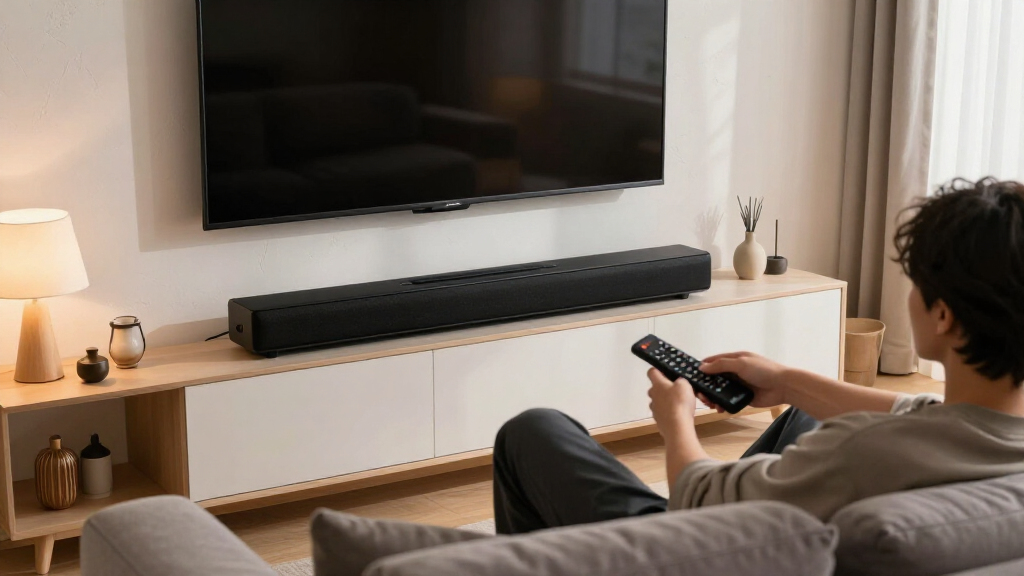
How We Picked
I ranked these 14 home theater soundbars on four buyer-relevant criteria. First, cinematic immersion: channel count, real Atmos or DTS:X support, and whether surround channels exist physically or are only virtualized. A 9.2.4 system and a 2.0 bar serve completely different buyers, and I ordered the lineup to reflect that reality. Second, dialogue clarity and midrange quality, because most movie dialogue lives in the midrange and a bar that buries voices ruins the experience regardless of bass output.
Third, connectivity and setup effort: HDMI eARC with Atmos passthrough beat older optical-only designs, and app-based calibration or room correction added real value for non-tweakers. Fourth, value relative to role — an $100 bar that nails its job ranks above a $600 bar that only partially justifies its price. I also weighed build quality, subwoofer integration, and how forgiving each system is in smaller rooms, since most buyers don’t have dedicated theater spaces.
Factors to Consider When Choosing Home Theater Soundbars
Before picking a specific model, it helps to understand what actually drives soundbar performance and where buyers most often overspend or underbuy.Channel Count and What the Numbers Actually Mean
Those confusing numbers — 2.0, 2.1, 5.1, 9.2.4 — tell you how many speakers the system has. The first digit is the number of main channels, the second is subwoofers, and the third is height or overhead channels for Atmos. What spec sheets hide is that physical speakers beat virtualized ones almost every time: a real 5.1 system like the LG S40TR delivers noticeably better surround effect than any bar claiming “virtual surround” from two drivers. At minimum, a home theater bar should include a subwoofer, which is why the bare 2.0 models in this lineup rank lower for movie watching despite their affordability. Height channels only matter if your ceiling is flat and under about 12 feet — vaulted ceilings waste Atmos money.
Room Size and Layout Reality Check
The most common mistake I see is buying system capacity that fights the room. A dual-subwoofer rig like the Shockwafe 9.2.4 in a 150-square-foot bedroom produces bloated, muddy bass that no calibration can fix, while a compact 2.1 bar in a large open-concept living space will sound thin at movie volume. Match roughly 30 watts of amplification per 100 square feet as a starting heuristic, then adjust for open doorways and hard surfaces. Room shape matters too: rear speakers need walls or stands behind the seating position, so a couch floating in the middle of a room undermines 5.1 systems. If you can’t place rears, spend that money on a better 3.1 or sound quality instead.
HDMI eARC versus Optical: The Connectivity Decision
This is where future-proofing lives, and it’s the detail budget buyers skip most often. Optical cables cannot carry lossless Dolby Atmos or DTS:X — they top out at compressed formats, so every expensive Atmos-capable bar plugged in via optical is running at partial capability. If your TV has an HDMI eARC port, use it and confirm the bar supports eARC rather than plain ARC, which handles Atmos but with occasional lip-sync quirks on older firmware. Also count your inputs: gamers and cable-box owners often need multiple HDMI inputs on the bar itself, which cheaper models like the Fire TV Soundbar omit entirely. Optical and AUX remain useful fallbacks for older TVs and PCs, which is why I favored models offering both.
Subwoofer Power, Neighbors, and Placement
Subwoofer size determines both thrills and problems. A 10-inch driver moves enough air to feel explosions in your chest, but low frequencies travel through floors and walls with remarkable efficiency — a genuine relationship risk in apartments and attached housing. Wireless subwoofers, standard on most picks here, give you placement flexibility to tame boominess: moving a sub out of a corner can cut perceived bass intensity by a surprising amount. If you live above someone, a smaller sealed sub like the Polk Signa S2’s or even a built-in-sub design like Samsung’s HW-B400F is the courteous choice. Dedicated home theater rooms are the only place where dual 10-inch subs like the Shockwafe’s make sense.
Smart Features, Calibration, and App Control
Auto room calibration was once a premium feature but now appears on mid-range bars like the TCL S55H, and it genuinely helps in acoustically awkward rooms by measuring reflections and adjusting EQ. App control divides opinion: it’s handy for fine-tuning bass and treble without a remote’s limited buttons, but some apps are cluttered with upsells or require accounts. Voice-enhancement modes deserve attention for households that struggle with dialogue — Bose, Polk, and JBL all implement them well, while generic brands often just boost volume and distortion together. Skip the marketing around “AI sound” and check whether the bar receives firmware updates, since brands like Samsung, Sony, and LG actually fix lip-sync and format bugs over time.
When to Pay More — and When Not To
Price jumps in this category buy three things: real Atmos height channels, physical rear speakers, and better driver quality. Below $150 you’re buying convenience and clarity, not theater sound, and that’s fine for a bedroom or secondary TV. Between $300 and $600 sits the sweet spot where systems like the LG S40TR and TCL S55H deliver genuine surround at prices most households can absorb. Above $800, returns diminish unless you have the room, ceiling height, and content library to exploit flagship features — 4K Blu-rays and streaming tiers that include Atmos matter here, since a basic cable feed wastes the capability. Paying for capability you can’t use is the category’s most expensive mistake.
Frequently Asked Questions
Do I need Dolby Atmos in a home theater soundbar, or is it just marketing?
Atmos matters only under specific conditions. If you watch 4K Blu-rays, Netflix Premium, Disney+, or Apple TV+ content mastered in Atmos, and your bar has upward-firing drivers plus a flat ceiling between 8 and 12 feet high, you’ll hear genuine height effects that add real immersion to films. Without height drivers — as on 2.0 bars that merely decode Atmos metadata — the feature is mostly a checkbox. You also need HDMI eARC, because optical connections can’t carry the lossless Atmos signal. If your content is mostly cable, sports, or YouTube, spend the Atmos premium on better front-channel quality instead.
Is a 2.1 soundbar with a subwoofer good enough for movies, or do I need rear speakers?
A 2.1 system covers the majority of what makes movies sound good: clear dialogue, wide stereo image, and deep bass for action. Rear speakers add directional effects — bullets whizzing behind you, crowd ambience — which is a real upgrade but not a foundational one. In this lineup, the gap between the Polk Signa S2 (2.1) and the LG S40TR (4.1 with rears) is noticeable in big action films but minor for dramas and comedy. If your couch sits against a wall or you can’t run wiring to the back of the room, skip rears and put the budget into subwoofer quality or brand reliability.
Can I add rear speakers or a subwoofer later to a cheaper soundbar?
Usually not, and this trips up a lot of buyers. Soundbar ecosystems are closed: Samsung rears only pair with Samsung bars, often only specific models within a generation, and budget brands like Saiyin or the generic 120W bar offer no expansion at all. If you suspect you’ll want fuller surround later, buy into an expandable system now — JBL’s detachable-surround approach on the Bar 700MK2 is one of the few designs that works both ways, functioning as a soundbar-only setup or full surround on demand. The alternative is replacing the whole system, which costs more than buying right the first time.
Why does my soundbar dialogue sound muddy even at high volume?
Three culprits are typical. First, an overpowering subwoofer level drowns the midrange where speech lives — dropping the sub by two or three steps on the remote or app fixes this instantly. Second, your TV’s audio output may be set to a virtualized or stereo-downmixed mode instead of passthrough bitstream, which strips the center-channel data that keeps dialogue anchored. Third, some budget bars simply have weak midrange drivers, which is a hardware limitation no setting can repair — this is where spending slightly more on brands like Polk or Bose pays off. Try the bar’s dedicated dialogue or voice mode before assuming the hardware is at fault.
Are cheap sub-$100 soundbars worth it for a home theater setup?
They’re worth it for the right job, which is upgrading a bedroom TV, monitor, or secondary screen where built-in speakers are unlistenable. Models like the Amazon Fire TV Soundbar and Sony S100F make dialogue clearer and add modest body to sound, and that’s a genuine improvement over TV audio. What they can’t do is produce the bass, dynamics, or surround effect that defines home theater — physics limits a two-driver bar without a sub. The smarter budget play is around $130 to $180, where systems like the Saiyin include a wireless subwoofer and deliver most of the movie-watching experience for a modest premium.
Conclusion
Matching the right home theater soundbar to your situation beats chasing specs. For best overall, the JBL Bar 700MK2 wins with its combination of Atmos immersion, detachable surround speakers, and everyday usability — it’s the system that satisfies both movie nights and casual TV. The best premium pick is the Shockwafe 9.2.4 for anyone with a dedicated room large enough to exploit dual 10-inch subwoofers. On value, the ULTIMEA Poseidon M60 and LG S40TR deliver genuine surround for a fraction of flagship pricing, with the TCL S55H close behind thanks to calibration and Atmos at a mid-tier price. For beginners and minimalists, the Bose TV Speaker and Polk Signa S2 offer plug-and-play simplicity and great dialogue, while the Amazon Fire TV Soundbar and Sony S100F suit bedrooms and secondary TVs. Small rooms and apartment dwellers should favor compact 2.1 setups like the Saiyin over anything with towering bass output. Whatever your budget, buy for the room and content you actually have — that single principle separates satisfied owners from remorseful ones.
Columbus Day / Indigenous Peoples' Day Picks
long weekend sales
As an affiliate, we earn on qualifying purchases.