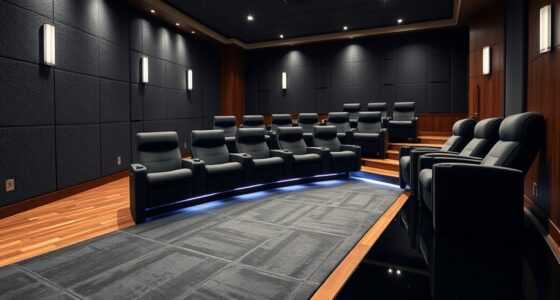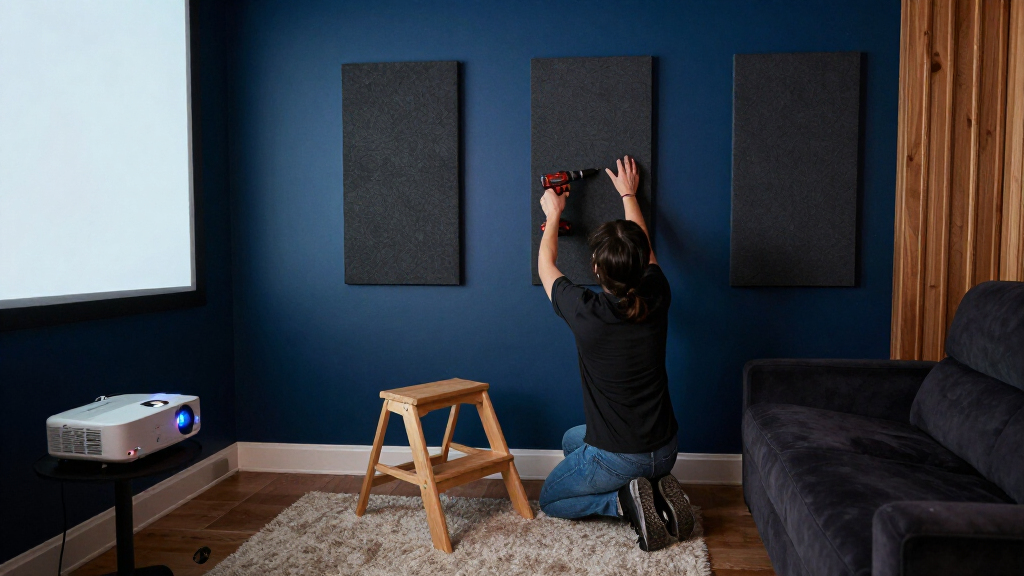
For most home theaters, I’d start with the Olanglab 2-Pack: its 2-inch, fabric-wrapped fiberglass panels offer a practical balance of absorption and a finished look. The TONOR Dual-Layer Panels stand out for broad wall coverage, while the NeatiEase Wood Slat Panels suit buyers who want acoustic treatment to double as décor. The main tradeoffs are absorption depth, wall coverage, installation effort, and appearance; thin foam is easy to place but is not equivalent to thick fiberglass, and none of these panels should be treated as soundproofing. Read on for how the 14 options compare and which type best matches your theater.

Get your home office setup delivered free — and shop member deals
- Fast, free delivery on millions of items
- Access to Prime Big Deal Days deals on October 6–7
- Prime Video, Amazon Music and more included
Complete the kit


Key Takeaways
Thicker fiberglass is the more theater-focused choice: the Olanglab and 2-inch fiberglass options offer more substantial absorption than the many thin foam tiles.
Large panels reduce installation work: TONOR’s oversized formats cover more wall area per panel than small tiles, though their lower profile means buyers should weigh coverage against thickness.
Decorative slats and sound absorption solve different priorities: NeatiEase adds a finished architectural look, while plain foam and fabric-wrapped panels put function ahead of visual impact.
Small foam packs can be easier to arrange, not necessarily better at control: the Focusound and SD SODOCT sets allow flexible placement, but their foam construction and panel depth limit what buyers should expect.
Adhesive convenience has a wall-surface tradeoff: self-adhesive options simplify placement but may be a poor match for delicate paint, textured walls, or renters who need clean removal.


| acoustic wall panels for home theater | Material | Thickness | Panel dimensions | Color |
|---|---|---|---|---|
| 4 Pack Acoustic Foam Panels | High-density polyurethane foam | 2 inches | 48 x 24 inches each | Black |
| 4 Pack Acoustic Panels 23.6"x1 | — | 2 inches | 23.6 x 11.8 inches each | Black |
| TONOR Large Self-Adhesive Acou | 100% polyester fiber | 0.35 inches | 47.2 x 23.6 inches each | Black |
| TONOR Dual-Layer Thickened Aco | 100% high-density polyester fiber | 0.72 inches | 47.2 x 23.6 inches each | — |
| SD SODOCT 24-Pack 2" Thick Pyr | High-density acoustic foam | 2 inches | — | — |
| 12in Acoustic Wall Panels | 100% polyester | 25% thicker than traditional panels | — | — |
| NeatiEase Wood Slat Wall Panel | — | — | — | Black |
| Focusound 52-Pack Acoustic Foa | High-density acoustic foam | — | 1 × 12 × 12 inches | — |
| 4-Pack Acoustic Fiberglass Pan | — | 2 inches | — | Charcoal grey |
| 2 Pack Acoustic Panels 47.2" x | — | — | — | Black |
| Olanglab Acoustic Wall Panels | — | 2 inches | — | Navy |
| 22-Pack Sound Proof Foam Panel | Eco-friendly polyester fiber | — | 12 x 12 x 0.4 inches | — |
| 20 Pack Acoustic Panels | 100% polyester | — | 11.8 x 11.8 x 0.36 inches | — |
| Soon Global Acoustic Wall Pane | High-density polyester fiber | — | — | — |
More Details on Our Top Picks
4 Pack Acoustic Foam Panels, 48″x24″x2″ – High Density Soundproof Foam Wall Panels for Noise Reduction, Studio Walls, Home Theater & Office
For a home theater with a few prominent reflection points, these panels offer large 48-by-24-inch faces and a 2-inch foam profile in a small set. Each panel covers more wall than the compact UMIACOUSTICS fiberglass panels, so placement takes fewer pieces; that can suit a focused setup behind or beside the listening area. The polyurethane foam is described as flame-retardant, odorless, and non-toxic, while the panels can go on walls or ceilings. The tradeoff is quantity: four panels may leave much of a theater untreated, and their foam construction does not make them a barrier against sound traveling through walls. I would choose them for selective echo control, not as a full-room soundproofing plan.
Pros:- Large 48-by-24-inch panels cover more wall per piece than the UMIACOUSTICS set.
- Two-inch thickness is suited to reducing room reflections.
- Described as flame-retardant, odorless, and non-toxic.
- Can be installed on walls or ceilings for targeted placement.
Cons:- Four panels may not cover enough area for a larger home theater.
- The product data does not specify mounting hardware or an installation method.
- Absorbs sound within the room but is not a soundproofing barrier.
Best for: Home-theater owners treating a few large reflection areas who want full-size panels rather than many small tiles.
Not ideal for: Buyers covering most of a large theater or trying to block noise from neighboring rooms; the four-panel pack has limited coverage and is for sound absorption, not sound isolation.
- Panel dimensions:48 x 24 inches each
- Thickness:2 inches
- Pack quantity:4 panels
- Material:High-density polyurethane foam
- Color:Black
- Safety description:Flame-retardant, odorless, and non-toxic
- Item weight:6.8 pounds
- Package dimensions:12.8 x 10.98 x 7.68 inches
Our verdict“Choose this set when you want a few large foam panels for targeted theater echo control, and skip it if you need broad coverage or sound isolation.”
4 Pack Acoustic Panels 23.6″x11.8″ Soundproof Fiberglass Panel, Black
The UMIACOUSTICS set suits theater owners who want a fabric-covered fiberglass panel and the option to remove it later. Its 2-inch fiberglass core gives it a different profile from the thinner TONOR self-adhesive panels: these are more focused on absorbent panel construction than quick decorative coverage. Brackets and nails are included, and the product specifies a two-year warranty. That mounting approach can be useful when adhesive is a poor fit, though it means making holes in the wall. Each panel is only 23.6 by 11.8 inches, so the four-piece set covers less area than the four large TONOR dual-layer panels. I’d favor this option for a small treatment zone, not a full theater wall.
Pros:- Two-inch fiberglass core is designed for sound absorption.
- Includes wall-mounting brackets and nails.
- Removable mounting is more adaptable than permanent adhesive placement.
- Product data lists an E0 rating and a two-year warranty.
Cons:- Small panel dimensions limit coverage compared with the large TONOR panels.
- Installation requires nails or screws, which leave holes.
- Available in black only, according to the supplied product information.
Best for: Theater owners treating a limited reflection area who prefer fabric-wrapped fiberglass and removable bracket mounting.
Not ideal for: Renters who cannot make nail or screw holes, or buyers seeking broad wall coverage from a single four-panel set.
- Panel dimensions:23.6 x 11.8 inches each
- Thickness:2 inches
- Number of panels:4
- Core material:White fiberglass fiber
- Cover material:High-density polyester fabric
- Color:Black
- Mounting:Brackets and nails included
- Warranty:2 years
Our verdict“Pick UMIACOUSTICS for a compact, removable fiberglass treatment area if wall holes are acceptable.”
TONOR Large Self-Adhesive Acoustic Panels (8 Pack, 47.2″ x 23.6″ x 0.35″)
When fast coverage matters more than a thick absorber, TONOR’s eight large panels bring a peel-and-stick format and a stated NRC of 0.9. Their 0.35-inch depth is far slimmer than the 2-inch SD SODOCT foam, so I would treat them as a low-profile way to reduce reflections and soften a hard-looking wall—not as the stronger, thicker choice for a demanding theater room. The stripe pattern also gives the installation a more finished appearance than plain foam tiles. The broad panel size means fewer pieces to position, but can make alignment awkward, and the adhesive is intended for smooth surfaces. Textured walls may need another mounting plan, while the black-only finish narrows the decor match.
Pros:- Eight large panels provide broad coverage with fewer seams than small tiles.
- Peel-and-stick backing avoids separate mounting hardware.
- Product data specifies an NRC of 0.9.
- Stripe pattern can function as wall decor as well as acoustic treatment.
Cons:- At 0.35 inches thick, these are much thinner than the 2-inch SD SODOCT foam.
- Adhesive may not hold well on textured or rough surfaces.
- Large panels can be awkward to align and position.
Best for: Home-theater owners with smooth walls who want large, decorative panels and tool-free installation for light echo control.
Not ideal for: Buyers seeking thick, high-profile absorption or installing on rough, textured walls where the adhesive may not hold reliably.
- Quantity:8 panels
- Panel dimensions:47.2 x 23.6 inches each
- Thickness:0.35 inches
- Material:100% polyester fiber
- Density:212.2 kg/m³
- NRC:0.9
- Installation:Self-adhesive, peel-and-stick
- Color:Black
- Warranty:2 years
Our verdict“Choose TONOR for slim, decorative treatment on smooth theater walls, but select a thicker panel if absorption is the priority.”
TONOR Dual-Layer Thickened Acoustic Wall Panels – 4 Pack (47.2″ x 23.6″ x 0.72″)
These TONOR panels occupy a middle ground: 0.72-inch dual-layer construction gives them more depth than TONOR’s 0.35-inch peel-and-stick set, while the large 47.2-by-23.6-inch faces keep the layout visually simple. For a home theater, that balance can make sense when you want a broad, stripe-patterned wall treatment without moving to the 2-inch foam or fiberglass options. The panels are self-adhesive and can be trimmed, which helps fit a planned layout around edges or obstacles. However, the listing provides no NRC figure, so I would not rank their acoustic performance alongside products with a stated absorption rating. Adhesion is also the weak point on textured or uneven walls.
Pros:- Dual-layer 0.72-inch construction is thicker than TONOR’s 0.35-inch panels.
- Large panel faces cover substantial wall area per piece.
- Self-adhesive backing offers a tool-free installation approach.
- Panels can be trimmed to fit different spaces.
Cons:- Adhesive may perform poorly on textured or uneven walls.
- No NRC or other quantified absorption figure is supplied.
- Four panels may not cover a large theater wall.
Best for: Buyers creating a coordinated, low-profile theater wall treatment who need large panels that can be trimmed to fit.
Not ideal for: Home-theater owners prioritizing documented absorption performance or mounting panels on rough, uneven, or textured surfaces.
- Panel dimensions:47.2 x 23.6 inches each
- Thickness:0.72 inches
- Pack quantity:4 panels
- Material:100% high-density polyester fiber
- Construction:Dual-layer reinforced structure
- Installation:Self-adhesive, peel-and-stick
- Pattern:Classic stripe
- Customization:Can be trimmed to fit
Our verdict“Choose this set for trim-to-fit decorative coverage and more depth than thin adhesive panels, not for a quantified acoustic-performance target.”
SD SODOCT 24-Pack 2″ Thick Pyramid Acoustic Foam Panels
SD SODOCT is the most coverage-oriented foam option here: 24 pyramid panels cover 24 square feet, giving theater owners more pieces to spread across several reflection points than the four-panel 48-by-24-inch foam set. The 2-inch thickness and 25 kg/m³ density are aimed at absorbing room reflections, while the pyramid surface adds texture to a plain wall. The foam is described as flame-retardant, but buyers should distinguish echo reduction from soundproofing: the product is not meant to stop external noise passing through walls. Installation is lightweight, though adhesive or tape is not included, so mounting supplies need to be sourced separately. I’d choose this for a segmented treatment layout, not a seamless or fabric-finished theater interior.
Pros:- Twenty-four pieces allow treatment to be spread across several wall locations.
- Two-inch thickness and 25 kg/m³ density are specified.
- Flame-retardant foam construction is described in the product data.
- Lightweight panels are suited to a flexible, segmented layout.
Cons:- Does not block external noise or provide full soundproofing.
- Adhesive or mounting tape is not included.
- Pyramid foam has a more textured look than the fabric-covered UMIACOUSTICS panels.
Best for: Home-theater owners who want to distribute multiple 2-inch foam pieces across a 24-square-foot treatment area.
Not ideal for: Buyers seeking sound isolation, a fabric-finished appearance, or a kit with mounting adhesive included.
- Quantity:24 panels
- Coverage area:24 square feet
- Thickness:2 inches
- Shape:Pyramid
- Material:High-density acoustic foam
- Density:25 kg/m³
- Safety:Flame-retardant
- Weight:3 pounds
- Warranty:6-month return warranty
Our verdict“Pick SD SODOCT for a flexible 24-square-foot foam layout if echo control matters more than sound isolation or a smooth, finished wall appearance.”
12in Acoustic Wall Panels, High-Density Soundproof Foam
For a home theater where I want to treat selected reflection points without committing to fabric-wrapped panels, these 12-inch polyester tiles offer an approachable, customizable format. Their stated density and thickness increases over traditional panels point to more substantial sound absorption than thin decorative tiles, while the 45-degree chamfered edges make mixed patterns look more deliberate. Compared with Focusound’s 52-pack of small foam wedges, these panels have a cleaner, less studio-focused appearance; Focusound, though, provides a larger piece count and more included adhesive strips. The self-adhesive backing avoids drilling, but its grip may not survive removal and reapplication, and the product calls for complete wall coverage for optimal dampening. That is a larger commitment than placing a few panels at key points, and it may be excessive for a room needing targeted echo control.
Pros:- Compact 12-inch format and chamfered edges support varied wall patterns.
- Described as 35% denser and 25% thicker than traditional panels.
- Self-adhesive backing allows tool-free installation.
- Polyester material is described as flame-retardant and odorless.
Cons:- The product calls for complete wall coverage for optimal sound dampening, which can require a substantial installation.
- Adhesive may need replacement if panels are removed and reapplied.
- No quantified acoustic rating is provided, making performance comparisons less precise.
Best for: DIY home-theater owners who want to arrange compact polyester panels in a custom pattern and prefer adhesive mounting over screws.
Not ideal for: Renters who expect to reposition panels repeatedly, or theater owners who want to treat only a few reflection points rather than cover a wall.
- Material:100% polyester
- Panel size:12 inches
- Density:35% denser than traditional panels
- Thickness:25% thicker than traditional panels
- Design:45° chamfered edges
- Mounting:Self-adhesive backing
- Listed features:Flame-retardant and odorless
Our verdict“Choose these if you want customizable, adhesive-mounted polyester tiles and can commit to broad wall coverage rather than occasional repositioning.”
NeatiEase Wood Slat Wall Panels – 4-Piece Set, 96″ x 12.6″, Black, Soundproof Acoustic Panels
When visible foam would clash with a finished media room, NeatiEase offers a more architectural alternative: long black slats that can run horizontally or vertically and cover about 33 square feet per set. The MDF-and-polyester-fiber construction combines a decorative wall treatment with acoustic dampening, making it a better fit for a theater that also serves as a living space. Compared with the compact 12-inch polyester panels, these create a continuous design feature rather than a tile pattern; compared with the 2-inch fiberglass panels, they give up a stated NRC rating and provide no quantified absorption figure. Installation also takes more commitment: the panels use screws or superglue, not a simple peel-and-stick approach. I’d choose them for appearance and broad coverage, not when measured acoustic performance or easy removal is the main priority.
Pros:- Four long panels cover roughly 33 square feet.
- Can be mounted horizontally or vertically on walls or ceilings.
- MDF and high-density polyester fiber offer a decorative alternative to exposed foam.
- Screw or superglue mounting gives installation flexibility.
Cons:- Installation requires screws or adhesive and may call for basic tools.
- No NRC or other quantified absorption rating is provided.
- Long, fixed-format slats offer less freedom for small, irregular treatment areas than tile panels.
Best for: Homeowners creating a polished media room or shared living space who want long-format black slats and can install them with screws or adhesive.
Not ideal for: Renters, buyers who need easy-to-remove treatment, or theater builders who require a stated NRC rating to plan acoustic performance.
- Piece count:4
- Dimensions per panel:96 × 12.6 inches
- Total coverage:Approximately 33 sq. ft.
- Materials:MDF and high-density polyester fiber
- Color:Black
- Installation:Screws or superglue
- Orientation:Horizontal or vertical; walls or ceilings
Our verdict“Pick NeatiEase when visual cohesion and substantial wall coverage matter more than removable mounting or a published acoustic rating.”
Focusound 52-Pack Acoustic Foam Panels, 1″ x 12″ x 12″, Noise-Cancelling Wedge Panels for Home Office and Recording Studio with 300 pcs Double-Side Adhesive
Focusound makes sense when I want to cover selected wall areas with many small foam wedges rather than mount a few large panels. The 52 one-inch squares can be arranged around a screen or at reflection points, and the 300 double-sided adhesive pieces give more mounting material than the self-adhesive 12-inch polyester panels provide. The triangular grooves are intended to reduce echo and reverb, a useful goal for dialogue clarity in a home theater, though this is foam rather than a thick, fabric-wrapped fiberglass panel. Compared with the two-panel fiberglass option, Focusound is easier to distribute in a pattern but offers no stated NRC rating and requires many more individual placements. Its foam can also lose its shape and may need soaking in water to recover. I’d favor it for flexible, small-area treatment, not a quick, seamless wall finish.
Pros:- Pack includes 52 panels for arranging across targeted wall areas.
- Triangular grooves are designed to absorb echo and reverb.
- Includes 300 double-sided adhesive pieces for mounting.
- Material is described as fire-resistant and non-toxic.
Cons:- Small panels require many placements to cover a large area.
- Foam may not recover its shape fully without soaking in water.
- No NRC rating is provided for comparison with the fiberglass panel options.
Best for: Theater owners who want to treat specific reflection areas with small, rearrangeable foam squares and are comfortable placing many individual pieces.
Not ideal for: Buyers seeking large, finished-looking panels, quantified acoustic performance, or minimal installation work across a large room.
- Brand:Focusound
- Model:FS0302F
- Quantity:52 panels
- Panel dimensions:1 × 12 × 12 inches
- Material:High-density acoustic foam
- Included adhesive:300 double-sided adhesive pieces
- Listed safety features:Fire-resistant and non-toxic
Our verdict“Choose Focusound for customizable, small-area echo treatment if you accept a more labor-intensive installation and foam’s shape-recovery caveat.”
4-Pack Acoustic Fiberglass Panels 23.6″ x 11.8″ Charcoal Grey
The clearest reason to choose these panels is their stated NRC of 0.95 and two-inch thickness. For a theater where echo control matters more than decorative wood slats, those details give me a more concrete basis for comparing treatment than the unrated NeatiEase set or Focusound foam. The four charcoal panels are each 23.6 by 11.8 inches, so they suit smaller wall sections or targeted placements better than the two-panel fiberglass set, whose individual panels are much larger. That smaller format also means more seams and less coverage per panel. The polyester fabric cover and E0-rated white fiberglass core support a finished, fabric-wrapped look, but the listing gives limited mounting detail: accessories are included, yet hardware specifics and installation guidance are unclear. This is a performance-led compact pick, not the easiest option to plan or mount.
Pros:- Stated NRC of 0.95 provides a quantified absorption figure.
- Two-inch thickness offers more substantial construction than one-inch foam panels.
- Four compact panels suit targeted treatment areas.
- Includes installation accessories.
Cons:- Mounting hardware details and installation guidance are limited.
- Charcoal grey is the only listed color.
- Smaller panels require more individual pieces to cover a broad wall area.
Best for: Home-theater owners treating defined reflection areas who want two-inch fiberglass panels with a published NRC and prefer a compact panel format.
Not ideal for: Buyers needing broad coverage with few panels, detailed mounting instructions, or a choice of colors beyond charcoal grey.
- Pack quantity:4 panels
- Dimensions:23.6 × 11.8 inches
- Thickness:2 inches
- NRC:0.95
- Cover:High-density polyester fabric
- Core:White fiberglass, E0-rated
- Color:Charcoal grey
Our verdict“Choose this set for compact, fabric-wrapped fiberglass treatment with a stated NRC, provided you can work around sparse mounting guidance.”
2 Pack Acoustic Panels 47.2″ x 23.6″ x 2″ Soundproof Fiberglass Panels, Black
For a home theater that needs fewer, larger pieces, this set pairs two-inch fiberglass panels with a stated NRC of 0.95 and included hanging hardware. Each panel measures 47.2 by 23.6 inches, giving it a much broader footprint than the four-panel charcoal-grey set. That can simplify layout across a front or side wall, although it offers less flexibility for narrow spots or scattered reflection points. The polyester fabric wrap and black finish also make the panels read more like deliberate wall fixtures than the wedges in Focusound’s foam pack. The tradeoff is a fixed, wall-mounted setup: there’s no freestanding option listed, and the listing provides only black. I’d put this ahead of the smaller fiberglass set when coverage per panel and mounting hardware matter most, but not when color choice or movable treatment is a priority.
Pros:- Large 47.2-by-23.6-inch panels cover broader areas per piece than the smaller fiberglass set.
- Two-inch fiberglass construction has a stated NRC of 0.95.
- Includes hanging hardware for wall installation.
- Polyester fabric wrap gives the panels a finished appearance.
Cons:- Requires wall mounting, with no freestanding option listed.
- Black is the only listed color.
- Two-panel format is less adaptable to small or irregular treatment areas than a multi-piece tile pack.
Best for: Home-theater owners who want large, fabric-wrapped fiberglass panels for broad wall sections and can use the included hanging hardware.
Not ideal for: Renters avoiding wall mounting, buyers who need freestanding treatment, or anyone wanting color options beyond black.
- Quantity:2 panels
- Dimensions per panel:47.2 × 23.6 × 2 inches
- Color:Black
- Cover material:100% polyester fabric
- Core material:100% white fiberglass
- NRC:0.95
- Included accessories:Hanging hardware
Our verdict“Choose this set when you want rated, large-format fiberglass panels and are ready to mount them on the wall.”
Olanglab Acoustic Wall Panels – 2 Pack, 2″ Thick, 24″ x 48″, Navy Fabric-Wrapped Fiberglass Sound-Dampening Panels
For a home theater where dialogue clarity and reflected sound are the priority, Olanglab’s 2-inch fiberglass core offers a more substantial treatment option than the thin, peel-and-stick panels in this group. Each panel measures 24 by 48 inches, so two can cover a meaningful section of a side or front wall without assembling a field of small tiles. The listed absorption coefficient reaches 0.95, though that figure does not mean the panels soundproof a room or control deep bass on their own. Compared with the Lebenforce 22-Pack, Olanglab is thicker and better suited to targeted treatment, but covers less area and takes more effort to mount. Its included impaling clips help with installation, while the nearly 20-pound package calls for careful wall placement. Navy is the only listed color.
Pros:- Two-inch fiberglass construction provides more depth than the thin polyester tile options.
- Large 24-by-48-inch panels cover wall area with fewer separate pieces.
- Listed absorption coefficient reaches up to 0.95.
- Impaling clips are included for mounting.
Cons:- The 19.61-pound package makes lifting and secure installation more demanding.
- Two panels provide less total coverage than multi-tile packs.
- Only navy is listed, which may not suit every theater palette.
Best for: Home theater owners who want substantial mid- and high-frequency absorption on selected wall areas and can securely mount heavier panels.
Not ideal for: Renters seeking removable, lightweight treatment or buyers who need broad wall coverage from a single pack.
- Panel size:24 x 48 inches
- Pack quantity:2 panels
- Thickness:2 inches
- Core and covering:Fiberglass core with fabric cover
- Absorption coefficient:Up to 0.95
- Color:Navy
- Package weight:19.61 pounds
- Included mounting:Impaling clips
Our verdict“Choose Olanglab for focused, thicker wall treatment when you can handle the weight and do not need a large multi-panel coverage area.”
22-Pack Sound Proof Foam Panels for Walls, 12″ x 12″ x 0.4″
The Lebenforce 22-pack is the straightforward choice for a theater owner who wants to cover scattered reflection points without handling large, heavy boards. Its peel-and-stick backing makes placement simpler than the Olanglab panels, which use impaling clips and weigh substantially more. The tradeoff is depth: at just 0.4 inch thick, these polyester squares are better viewed as light echo treatment than as a substitute for thicker panels, and they are not a fix for sound leakage or deep bass buildup. Twenty-two tiles allow a flexible layout, while the small square format takes more time to arrange across a wall. Adhesion is also dependent on a smooth, clean surface, making this less dependable on textured theater walls. Multiple colors are described as available, but a specific finish is not given here.
Pros:- Self-adhesive backing allows installation without separate clips or mounting hardware.
- Twenty-two small panels support flexible placement around a room.
- Polyester fiber is described as non-shedding.
- Multiple color options can help coordinate treatment with a room.
Cons:- At 0.4 inch thick, the panels offer limited depth for low-frequency control.
- Adhesive may not hold well on textured wall surfaces.
- Arranging many small tiles takes more time than mounting large panels.
Best for: DIY home theater owners who want lightweight, small-format tiles for modest echo reduction on smooth walls.
Not ideal for: Buyers treating deep bass, textured walls, or large theater surfaces who want thicker, more substantial panels.
- Panel dimensions:12 x 12 x 0.4 inches
- Pack quantity:22 panels
- Material:Eco-friendly polyester fiber
- Installation:Self-adhesive backing
- Package weight:6.5 pounds
- Panel shape:Square
Our verdict“Pick Lebenforce for a light, easy-to-place echo-treatment project on smooth walls, not for bass control or heavy-duty theater treatment.”
20 Pack Acoustic Panels – 11.8″ x 11.8″ x 0.36″ High-Density Self-Adhesive Brick Design Foam Panels in Black
NEPIS pairs a brick-style surface with self-adhesive mounting, giving theater owners a more patterned look than the plain small tiles in the Lebenforce 22-pack. The 20 panels cover about 20 square feet, which suits a defined section of a wall but will not treat a whole room without additional packs. Its listed NRC is above 0.95, yet the panels are only 0.36 inch thick; I would not read that rating as evidence of meaningful deep-bass control or sound isolation. The dense polyester construction and tool-free backing make this a convenient choice for addressing light reflections and adding visual texture. Compared with Olanglab’s much thicker fiberglass panels, NEPIS is easier to apply and covers a tiled area, but sacrifices depth and has adhesive that may leave residue when removed.
Pros:- Brick-style 3D pattern adds texture to a theater wall.
- Self-adhesive backing avoids separate mounting hardware.
- Twenty panels cover approximately 20 square feet.
- High-density 100% polyester construction is listed at 14.35 lb/ft³.
Cons:- The 0.36-inch profile provides limited depth for bass treatment.
- One pack covers only about 20 square feet.
- Adhesive may leave residue on some surfaces when panels are removed.
Best for: Home theater owners who want black, patterned tiles for a small wall section and prefer peel-and-stick installation.
Not ideal for: Buyers seeking deep-bass absorption, removable wall treatment, or enough coverage to treat a large room with one pack.
- Panel dimensions:11.8 x 11.8 x 0.36 inches
- Pack quantity:20 panels
- Coverage area:Approximately 20 square feet
- Material:100% polyester
- Density:14.35 lb/ft³
- NRC:Greater than 0.95
- Color and design:Black, brick design
- Installation:Self-adhesive backing
Our verdict“Choose NEPIS for decorative, small-area echo treatment when a brick pattern matters more than panel depth or broad coverage.”
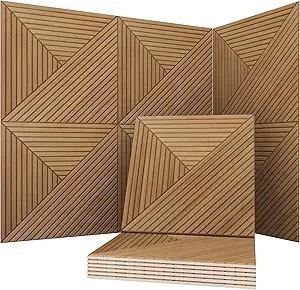
Soon Global Acoustic Wall Panels – Arcadian Vortex
Soon Global is the style-led pick in this group: its wood-grain print and groove pattern are designed to read more like wall decor than conventional acoustic tiles. That makes it a stronger fit for a living-room theater where visible foam or fabric panels would feel out of place. The six-panel set includes 30 transparent adhesive squares, so mounting does not require tools, though a sticky installation is less reassuring than Olanglab’s clip-based mounting for panels that may be handled or bumped. The product description claims sound absorption but supplies no panel dimensions, coverage figure, or absorption rating here, making acoustic performance harder to compare with the quantified Olanglab and NEPIS options. I’d choose it for appearance and convenience, not when measured coverage or a specified acoustic target is the deciding factor.
Pros:- Wood-texture print and groove pattern create a more furniture-like appearance.
- High-density polyester fiber is suited to acoustic wall treatment.
- Six panels are supplied as a coordinated set.
- Transparent adhesive squares allow tool-free mounting.
Cons:- No panel dimensions, coverage area, or absorption rating are provided in the supplied product data.
- Adhesive mounting may be less secure on high-traffic walls or with heavier panels.
- The acoustic performance is harder to compare directly with products that list measurements.
Best for: Living-room theater owners who want a decorative, wood-look wall treatment and tool-free installation.
Not ideal for: Buyers who need documented absorption figures, known coverage dimensions, or a more secure mounting method for high-traffic walls.
- Material:High-density polyester fiber
- Pack size:6 panels
- Pattern:Groove-patterned with wood-texture print
- Installation method:Tool-free adhesive mounting
- Included adhesive:30 transparent double-sided squares
Our verdict“Choose Arcadian Vortex when a coordinated wood-look finish and easy installation matter more than published acoustic measurements.”

How We Picked
I compared the 14 products for the needs that matter in a home theater: panel thickness and material, practical wall coverage, installation demands, appearance, and flexibility in placement. I gave more weight to substantial absorbers, especially thicker fiberglass panels, because theater reflections and room echo call for more than a decorative surface or a thin foam tile. I also considered whether a pack gives buyers useful coverage without forcing a complicated layout.
The ranking favors options with a stronger mix of acoustic potential and theater-friendly usability, rather than treating every product labeled “soundproof” as equivalent. Larger panels rank well for coverage and simpler installation; compact foam packs make more sense for targeted treatment or tight budgets. Decorative and self-adhesive products remain useful for specific rooms, but their looks, wall compatibility, or thinner construction limit their fit as a primary theater treatment.
Factors to Consider When Choosing Acoustic Wall Panels For Home Theaters
Before choosing panels, I’d match the treatment to the problem in the room. Echo, sharp reflections, bass buildup, and sound escaping to other rooms are different issues; wall panels mainly help with sound inside the theater. These broader checks can prevent buying more material than the room needs—or expecting a panel to fix a problem it cannot address.
Match the Panel to the Acoustic Problem
Start by identifying what you hear from the main seats: flutter echo between parallel walls, harsh early reflections, or a room that sounds overly live. Wall absorption can reduce reflected sound, but it will not stop much sound from passing through a shared wall. Bass buildup and low-frequency ringing usually need different treatment, often including bass traps or changes to speaker and subwoofer placement. A common mistake is covering every wall with thin foam before finding the reflections that matter. I’d treat key reflection points first, then listen again before expanding coverage. That staged approach helps preserve some liveliness instead of making dialogue and effects sound unnaturally muted.
Compare Material and Thickness, Not Labels
Product terms such as “soundproof” and “noise-cancelling” do not tell you how a panel will perform in a room. Foam, fiberglass, and slatted decorative panels have different construction and absorption characteristics, so material and thickness are more useful starting points. Thin tiles can help with higher-frequency reflections, but buyers should not expect them to manage bass or block neighbors’ sound. A thicker panel can be more capable, though its actual behavior depends on its full construction and placement. Check for clear dimensions and material details rather than choosing by a dramatic product name. If the listing provides no acoustic test data, treat performance claims as limited evidence, not a guarantee.
Plan Coverage Around the Room, Not the Pack Count
Pack counts can be misleading because a set of many small tiles may cover less useful wall area than a few large panels. Measure the wall sections you can actually treat, including space around doors, screens, speakers, and sconces. Then compare the panels’ combined face area and decide whether you need broad coverage or targeted placement. Large panels reduce seams and installation time, while small pieces give more freedom around obstacles. Avoid placing absorption behind a screen or behind furnishings simply because those spaces are available. A simple room sketch can help balance left and right walls and keep treatment focused around the listening area.
Check Installation and Wall Compatibility
Adhesive-backed panels may be convenient, but removal can damage paint or leave residue, especially on older, textured, or freshly painted walls. For a rental or a wall you may redecorate, look for mounting options that suit removable hooks, rails, or another non-permanent method. Larger or heavier panels need a secure mounting plan rather than an assumption that any adhesive will hold indefinitely. Also check whether the panel’s back surface and mounting hardware are included or must be sourced separately. Foam tiles are light and easy to arrange, but their adhesive layout can become tedious across a large room. Test a small area first if the wall finish matters.
Balance Theater Appearance With Room Treatment
Panels are visible in a theater, so color, fabric, shape, and spacing affect the finished room as much as the acoustics. Fabric-wrapped panels can blend with dark walls and reduce visual distraction near a screen. Slat-style designs may suit a room that doubles as a living space, but decorative appeal alone does not tell you how much absorption they provide. Foam patterns can create a studio-like look that some buyers prefer and others may find out of place. Consider how the panels will sit beside speakers, trim, and lighting before ordering a full set. If a product’s appearance encourages you to install it in useful locations, that can be more practical than choosing a less appealing panel you leave boxed.
Set Expectations for Sound Leakage and Bass
Wall panels generally improve the sound within a room by managing reflections; they are not a substitute for construction changes that limit sound transmission. If the main concern is disturbing other household members, look at door seals, gaps, wall construction, and isolation measures rather than relying on foam tiles. For bass problems, adding more thin panels may do little to smooth deep-frequency peaks. Speaker distance from boundaries, subwoofer placement, and listening-seat position can change what you hear without adding wall treatment. Buyers often spend on broad surface coverage before checking these basics. I’d address placement and leakage paths first, then use panels to refine the room’s reflected sound.
Frequently Asked Questions
Will acoustic wall panels stop movie sound from reaching the next room?
Usually, no. These panels are intended to reduce sound reflections within the theater, not to block sound passing through walls, doors, or ceiling gaps. For sound leakage, focus on weak points such as an unsealed door, thin partitions, and openings around cables or vents. Heavier construction and airtight sealing are more relevant to isolation than surface foam. If you want clearer dialogue and less echo inside the room, panels can help; if the goal is quieter adjacent rooms, treat that as a separate project.
Should I cover every wall in my home theater?
Not by default. Full coverage can make a room sound overly damped, while a smaller amount of well-placed treatment may reduce the strongest reflections. Start with the side-wall reflection points near the listening area and assess the result before adding more panels. Keep the screen wall, rear wall, and ceiling in the plan only when the room’s sound and layout call for them. The right amount depends on room size, furnishings, speaker setup, and personal preference, so a measured, staged approach is safer than buying a large pack upfront.
Are thin foam panels enough for a dedicated theater?
Thin foam can be useful for light, targeted control of higher-frequency reflections, but it is not a complete treatment for a dedicated theater. It is less suited to low-frequency issues, and it does not provide sound isolation. A room with prominent echo or harsh reflections may benefit from thicker or more substantial absorbers at key locations. Consider mixing panel types only when each has a clear job, rather than assuming more small tiles will solve every acoustic problem. For a primary listening room, compare thickness, material, and the exact problem you hear before choosing foam alone.
How do I choose between large panels and small foam tiles?
Large panels make sense when you have clear wall sections and want to cover them with fewer pieces and seams. Small tiles are easier to arrange around obstacles and can work for targeted treatment, but installing enough to cover a broad area may take more time. Compare total face area rather than pack count, and factor in mounting hardware or adhesive needs. Also consider whether the panel material and depth suit your acoustic goal; format alone does not determine performance. If your walls are irregular or you are still refining placement, smaller pieces offer flexibility, while large panels make a cleaner fit on open walls.
Can I mount self-adhesive panels on a rental apartment wall?
Only if the wall finish and adhesive are compatible, and even then removal can be uncertain. Adhesive may lift paint, leave residue, or fail on textured or dusty surfaces. Check the product’s mounting guidance and your lease, then test one panel in a discreet spot before covering a large area. Removable hooks, rails, or freestanding treatment may be safer options when the wall must be restored later. Also remember that removable surface panels can improve room reflections without providing meaningful sound isolation from nearby units.
Conclusion
For the strongest all-around starting point, I’d choose the Olanglab 2-Pack for its 2-inch fabric-wrapped fiberglass construction. Buyers prioritizing broad coverage and fewer pieces should compare it with the TONOR Dual-Layer Panels; those seeking a decorative finish should look at the NeatiEase Wood Slat Panels, while recognizing that appearance and acoustic treatment are separate considerations. For a lower-commitment first step, a small foam set such as Focusound offers flexible placement, though it is not a substitute for thicker treatment. If value means covering specific reflection points with simple foam, the SD SODOCT 24-Pack is the more targeted route. Choose based on the room’s actual acoustic problem, wall constraints, and visual priorities—not the largest pack or the strongest soundproofing claim.
Halloween Picks
halloween
As an affiliate, we earn on qualifying purchases.