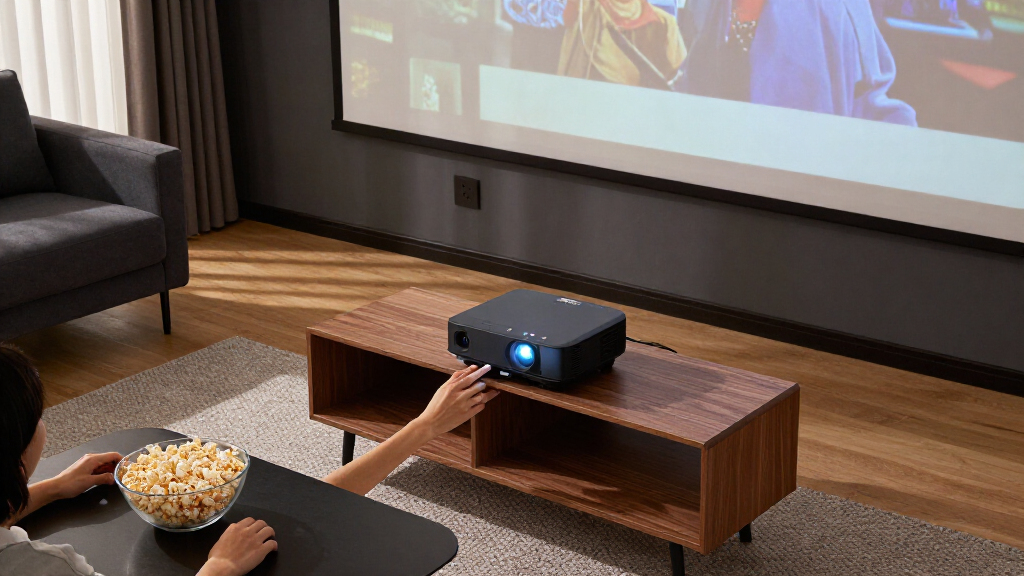
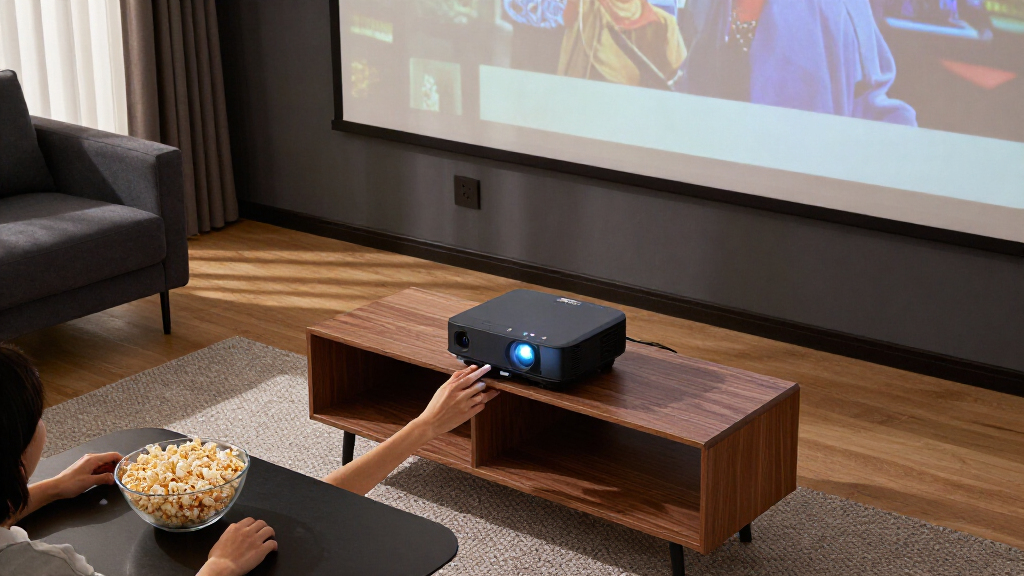
Short throw laser projectors can create a large image from close to the wall, but the right pick depends on room layout, image quality, and how you plan to watch. I’d put the Hisense PX3-PRO at the top for its 4K triple-laser UST setup, while the Optoma GT2400HDR is a more focused Full HD choice and the Optoma ML1080UST Photon GO suits buyers who need portability. The main tradeoff is between premium 4K color and home-theater features, compact convenience, and simpler Full HD performance. UST models also demand careful placement, while conventional short-throw options may need a different throw distance and screen setup. Read on for how all 13 compare and which one fits your room and priorities.

Get business pricing on your home office setup
- Business-only prices and quantity discounts
- Tax-exempt purchasing
- Multiple users, one account, clear invoices
Complete the kit


Key Takeaways
- The Hisense PX3-PRO is my overall pick for buyers seeking a 4K triple-laser UST system; its close-wall placement and premium image ambitions make it a stronger living-room centerpiece than the simpler Full HD gaming options.
- Triple-laser 4K is the premium tier in this lineup. The Hisense PX3-PRO, JMGO O2S Ultra, AWOL VISION Aetherion models, LTV-3000 Pro, and XGIMI MIRA target buyers who value resolution and color over compact size or basic setup.
- Full HD short-throw models serve more specific needs. The Optoma GT2300HDR and GT2400HDR focus on straightforward short-throw viewing, while the GT2000HDR emphasizes a compact footprint and the ViewSonic LSD400HD-ST targets a different installation profile.
- Portable convenience and UST placement are competing priorities. The Optoma ML1080UST Photon GO stands apart for portability, while fixed UST choices make more sense when the projector can live near a suitable wall or screen.
- There is no single throw category for every room. UST models sit very close to the screen, while short-throw models generally need more distance; choosing by the label alone can lead to a poor fit even when the projector’s image features look right.
| JMGO O2S Ultra 4K Ultra Short Throw Triple Laser Projector |  | Best Overall for 4K UST Versatility | Native resolution: 3840 x 2160 | Brightness: 3,600 ISO lumens | Light source: RGB triple laser | VIEW LATEST PRICE | See Our Full Breakdown |
| Optoma GT2300HDR Full HD Short-Throw Laser Projector |  | Best for Responsive Gaming | Native resolution: 1920 x 1080 | Brightness: 3,600 lumens | Light source: Laser | VIEW LATEST PRICE | See Our Full Breakdown |
| Optoma ML1080UST Photon GO Portable Ultra Short Throw 1080p Projector |  | Best Portable UST Pick | Native resolution: 1920 x 1080 | Brightness: 650 ANSI lumens | Light source: Triple RGB laser | VIEW LATEST PRICE | See Our Full Breakdown |
| Hisense PX3-PRO 4K Ultra Short Throw Triple Laser Projector |  | Best for Color-Focused Home Theater | Native resolution: 3840 x 2160 | Brightness: 3,000 lumens | Light source: Triple laser | VIEW LATEST PRICE | See Our Full Breakdown |
| AWOL VISION Aetherion Pro 4K Ultra Short Throw Laser Projector |  | Best Premium Gaming and Large-Screen Pick | Native resolution: 3840 x 2160 | Brightness: 3,000 lumens listed; 2,600 ISO lumens in description | Light source: RGB triple laser | VIEW LATEST PRICE | See Our Full Breakdown |
| AWOL VISION LTV-3000 Pro 4K 3D Ultra Short Throw Triple Laser Projector |  | Best for Immersive Movie Nights | Native resolution: 3840 × 2160 | Throw ratio: 0.25:1 | Image size: 80–150 inches | VIEW LATEST PRICE | See Our Full Breakdown |
| BenQ TH671ST 1080p Short-Throw Home Entertainment Projector |  | Best for Budget-Conscious Gaming | Display technology: DLP | Native resolution: 1920 × 1080 | Brightness: 3,000 ANSI lumens | VIEW LATEST PRICE | See Our Full Breakdown |
| AWOL VISION Aetherion Max 4K Ultra Short Throw Laser Projector, 3,300 ISO Lumens |  | Best for High-End Gaming and HDR | Native resolution: 3840 × 2160 | Brightness: 3,300 ISO lumens | Display type: RGB triple laser | VIEW LATEST PRICE | See Our Full Breakdown |
| Optoma GT3900UHD True 4K UHD Short-Throw Laser Projector | | Best for Bright-Room 4K Gaming | Resolution: 3840 × 2160 (4K UHD) | Brightness: 4,000 lumens | Throw ratio: 0.496:1 | VIEW LATEST PRICE | See Our Full Breakdown |
| ViewSonic LSD400HD-ST 1080p Short-Throw Laser Projector |  | Best for Golf Simulators and Installed Spaces | Native resolution: 1920 × 1080 | Brightness: 4,000 ANSI lumens | Throw ratio: 0.5 | VIEW LATEST PRICE | See Our Full Breakdown |
| Optoma GT2400HDR Full HD Short Throw Laser Projector | | Best for Bright-Room Gaming | Native resolution: 1920 × 1080 | Maximum input resolution: 3840 × 2160 | Brightness: 4,200 lumens | VIEW LATEST PRICE | See Our Full Breakdown |
| Optoma GT2000HDR Ultra-Compact Short-Throw Full HD Laser Projector |  | Best Compact, Dust-Resistant Pick | Native resolution: 1920 × 1080 | Brightness: 3,500 lumens | Contrast ratio: 300,000:1 | VIEW LATEST PRICE | See Our Full Breakdown |
| XGIMI MIRA 4K Triple-Laser Ultra-Short-Throw Projector |  | Best Premium Ultra-Short-Throw 4K Pick | Native resolution: 3840 × 2160 | Display type: DLP | Light source: RGB triple laser | VIEW LATEST PRICE | See Our Full Breakdown |
| short throw laser projector | Brightness | Native resolution | Light source | Throw ratio |
|---|---|---|---|---|
| JMGO O2S Ultra 4K Ultra Short | 3,600 ISO lumens | 3840 x 2160 | RGB triple laser | 0.16:1 |
| Optoma GT2300HDR Full HD Short | 3,600 lumens | 1920 x 1080 | Laser | 0.49 |
| Optoma ML1080UST Photon GO Por | 650 ANSI lumens | 1920 x 1080 | Triple RGB laser | — |
| Hisense PX3-PRO 4K Ultra Short | 3,000 lumens | 3840 x 2160 | Triple laser | — |
| AWOL VISION Aetherion Pro 4K U | 3,000 lumens listed; 2,600 ISO lumens in description | 3840 x 2160 | RGB triple laser | 0.2:1 |
| AWOL VISION LTV-3000 Pro 4K 3D | 2,000 lm; maximum white brightness 3,000 ANSI lumens | 3840 × 2160 | Triple laser; rated life 25,000 hours | 0.25:1 |
| BenQ TH671ST 1080p Short-Throw | 3,000 ANSI lumens | 1920 × 1080 | — | 0.69–0.83 |
| AWOL VISION Aetherion Max 4K U | 3,300 ISO lumens | 3840 × 2160 | — | 0.2:1 |
| Optoma GT3900UHD True 4K UHD S | 4,000 lumens | — | DuraCore laser | 0.496:1 |
| ViewSonic LSD400HD-ST 1080p Sh | 4,000 ANSI lumens | 1920 × 1080 | Laser phosphor; rated life 20,000 hours | 0.5 |
| Optoma GT2400HDR Full HD Short | 4,200 lumens | 1920 × 1080 | DuraCore laser | — |
| Optoma GT2000HDR Ultra-Compact | 3,500 lumens | 1920 × 1080 | DuraCore laser | — |
| XGIMI MIRA 4K Triple-Laser Ult | 2,000 ISO lumens | 3840 × 2160 | RGB triple laser | 0.175:1 |
More Details on Our Top Picks
JMGO O2S Ultra 4K Ultra Short Throw Triple Laser Projector
The JMGO O2S Ultra is my strongest all-round pick for buyers who want a short-throw setup that covers films, streaming, and casual gaming without adding a separate sound system. Its 0.16:1 throw ratio puts a large image close to the wall, while native 4K, RGB triple laser, and Dolby Vision give it a more cinematic picture than the 1080p Optoma GT2300HDR. Google TV with native Netflix also makes it easier to use as a standalone viewing hub. The tradeoff is a smaller setup can’t take advantage of its 80-inch minimum image, and the tabletop-only mounting limits placement flexibility. Compared with the Hisense PX3-PRO, it offers similarly ambitious 4K UST features, but its listed 3,600 ISO lumens give it a brightness advantage on paper.
Pros:- 0.16:1 throw ratio supports a large image from very close to the wall.
- Native 4K RGB triple-laser picture with Dolby Vision.
- Google TV with native Netflix reduces reliance on an external streamer.
- 20W Dynaudio speakers support Dolby Atmos and DTS:X.
Cons:- The minimum image size of 80 inches may be too large for compact rooms.
- Tabletop mounting narrows placement options.
- The listed maximum throw distance is 4 meters, so larger-room placement may need careful planning.
Best for: Living-room viewers who want a close-to-wall 4K projector with built-in streaming and capable integrated audio.
Not ideal for: People with a small viewing area or fixed wall space for an image under 80 inches, and buyers who need ceiling or wall mounting.
- Native resolution:3840 x 2160
- Brightness:3,600 ISO lumens
- Light source:RGB triple laser
- Throw ratio:0.16:1
- Image size:80–150 inches
- Contrast ratio:4,000:1
- Audio:20W Dynaudio speakers; Dolby Atmos and DTS:X support
- Smart platform:Google TV with native Netflix
Our verdict“Choose the JMGO O2S Ultra if you want a bright, feature-rich 4K UST centerpiece and can accommodate an image at least 80 inches wide.”
Optoma GT2300HDR Full HD Short-Throw Laser Projector
The Optoma GT2300HDR prioritizes gaming response and practical short-throw placement over 4K resolution. Its 1080p at 120 Hz support and low input lag suit players who want a large image without sitting far from the screen; the listed 2.6-to-3.7-foot throw range is especially useful for compact rooms and simulator layouts. That makes it a different choice from the JMGO O2S Ultra, which offers native 4K and built-in Google TV but is geared more toward mixed entertainment. The Optoma’s 3,600-lumen brightness and long-life laser also help in spaces that aren’t fully dark. Its tradeoffs are clear: resolution stops at 1080p, and HDMI is the only listed connection type, so buyers with a broad collection of wireless devices may need other equipment.
Pros:- 1080p at 120 Hz and low input lag support responsive gameplay.
- Short-throw range works well in compact rooms and simulator setups.
- 3,600-lumen brightness is suited to mixed-light environments.
- Laser light source is rated for up to 30,000 hours.
Cons:- Native and maximum resolution are limited to 1920 x 1080.
- Only HDMI connectivity is listed.
- At 9.8 pounds, it is less convenient to move than the portable Optoma ML1080UST Photon GO.
Best for: Console gamers and golf-simulator owners who need a responsive, bright 1080p image from a short distance.
Not ideal for: Movie-first buyers seeking native 4K, built-in smart streaming, or wireless connectivity beyond HDMI.
- Native resolution:1920 x 1080
- Brightness:3,600 lumens
- Light source:Laser
- Throw ratio:0.49
- Throw distance:2.6–3.7 feet
- Refresh support:1080p at 120 Hz
- Light-source life:Up to 30,000 hours
- Connectivity:HDMI
Our verdict“Pick the GT2300HDR if gaming responsiveness and short-range placement matter more to you than 4K detail or built-in streaming.”
Optoma ML1080UST Photon GO Portable Ultra Short Throw 1080p Projector
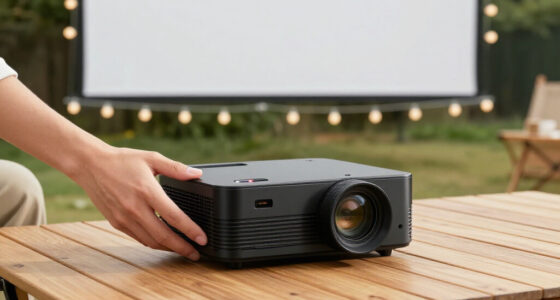
The Optoma ML1080UST Photon GO is the lineup’s most mobile UST option: it can form an image as large as 100 inches from less than a foot away and includes a battery rated for up to 1.5 hours. That combination suits pop-up movie nights where a power outlet or permanent projector cabinet isn’t available. Its Google TV, Google Cast, Wi-Fi, and Bluetooth give it more standalone flexibility than the HDMI-focused Optoma GT2300HDR, though the GT2300HDR is the better fit for brighter rooms and high-refresh gaming. The Photon GO’s 650 ANSI lumens are the limiting factor: it is better suited to darkened spaces than everyday ambient light. Full HD resolution also trails the 4K JMGO O2S Ultra, and the battery is best treated as a portability aid rather than a full-length movie guarantee.
Pros:- Projects up to 100 inches from less than a foot away.
- Built-in battery supports up to 1.5 hours of use.
- Google TV, Google Cast, Wi-Fi, and Bluetooth support flexible streaming.
- Triple RGB laser and 20W stereo speakers provide integrated picture and sound.
Cons:- 650 ANSI lumens are better suited to darkened viewing than mixed-light rooms.
- Battery life is limited to up to 1.5 hours.
- 1080p resolution cannot match the 4K detail of the JMGO O2S Ultra or Hisense PX3-PRO.
Best for: People who want a portable UST projector for occasional indoor or outdoor viewing, with streaming and short battery-powered sessions.
Not ideal for: Bright-room viewers, buyers who need native 4K, or anyone expecting the battery to cover long screenings without power.
- Native resolution:1920 x 1080
- Brightness:650 ANSI lumens
- Light source:Triple RGB laser
- Throw distance:0.34–0.81 feet
- Image size:60–100 inches
- Battery life:Up to 1.5 hours
- Built-in audio:20W stereo speakers
- Smart and wireless features:Google TV, Google Cast, Wi-Fi, Bluetooth
Our verdict“Choose the Photon GO if portability and battery-powered UST viewing matter more than brightness, long runtimes, or 4K resolution.”
Hisense PX3-PRO 4K Ultra Short Throw Triple Laser Projector
The Hisense PX3-PRO suits buyers building a dedicated, tabletop home theater around color and 4K detail. Its native 4K resolution, triple-laser engine, and stated 110% BT.2020 color gamut make it a more color-focused alternative to the Optoma GT2300HDR, which trades resolution for 1080p high-refresh gaming. Dolby Vision, Dolby Atmos, IMAX Enhanced, and Google TV broaden its movie-night appeal without requiring a separate streaming box. It also lists Xbox compatibility, making it more versatile than a film-only display. The compromises are placement and scale: it needs a stable surface close to the wall, and its image range tops out at 150 inches, while the AWOL VISION Aetherion Pro lists support for up to 200 inches. The supplied throw-distance figures appear reversed, so I would verify placement guidance before planning a cabinet.
Pros:- Native 4K resolution with AI upscaling.
- Triple-laser color system lists 110% BT.2020 coverage and ΔE≈0.9 color accuracy.
- Dolby Vision, Dolby Atmos, IMAX Enhanced, and Google TV support a feature-rich theater setup.
- Connectivity includes HDMI, USB 3.0, Ethernet, Bluetooth 5, and Wi-Fi.
Cons:- Tabletop placement requires a suitable surface close to the wall.
- Maximum image size is 150 inches, below the AWOL VISION Aetherion Pro’s listed 200-inch maximum.
- The listed minimum and maximum throw distances are inconsistent with their labels and should be checked before installation.
Best for: Home-theater viewers who want native 4K, wide color, and built-in streaming in a fixed tabletop UST setup.
Not ideal for: Buyers who need flexible mounting, an image larger than 150 inches, or precise installation planning without confirming the throw-distance range.
- Native resolution:3840 x 2160
- Brightness:3,000 lumens
- Light source:Triple laser
- Contrast ratio:3,000:1
- Projection size:80–150 inches
- Color gamut:110% BT.2020
- Light-source life:25,000 hours
- Connectivity:Bluetooth 5, Ethernet, HDMI, USB 3.0, Wi-Fi
Our verdict“Choose the PX3-PRO if color-rich native 4K viewing is your priority and you have a fixed tabletop location for an image up to 150 inches.”
AWOL VISION Aetherion Pro 4K Ultra Short Throw Laser Projector
The AWOL VISION Aetherion Pro is the most ambitious large-screen and gaming choice in this group. Its 0.2:1 throw ratio and listed 200-inch maximum go beyond the 150-inch limits of the JMGO O2S Ultra and Hisense PX3-PRO, while three HDMI 2.1 inputs make it easier to keep several modern sources connected. For competitive play, its modes reach 1080p at 240 Hz; it also supports 4K at 60 Hz and lists ALLM and VRR. Google TV, Wi-Fi 7, and a motorized lens cover round out a premium, permanent-installation feel. The tradeoff is that a large UST image demands careful screen and cabinet alignment, and the brightness is reported differently as 3,000 lumens and 2,600 ISO lumens. Buyers should also note that its rainbow-artifact feature is specified only at Warm 1 color temperature.
Pros:- RGB triple-laser 4K picture supports Dolby Vision, HDR10+, HDR10, and HLG.
- Gaming modes include 1080p at 240 Hz, 1080p at 120 Hz, and 4K at 60 Hz.
- Three HDMI 2.1 inputs support several connected sources.
- Listed image size reaches 200 inches, with a motorized lens cover for protection.
Cons:- Large UST images require precise alignment between projector, cabinet, and screen.
- Brightness is listed as both 3,000 lumens and 2,600 ISO lumens in the supplied data.
- The anti-rainbow-artifact feature is specified only for the Warm 1 color temperature setting.
Best for: Dedicated theater and gaming-room owners who want a very large 4K UST image, multiple HDMI 2.1 sources, and high-refresh 1080p play.
Not ideal for: Casual viewers seeking a simple portable setup, or buyers who need unambiguous brightness figures and low-effort placement.
- Native resolution:3840 x 2160
- Brightness:3,000 lumens listed; 2,600 ISO lumens in description
- Light source:RGB triple laser
- Throw ratio:0.2:1
- Image size:80–200 inches
- Contrast ratio:6,000:1 native; up to 60,000:1 enhanced
- Gaming modes:1080p at 240 Hz, 1080p at 120 Hz, or 4K at 60 Hz
- Connectivity:Three HDMI 2.1 inputs, Wi-Fi 7, Gigabit Ethernet, Bluetooth 5.4, USB
- Smart platform and storage:Google TV; 8GB RAM and 128GB storage
Our verdict“Pick the Aetherion Pro if you have a carefully planned theater setup and want a larger image and more advanced gaming connections than the JMGO or Hisense provide.”
AWOL VISION LTV-3000 Pro 4K 3D Ultra Short Throw Triple Laser Projector
The AWOL VISION LTV-3000 Pro suits a dedicated movie room where its 0.25:1 throw ratio can create a large picture from a cabinet close to the wall. Its triple-laser engine, 4K resolution, Dolby Vision, HDR10+, and 3D support give film-focused buyers more format flexibility than the 1080p ViewSonic LSD400HD-ST. A built-in center-channel speaker also anchors dialogue near the screen, though it does not replace a full surround setup. The tradeoff is brightness: its stated 2,000 lm figure makes a darkened room a safer fit, and bright-room viewers may need an ALR screen. Placement also needs care because the throw ratio is fixed. Choose it for feature-rich cinema viewing, not casual daytime projection.
Pros:- 4K triple-laser imaging with Dolby Vision and HDR10+ support
- 0.25:1 throw ratio places a large image close to the wall
- Built-in center-channel speaker helps keep dialogue aligned with the picture
- Supports 3D and images up to 150 inches
Cons:- Best suited to darker rooms; bright environments may call for an ALR screen
- Fixed throw ratio leaves little room to adjust placement
- 3D viewing requires active-shutter glasses and compatible content
Best for: Movie fans setting up a darkened living room or dedicated theater who want 4K HDR, 3D, and a close-to-wall installation.
Not ideal for: Buyers who watch mainly with lights on, need flexible lens placement, or expect the built-in speaker to provide full theater sound.
- Native resolution:3840 × 2160
- Throw ratio:0.25:1
- Image size:80–150 inches
- Maximum throw distance:1.68 feet
- Brightness:2,000 lm; maximum white brightness 3,000 ANSI lumens
- Light source:Triple laser; rated life 25,000 hours
- Contrast ratio:2,500:1
- Color gamut:107% BT.2020; 147% DCI-P3
- Connectivity and control:HDMI; PJ Link IP control; Control4 integration
Our verdict“Choose the LTV-3000 Pro for close-placement 4K movie viewing with HDR and 3D, provided you can control room light.”
BenQ TH671ST 1080p Short-Throw Home Entertainment Projector
The BenQ TH671ST is the straightforward gaming pick: native 1080p, 3000 ANSI lumens, and low input lag make it more suitable for responsive play than the cinema-first AWOL LTV-3000 Pro. Its 0.69–0.83 throw ratio can produce a 100-inch picture from about five feet, a useful fit for rooms where a standard projector would sit too far back. The DLP design and Rec. 709 coverage favor familiar, clear Full HD viewing rather than 4K HDR spectacle; compared with the 4K Optoma GT3900UHD, it gives up detail and laser longevity but offers a simpler 1080p gaming setup. The single 5 W speaker is modest, and this is a lamp projector rather than a laser model, so it is a less exact match for buyers specifically seeking lamp-free projection.
Pros:- Native 1080p resolution with 3000 ANSI lumens
- Short-throw lens can create a 100-inch image from about five feet
- Low input lag suits gaming
- 1.2× zoom and multiple connections offer useful setup flexibility
Cons:- Lamp-based light source does not provide the lamp-free operation of the laser models here
- Single 5 W speaker is limited for movies and games
- Full HD resolution falls short of the 4K Optoma GT3900UHD
Best for: Console gamers and home-entertainment buyers who want a bright Full HD short-throw image and responsive play without requiring 4K.
Not ideal for: Buyers who specifically want laser light, 4K detail, HDR formats, or strong built-in audio.
- Display technology:DLP
- Native resolution:1920 × 1080
- Brightness:3,000 ANSI lumens
- Throw ratio:0.69–0.83
- Projection size:30–300 inches
- Native contrast ratio:10,000:1
- Color coverage:More than 92% Rec. 709
- Lamp life:Up to 15,000 hours
- Connections:2 HDMI, VGA in/out, USB-A, USB mini-B, 3.5 mm audio in/out, RS-232
Our verdict“Pick the TH671ST if gaming responsiveness and bright 1080p projection matter more than 4K resolution or a laser light source.”
AWOL VISION Aetherion Max 4K Ultra Short Throw Laser Projector, 3,300 ISO Lumens
The AWOL VISION Aetherion Max is the most gaming-oriented 4K pick in this group. Its 0.2:1 throw ratio keeps the projector close to the wall, while VRR, ALLM, up to 240Hz, and 1ms-class input latency target players who want a large image without giving up responsive controls. Three HDMI 2.1a ports plus DisplayPort 1.4a offer broader gaming connections than the HDMI-only listing for the Optoma GT3900UHD. The RGB triple laser and Dolby Vision/HDR10+ support also make it suitable for films and sports. Its 3,300 ISO lumens and adjustable iris add flexibility, but direct overhead lighting may still call for an ALR screen. The unusually short stated throw distance needs confirmation against the actual room and screen size before installation.
Pros:- 4K RGB triple-laser projection rated at 3,300 ISO lumens
- VRR, ALLM, up to 240Hz, and 1ms-class input latency support gaming
- HDMI 2.1a and DisplayPort 1.4a provide broad source connectivity
- Supports Dolby Vision, HDR10+, HDR10, and HLG
Cons:- An ALR screen is recommended for higher contrast under direct overhead lighting
- Published maximum throw-distance information may need clarification
- A very short 0.2:1 ratio calls for careful screen and cabinet planning
Best for: Gamers and home-cinema buyers who want 4K HDR, high refresh-rate features, and a projector that can sit very close to the screen.
Not ideal for: Buyers with direct overhead lighting who do not plan to use an ALR screen, or installers who need fully verified placement measurements before purchase.
- Native resolution:3840 × 2160
- Brightness:3,300 ISO lumens
- Display type:RGB triple laser
- Throw ratio:0.2:1
- Maximum image size:150 inches
- Contrast ratio:Up to 6,000:1 native; 60,000:1 viewing
- Gaming features:VRR, ALLM, up to 240Hz, 1ms-class input latency
- Connectivity:HDMI 2.1a, DisplayPort 1.4a, USB, Bluetooth, Wi-Fi
- Light source life:25,000 hours
Our verdict“Choose the Aetherion Max for a close-set 4K screen that can handle demanding gaming features, after confirming your installation measurements.”
Optoma GT3900UHD True 4K UHD Short-Throw Laser Projector
The Optoma GT3900UHD combines 4K resolution with a stated 4,000 lumens, making it a stronger fit for rooms with some ambient light than the darker-room-oriented AWOL LTV-3000 Pro. Its 0.496:1 throw ratio is short enough for smaller rooms and golf simulation, while support for 1080p at 240Hz and 4K at 60Hz gives gamers options for balancing speed and detail. Compared with the 1080p ViewSonic LSD400HD-ST, it adds 4K resolution and a laser source; the ViewSonic, however, provides a more clearly specified 0.5 throw ratio and installation features such as LAN control. The Optoma’s listing specifies HDMI but no other connections, and its throw-distance figures omit units, so I would verify both before planning a fixed installation.
Pros:- 4K UHD resolution with a stated 4,000 lumens of brightness
- 0.496:1 throw ratio suits smaller rooms and golf simulation
- Supports 1080p at 240Hz and 4K at 60Hz
- DuraCore laser light source rated for up to 30,000 hours
Cons:- Only HDMI connectivity is specified
- Throw-distance figures are listed without units
- Compared with the ViewSonic LSD400HD-ST, its installation and control connections are less fully documented
Best for: Gamers, golf-simulation users, and home-entertainment buyers who want 4K detail and a bright short-throw laser image.
Not ideal for: Buyers who need a clearly documented full range of inputs or precise throw-distance measurements for a fixed installation.
- Resolution:3840 × 2160 (4K UHD)
- Brightness:4,000 lumens
- Throw ratio:0.496:1
- Throw distance:Minimum 1.08; maximum 10.8 (units not specified)
- Light source:DuraCore laser
- Light source life:Up to 30,000 hours
- Gaming support:1080p at 240Hz; 4K at 60Hz
- Connectivity:HDMI
- Weight:6.4 lb
Our verdict“The GT3900UHD is a compelling fit for bright-room 4K gaming if its connection options and throw measurements suit your setup.”
ViewSonic LSD400HD-ST 1080p Short-Throw Laser Projector
The ViewSonic LSD400HD-ST prioritizes brightness and installation utility over cinematic resolution. Its 4,000 ANSI lumens and 0.5 throw ratio suit golf simulators, classrooms, and other rooms where the image must remain visible with ambient light. Golf Mode, 360° projection, portrait mode, LAN control, and an IP6X sealed optical engine make it more installation-focused than the home-cinema-oriented AWOL LTV-3000 Pro. A 100-inch image from 1.1 meters helps keep the projector out of the way, while its laser light source avoids routine lamp replacement. The tradeoff is 1080p: the 4K Optoma GT3900UHD provides finer detail for movies and games, and the ViewSonic’s ceiling-mount listing may not suit buyers seeking a simple tabletop setup.
Pros:- 4,000 ANSI lumens supports viewing in rooms with ambient light
- 0.5 throw ratio produces a 100-inch image from 1.1 meters
- Golf Mode, 360° projection, and portrait mode serve specialized installations
- IP6X sealed optical engine and LAN control support ongoing professional use
Cons:- Native 1080p resolution cannot match the 4K detail of the Optoma GT3900UHD
- Ceiling-mount orientation may be less convenient for casual tabletop use
- Laser light source is rated for 20,000 hours, shorter than the listed life of the AWOL models
Best for: Golf-simulator owners, schools, and commercial installers who need a bright short-throw image with network management and flexible projection modes.
Not ideal for: Home-cinema buyers focused on 4K detail, or users who need a projector designed primarily for quick tabletop placement.
- Native resolution:1920 × 1080
- Brightness:4,000 ANSI lumens
- Throw ratio:0.5
- Throw distance:0.44–3.29 meters
- Image size:40–300 inches
- Light source:Laser phosphor; rated life 20,000 hours
- Dynamic contrast ratio:3,000,000:1
- Connectivity:Ethernet, HDMI, USB 2.0 Type-A, 3.5 mm audio
- Additional features:Golf Mode, 360° projection, portrait mode, IP6X sealed optical engine, LAN control
Our verdict“Choose the LSD400HD-ST for a bright, installation-ready 1080p image in golf, classroom, or commercial spaces rather than a 4K home theater.”
Optoma GT2400HDR Full HD Short Throw Laser Projector
The GT2400HDR is the brighter gaming-focused pick here: its 4,200 lumens can help keep a projected image visible with some ambient light, while low input lag suits responsive play. Its 2.6-to-3.7-foot throw range is especially useful when a room cannot accommodate a conventional projector setup, though that short placement range leaves less flexibility than the GT2000HDR’s listed 1-to-10-meter range. Both Optoma models use a long-life laser and accept 4K input, but the GT2400HDR’s native image remains 1080p; input compatibility is not 4K projection. It is a practical fit for gaming rooms and golf simulators where brightness and compact placement matter more than native 4K detail. Skip it if you need a longer throw or a true 4K picture.
Pros:- 4,200 lumens offer more brightness than the GT2000HDR’s 3,500 lumens
- Short throw suits smaller rooms and constrained gaming setups
- Low input lag supports responsive gameplay
- DuraCore laser is rated for up to 30,000 hours
Cons:- Native resolution is 1920 × 1080 despite 4K input compatibility
- Maximum listed throw distance of 3.7 feet limits placement flexibility
Best for: Gamers and golf-simulation users who need a bright Full HD image from a short distance in a room with some ambient light
Not ideal for: Buyers seeking native 4K detail or flexible placement several feet beyond the projector’s 3.7-foot maximum throw distance
- Native resolution:1920 × 1080
- Maximum input resolution:3840 × 2160
- Brightness:4,200 lumens
- Light source:DuraCore laser
- Light source life:Up to 30,000 hours
- Throw distance:2.6–3.7 feet
- Maximum image size:300 inches
- Connectivity:Ethernet, HDMI, USB, VGA
- Weight:9.4 pounds
Our verdict“Choose the GT2400HDR for a bright, short-throw Full HD gaming or simulator setup, but look elsewhere for native 4K or more flexible placement.”
Optoma GT2000HDR Ultra-Compact Short-Throw Full HD Laser Projector
The GT2000HDR makes the most sense for buyers who value a compact, dust-resistant projector over maximum brightness. Its IPX6 dust resistance and small footprint suit a room where equipment may face dust exposure, while the short-throw lens can create a 120-inch image from 4 feet 4 inches away. Compared with the brighter GT2400HDR, its 3,500 lumens give up some headroom in rooms with ambient light; in return, this model lists a broader 1-to-10-meter throw range, which can offer more placement options. It remains a 1080p projector, even when accepting 4K HDR input, so it is not the choice for native 4K detail. The enhanced game mode and long-life laser make it a versatile compact pick, but check your intended image size and room layout before buying.
Pros:- IPX6 dust resistance is a useful distinction from the GT2400HDR
- Projects a 120-inch image from 4 feet 4 inches away
- Compact design and DuraCore laser rated for up to 30,000 hours
- Enhanced game mode and 4K HDR input compatibility
Cons:- At 3,500 lumens, it is dimmer than the GT2400HDR’s 4,200 lumens
- Native resolution is 1920 × 1080, not 4K
- Room layout and setup can limit the practical use of its listed maximum image size
Best for: Buyers fitting a compact projector into a dust-prone media or gaming room who want short-throw projection and long laser life
Not ideal for: Viewers who prioritize maximum brightness for ambient-light use or demand native 4K resolution
- Native resolution:1920 × 1080
- Brightness:3,500 lumens
- Contrast ratio:300,000:1
- Light source:DuraCore laser
- Light source life:Up to 30,000 hours
- Throw distance:1–10 meters
- Maximum image size:300 inches
- Dust resistance:IPX6
- Connectivity:HDMI, USB, RCA, 3.5 mm audio
Our verdict“Pick the GT2000HDR for a compact, dust-resistant Full HD setup, especially when its wider listed throw range matters more than the GT2400HDR’s extra brightness.”
XGIMI MIRA 4K Triple-Laser Ultra-Short-Throw Projector
Unlike the Optoma GT2400HDR and GT2000HDR, the XGIMI MIRA delivers native 4K resolution and uses RGB triple-laser technology for a stated 110% BT.2020 color gamut. Its 0.175:1 throw ratio puts a 100-inch image just 7.6 inches from the projection surface, making it the clearest fit for a tabletop setup close to the wall. Built-in Google TV and 36W Harman Kardon audio also reduce the need for separate streaming and sound equipment. That convenience comes with tradeoffs: its 2,000 ISO lumens are below the GT2400HDR’s stated 4,200 lumens, and the listed 80-to-120-inch image range is narrower than those Optoma models’ 300-inch maximum. Choose it for 4K picture detail and an integrated living-room setup, not for a large, bright-room projection.
Pros:- Native 3840 × 2160 resolution with RGB triple-laser projection
- 0.175:1 throw ratio produces a 100-inch image from 7.6 inches away
- Google TV and 36W Harman Kardon audio are built in
- Automatic focus, keystone, and screen alignment simplify setup
Cons:- Its 2,000 ISO lumens are substantially below the GT2400HDR’s 4,200 lumens
- Listed image size is limited to 80–120 inches
- Maximum listed throw distance is only 2 feet, limiting placement flexibility
Best for: Living-room viewers who want native 4K, a very close wall placement, integrated streaming, and built-in audio
Not ideal for: Buyers needing higher stated brightness, a projected image larger than 120 inches, or the broad size flexibility offered by the Optoma models
- Native resolution:3840 × 2160
- Display type:DLP
- Light source:RGB triple laser
- Brightness:2,000 ISO lumens
- Throw ratio:0.175:1
- Image size:80–120 inches
- Color gamut:110% BT.2020
- Smart TV platform:Google TV
- Audio:36W Harman Kardon with Dolby Audio
Our verdict“Choose the MIRA for native 4K and a near-wall, all-in-one entertainment setup, but favor an Optoma if brightness or a larger image matters more.”
How We Picked
I ranked these projectors by how well their designs match real short-throw use, not by resolution alone. I weighed throw style and placement flexibility, image resolution and laser configuration, stated brightness where provided, and whether a model’s format suits a fixed living-room installation, gaming setup, or portable use. I also considered usability factors such as footprint and the demands of aligning a UST image, since a theoretically capable projector can be frustrating if it does not fit the room.
The order favors versatile options with a clear use case and strong capability for their intended audience. Premium 4K triple-laser models rank highly for buyers building a dedicated large-screen setup, while Full HD models remain relevant when simplicity, compactness, or a more focused use matters more than resolution. I treated product roles as distinct rather than assuming every model competes directly: an ultra-short-throw home-theater projector is not a substitute for a portable unit, and a short-throw gaming model is not automatically the best living-room choice.
Factors to Consider When Choosing Short Throw Laser Projectors
Before comparing headline resolution or laser type, I’d start with the room. Short-throw and ultra-short-throw models solve different placement problems, and a mismatch can outweigh an image-quality advantage. These factors help narrow the field before you choose between premium 4K systems and more focused Full HD options.
Match Throw Distance to Your Room
Measure the distance from the proposed projector position to the screen, then compare it with the manufacturer’s throw specifications for your desired image size. “Short throw” and “ultra-short throw” are not interchangeable: UST projectors sit very near the screen, while other short-throw designs need more room. A UST setup can free a ceiling mount and reduce shadows, but it needs a stable surface close to the wall. Small changes in position or angle can shift the image enough to complicate alignment. A common mistake is buying by screen size alone without checking the required placement. If the projector must move between rooms, prioritize a setup that tolerates your available distances rather than assuming every short-throw model is flexible.
Choose the Screen and Wall Before the Projector
The display surface has a major effect on perceived contrast and uniformity, particularly with UST models that send light upward at a steep angle. A flat, smooth wall may work for casual viewing, but texture, unevenness, or a slight bow can become visible across a large image. Some rooms benefit from a screen designed for UST projection, while a standard screen may suit a different projector layout. Check screen compatibility and mounting height before committing to a projector. A frequent misstep is buying the projector first and discovering that the screen’s frame or surface does not suit the optical path. Budget and plan for the full image system, not just the projector.
Treat Brightness as a Room-Matching Choice
Brightness matters most when you watch with ambient light or want a very large image, but a lumen figure alone does not predict the result in your room. Screen size, screen material, wall color, and window placement all change how bright and punchy the image appears. A model suited to a light-controlled room may feel less convincing in a bright family space. Conversely, choosing the brightest option available can add capability you rarely use if you watch mostly at night. Compare brightness claims on a consistent basis where possible, and look for independent measurement details when they are available. If daytime viewing is a priority, consider room-darkening measures and screen choice alongside projector output.
Decide Whether 4K Is Worth the Setup and Spend
4K can reveal finer detail on a large screen, especially when viewers sit close, but it should not be the only reason to choose a projector. Source quality, image processing, contrast, and room conditions also affect what you see. The triple-laser models in this roundup target buyers who want a premium image system, while Full HD options can make more sense for gaming, secondary rooms, or viewers who sit farther back. Check which streaming devices and sources you already own before paying for resolution your content rarely uses. Also confirm whether a model’s advertised resolution reflects native imaging or a supported input format. A balanced setup may spend more on the screen or room control instead of moving to a higher resolution tier.
Separate Gaming Needs From Movie-Watching Needs
A projector that works well for movies may not be the best fit for responsive gaming. Check supported resolution and refresh modes, input lag information, and which HDMI ports support the features you need. HDR support can improve compatible content, but it does not guarantee strong HDR impact on a large projected image. If you play fast-paced games, prioritize measured latency and the display modes available at your preferred resolution. For films, contrast, color, and quiet operation may matter more than a specialized gaming mode. Avoid assuming that “gaming” in a product name tells the whole story; verify the exact performance limits for your console or PC.
Plan for Installation, Sound, and Long-Term Use
A fixed UST installation can keep the projector accessible, but it also makes placement and cable routing part of the room design. Check the unit’s dimensions, ventilation clearances, power access, and connections before selecting a cabinet or shelf. Built-in audio may handle casual viewing, yet an external sound system usually gives a larger room more presence and clearer dialogue. Laser light sources avoid routine lamp changes, but that does not remove the need to keep vents clear or follow maintenance guidance. Portable models trade a permanent installation for easier relocation, often with different compromises in brightness and setup. Decide whether the projector will be a room centerpiece or an occasional-use device before paying for features that do not match your habits.
Frequently Asked Questions
Can I use an ultra-short-throw projector on a regular wall?
Yes, but the wall needs to be smooth, flat, and evenly finished for the image to look its best. UST projection makes surface flaws more visible because light reaches the screen at a steep angle. A textured wall or slight unevenness can distort lines or create inconsistent brightness across the image. If you plan to use the projector every day, compare the cost and placement of a compatible screen with the limitations of your wall. Check the projector maker’s screen guidance before choosing a screen material.
Is 4K a better choice than Full HD for a short-throw projector?
4K is most worthwhile when you want a large image, sit relatively close, and watch high-resolution sources. Full HD can still be a sensible choice for gaming, a smaller screen, or a room where convenience matters more than fine detail. The resolution label does not tell you how the projector handles contrast, color, or HDR, so compare the whole picture system. Also check whether the model uses native 4K imaging or accepts 4K sources through another display method. If your viewing habits are mostly streaming at lower quality, a better room and screen match may matter more than the resolution upgrade.
Do I need a special screen for a UST projector?
You do not always need one, but a UST-compatible screen can improve the viewing experience in rooms with ambient light and help manage the projector’s steep light path. A standard screen may work, but compatibility depends on its surface and how it is installed. A flat wall can be an inexpensive starting point if it is smooth and the room is controlled. Before buying, confirm the screen’s intended projector type, size, mounting position, and frame dimensions. This check can prevent a screen that blocks the image or produces uneven results.
Can a short-throw projector replace a television for daytime viewing?
It can serve as a large-screen display, but daylight performance depends on brightness, image size, screen material, and how much light enters the room. A projector image usually looks more convincing when you can reduce window glare or use a screen suited to the room. If you watch sports or television during bright daytime hours, compare the projector’s capabilities with the practical advantages of a TV before deciding. Consider whether you want a permanent screen and a dedicated spot for the projector. For mixed daytime and evening use, room control and screen choice should be part of the purchase plan.
What should I check before choosing a short-throw projector for gaming?
Look for input-lag measurements, supported refresh rates, and the resolution each gaming mode can maintain. Check which HDMI inputs support the features your console or PC uses, since not every port necessarily offers the same capabilities. HDR support can be useful, but projected HDR may look different from HDR on a television because image size and room light affect perceived impact. Consider whether you need a fixed UST setup or a conventional short-throw position that better fits your gaming space. If responsiveness is your priority, verified latency data is more useful than a gaming label alone.
Conclusion
For most buyers building a permanent large-screen setup, I’d start with the Hisense PX3-PRO as the best overall pick, with the JMGO O2S Ultra and AWOL VISION Aetherion models as premium alternatives for shoppers comparing high-end 4K UST designs. For best value in a focused Full HD setup, compare the Optoma GT2400HDR and GT2300HDR against your gaming and room needs rather than paying for features you will not use. The Optoma ML1080UST Photon GO is my beginner-friendly choice for buyers who prioritize portability, while the compact Optoma GT2000HDR suits those who need a small fixed projector. For premium brightness, the AWOL VISION Aetherion Max lists 3,300 ISO lumens; for a different installation or gaming need, consider the ViewSonic LSD400HD-ST, BenQ TH671ST, or Optoma GT3900UHD by their exact placement and feature requirements. I’d choose by measuring the room first, then narrowing the list by screen, image goals, and use case.
Black Friday Picks

Bose TV Speaker Compact Soundbar with Bluetooth and HDMI-ARC, Black
As an affiliate, we earn on qualifying purchases.