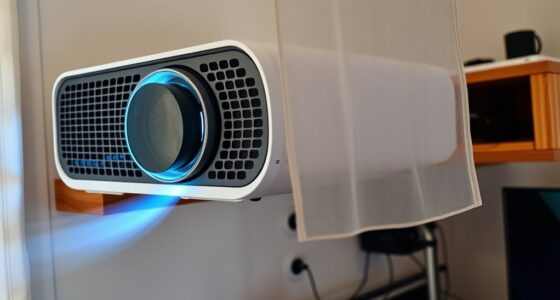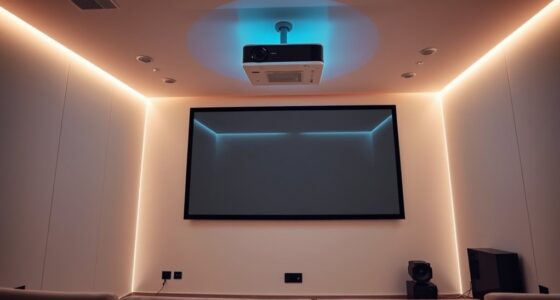
Choosing the right projector screen material depends on your environment and viewing preferences. Use white screens if you want bright, clear images in controlled lighting, perfect for home theaters or classrooms. Gray screens help maintain contrast in rooms with some ambient light, offering richer colors. Ambient-light rejecting (ALR) screens are ideal outdoors or in bright spaces, reducing glare and enhancing visibility. Continue exploring to see how each option can best suit your setup and needs.

Get business pricing on your home office setup
- Business-only prices and quantity discounts
- Tax-exempt purchasing
- Multiple users, one account, clear invoices
Key Takeaways
- White screens are ideal for controlled lighting environments, offering high brightness and color accuracy.
- Gray screens enhance contrast and color richness in rooms with some ambient light.
- Ambient-light rejecting (ALR) screens are best for outdoor or brightly lit spaces, reducing ambient light interference.
- Choosing between materials depends on your environment’s lighting conditions and desired image quality.
- Durability and environmental resistance are key factors for outdoor or portable projector screens.

Choosing the right projector screen material is essential for getting the best image quality. Your choice of screen fabric options can considerably impact how vibrant, sharp, and clear the projected image appears. When deciding, you need to take into account whether you’ll be using the screen indoors or outdoors, as this influences the type of material that will work best. Indoor screens typically benefit from materials that maximize brightness and color accuracy. The pure white fabric reflects light uniformly, resulting in a crisp, clear image that’s ideal for controlled lighting environments. However, if you’re in a space with some ambient light, you might consider a gray screen. Gray fabrics, especially those with a darker tone, help improve contrast by reducing the washout caused by ambient light. They are particularly useful in rooms where controlling lighting isn’t always easy, providing a more balanced picture without sacrificing color richness. When choosing the fabric, consider the contrast ratio to ensure your images will have deep blacks and vibrant whites, enhancing overall picture quality.
Choosing the right projector screen material enhances image clarity, color, and brightness for indoor or outdoor use.
When it comes to outdoor use, the choice of screen fabric options becomes even more critical. Natural light and environmental factors demand materials that can reject ambient light effectively. Ambient-light rejecting (ALR) screens are specially designed for outdoor or brightly lit environments. These screens feature a textured surface or specific optical coatings that direct ambient light away from the viewer’s line of sight while reflecting the projector’s light back toward the audience. This characteristic ensures that even in daylight or bright outdoor settings, your image remains bright, sharp, and easy to see. The outdoor vs indoor comparison highlights a key consideration: the environment influences your fabric choice. Indoor screens prioritize color accuracy and brightness, while outdoor screens focus on ambient light rejection and durability. If you plan to set up a portable or semi-permanent outdoor theater, investing in an ALR screen can make all the difference in image quality. Conversely, for a dedicated home theater or classroom, a high-quality white or gray fabric might suffice and provide excellent performance.
Frequently Asked Questions
How Do Ambient Light Conditions Influence Screen Material Choice?
Ambient light conditions markedly impact your screen material choice. In bright rooms, you’ll benefit from ambient-light rejecting screens that adapt well to high light levels, reducing glare and improving image clarity. For durability, choose screen materials designed for frequent use and exposure to different lighting conditions. Gray screens are ideal for ambient-light adaptation, enhancing contrast in well-lit spaces, while white screens work best in darker environments.
Can White Screens Improve Image Contrast in Dark Rooms?
White screens can considerably boost image contrast in dark rooms, turning your viewing experience into a cinematic masterpiece. Their reflective surface enhances brightness and preserves color accuracy, making visuals look sharp and vibrant. While gray screens excel in ambient light, white screens excel in controlled dark environments, providing a crisp, punchy picture. So, if your room is nearly pitch black, a white screen can transform your space into a visual wonderland.
Are Gray Screens Suitable for Outdoor Projection Environments?
Gray screens are suitable for outdoor projection environments because they offer good outdoor durability and help maintain color accuracy despite ambient light. You’ll find that gray screens reduce washout from sunlight or streetlights, improving image contrast and clarity. Their durability guarantees they withstand weather conditions, making them a reliable choice for outdoor use. Just make certain you select a model specifically designed for outdoor environments to maximize performance and longevity.
Do Ambient-Light Rejecting Screens Require Special Projector Settings?
A wise man once said, “Know your terrain.” Ambient-light rejecting screens often do require special projector settings. You should adjust your projection screen coatings and settings to maximize ambient light control, ensuring bright, clear images. Many models have recommended projector modes or brightness adjustments to work with their unique surface properties. To get the best results, consult your screen’s specifications and fine-tune your projector for ideal contrast and clarity.
What Maintenance Is Needed for Different Screen Materials?
You should perform regular cleaning routines on your screen to keep it clear and vibrant, using a soft, damp cloth to avoid scratches. For white and gray screens, avoid harsh chemicals, while ambient-light rejecting screens may need gentle dusting to maintain contrast. Additionally, check the frame’s durability periodically, ensuring it stays sturdy and free from damage. Proper maintenance helps preserve your screen’s performance and lifespan over time.
Conclusion
Choosing the right projector screen material is like selecting a canvas for your dreams. White screens shine brightly, symbolizing clarity and purity, perfect for vivid storytelling. Gray screens offer a calm, understated backdrop, representing focus and balance. Ambient-light rejecting screens act as shields, protecting your visuals from chaos, much like a steady lighthouse guiding ships safely home. Whichever you pick, remember it’s more than material—it’s the foundation of your visual journey, shaping memories that last a lifetime.
Fall Picks
fall essentials
As an affiliate, we earn on qualifying purchases.