If you’re choosing between ultra short throw and traditional projectors, consider your space and setup needs. Ultra short throw models sit close to the wall, saving space, and reducing shadows, making them great for small rooms. Traditional projectors need more room, are flexible for large spaces, but can be trickier to install. Each has pros and cons depending on your budget, environment, and image quality preferences. Keep exploring to find out which option best fits your setup.
Listen free for 30 days with Audible
Thousands of audiobooks and originals — cancel anytime.
As an affiliate, we earn on qualifying purchases.
Key Takeaways
- Ultra short throw projectors save space and reduce shadows, ideal for small rooms, whereas traditional projectors require more room and setup space.
- Ultra short throw models are easier to install with automatic adjustments, while traditional projectors may need professional setup and calibration.
- Ultra short throw projectors are generally more expensive upfront, with traditional models being more budget-friendly initially.
- Ultra short throw projectors are sensitive to alignment, requiring precise setup, whereas traditional projectors offer adjustable lens shift and zoom.
- Both types offer high-quality images, but advancements continue to improve performance, with choice depending on space, budget, and convenience.
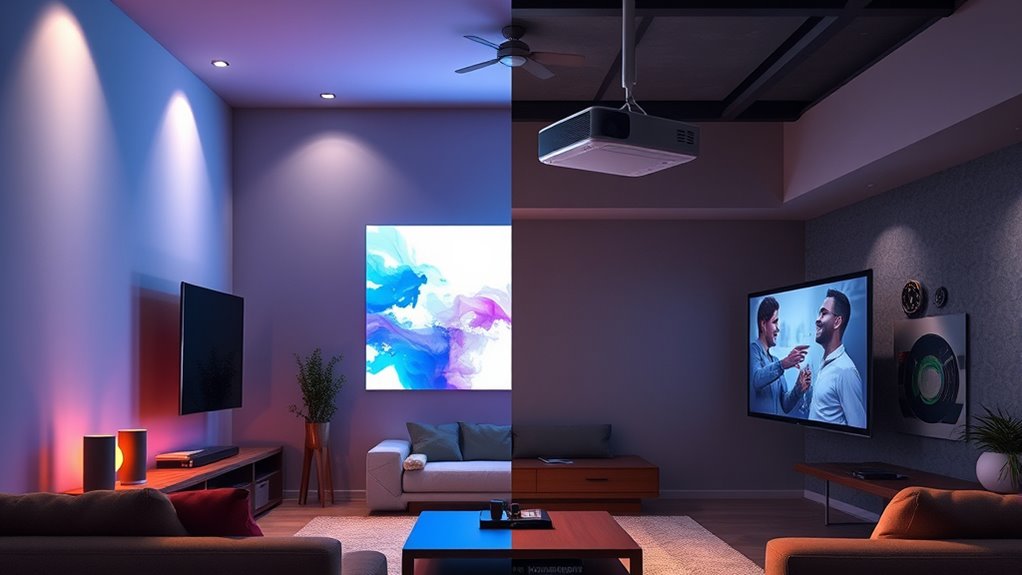
When choosing between ultra short throw projectors and traditional projectors, understanding their key differences can help you make an informed decision. Ultra short throw projectors are designed to sit very close to the screen or wall—often just inches away—allowing you to project large images without the projector being in the way. Traditional projectors, on the other hand, require a longer distance from the screen, typically several feet or more, to produce a comparable image size. This fundamental difference affects not only where you place the device but also how your space functions.
Ultra short throw projectors sit close to the wall, saving space; traditional projectors require more room for setup.
If space is limited, an ultra short throw projector offers clear advantages. Because it sits close to the wall, you don’t need a dedicated TV-sized room or a large empty wall. You can set it up in a small living room, a classroom, or even a conference room without sacrificing much space. This proximity also minimizes shadows cast by people moving around during presentations or movie nights. However, the closer placement means that the projector must be precisely aligned to avoid image distortion or keystone issues, which can sometimes be tricky to calibrate. Additionally, some models include lens shift technology, making alignment easier in tight spaces. It’s also worth noting that lens correction features are increasingly incorporated to address these alignment challenges.
Traditional projectors, meanwhile, provide flexibility in placement because they can be positioned at various distances from the screen, often with adjustable lens shift and zoom features. That means you can set them up in larger rooms or auditoriums where distance isn’t an issue. However, they typically require more space, which could be problematic in smaller areas. Additionally, because traditional projectors sit farther back, they can be more susceptible to shadows cast by viewers or presenters, potentially disrupting the viewing experience.
Another factor to consider is installation complexity. Ultra short throw projectors tend to be simpler to set up since you only need to position them near the wall, and many models come with automatic keystone correction and focus features. Traditional projectors might require more effort to install correctly, especially if you’re setting up a permanent installation that involves mounting, adjusting lens settings, and ensuring proper alignment. This can be more time-consuming and sometimes require professional help.
In terms of cost, ultra short throw projectors are often more expensive upfront, mainly because of their specialized optics and compact design. Traditional projectors, especially older models, tend to be more affordable but might incur additional costs for installation and wiring. Both types have their pros and cons, but your choice ultimately depends on the space you have, your setup preferences, and your budget. Understanding these differences helps you pick the right projector for your needs, ensuring a better viewing experience. Additionally, advancements in projection technology continue to improve image quality and usability for both types.
Frequently Asked Questions
How Do Ultra Short Throw Projectors Handle Ambient Light?
Ambient light can wash out images, making it tough to see your projector’s display clearly. Ultra short throw projectors handle this better because they sit very close to the screen, reducing the chances of ambient light interfering. You can use them in brighter rooms without losing picture quality. Just remember, the screen’s reflective surface also plays a role in how well your projector handles ambient light.
What Is the Typical Lifespan of Projector Bulbs?
Imagine you’re in a 1920s cinema, hoping your projector lasts long. Typically, projector bulbs last between 1,500 to 3,000 hours, depending on usage and quality. You can prolong their lifespan by keeping the projector cool and avoiding frequent on/off cycles. When the bulb dims or flickers, it’s time for a replacement. Regular maintenance ensures your projector continues delivering bright, sharp images without sudden interruptions.
Are There Differences in Audio Quality Between the Two Types?
You might notice differences in audio quality between projector types. Generally, both ultra short throw and traditional projectors rely on built-in speakers, which often aren’t high quality. However, ultra short throw projectors tend to have smaller speakers due to their compact design, possibly leading to less impressive sound. To get better audio, you should consider external speakers or a sound system, regardless of the projector type you choose.
Which Projector Type Is More Energy-Efficient?
You’re wondering which projector type is more energy-efficient. Generally, ultra short throw projectors tend to use less power because they often have LED or laser light sources that consume less energy and last longer. Traditional projectors, especially those with lamp-based bulbs, typically consume more power and require frequent bulb replacements. So, if energy efficiency is your priority, ultra short throw projectors usually have the edge over traditional models.
Can Ultra Short Throw Projectors Be Used Outdoors Effectively?
Imagine your outdoor gathering as a vibrant canvas, waiting for a splash of light. Ultra short throw projectors can work outdoors, but they face challenges like ambient sunlight and weather conditions. To make the most of them, you’ll need a shaded area and protection from elements. While they excel indoors, outdoors they rely heavily on controlled lighting, like a painter’s careful brushstroke, to deliver a clear and vivid display.
Conclusion
Choosing between ultra short throw and traditional projectors is like picking a hero for your home theater—each has superpowers. Ultra short throw projectors can make your room look like a giant cinema with just inches of space, while traditional projectors can dazzle with massive screens from across the room. Whichever you pick, you’re about to unleash cinematic magic in your own home—get ready for an epic viewing adventure that’ll blow your mind!
Evergreen bestsellers Picks
bestsellers
As an affiliate, we earn on qualifying purchases.