To select the appropriate AV receiver, you need to accurately count its channels and match them to your room size and future plans. Start by evaluating your current setup, room acoustics, and desired immersion. Remember, more channels don’t automatically mean better sound without proper placement and calibration. Planning for upgrades ensures your system remains high-quality over time. If you want to learn the best way to count channels and match your setup, keep exploring further.
Key Takeaways
- Always verify the number of supported channels to match your room size and speaker setup.
- Count all speaker outputs, including height or surround back channels, for future expansion.
- Ensure the AV receiver’s format support (e.g., Dolby Atmos, DTS:X) aligns with your desired configuration.
- Use proper calibration and placement to maximize sound quality with the given channel count.
- Plan for scalability by choosing a receiver with extra pre-outs and room for additional speakers.

XHF 120 PCS Adhesive Cable Wire Clips Black, Outdoor Christmas Light Clips, Cable Management Wire Organizer Cord Holder for Under Desk, Car, Wall, TV PC Ethernet Cable
- High quality material:XHF Adhesive Cable Clips are manufactured...
- Widely used: USB Cable, Ethernet Cable, Outdoor...
- Size: Base 5/8" x 5/8", inner...
As an affiliate, we earn on qualifying purchases.
Why Counting Your AV Receiver’s Channels Correctly Matters

Counting your AV receiver’s channels accurately is essential because it directly impacts your home theater experience. When you know the correct number of channels, you can optimize speaker placement, ensuring sound is evenly distributed throughout the room. Proper speaker placement enhances room acoustics, making dialogue clearer and immersive sound effects more realistic. If you underestimate the number of channels, you might miss out on full surround sound, leaving your setup feeling incomplete. Overestimating can lead to unnecessary expenses and confusing configurations. Understanding your receiver’s channels helps you design a balanced, immersive environment that maximizes audio quality. Knowing the channel configuration of your AV receiver is crucial for achieving optimal sound performance. Additionally, being aware of the contrast ratio and how it affects image quality can help you create a more engaging home cinema experience. Ultimately, accurate channel counting ensures your home theater delivers rich, well-rounded sound that matches your space and listening preferences.

SOULWIT 50Pcs Self Adhesive Cable Management Clips - Black
- 🔷SUPER EASY TO USE: Stick to clean surface, open...
- 🔷PREMIUM MATERIAL: Made from eco-friendly Polyamide66 material,...
- 🔷STICKY IN MANY SURFACES: Works on all clean surfaces...
As an affiliate, we earn on qualifying purchases.
How to Determine the Right Number of Channels for Your Home Theater
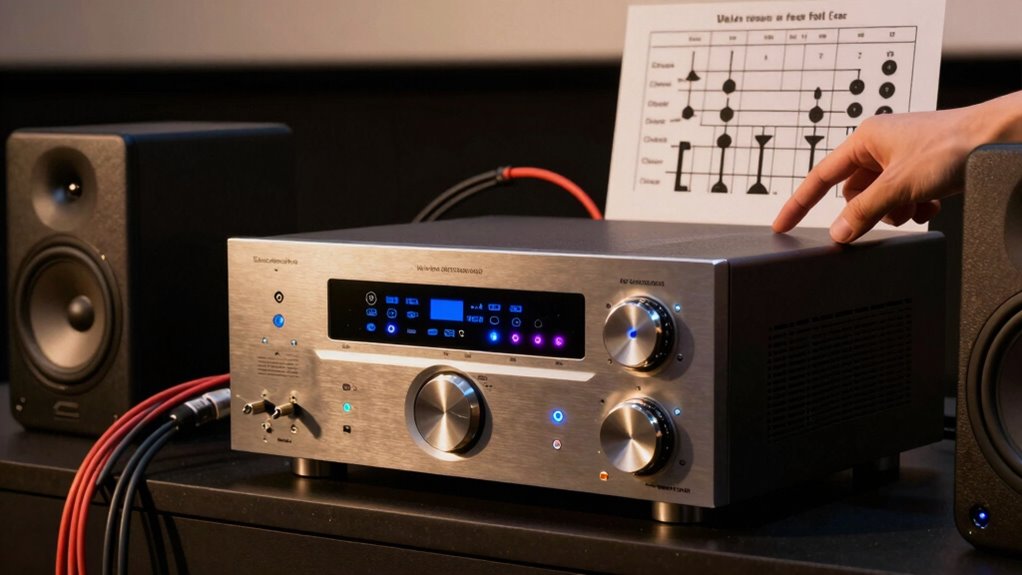
Choosing the right number of channels for your home theater depends on your room size, budget, and desired audio experience. Start by considering speaker placement—smaller rooms may only need a 5.1 setup, while larger spaces can benefit from 7.1 or more channels. Room acoustics also play a role; reflective surfaces or irregular shapes can affect sound quality, so you might need extra channels or careful placement to optimize sound distribution. Think about how immersive you want your audio to feel and whether your content supports additional speakers. Keep in mind that more channels require a capable AV receiver and proper calibration. By evaluating your room’s size, acoustics, and your listening preferences, you can determine the ideal number of channels to create a balanced, immersive home theater experience.
Understanding AV Receiver Channel Formats and Expansion Options
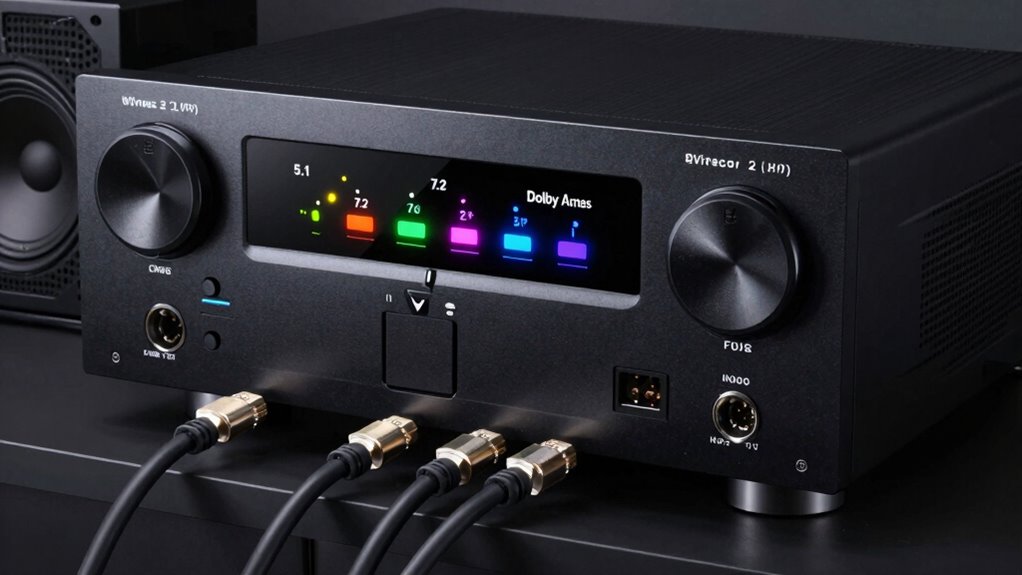
Once you’ve determined the number of channels that suit your space, understanding how your AV receiver handles different channel formats becomes important. Many receivers support various configurations like 5.1, 7.2, or Dolby Atmos, which influence speaker placement and power handling. Expansion options allow you to add speakers or upgrade existing ones as your needs grow. For example, a receiver with multi-channel pre-outs can expand to support additional speakers or height channels for immersive sound. Choosing the right format guarantees your setup delivers balanced sound with adequate power for each speaker. Keep in mind that more channels often require better speaker placement and increased power handling to avoid distortion and ensure ideal performance.
| Format | Speaker Placement | Power Handling |
|---|---|---|
| 5.1 | Front, center, surround, subwoofer | Moderate, enough for typical speakers |
| 7.2 | Adds rear surrounds, second subwoofer | Higher, supports larger speakers |
| Dolby Atmos | Overhead or upward-firing speakers | Needs robust power for height channels |
| DTS:X | Flexible placement, object-based sound | Similar to Atmos, depends on speaker setup |
| Expandable | Additional channels via pre-outs | Increased, requires capable receiver |

URRED Power Loveseat Recliner Sofa with Massage and Heat, Wall Hugger Reclining Loveseat with Console, RV Couch Home Theater Seating with LED Lights for Living Room (Black, 67" - 2 Seats)
- Power Reclining Comfort: One-touch control lets you smoothly...
- Massage & Heat Relaxation: 8-point vibration massage with 5...
- Home Theater Experience: LED ambient lighting sets the...
As an affiliate, we earn on qualifying purchases.
Common Mistakes When Choosing an AV Receiver Based on Channel Count
Many people assume that more channels always mean better sound, but that’s not always true. You might end up sacrificing audio quality just to get a higher channel count. Focus on sound performance first, and use channel numbers as a secondary factor.
Channel Count Can Be Deceptive
While a higher channel count might seem like an obvious indicator of better surround sound, it can actually be misleading. More channels don’t guarantee improved audio if speaker placement and room acoustics aren’t optimized. An AV receiver with 7.2.4 channels may sound worse than a well-calibrated 5.1 setup. Focus on how the system uses those channels rather than just the number.
| Channel Count | Typical Setup Example |
|---|---|
| 5.1 | Front, center, surround, subwoofer |
| 7.2 | Adds rear surrounds, dual subs |
| 9.2 | Adds height speakers |
| 11.2 | More height and surround channels |
A higher count can be tempting, but without proper speaker placement and attention to room acoustics, it won’t deliver better sound quality.
Prioritize Sound Quality Over Numbers
Focusing solely on the number of channels can lead you to overlook what truly matters: sound quality. A higher channel count doesn’t automatically mean better audio fidelity. Instead, pay attention to how well the receiver handles your speakers and maintains clarity across different formats. An AV receiver with fewer channels but superior processing can deliver richer, more immersive sound. Compatibility is vital; confirm the receiver supports your speaker types and configurations. Prioritizing sound quality means listening to demos or reading expert reviews rather than just counting outputs. Remember, a well-matched system with excellent audio fidelity will outperform a larger setup that’s poorly integrated. Additionally, understanding audio processing can help you evaluate how effectively a receiver manages sound signals for optimal clarity. Evaluating power handling capacity ensures your receiver can sustain high-quality sound without distortion during intense audio moments. When evaluating options, consider speaker compatibility to ensure your setup performs at its best, regardless of the channel count. Incorporating room acoustics considerations can further enhance your overall listening experience. Ultimately, the best choice enhances your listening experience, not just increases channel numbers. Paying attention to system calibration can also make a significant difference in achieving balanced and accurate sound reproduction.
Tips for Matching Your Receiver’s Channels to Your Setup

Matching your receiver’s channels to your setup is essential for ideal sound quality. Start by evaluating your speaker placement; verify speakers are positioned to create a balanced soundstage. Proper speaker placement minimizes sound reflections and optimizes direct sound, enhancing clarity. Consider room acoustics—hard surfaces can cause echoes, while soft furnishings absorb sound, affecting channel performance. Adjust your receiver’s channel configuration to match your speaker setup, whether you have a 5.1, 7.2, or other system. Make sure each speaker is assigned to the correct channel and that your receiver can handle the total number of speakers you plan to use. Fine-tuning this alignment ensures your system delivers immersive, well-balanced audio that fills your space effectively.
Planning for Future Channel Upgrades and Growth
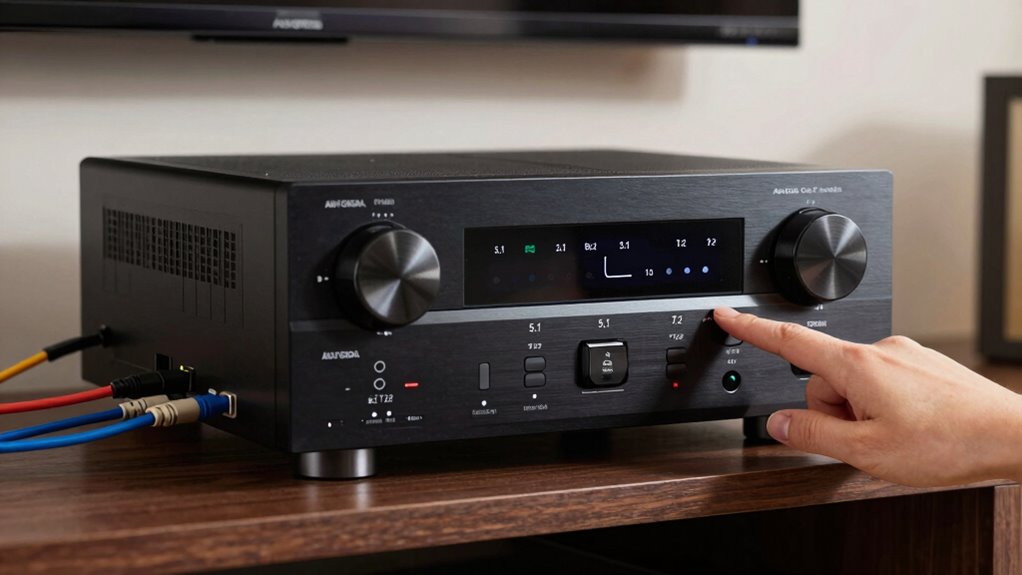
Planning for future channel upgrades and growth guarantees your AV system remains flexible and current. Consider how additional speakers will fit into your speaker placement strategy, ensuring your setup can expand smoothly without major reconfiguration. Check that your receiver’s power handling capacity can support more channels as you add speakers, avoiding overloads or performance issues. Think long-term about your room’s acoustics and wiring, so future upgrades won’t be hindered by physical or technical limitations. Investing in a receiver with extra channels now allows you to increase surround sound layers or home theater complexity later. By proactively planning for growth, you ensure your system stays relevant and immersive, avoiding costly replacements down the line. This approach creates a scalable, high-performance home theater that adapts with your evolving needs.
Frequently Asked Questions
How Do I Verify the Actual Number of Channels on My Current AV Receiver?
To verify your AV receiver’s actual number of channels, check its channel configuration setting in the menu or user manual. You can also run speaker calibration if your receiver offers it; this process tests each speaker and confirms how many channels are active. Additionally, look at the back panel for labeled outputs or consult the receiver’s specifications online to make sure you’re aware of its channel count.
Can I Upgrade My AV Receiver’s Channels Later Easily?
Upgrading your AV receiver’s channels later is like adding new brushstrokes to a painting. You can expand your system by adjusting speaker placement and optimizing room acoustics, but it’s not always simple. Many receivers support additional channels, yet some require compatible hardware or module upgrades. Check your receiver’s specs first, then plan for speaker placement and acoustics, ensuring your room is ready to handle the enhanced soundscape.
What Are the Signs My AV Receiver Might Be Miscounting Channels?
You might notice your AV receiver is miscounting channels if the sound seems uneven or some speakers don’t produce audio. Check your speaker placement and room acoustics, as poor placement or acoustics can cause confusion. If the surround sound feels off or certain speakers aren’t working as expected, it could be a channel miscount issue. Reassessing your setup and ensuring proper calibration can help identify and fix these problems.
How Does Channel Count Impact Audio Quality and Immersion?
Imagine you’re setting up a home theater, aiming for immersive surround sound. When your AV receiver has more channels, it can better handle speaker placement, creating a richer, more realistic experience. Higher channel counts enhance audio quality by distributing sound more precisely, making you feel like you’re in the scene. Without enough channels, the sound feels flat or disconnected, diminishing immersion. More channels mean better surround sound and a truly engaging experience.
Are There Specific Brands Known for Accurate Channel Support?
You should consider brands like Denon, Yamaha, and Marantz, as they’re known for strong reputation and adherence to compatibility standards. These brands offer AV receivers that accurately support multiple channels, ensuring your system performs as intended. Their products are reliable, widely compatible, and often come with advanced features for immersive audio. Investing in these brands helps guarantee your channel support aligns with your setup, delivering superior sound quality and immersive experiences.
Conclusion
Choosing the right AV receiver is like planting a sturdy tree—you need to know how many branches (channels) it can support now and in the future. By counting your channels carefully, you ensure your home theater grows strong and vibrant, filling every corner with immersive sound. Don’t settle for a one-size-fits-all; instead, tailor your setup like a master gardener tending to a lush, thriving landscape. Your perfect audio oasis starts with the right foundation.